Lawrence Durrell
Representing the ATLANTIC in Europe, Mr. Cate was born in France and received his education at Harvard and at Oxford. This evaluation of Lawrence Durrell’s work is based on several meetings with the author of the Alexandria Quartet.
LAWRENCE DURRELL
BY CURTIS CATE
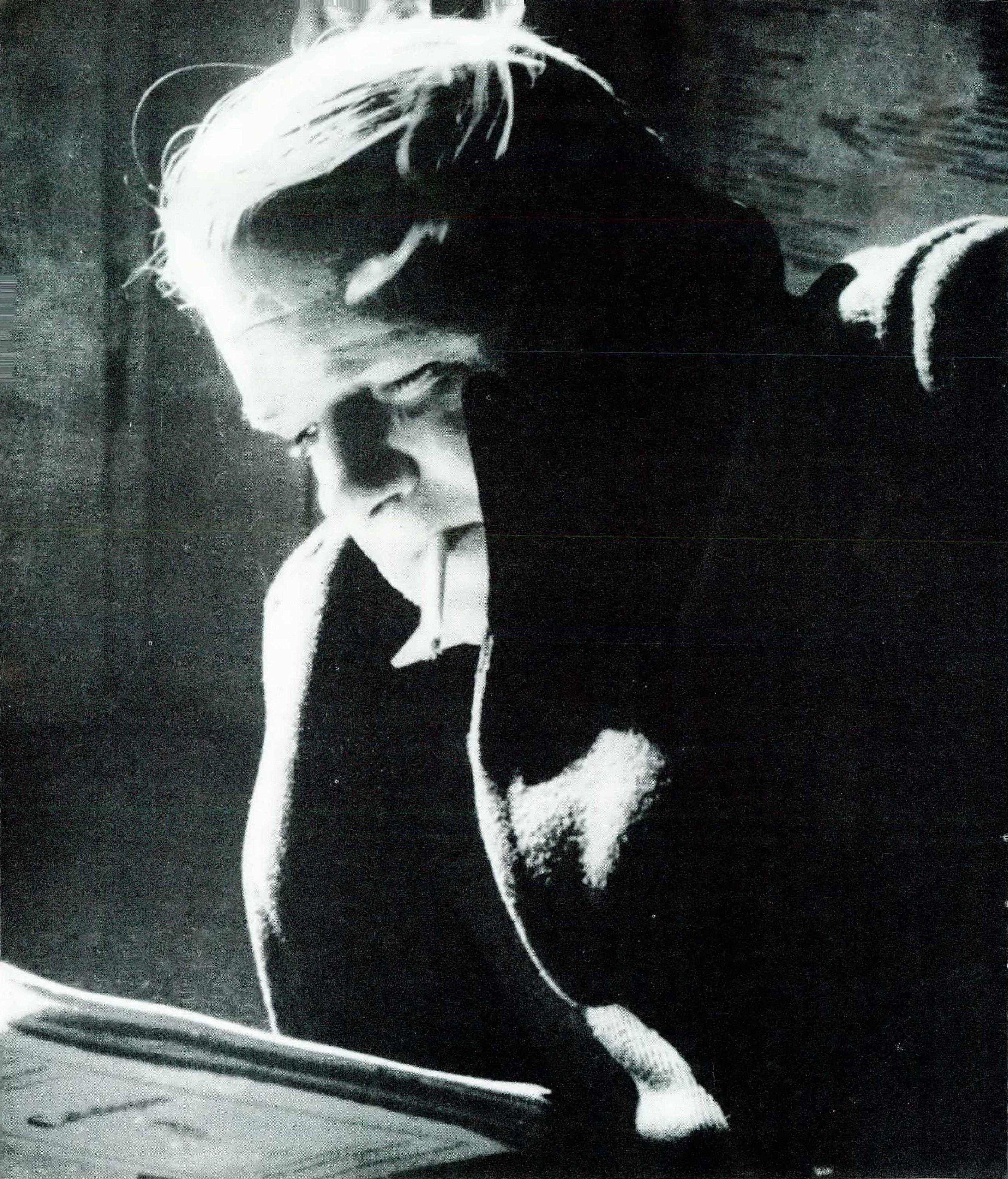
THE last time I saw Lawrence Durrell in Paris he was on his way to London, where he was to pick up one of his daughters for the Christinas holidays. He had, as ever, that faintly wind-blown air of a seaman who has just stepped ashore from a rocking dinghy. A scarf was loosely Hung around his neck, and the pockets of his tweed jacket bulged with what proved to be a thin volume of Chinese philosophy and a fistful of newspaper clippings.
“I’ll be in front of my publisher’s the moment the doors open tomorrow morning at nine,” he explained, a mischievous smile puckering his warm, weather-beaten face. “I’ll sit in the front hall reading the morning papers, and I’ll use the hour or so before the directors turn up to cover the lavatory walls with these clippings about my books — in fourteen different languages!”
This was, of course, a private joke. Durrell had been getting letters from frustrated readers all over the world complaining of the difficulty of finding copies of his Alexandria novels, and the moment seemed well chosen for twitting his London publisher, the distinguished firm of Faber and Faber, for its failure to anticipate the world-wide demand which his books had aroused. Its admirable loyalty to avant-garde poets and sophisticated writers had evidently not prepared it for coping with the problems of mass book production which arose when one of its esoteric authors unexpectedly turned into a best seller; and if Durrell was happy to pull its leg a little, he did so in no spirit of malice, but as an ironic tribute to his publisher’s steadfast perspicacity. Durrell is the first to admit the great debt he owes to Faber’s, and above all to its literary mentor, T. S. Eliot.
It was Eliot who published Durrell’s first poems and gave the unknown young author precious encouragement when he sent in the manuscript of The Black Book, that extraordinary tone poem of a novel, lying midway between Henry Miller or James Joyce and Eliot himself. Durrell, then twenty-three, had spent a year wrestling with that manuscript on the soft, leisurely island of Corfu, at a time when he so despaired of his literary future that he was almost ready to blow out his brains. Eliot’s critical therapy — offered gratuitously, since he simultaneously declined to publish The Black Book as too pornographic — sufficed to make Durrell feci less an outsider, though it failed to reconcile him with a country where, for reasons of temperament as much as of birth, he has never really been at home.
Like Rudyard Kipling and Saki (who was born in Burma), Lawrence Durrell is a product of that imperial Diaspora which reached its apogee in the sunset years of the Edwardian age. His father was an engineer who went out to India to help lay down the first railroads, and his mother was Irish; and this twin accident, if such it can be called, was enough to make him a preordained rebel against the prim, purse-lipped domestication of so much of modern British life. The India of his youth was a rough place where poisonous scorpions had to be eased off the mosquito nets in the morning and where cobras were a terrifying reality to a boy of ten.
To be sent to a public school in Canterbury at the age of twelve came inevitably as something of a shock to this frontiersman’s son, who could not help finding the diet of John Bull manliness and boxing-glove ethics a trifle insipid and childishly artificial in a land of soft autumn mists and exquisitely manicured cricket fields. The consequent frustrations and a despairing inability to cope with the intricacies of mathematics explain why a student who excelled in English and French failed his entrance exams to Cambridge University three times and was eventually reduced to eking out a living for a while pounding a piano in a dingy London night club.
In a charming fragment of autobiography called My Family and Other Animals, Gerald Durrell has given us an entertaining account of his elder brother, Larry’s, strenuous efforts to escape from what was beginning to look like an ominously barren existence. So relentlessly did he harry his mother that he finally got her to transport her three sons and her daughter from “the gloom of an English summer in Bournemouth” to the sunblessed island of Corfu, where they were twice obliged to move into a bigger house to accommodate the bookish Bohemians and bearded poets who kept landing on the island to visit him.
This flight from England was not just a passing accident in Lawrence Durrell’s career, for he has resolutely refused to live in England ever since. He was still in Greece when World War II overtook him and Henry Miller, whom he had lured to the Peloponnesus; and to escape the invading Germans, in 1941 he had to sail to Crete in a caique and be evacuated from there to Egypt in a British man-of-war. He spent the rest of the war years in Alexandria and Cairo, as assistant press officer for the British Middle Eastern forces, but with the return of peace he was as loath as ever to go back to England, preferring to roam the Greek islands in search of travel-book material. When his funds ran low, he agreed to serve for a while as press officer with the British Embassy in Belgrade. This experience, as much as his years in Egypt, gave him that knowing insight into the byways of British diplomacy which is illustrated in Mountolive, the third of the Alexandria novels.
As a civil servant in His Majesty’s service, Durrell seems to have been popular with the journalists, whom he had to placate with well-worded platitudes and carefully camouflaged falsehoods, but suspect to his professional superiors, who looked askance at his carefree penchant for drinking with the boys into the wee hours of the morning. Something of this irrepressible bonhomie comes through in those humorous reflections on the nature of British diplomacy which have been collected in two slim volumes, Esprit de Corps and Stiff Upper Lip. It also emerges from Bitter Lemons, in which Durrell has chronicled his efforts to establish himself as an English teacher in Cyprus, where, as a result of the 1953 uprising of EOKA, the rebel forces, lie found himself once again dragooned into service as press officer.
Since 1954 he has lived near Nimes in the French Provence, within easy reach of the Mediterranean, which has long been his spiritual home; and iL is here that most of the Justine novels were written.
THESE biographical details are important for the proper understanding of both the genesis and character of the Alexandria Quartet. For Durrell’s revolt against his mother country has been, if anything, more total and sweeping than that of his illustrious predecessor, D. H. Lawrence. Lawrence saw in love and in sex a possible escape from the gray utilitarianism and soul-killing industrialization of the late Victorian age; Durrell has implicitly elevated exile as the easiest way out of the cramping restrictions of the Crippsian welfare state or out of Macmillan’s moth-ball conservatism. It is certainly no accident that a good half of the characters in the Alexandria Quartet are non-English.
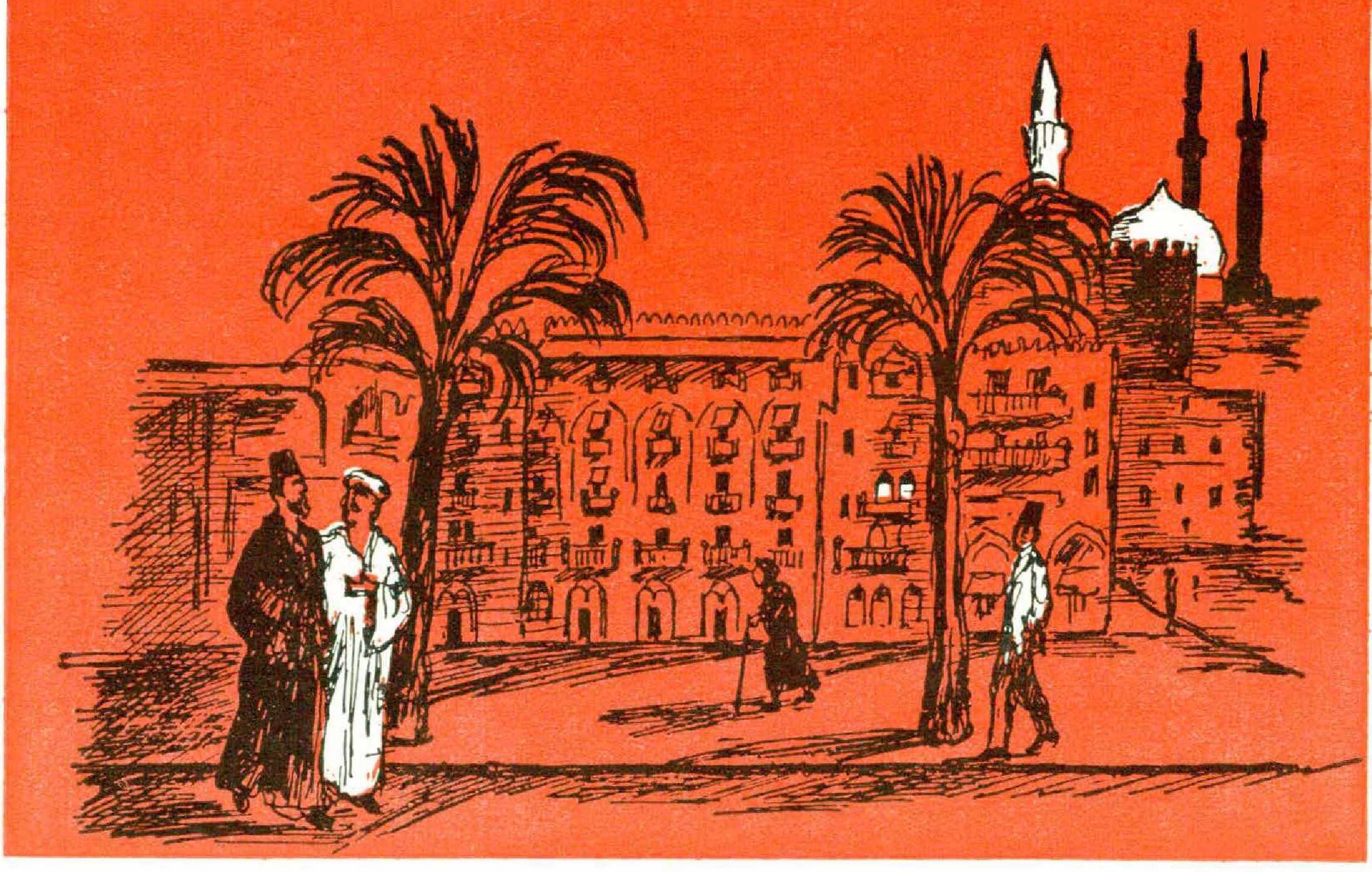
The four Alexandria novels offer a more hopeless outlook for the future of personal freedom in Britain than any of Lawrence’s books, and this may well explain much of the harsh treatment meted out to these novels by so many British critics. For in seeking to resuscitate, almost by artificial respiration, what Cecily Mackworth has aptly called a “new romanticism,” Durrell has thrown down the gauntlet to the tea-and-gingerbiscuits literature of the Angus Wilson school. And, since tea and ginger biscuits are the daily fare of most inhabitants of this terribly overcrowded island, these English critics were reacting humanly, if not too objectively, in feeling that in some insidiously Levantine way Lawrence Durrell’s novels, bedded down in the sensuous, corrupting world of Faruk’s Egypt, amounted to a vote of no confidence in the British way of life.
Durrell’s revolt against the prevailing literary trends in England has, furthermore, been more radical than Lawrence’s in an even more important respect — that of form; and this is why he likes to say that, after a man like Proust comes along and deals a mighty blow to the traditional novel, one cannot just go on doing the same thing over and over again. “We have to break up the old pattern. That’s what I’ve tried to do in this series — break up the personality and show its different facets. There’s no such thing as a whole personality. . . . My characters aren’t real. I haven’t taken them from ‘real life.’ They’re invented, I wanted to get away from this sterile realism and back to characters that aren’t like life, but that are larger than life. Prototypes, if you want .... Puppets that you can turn and look at from different angles and against a special background.”
It is typical of Durrell that he should not have hesitated to lead with his chin, for his candid description of his characters as “puppets” is the kind of admission that critics like to seize on to justify their own misgivings when the normal realistic canons of their trade threaten to fail them. The point Durrell was making, of course, was not that his characters are lifeless or mechanical, but that he had endeavored to view and present them in spatial rather than in temporal terms — in other words, in a fundamentally different way from Proust’s.
What Durrell has set out to do in his Alexandria novels is to illustrate the subtle changes in human behavior, not in terms of time — as inner, organic changes taking place over a period of ten, twenty, or more years — but in terms of space, of pei*spective. In the first three novels, his characters are viewed simultaneously from various external vantage points, through the eyes of different spectators; and though, in the fourth and last, Clea, the scene is laid in wartime rather than in pre-war Alexandria, much of the novel is devoted to reconsidering and reassessing the earlier constellation of events in the light of new insights into them. Like a merry-go-round or a Caldcr mobile slowly rotating in the breeze, the protagonists are made to turn before our eyes, exposing different facets of their personalities as the perspective changes.
At first sight, this does not seem particularly original. Faulkner has done much the same thing, just as Ford Madox Ford did it almost fifty years ago in The Good Soldier, which has been described as the most perfect French novel in the English language. In what, then, does the real originality of Durrell’s Quartet consist? And why is it that these novels have won such world-wide acclaim as a major event in post-war English letters?
Perhaps the easiest way of appreciating what Durrell was trying to do is to take the most important single event of the four novels, the death of Pursewarden. His name, it is pertinent to note, has been coined after that of the English critic Percy Wyndham Lewis, whose Time and Western Man, with its scathing attack on Proust’s and Joyce’s obsession with time at the expense of space, greatly influenced Durrell in the construction of his Quartet. Pursewarden is a short, fattish Englishman with a blond mustache who has learned to conceal the artistic sensitivity of his nature behind a sardonic mask, a mask worn by a writer who has exiled himself to Alexandria, oppressed by the hollowness of the fame which has belatedly overtaken him with the publication of his crowning work, a trilogy entitled God Is a Humorist. If Durrell had been writing a traditional novel series, Pursewarden’s suicide would have come in the final volume, as the logical climax to a prolonged and complex process of disenchantment. But this is not the kind of work he was writing, and he himself has said of the Quartet that “this is not a novel, but a four part masque.” So this central event is deliberately offered us — though only sketchily — in the very first book, Justine.
In the second, Balthazar, we are allowed to draw a little closer, and we are actually admitted to the manuscript-cluttered bedroom in the “Mount Vulture Hotel” (as Pursewarden has sardonically dubbed it) where the author is lying with his nose pointing at the ceiling, having swallowed a lethal dose of cyanide. The Jewish doctor Balthazar, who here acts as our guide, is nevertheless at a loss as to whether to attribute this suicide to a general disillusionment with life or to a feeling of personal artistic failure. In the third novel, Mountolive, the mystery is, if anything, deepened when it is revealed that Pursewarden was terribly shaken by the heartbreaking discovery that his dear friend, the Alexandrian banker Nessim, was involved in an anti-British conspiracy aimed at protecting the interests of his Coptic coreligionists against the threatening power and pressure of a hostile Arab world by giving aid to the Jews in Palestine. In the final novel, Clea, we are offered yet another explanation of this suicide — as owing to Pursewarden’s despair at the realization that his monstrous love for his sister Liza was no longer reciprocated, since she had given her heart to the British ambassador, Mountolive.
Which of these motivations is the “true” one, or are all of them no more than half or quarter truths? In which of these different interpretations is the “real” Pursewarden to be found, or is the real Pursewarden only an elusive phantom of the oversimplifying imagination? These are the questions which lie in the still, dark depths of Durrell’s novels and which make them so disturbingly provocative and original. For what is at issue here is the traditional Western concept of the unitary human personality.
“Human beings are like pipe-organs,” Pursewarden muses in Clea. “You pull out a stop marked ‘Lover’ or ‘Mother’ and the requisite emotions are unleashed — tears or sighs or endearments. Sometimes I try and think of us all as habit-patterns rather than human beings. I mean, wasn’t the idea of the individual soul grafted on us by the Greeks in the wild hope that, by its sheer beauty, it would ‘take’ — as we say of vaccination?”
The idea may not be too happily expressed, but this quotation — and there are a score of others along the same lines strewn through the four books — makes it clear that Durrell has tried to challenge the traditional notion of the human character which the modern novel unconsciously inherited, along with so much else, from ancient Greece.
Durrell owes as much to the great psychologists as to such master novelists as Proust and Joyce. The idea which is expressed in the opening paragraphs of Justine, and which returns again like a haunting leitmotiv, that the characters in the four novels have simply been the hapless marionettes of the contagious passions and dramas of a perverse, corrupting city (Alexandria, “the great wine-press of love”), stems straight from Jung’s notion of the collective unconscious. So, too, Freud’s theory that man never completely outgrows his infancy — the child lingers on in the adult body in the strange and often crippling intimacy of cohabitation — is illustrated in such Durrell characters as the loutish, harelipped, hopelessly frustrated Narouz or the British policeman and spy, Scobie.
The strongest and most interesting of these influences, however, can be traced back to a littleknown disciple of Freud’s named Georg Groddeck, to whom Durrell has openly admitted his debt. Groddeck, who was something of an eccentric, pushed Freud’s insinuations to their extreme and often absurd conclusions in emphasizing the conflicting stresses of the psyche. He maintained, for example, that the masculine and feminine instincts in the human being do not simply tend, as Freud taught, to congeal into a fairly definite preponderance in youth, but continue to divide and perplex the individual throughout adult life.
Many of Durrell’s Alexandrian characters are made to exhibit this deliberately androgynous quality of personality: the dark-browed Justine (a kind of twentieth-century Empress Theodora), with her mannish way of talking and thinking, and even of making love; the rather boyish Clea, with her candid, cornflower-blue eyes, whose great passion was for a member of her own sex; the soft-spoken banker Nessim, whose effeminate flabbiness of face and hips conceals an iron masculinity of will; the Jewish doctor Balthazar, “the only man whose pederasty is somehow no qualification of his innate masculinity of mind,” as the authornarrator Darley remarks of him; Scobie, with his “ambiguous” tendencies and his occasional irresistible urge to dress up as a woman — all exhibit this psychological complexity, as, in a more subtle way, does the writer Pursewarden. “His intuition was very feminine and much sharper than hers,” Clea remarks of his relations with Justine,
and you know that women instinctively like a man with plenty of female in him; there, they suspect, is the only sort of lover who can sufficiently identify himself with them to : : : deliver them of being just women, catalysts, strops, oil-stones. Most of us have to be content to play the role of machine à plaisir!
IT WOULD be a mistake, however, to conclude from this that what interests Durrell is solely the ambivalent or bisexual pattern in human beings. This pattern interests him only insofar as it illustrates a broader and deeper psychological thesis, a thesis which is centrifugal rather than centripetal. Rather than attempt to emphasize what is most central and solid in each of his characters, he has sought to demonstrate what is most peripheral — that is, what in each human being is most apt to respond to the external influences and stimuli he is subjected to. “How much of him can I claim to know?” Darley asks himself in Justine, apropos of Pursewarden.
I realize that each person can only claim one aspect of our character as part of his knowledge. To every one we turn a different face of the prism. Over and over again I have found myself surprised by observations which brought this home to me. As for example when Justine said of Pombal, “one of the great primates of sex.” To me my friend had never seemed predatory; only self-indulgent to a ludicrous degree. I saw him as touching and amusing, faintly to be cherished for an inherent ridiculousness. But she must have seen in him the great soft-looted cat he was (to her).
Three books further on, in Clea, we find Pursewarden, in his literary notebook, holding up another face of the prism to Darley:
To see is to imagine! And what, Brother Ass, could be a better illustration than your manner of seeing Justine, fitfully lit up in the electric signs of the imagination? It is not the same woman evidently who set about besieging me and who was finally driven off by my sardonic laughter. What you saw as soft and appealing in her seemed to me a specially calculated hardness, not which she invented, but which you evoked in her.
What Durrell is here suggesting is not simply that “Beauty is in the eye of the beholder”; he is suggesting that each human encounter, as in the universe of Arnold Toynbee, constitutes a challenge and elicits a response, a response which, in the paradoxical nature of things, can easily be as deceptive as enlightening, as chilling as heartwarming. For, just as the sun in striking a shield can blind us, so the impact we make on another person can cause him instinctively to shield a whole area of his personality from us. Thus, in Justine Darley is dismayed to discover that his mistress, the hashish-smoking Greek dancing girl, Melissa, has revealed things to her former lover, Cohen, which she has scrupulously hidden from him.
All knowledge, in the prismatic universe of human relationships, is fragmentary at best; and just as it is from others that we sometimes learn the truth about our closest friends, so it is from others that we learn the truth about ourselves. This is the key to Durrell’s fascination with mirrors; also, it explains the quotation from the Marquis de Sade’s Justine which Durrell has prefixed to Balthazar:
The mirror sees the man as beautiful, the mirror loves the man; another mirror sees the man as frightful and hates him; and it is always the same being who produces the impressions.
IT IS one thing to understand the philosophical and psychological principles underlying the construction of the Alexandria Quartet, and quite another to decide whether the author has successfully developed and illustrated them. One of the major criticisms that can be leveled at these novels is that the characters spend as much time, if not more, evoking these principles in conversation as they do exhibiting them in their behavior; and by the time one is three quarters of the way through the series, it is difficult to suppress the suspicion that the author’s initial élan has somehow lost steam and that, bit by bit, he has unwittingly reverted to the traditional delineation of fictional character. One can, indeed, pinpoint the spot where this deflection of purpose becomes evident; it is in the opening of the third novel, where we are treated to a long recapitulation of Mountolive’s diplomatic past, a recapitulation which would have been perfectly normal and predictable in a traditional novel, but which is entirely gratuitous in the more complicated context of what Durrell had set out to do.
The simplest way of illustrating the prismatic nature of human behavior and the relativity of our knowledge of others would have been to write four books, each viewing the same constellation of events through the eyes of different spectators. Durrell carefully side-stepped this all too easy solution; such a pattern would have been altogether too artificial and symmetrical, and it was an intrinsic feature of his design to construct a work as deliberately asymmetrical, incomplete, and charged with kinetic potentialities as a Picasso painting. As his author-narrator, Darley, says in his first book: “I want to put things down simply and crudely, without style . . . for the portrait of Justine should be rough-cast, with the honest stonework of the predicament showing through.”
In these novels, furthermore, Durrell set out, much as Pasternak did in Doctor Zhivago, to present reality poetically rather than prosaically — not, that is, in a broad stream of events advancing inexorably “like the quickly flowing river of the Christian hymns,” but rather as a cataract of disconnected scenes, isolated fragments of life, offered, as it were, raw, without warning, and with a minimum of interconnecting tissue.
The solution Durrell adopted was to keep the same narrator, the struggling, impecunious English writer Darley, in the first two and in the last of the four novels, and to supplement his limited angle of vision with fairly frequent snatches of introspective conversation and with generous quotations from the diaries, letters, and notebooks of other protagonists and spectators. This is a patently artificial device (one which, interestingly enough, Durrell had already used in The Black Book), but for his purpose it was unavoidable, for only in this oblique and indirect fashion could the characters other than Darley reveal something of their inner, hidden selves.
Viewing his characters in this way — from the outside, behavioristically — was an essential requirement of Durrell’s experiment with perspective and prismatic vision, and in the first two novels he undoubtedly made a determined effort to follow this prescription. Justine is largely taken up with Darley’s despairing effort to probe the baffling riddle of his unhappy love affair with Nessim’s wife, at once so passionate and so maddeningly elusive. Balthazar reveals an entirely different aspect of this situation in Justine’s love for Pursewarden, offered to us in the form of a lengthy commentary which the Jewish doctor Balthazar has obligingly appended to Darley’s initial appraisal. Neither book pretends to do more than offer a partial, external glimpse into the impenetrable heart of a complex woman’s personality. But in the succeeding volume, Mountolive, this very notion of the mysterious, masked character of human beings is simply thrown overboard, and the author casually reverts to the classic nineteenth-century fiction of the invisible narrator in order to show us the world through the successive eyes of a diplomat, Mountolive; a writer, Pursewarden; an unstable, tormented woman, Justine; a banker, Nessim; and his brooding, introverted brother, Narouz.
What is the explanation for this sudden jettisoning of a cardinal principle? My own suspicion is that Durrell found it increasingly difficult, as he went along, to limit himself to an essentially external, prismatic presentation of events. Such a fragmented presentation demands more of the reader, and much more of the writer, than the straightforward narrative form of the traditional novel. It means adhering rigidly to Wyndham Lewis’ “external eye” and denying oneself the luxury of the ubiquitous Joycean inner monologue.
Nor is this all. Neither Justine nor Balthazar sold well at first, and by the time Durrell started work on Mountolive, he and his present wife (who also writes books, under the name of Claude Vincent), with four children, between them, to support, were reduced to living on 5000 francs, or twelve dollars, a week. Durrell came close to having to cease work on the Quartet and take a job as a teacher of English in Nimes.
This helps explain why Durrell was forced to write these novels at great speed, after having made the painful discovery that writing sophisticated travel books and esoteric poems was an elegant way to starve. Justine, which he began seven years ago in Cyprus and finally finished in Provence, took nine months to write — and that includes interruptions; Balthazar was written in six weeks, Mountolive in eight, and Clea in seven. Even allowing for an irrepressible element of Irish bravado in these admissions, the bare year and a half of actual creative effort which went into the making of these books can hardly be considered adequate for such a major undertaking.
Is it being uncharitable to suggest that, subjected as he was to serious financial pressure, Durrell decided to compromise with his initial design and to write, in Mountolive, a more easily digestible and potentially popular book? If so, it was a shrewd gamble, which was duly rewarded by the umpires of the Book-of-the-Month Club. Perhaps these arbiters of American middlebrow taste could not act otherwise, but I cannot help regretting that they should have chosen to overlook the artistic mastery of Justine and to bestow their laurels instead on a book which has quietly slipped back into the old, hackneyed rut of traditional narration. It is a bit as though Picasso, toward the end of his cubist period, had suddenly taken fright and gone back to painting like Ingres.
A SIMILAR divergence between original aim and final execution can be found in the treatment of the central topic of these four books, which the author, in an introductory note to Balthazar, rather rashly advertised as “an investigation of modern love.” This recipe was fairly faithfully followed in the first two books, Justine presenting one face of a love relationship and Balthazar another; but in Mountolive, which is largely devoted to political intrigue, the focus loses its sharpness, while in Clea the whole pattern dissolves, save for one or two trenchant passages, into a jumble of random incidents, virtuoso descriptions of air raids over Alexandria and underwater spear-gun shootings, unnecessary paraphrases of Paracelsus, and, for once, rather limp excursions into humor.
When questioned about this shift of emphasis, shortly before the publication of Clea, Durrell declared that the four novels were intended, among other things, to show how an artist — in this case, Darley — grows up; and that in the last volume he was trying to develop the idea that “the sexual act is our ‘knowing’ machine.” This was a revealing confession, for it confirmed what a casual reading of these four novels might lead one to suspect — that their author suffers from a selfmade intellectual’s craving for borrowing ideas from others in order to buttress what he all too humbly regards as his own cultural shortcomings. The idea about artists developing into personalities in their own right comes straight from Otto Rank’s Art and Artist, just as the idea that sex is a basic form of knowledge has been borrowed from D. H. Lawrence.
Now, there is nothing inherently wrong in novelists’ borrowing ideas from thinkers, essayists, or fellow authors, and, indeed, the ability to do so is one of the gifts which raises a Proust, or a Joyce, or a Thomas Mann above the humbler level of the rank and file. But it is no less true that such philosophical incorporations must fit in with the author’s own range and mode of experience if they are not to wear the telltale look of shopworn notions which have simply been dragged in by the heels. And one may well wonder if it is really true, as Durrell would have us believe, that “human beings best reveal themselves in their relations to one another through the point faible, the sexual relation” — all the more so since, though this is held up as a cardinal psychological axiom, we find little sign of any serious effort to bear it out in these four novels. Putting it to the test would necessarily have demanded considerable erotic description, but in contrast to Durrell’s youthful effort, The Black Book, the Alexandria Quartet is almost self-consciously conservative in its avoidance of pornographic detail.
Are we to conclude from this that Durrell did not dare go so far as D. H. Lawrence for fear that these novels might suffer the same kind of crippling veto which hung for so many years over Lady Chatterley’s Lover? Or was it that, perhaps only half-consciously, he already dimly perceived the limitations of the Lawrence axiom? Aldous Huxley, with his customary acumen, put his finger on the nub of the problem years ago when he noted that “for Lawrence the significance of the sexual experience was this: that in it, the immediate, non-mental knowledge of divine otherness is brought, so to speak, to a focus — a focus of darkness.” What knowledge may be derived from the sexual experience is so intense, personal, and intimate as to be virtually incommunicable, and Lawrence, who strove so desperately to communicate what it meant to him, could only do so in poetic and metaphorical language. He could only dimly suggest it, as the mystic can only paraphrase his sense of ecstatic communion with the divine.
Unlike Lawrence, Durrell is no mystic sentimentalist or an enemy of science, nor does he believe that the only true form of knowledge is “blood knowledge.” The insights we get into the psychological make-up of his characters come more from the other shared experiences normally accompanying sexual intimacy than from the experience of the act itself. Occasionally there are even hints that the sexual act, far from opening up a window on another’s soul, may only offer a dazzling mirage, a sublime illusion, echoing Stendhal’s cynical definition of love as “le contact de deux épidermes et la separation de deux fantaisies.”
Justine writes in one of her diaries that it is
Idle . . . to imagine falling in love as a correspondence of minds, of thoughts; it is a simultaneous firing of two spirits engaged in the autonomous act of growing up. . . . Around this event, dazed and preoccupied, the lover moves examining his or her own experience; her gratitude alone, stretching away towards a mistaken donor, creates the illusion that she communicates with her fellow, but this is false. The loved object is simply one that has shared an experience at the same moment of time, narcissistically.
In passages like this, influenced as it obviously is by Groddcck. who maintained that all love is basically narcissistic, we are offered glimpses of a psychology of love which seems to be derived from the author’s own experience. But after Justine, these glimpses grow rarer, the vision fades, and we are finally left with a stage cluttered with brilliantly painted sets of duck shoots, masked balls, bacchant funerals, the baroque magnificence of which cannot stifle the uneasy feeling we have that somewhere between the second and third acts, the thread of the play has been lost.
THE trouble with modern literature,” Durrell remarked to me one day as we sat at a sidewalk cafe in Nimes, “is that it has all gone up into the head. You give a man a thousand pages of Joyce to plow through, and what have you got? A dense jungle of egomania and forced intellectualism. What I wanted to do was to get back to the origins, reverse the trend. Modern literature goes from Rabelais to Sade. I want to get fi back to Rabelais — out of the mind and back into the belly, where we can stitch it up again.”
There is something odd, to put it mildly, about a theory of literature which holds that modern fiction goes from Rabelais to Sade; but even if we are prepared to give Durrell the benefit of the doubt and to treat it with a momentary seriousness, it is clear that his own work of art stands condemned by virtue of this very criterion. For the Alexandria Quartet lacks both the Marquis de Sade’s philosophical interest in the amorality of nature and Rabelais’s lusty bawdiness, so that it was bound to end up falling between two stools. Durrell must suspect it himself, for he has admitted to wanting to write a comic, bawdy novel in a rousing Elizabethan vein.
Yet, with all its failings, the Alexandria Quartet is the work of an extraordinarily gifted prose poet. Durrell has elevated the lictitious Alexandria into a kind of urban microcosm of turbulent mankind, a sensual, all too human City of Man, within whose teeming precincts his twentieth-century figures could probe the bounds of human ignorance and lose themselves in the tortuous byways of love. And, paradoxical as it may seem, it is precisely this calculated artificiality which makes the Quartet so real. Its reality is akin to that of a Picasso painting, where distortions are introduced to lay bare some half-hidden, wrenching truth.
Ignorance, the baffling ignorance of the human condition, is, indeed, the puppet master whose mighty invisible hands move the figures in the merry-go-round he has invented. What Durrell has here explored is less the realm of knowledge than the realm of doubt, less the hemisphere of light than that of shadow, less the fixed than the uncertain, less the factual than the fancied. In this resides the Quartet’s true modernity.