At the Hemingways: Walloon Lake
The origin and upbringing of a ,famous writer are of permanent interest to those who admire and study his work. For his first eighteen years, Ernest Hemingway lived in the midst of a happy family, spending his winters in Oak Park. Illinois, a suburb of Chicago, where he made a name for himself in high school, and the summer holidays at the family collage at Walloon Lake, Michigan. No one has a clearer picture of these formative years than his sister MARCELLINE HEMINGWAY SANFORD,eighteen months his senior. At the editor’s urging, and to hand down a true account to her children and grandchildren, she began to record her recollections in 1956, and in her book, which will be published under the Atlantic-Little, Brown imprint, ice see the influence of Grandfather Ernest Half known to the family as “Abba,” and of the storytelling great-uncle, Tyley Hancock: the strong ivill of Dr. Hemingway, Ernest’s father, to whom he was devoted: and the resourcefulness of his mother. Most important, we watch the boy’s development and independence. This is the first of three installments to appear in theATLANTIC.
SOME of the happiest times of our childhood were spent at our cottage, “Windemere,” at Walloon Lake, Michigan. Daddy and Mother’s first trip north was in August of 1898; they took me with them (1 was about seven months old) with my nurse, Sophie, and we stayed in a cottage borrowed from Mother’s favorite cousin, Madelaine Randall Board. The trip, an arduous one, began on the lake steamer, the State of Ohio, which took us from Chicago to Harbor Springs. Here my parents carried their luggage aboard the local train bound for Petoskey; in Petoskey they again unloaded and changed cars for the train to the village of Walloon Lake, where, for the last time, they tugged out their luggage and transferred it to the little steamer which took them up the lake. This was to be our itinerary for many summers to come.
They enjoyed their first visit to Walloon and spent much of their time exploring the lake in a rowboat. They loved the clear spring-fed waters and the surrounding birches and pines, and having decided that they wanted a place of their own, they spent two weeks looking over the shore lines for a possible site to build on. The place that attracted them both was a baylike area, on the north shore almost opposite Wildwood Harbor, owned by Henry Bacon, a farmer and a former Canadian from Manitoba.
The beach my parents selected was sandy and wide; the lake here had a good hard clean bottom and no abrupt drop-off into deep water. White birches and cedars grew along the shore, and maples and beeches and hemlocks further back from the water. The bay was protected from the northwest wind by a point of land with a dock, referred to by all the local people as “Murphy’s Point.” Everything about the spot appealed to my parents. The fishing in Walloon was good. Their land was close enough to Bacon’s farm to get fresh milk and eggs easily, and yet not close enough “to smell the pigs,” as Mother said. The Hemingways closed the deal for four lots, amounting to an acre in all, before they left for Oak Park that September.
The cottage, as Mother planned it, consisted of a living room with window seats on each side of the huge brick fireplace, a small dining room, and kitchen, and two bedrooms. There was a roofed-over porch with a railing, and a hooked, hinged double gate across the front steps, which led down toward the lake. The outside was white clapboard, and the interior white pine. No plumbing, of course. A well was dug to the right of the cottage in the front yard. Visiting and communication were by water. Wood-burning steamers — The Tourist, impressive with its two decks, its uniformed captain and engineer, and The Outing, a smaller steamboat — made regular trips around the lake four times a day and sometimes a moonlight excursion in the evening. When we needed something, we flagged boats in to our dock by displaying a white banner — it could be a piece of torn sheeting, or even a bath towel. If the helmsman didn’t toot to show he saw us, we would wave our white flag wildly until his whistle sounded and the boat veered toward our dock. If all else failed to get the pilot’s attention, Daddy would blow on his bugle. He also used the bugle to call us when we were out in the fields or on the water near Windemere, or he would blow on a ram’shorn, like the one described in the Bible, which he had bought in Switzerland before he was married. Though there was no variation in the tone of this instrument, the sound of its one note had tremendous carrying power and could be heard for great distances across the lake.
The nearest town, Petoskey, was nine miles away, and the road to it was a mere sand track over many high hills. For a farmer like Henry Bacon to drive his horse and wagon to town and back for supplies was a long day’s chore. Nobody went to town any oftener than necessary.
From my earliest memories, Daddy always spent all summer with us children and Mother at the cottage. He had a license to practice medicine in Michigan as well as in Illinois, and he took care of any illness or emergency cases that might occur among the lake cottagers or the lumbermen or the Ottawa Indians, who were hired to peel the logs. We either brought two maids with us from Chicago or hired a cook or a nursemaid locally. Sometimes the Petoskey or Boyne City girls who joined our household for the summer would come back to Oak Park with us in the fall.
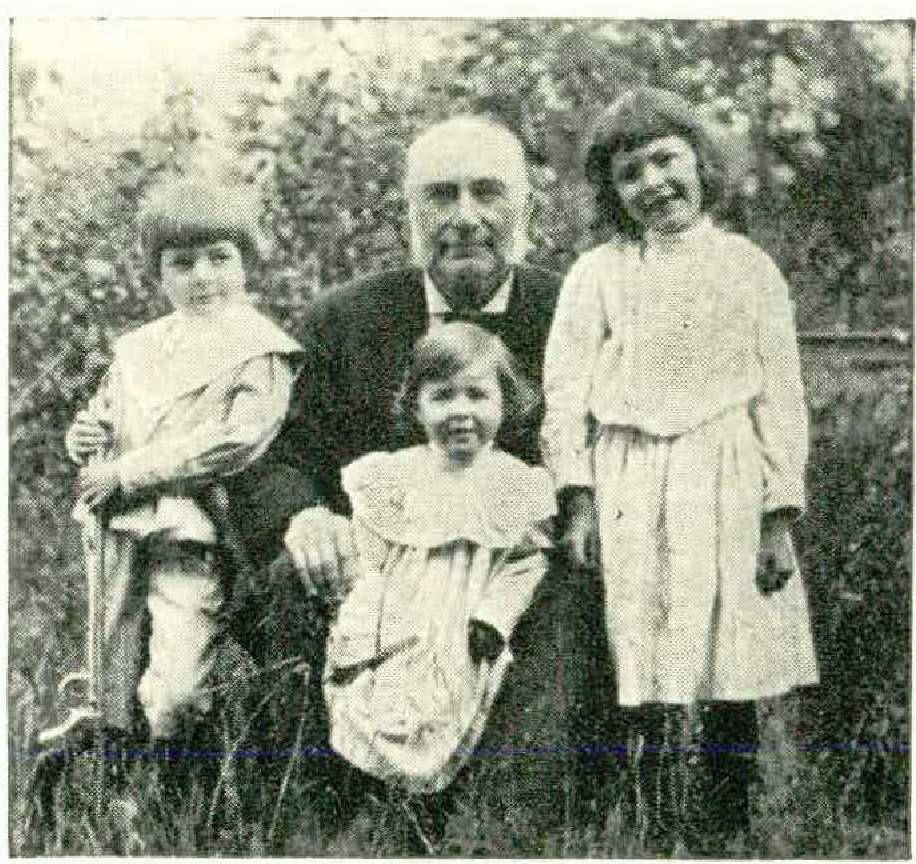
During his lifetime Grandfather Hall visited us for a short time every summer and took long walks on the beach. He loved climbing to the hill behind our cottage to see the sunsets. We used to go with him, and he often held us by the hand as we climbed the hill. I remember his lifting Ursula to the top of the rock pile to see the sunset. That was the summer she was three, the last time he visited us at the lake.
Abba Hall didn’t like fishing, nor was his fastidious taste able to adjust happily to our extremely informal life. True, he wore a cap instead of a hat, but he never appeared without his regular starched collar and tie and his suit coat. Mama used to say that it was very nice of Abba to pretend he liked eating outdoors on the porch on an oilcloth-covered table. Really, he loathed it. He was much happier in his own well-run home, or eating at a good restaurant, like Henrici’s in Chicago, where the napkins were heavy white damask, and the service impeccable.
Abba only came to Walloon out of love. Though our family lived according to his standards most of the year, he found it almost impossible to enjoy descending to our vacation informality.
Grandfather Hall disliked fishing and cottage life, but our Granduncle Tyley Hancock took to them with enthusiasm. His visits were long, and his pleasure on being on the water was infectious. He was an excellent fisherman and an enthusiastic swimmer, and his appetite, which in the city was often a finicky one, was perfect at Walloon. He relished everything we served him. Daddy used to say, “Uncle, you’re a different person when you’re up here. Even your color is better. I guess what you need is more Walloon Lake and less time in hotel rooms.”
Uncle wore old shoes, and canvas leggings that came to his knees, over baggy old trousers; his comfortable, wrinkled tan corduroy jacket had lots of pockets for his pipe and tobacco and fish hooks. Though he didn’t feel he could be quite so unconventional as to go without a tie, and never did. his battered fishing hat, worn slightly cocked over one eye, gave him a sort of rakish, sporty look that was just right for Windemere.
Among Uncle’s catches were some of the biggest fish ever caught in Walloon Lake. A picture taken in July, 1905, shows my father and uncle shaking hands over a string of pickerel and pike, all six of them from three to four feet long. Uncle had great patience. I can still see him puffing on his pipe as he rowed the boat. After we got to the fishing grounds, he feathered an oar with one hand, just enough to keep the boat from drifting toward shore, as he kept his eyes intent on his fish pole. He wasn’t very conversational when he had a rod in his hand. When he did speak, it was through an almost closed mouth, his teeth gripping his pipe stem. “Don’t wiggle, you’ll scare the fish. Trim the boat, Marce,” he’d say. “Sit over in the middle of the stern. If you’re tired of fishing, I’ll take you to shore, but if you want to stay out here with Uncle, you must learn to be patient. That’s the secret of fishing.”
We loved having Uncle visit us. He was fun. He and Mother often sang duets in the evening, and sometimes Uncle danced a gay little buckand-wing step or a hornpipe while Mother played on the parlor organ.
When we first went to Walloon Lake, lumbering was still going on in the area. A sawmill stood on the Boyne City side of the lake, a mile or two west of Wildwood Harbor. The superintendent and other executives of the mill lived in cabins along the shore, and the mill hands lived in long, roughboard bunkhouses up the slope behind the mill. Huge booms of logs moved up the lake toward the mill, drawn by chugging steam tugs, and now and then a boom would get loose and float down the lake — a great danger to the regular summer boat traffic.
When a boom got loose, a tug would pursue it, and an agile lumberjack, cant hook in hand, would leap onto one of the rolling logs and attach the chain from the tug to the outside circle, and back the boom would be dragged, like a runaway child.
As small children, Ernest and I were often taken to visit the mill. We watched the logs pulled up the ladderlike chain from the millpond toward the screaming saw above. The saw operator pressed the lever expertly, first to cut off the bark on four sides of the log. then to slice it into boards; next, he pressed another lever that took the clean boards on an endless chain out of the mill, where they landed on a platform ready for the mill hands to put them in air-spaced piles in the sun to dry. They stacked the boards two one way and two the other, making a hollow square at least three times the height of a man. The smell of fresh sawdust from the hemlock logs was a perfume we looked forward to every summer as long as the mill remained at Walloon Lake.
Once in a while Daddy took Ernest and me along for a ride on the horse-drawn lumber train from the mill to Boyne City. The two or three open flatcars rolled on regular iron railroad wheels, over wooden tracks laid through the woods up and down hill to the boat docks in Boyne City. We rode on top of the piled lumber in the first car, right behind the driver. We could watch him flick his long whip to the ears and backs of all four horses, two abreast, that drew the lumber train, it was exciting to sit so high in the air with nothing to hold on to but the edge of the jiggling pile of boards. The wood felt hot to our bare feet, and we had to sit very still, because it was easy to get a splinter in our toes if we moved about. Often we had to duck to keep the branches of the trees we passed from hitting us in the face.
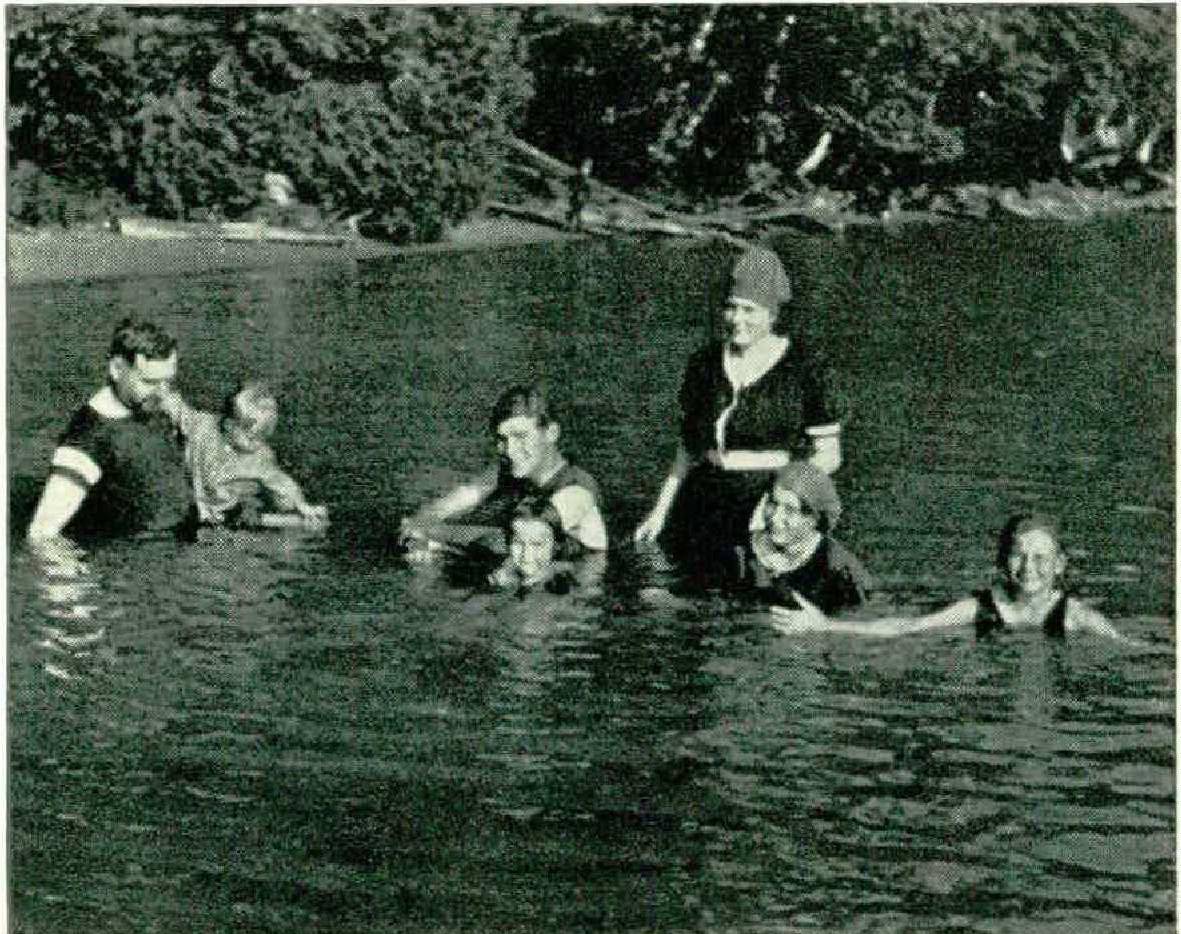
DADDY taught us how to swim at an early age. I remember being supported by his firm hand under my chest while he taught me how to dog paddle. When I was three, my parents had post cards made, using a picture of Ernest and me in the water beside our rowboat. We almost lived in the water, fhere was just one rule. We were not sttpposed to fall in the lake with our clothes on, and were punished if we did.
Mother, having fair skin, never tanned; she only freckled and blistered. My dark-haired, bearded young father loved the sun and tanned to mahogany. Mother liked to swim, but she hated to touch her feet to the bottom for fear that she would hit something “slimy.” Actually, there wasn’t anything to touch but some sticks or a sunken log. Mother would swim out to Dad, who would station himself, treading water, in deep water well over his head. Mother would rest on his shoulder for a moment, then turn and swim back. That way her feet never touched bottom until she could see the good hard sand in the clear water near shore.
As we grew older, we had regular lifesaving drills. Mother watched but never took part in the drills. She would Stand on shore, calling “Be careful!” Dad would take us out in the rowboat into deep water. He would say, “Now, when 1 tip the boat over, swim for shore!” Other times he would call out, “When I tip the boat over, climb on top of it as quickly as you can -and hang on !” Then he would deliberately rock the boat until it capsized. It was exciting. Later we learned to undress in water over our heads, and Dad would time us to see how quickly we could take off clothing and tennis shoes and get to shore. We were keen to compete in these races. Our aim was to do it in one minute.
We had no bathtub at the cottage, of course, and we were often in and out of the water three or four times a day. Sometimes, as a special treat, we would be allowed to go into the water without bathing suits in the evening. This we called “Secret Society.” We felt so free as the water slid past our naked bodies. Even when we were in our teens, our parents let us swim this way on hot nights.
Several years, Daddy bought tiny pink pigs to occupy a pen he built at the back of the boathouse. We named them and grew fond of them as we fed them the family scraps three times a day; and we could never bear it without weeping, when, at the end of the season, our pigs, now fully grown, were taken away squealing to a fate we knew only too Well would result in ham and bacon.
Not only did our pigs grow in the summer, but we did too. Often the traveling clothes we wore to come up north on the boat were almost pathetically small for us three months later when we put on our city garments to go home. One year, I remember, when Ernie was about eight or nine, he took off his shoes when he got to the cottage in June. He ran barefoot all summer. He gave up going to town or visiting family friends with us rather than put on his shoes any time that summer. When the last day of vacation came and we were closing the cottage, Ernest was dressed, all but his shoes.
“Hurry up! Put on your shoes and stockings,” Daddy ordered. “The boat will be here in a minute. I’ve got to lock the doors.”
“I can’t wear them, Dad,” said Ernie. “They hurt.”
“Hurt or not, I won’t take you barefoot on the steamer,” his father replied.
Reluctantly, Ernie drew on his long black stockings, and after much tugging he pulled on his black laced shoes. He complained all the way down the lake and on the train from “the Foot” (as we called the town of Walloon Lake) to Petoskey. Daddy wanted to get Ernie a new pair of shoes in Pctoskey, but he was afraid there wasn’t time before the next train left for Harbor Springs. Fryman’s Shoe Store, where we usually bought outfootwear, was several blocks from the station. He and Ernest started up the street toward Fryman’s; then Daddy glanced at his watch and realized they couldn’t make it there in time. Back they turned to the station, Daddy striding ahead. Ernie followed slowly. A summer visitor looked at the little boy limping along and said, “Here, boy, here’s a dime. It must be awful to be lame!”
Ernie took the dime and hurried to catch up. He was laughing as he showed Dad the dime.
“Look what the man gave me! Did you know I was a little lame boy?” he said. “Now you’ll have to get me some new shoes!”
They were both hooting with laughter by the time they reached the rest ol us where we sat with a huge pile of baggage, waiting for the train to Harbor Springs.
WE HAD two rowboats, the Marcelline of Windemere, and later, the Ursula of Windemere. And it was an exciting day when Dad bought our first motorboat, about 1910. It was named The Sunny, was eighteen feet long, and was driven by a Gray Marine motor. What a time Daddy had cranking that inboard engine! He’d prime it and crank, then prime and crank. Sometimes it took hall an hour to start it. Sometimes the motor would give a little chug and then stop for the day. Dad wasn’t mechanical, and starting that boat almost wore out his patience.
Now, my father was very particular about anyone’s using profanity, or even ordinary slang swearwords, like “darn” or “gosh,” in his presence. He limited himself to phrases like “Hold your horses!” or “Oh, rats!” But the way that motor misbehaved forced out his favorite expletives, “Oh, rats!” or “Dad gum it!”, with all the fervor and emphasis of the most violent oaths I’ve ever heard. I remember hearing him tell Mother, “That blankety-blank-blank engine will kill me yet!”
Mechanical ability of any sort was not one of my father’s strong points. He could do anything with a gun or a fishing rod, or a knife or a surgical instrument. He had performed seeming miracles in early plastic surgery, but a motor was a devil of obstinacy to him. He treated it like a personal enemy, and it behaved like one. In later years, even our second motorboat, The Carol, a slower, easier boat to run, was troublesome to Daddy.
My father was among the last of the doctors in Oak Park to give up a horse and buggy for his professional calls. Not because he loved horses so much, though he was very fond of them, but because, after all the trouble he had had with that motor on The Sunny, he distrusted all engines. The thought of having to take time to fight with a motor in a car when he had to rush to a sick patient was frightening to him. He said he would hate to depend on any automobile.
“Besides,” he said to Mother, “it wouldn’t have sense enough to find its way home like a horse.” Daddy counted on his horse when he was tired, and nodded after he’d stayed up all night with a pneumonia case or a heart patient or bringing a new baby.
Later, my father enjoyed driving a car. He got to feel so at ease with his Model T Ford that he would take both hands off the wheel while he pointed out the scenery. We were sometimes nervous wrecks as he drove.
It was a terrific achievement to go from the cottage over the sand hills nine miles to Pctoskey in Dad’s first car in 1915, for the narrow, loosesand trail over the hills to town had not yet been improved, and Daddy always carried an ax to cut branches to get himself a firm start on top of the deep sand at the bottom of each hill.
One summer Daddy ordered a steel trap and three barrels of clay pigeons sent up to the cottage from Montgomery Ward in Chicago. That was a memorable time for us. Daddy thought it just as important for us to learn to shoot as to swim.
We older children had all been taught to shoot a twenty-two as soon as we graduated from air rifles. We practiced shooting at targets before we were in high school. Daddy was as careful in teaching us techniques for using guns as he was about teaching water safety.
“Accidents don’t happen to people who know how to handle guns,” he told us over and over. “Treat a gun like a friend. Keep it clean. Oil it, clean it after every use, but always remember, it’s an enemy if it’s carelessly used.”
Keeping the gun pointed to the ground, never toward anyone, even in fun, was a cardinal rule. He never let us shoot over water. We learned these rules early. Dad let us load and unload his twenty-twos and his Colt revolvers, but only he touched “Big Ed,” the heavy rifle he had had since his college days. “Big Ed” was the gun he had used on his trip to the Smoky Mountains in the early nineties.
Dad showed us how a rifle shell was put together, and he would let us taste the strong saltpeter in the cartridge. He told us how hunters would use this form of salt on game, if caught without supplies in emergencies in the woods.
In Oak Park during the winters, Dad let us help him mold bullets in an old army bullet mold which had been his father’s during the Civil War. The sputter of the hot lead melting in the small funnelshaped dipper, with its long metal handle (very long, to reach over a campfire, he told us), still stays in my memory. The lump of lead was dull and gray when he held it over the gas flame on the basement laundry stove, but when the liquid lead was poured into the bullet molds and the cooled bullets were turned out, they were silver bright.
“Oxygen’s burned off in the heating.” he’d say, “but they’ll pick up more as they stand in the air.”
The summer the clay-pigeon trap arrived, we were using guns with regular shells, not bullets. My father and Uncle Tyley and various friends had great fun at the trap, and Ernest and I joined them often. Mother and the younger girls, Sunny and Ursula, shot too, but the recoil of the shot hurt Mother’s shoulder. It hurt mine, too, but not enough to keep me from shooting. Ernest and I teased and teased to be allowed to try one shot with Dad’s own rifle, “Big Ed.” Finally Dad gave in. He let us each try it once.
“All right, but it will knock you backwards,” he said. He held the heavy gun against my shoulder, and I sighted and pulled the trigger. Even with his help in holding the gun, the thump was terrific. He caught me as I fell back against him.
One childish gesture Dad would not permit. He got terribly angry if he saw it happen. “Don’t you ever let me catch you closing your eyes as you shoot. A marksman can be a murderer in a split second if he’s not in control of his weapon. It takes judgment to shoot. It takes kindness to kill cleanly, and it takes a wise man never to shoot more than he can use to eat.”
He had the greatest contempt for so-called sportsmen who killed ruthlessly for the fun of killing or to boast about the size of the bag. He was a great believer in conservation and an exponent of decency in sport.
Of course, he was humanly fallible too. His sense of honor didn’t keep him from getting an occasional grouse or woodcock for the table, even though the game-law calendar and his appetite might not quite coincide. This happened with trout too.
I remember having once what I thought was fried chicken for breakfast and wondering why Dad insisted we finish it so quickly. When every scrap was gone, Dad burned the feathers in the stove, making a nasty odor, even before we left the table.
“Do you have to burn the feathers now? Couldn’t you wait till we’re through breakfast?” said Mother.
“Never can tell who might be nosing around with a badge on,” Daddy replied.
“Now, Clarence, what will the children think?” teased Mother.
“They ate it, didn’t they? Tasted good, didn’t it? I pay taxes for this land all year round. Too bad a man can’t fire a shot at a moving object on his own property once a year without permission,” he sputtered. “How did I know it was going to be a grouse?” But his sheepish grin belied the belligerence of his words. Mother smiled too.
“You’re incorrigible, dear,” she said as she kissed him.
IN 1902, when Ursula was born, a kitchen wing was built and the enlarging began; in time the cottage grew to six bedrooms, three of them in a separate annex. Yet, even with these extra rooms, Ernest and his boy friends usually preferred to sleep in a tent pitched in the back yard some distance from both the cottage and the annex, while Ursula and Sunny used Ernest’s room. Ernie liked to read at night, just as I did, but he had to drape a mosquito netting over his cot, because his lantern attracted the flying creatures that edged in around the tent flap. We often used candles to augment our kerosene lamps, but they were not allowed to be used in the tent.
There were lots of parties and entertaining at Walloon Lake — not the kind we had in the city, but parties where we made our own fun. One of the first social events I remember was a barnraising at llenry Bacon’s farm. I wasn’t yet five, but I still remember the thrill of being allowed to go along with my parents that day when Daddy helped sixteen men put up the framework of a big barn, while all the women and some of us youngsters kept at a sale distance and listened to the shouts as the main beams and braces were put in place. A barn-raising was a community activity in those days.
To feed the crowd, trestle tables were set up beside the Bacon’s log cabin, with long boards supported by chunks of wood for seats on each side of the white paper-covered table. Even the sawhorses that supported the table boards were homemade, and the nubby knots showed along the sawhorse legs. The man called the “masterbuilder,” who had no whiskers on his upper lip, but a squared-off beard and an almost bald head, was the one who told the other men what to do. Everyone treated him with respect.
The mass of food on the tables that noon was exciting to me. I remember there were four kinds of cake — white-topped, chocolate, fruit, and a pink one with high layers; three kinds of pie — apple, mince, and blackberry; as well as big dishes of meat and potato salad and vegetables and cutup cucumbers with onions in a big white china bowl. People took turns sitting down at the table, and I can remember my mother saying that Mrs. Bacon and all her girls must have cooked for a week to serve over a hundred people for supper that night. A big cheer went up when the top timber was put in place, and my father helped put it there.
We were always having picnics, marshmallow roasts, corn roasts around a fire on the beach. I remember one special Fourth of July picnic when Daddy dug a big pit and roasted half a lamb over coals, barbecue fashion. He had to make the fire hours ahead so the deep bed of coals would be just right to cook the lamb but not burn it. That same day a whole little pig, an apple in its mouth, was roasted in the oven in the kitchen, while dishpans — one filled with potato salad and one with popcorn — and big pails of lemonade were prepared for the crowd of guests who came from Boyne City and from other areas around the lake.
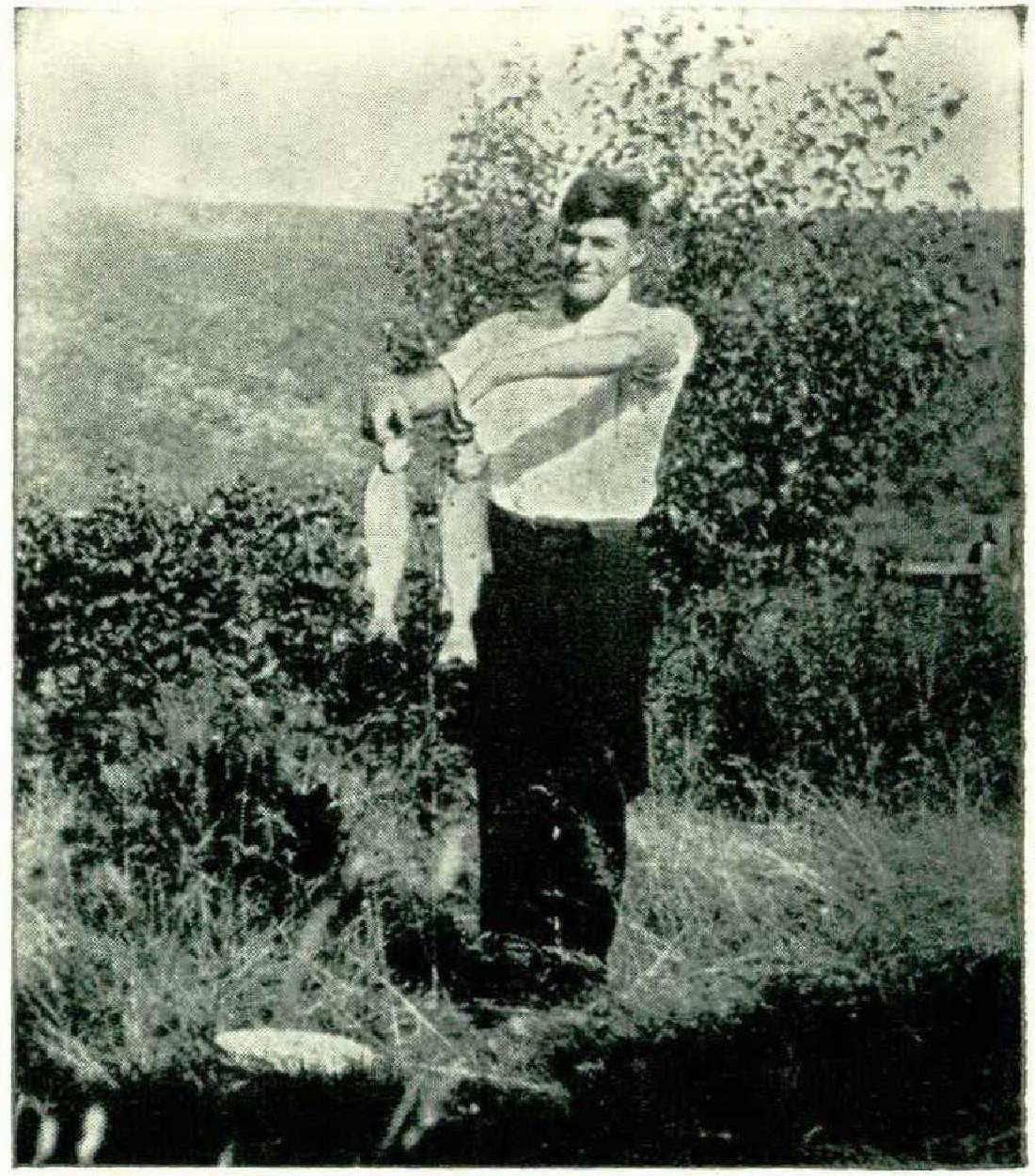
FISHING was excellent in Walloon Lake during our first years at the cottage, and pictures which were taken of Mother holding a seven-and-a-halfpound pike she had caught, as well as others of Unclc Tyley and Bobbie and Daddy with their various big catches, proved it.
About 1907, Daddy and Uncle Tyley went to Brevoort Lake in the Upper Peninsula, where the muskellunge fishing was said to be really sporting. An old guide at whose cabin they stayed outfitted the party. Daddy brought home three hundred pounds of fish caught in three days! The muskellunge and pike were gigantic to my eyes. Daddy was busy all the first day back, giving away fish to the neighbors. He kept our supply in the wooden icebox under the trees, and for the next week we ate fish baked and broiled and fried. The pike was especially good baked with bread stuffing flavored with sage and onion, and the stories Daddy told of his adventures in acquiring his catch added to the zest of our fish dinners.
The next year Ernest was keen to go on the Brevoort Lake trip.
“I don’t know about that,” said Daddy. “You’re supposed to spend your time learning your multiplication tables this summer. Your teacher said you couldn’t pass to the next grade in September unless you memorized them. Besides, you don’t like canned beans, and we live on canned beans at Brevoort Lake.”
“I can learn to like beans,” said Ernie eagerly. “I can learn the multiplication tables. Please let me go with you!”
“Well, then, prove it,” said Dad. “I’ll give you a can of beans, and you eat some of them every day for a week, and if you can learn your multiplication tables between now and next week, you can go. But there’s to be no fooling about this. I’ll try you on your tables a week from today, and if you miss a single one, you’ll stay home. Is that understood?”
Ernie agreed, and Daddy came to me quietly a little while later and said, “Marce, you help Ernie learn his tables. He can do it if you just keep him at it.”
We started in. We sat on the front porch, Ernie in the hammock and I on a chair beside him with the arithmetic book in my hand. We went over two times two is four, up to twelve times twelve, over and over and over again. The sevens and the eights were hardest for Ernie. Every day, when he thought he had a group all memorized, I would skip around the tables, and he would miss some combinations. Ernie didn’t think that was fair. If I would just ask for them in order, he knew he had them straight. But I knew Daddy wouldn’t question him in any such orderly sequence.
Several times Ernie almost lost interest. He would pick up a magazine and start to read. Then I would remind him there were just three days before Daddy would test him, and he would reluctantly lay down the magazine and go on repeating the tables. Ernie gave up his morning swimming time. With a sigh, he would plunk himself down in the hammock after breakfast and go over and over the multiplication tables with me. I was as sick of them as he was, by the end of the week, but the day before Daddy was to leave for Brevoort, Ernie passed his examination, and with a yell of delight ran off to pack his things. He had stuck to his promise to eat some canned beans daily, as I recall, and had earned his right to go on the trip. I don’t know who was prouder, Ernie or I, when our menfolk started off for the Upper Peninsula.
In afteryears, Ernie used to say, “You know, I love canned beans.” I often wondered if he remembered how he came to like them.
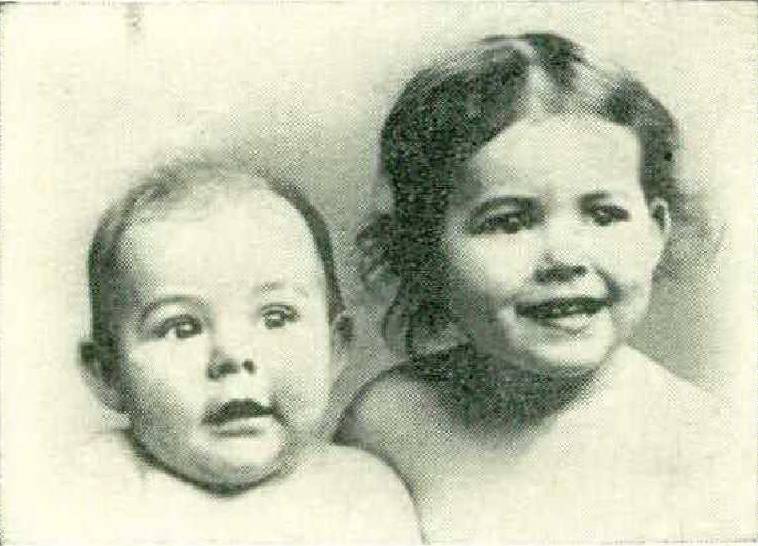
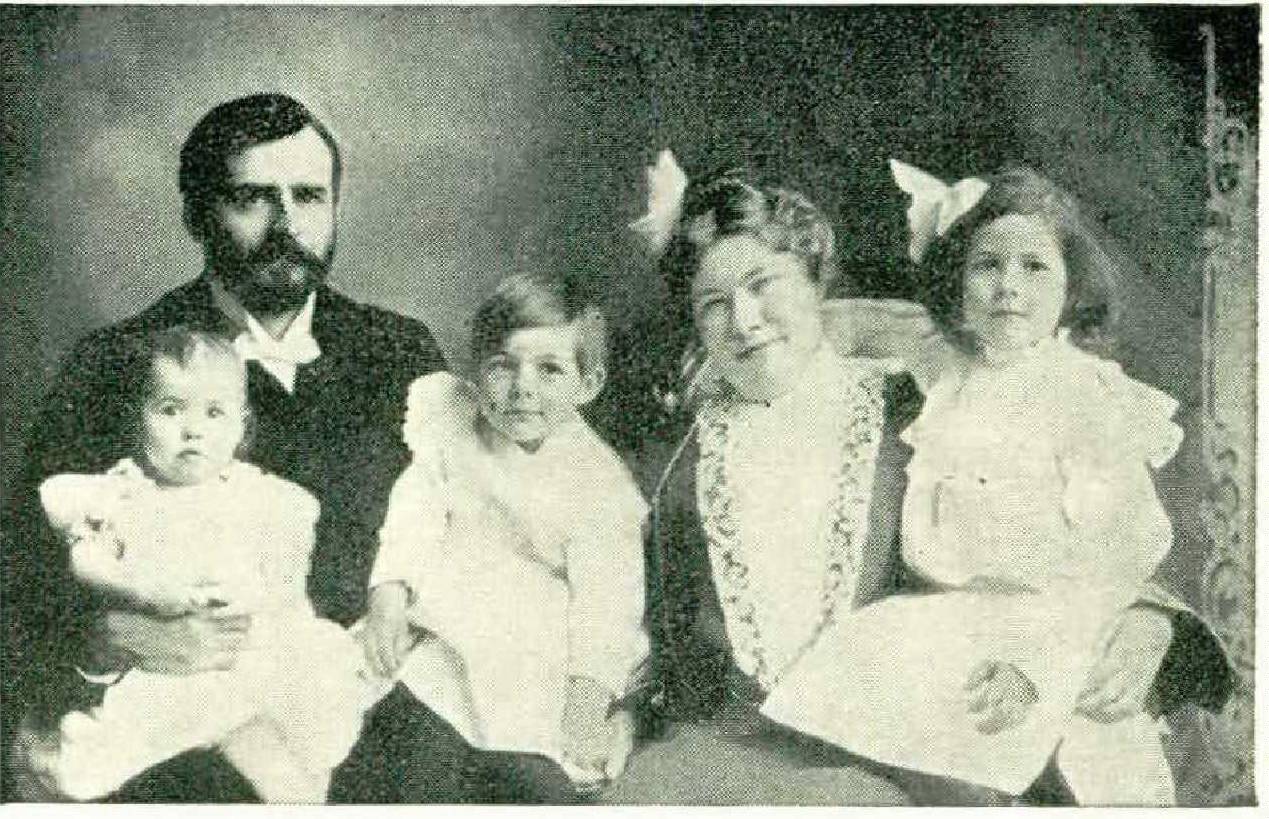
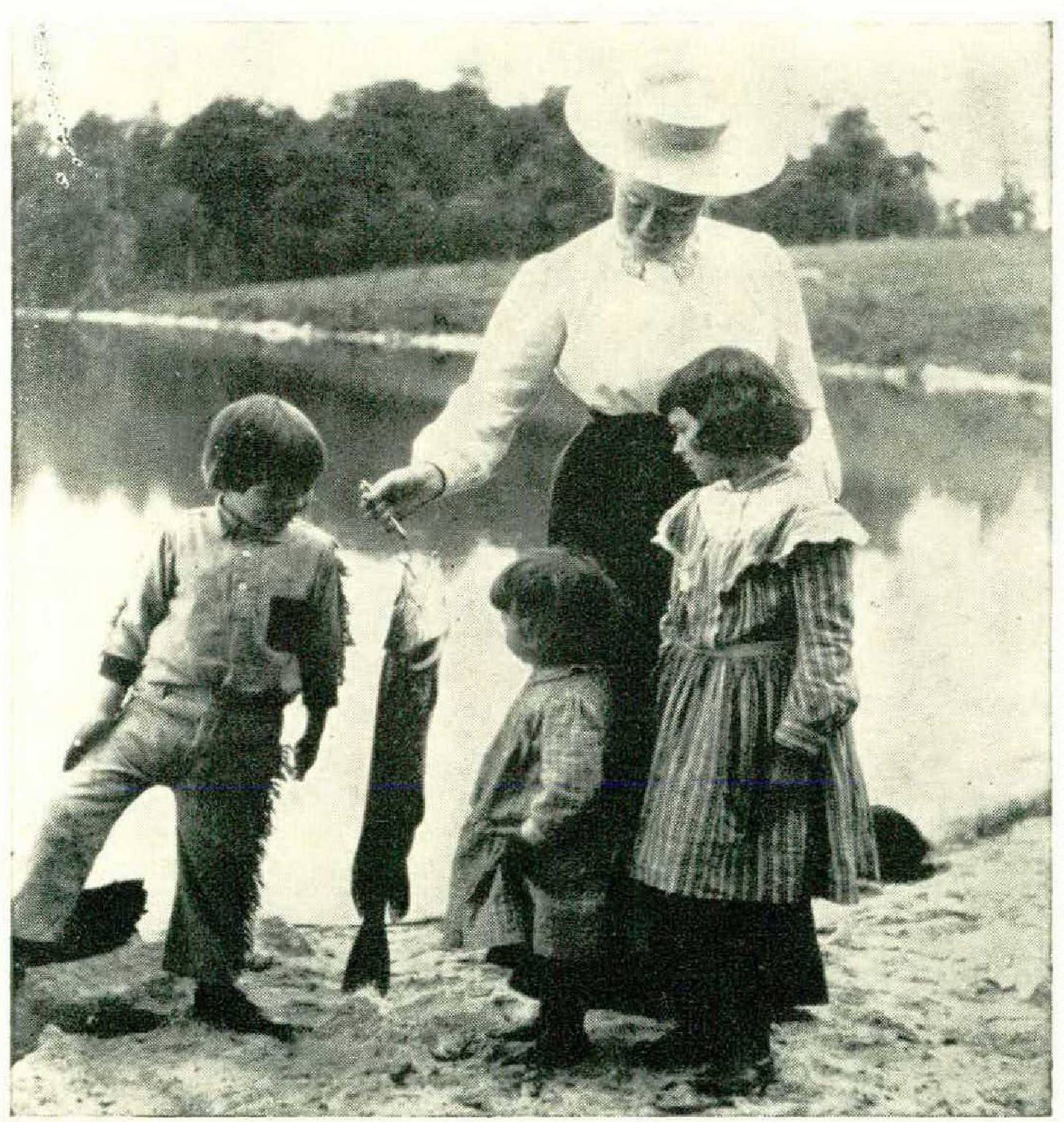
THE summer of 1911 at the lake was quite different from all the others. A new baby was expected, and I, who was thirteen, was old enough to be treated as a real confidante by Mother. The baby was expected in July, Mama told me, and rather than keep us all home in Oak Park in hot weather, Daddy and Mother planned that their fifth child would arrive at Walloon Lake. Long before we left for the cottage early in June, Mother talked over plans for the baby’s birth with me and explained that a trained nurse, a graduate of Daddy’s classes in obstetrics at Oak Park Hospital, would be with us at the lake, as well as our nurse and cook. Mother felt quite sure the baby would be born before the Fourth of July.
If it was a boy, as my parents hoped, he was to be called Forrest, and in anticipation I embroidered an Old English F in blue silk on a baby pillow. If it was a girl, Mother told me, she would be called Carol, a shortening of my Grandmother Hall’s name, Caroline.
The days passed, and the first week of July came and went. But there was no sign of the baby. Every morning at breakfast Daddy would look inquiringly at Mother, and Mother would shake her head as though to say, “Not yet.”
We were having breakfast on July 19 when all of a sudden Mother said, “Oh, dear!” It wasn’t what she said, but the tone of voice in which she said it. There was relief and fear combined. Daddy jumped up from the table.
“Finish your breakfast quickly, kids,” he said, “and make yourselves scarce.”
Things began to happen fast after that. Each of us children had a place to go. I was banished with a picnic lunch and told I could spend the day at Murphy’s Point, a quarter of a mile away. I took along a sketch pad, writing paper, and a book. Bobbie took the younger children to Bacon’s farm for the day. Ernest went fishing.
Late that afternoon, I saw my new sister in her pink bassinet. Carol was tiny and dark-haired with perfect features, the most adorable little creature I had ever seen. I loved her from that moment and have never stopped feeling that way. Carol was the most beautiful member of our family.
Ernest was very fond of Carol, too. He said she was almost his birthday present. Ernie didn’t get much of a celebration on July 21 that year. But from Carol’s second birthday on, they celebrated their birthdays together with a birthday tree. The day before Carol’s birthday, Dad and Ernie would cut a small pine tree in the woods nearby, and Carol would ride back to the cottage on top of it as they carried it between their shoulders like a yule log in pictures of early English celebrations. After that, the tree was set in a homemade stand on the dining porch, and the boughs festooned with our decorations.
After Carol was born that summer, Daddy and Mother made ready for a special family reunion. Much sawing and hammering went on while a new wing was added to the screened-porch dining room. After it was finished, there was plenty of room for thirty people to be seated at the two long tables. The reason for the celebration was that Uncle Will and Aunt Mary Hemingway were coming home from China. Uncle Will was Daddy’s cheerful missionary doctor brother, and he and his charming little wife, Aunt Mary, who had been born in China, were especially kind to me. I had been a flower girl at their wedding.
They had gone to the Orient right after the Boxer uprising, and since we were a family of inveterate letter writers and photographers, we had all kept in close touch. Uncle Will was a sort of hero to us children, and we had been brought up on tales of his courage. The story of how he accidently cut off his finger in the corn shelter when he was a boy, and then had grown up to become a competent surgeon, even without the use of his right index finger, amazed us. Ernie and I had often heard from Daddy the story that Uncle Will, as a medical student, watched his own appendectomy in mirrors hung over the operating table. He just had to know how it felt from the patient’s point of view. We had read letters about his dangerous trip to see the Dalai Lama, later called the “Great Thirteenth,” who was traveling through China when the forbidden kingdom of Tibet was completely closed to foreigners, on pain of death; and we chuckled with the rest of the family when we learned that the gifts he had given to that royal personage — gifts that may have saved his life — were a jar of raspberry jam, a collapsible tin cup, a many-bladed knife, and a kerosene lantern. In return, the Dalai Lama gave Uncle Will and Dr. Tucker, who accompanied him, some lengths of narrow, woven wool cloth, dark red, and some scarves of thin blue silk, which Aunt Mary still has. Uncle Will and Dr. Tucker were said to be the first Americans or Europeans who had ever met the Dalai Lama.
That August of 1911, Aunt Mary and Uncle Will brought their two little girls to America for the first time. Adelaide, not quite six, spoke both Chinese and English, but little Isabel, we’d been warned, spoke only Chinese. We were filled with excitement as we waited to greet them.
The reunion was a big moment for our Hemingway grandparents, too — the first time the whole family, four sons and two daughters, had been together since before Uncle Will’s wedding in 1903. While Mother nursed month-old Carol and supervised the preparations, we twelve cousins romped in the water in our bathing suits, played in our treehouses, and had marshmallow roasts on the beach. Little Isabel learned English quickly, while we picked up a few words of Chinese from her.
We had a big beach picnic one night, I remember, and sang songs around the fire as the sun went down, while Mother accompanied us on the small Autoharp she held in her lap.
Best of all were the stories Uncle Will and Aunt Mary told us. Kindly Aunt Mary, with her wonderful smile and gentle sense ol humor, had the Welsh gift for storytelling. And one of the tales that stayed with us longest was the story of the finding of the abandoned orphan child Peach, our little “sister,” whom Daddy and Mother supported in the mission school.
THE summer of 1913 Ernie and Sunny went fishing at the far end of the West Arm. Ernie took his gun along. Dad was away, or he would never have dared take a gun on the water. When a rare blue heron suddenly flew up near them, Ernie shot it. He told us later he wanted it for the school museum. Unfortunately for Ernie, the game warden’s house was near that end of the lake. The warden was away, but the warden’s son, just a little older than Ernest, yelled at Ernie and Sunny and told them his father would arrest them. He came out in a rowboat, threatening and scolding; my brother and sister were thoroughly scared and started rowing back to our cottage, several miles away, as fast as they could.
The first thing we knew about it was when they landed, out of breath, and Ernie gasped out the news that the game warden was on his trail and might be following him any minute.
“I’ve got to get out of here before the warden comes!” Ernie gasped.
“Aren’t you going to eat first?” I asked.
“No time,” said Ernie as he shoved off in the Ursula and turned it toward Longfield farm across the lake.
“Where will you be?” I called.
“First I’ll go to Horton’s. I’ll ask Wesley or Uncle Jim what to do.”
“When will you be back?” I shouted to the retreating boat.
“When you see me,” he yelled. “Maybe a week, maybe two weeks.”
“I’ll bring you some clothes to Horton’s,” I shouted.
“OK,” came Ernie’s voice, as he bucked the waves outside the point.
He had about a half-hour start on me. I never footed those three miles of hot sand hills to Horton Bay any faster. When I got to the Dilworth house, I was worn out from running. It was a very hot day, and I remember sticking my head in the door of the cool dark kitchen and saying, “Where is he?”
“Why, Marcelline, how nice to see you,” said Auntie Beth Dilworth. “Where is who?”
“Ernie. I’ve got his clothes.” It seemed the most important thing in the world to me. I didn’t see why she didn’t understand.
“Oh,” said Auntie Beth, “Wesley gave him a ride into Boyne City. Wesley called up Judge Stroud in town, and he and Uncle Jim told him about Ernest’s shooting the bird.”
“But, the warden,” I said. “He’s after Ernest. He’s going to put him in jail.”
“Don’t worry about that,” said Auntie Beth calmly. “It’s all arranged. Wesley will take Ernest to the judge, Ernest will confess that he has broken the law. The judge will give him the minimum fine. When he’s paid it and has a receipt, nobody can arrest him again for shooting that bird.”
When I got home from Horton Bay that evening, the warden and his son had been there and gone again, both of them vowing to catch Ernest if they had to come back every day.
When Ernie got home a day or two later, he proudly showed his receipt for his fine to Dad.
“I’d like to see the warden’s face when he secs this,” said Ernie, feeling very cocky about the whole thing.
“It’s cheaper to obey the game laws,” said Daddy.
Ernie said, “But you don’t always keep the game laws, Daddy.”
My father tried to look stern, but he had a little grin at the corner of his mouth. “But I don’t get caught,” Dad replied.
(The second installment, describing that robust character, Clarence Edmonds Hemingwav, their doctor father, will abbear in the January ATLANTIC.)