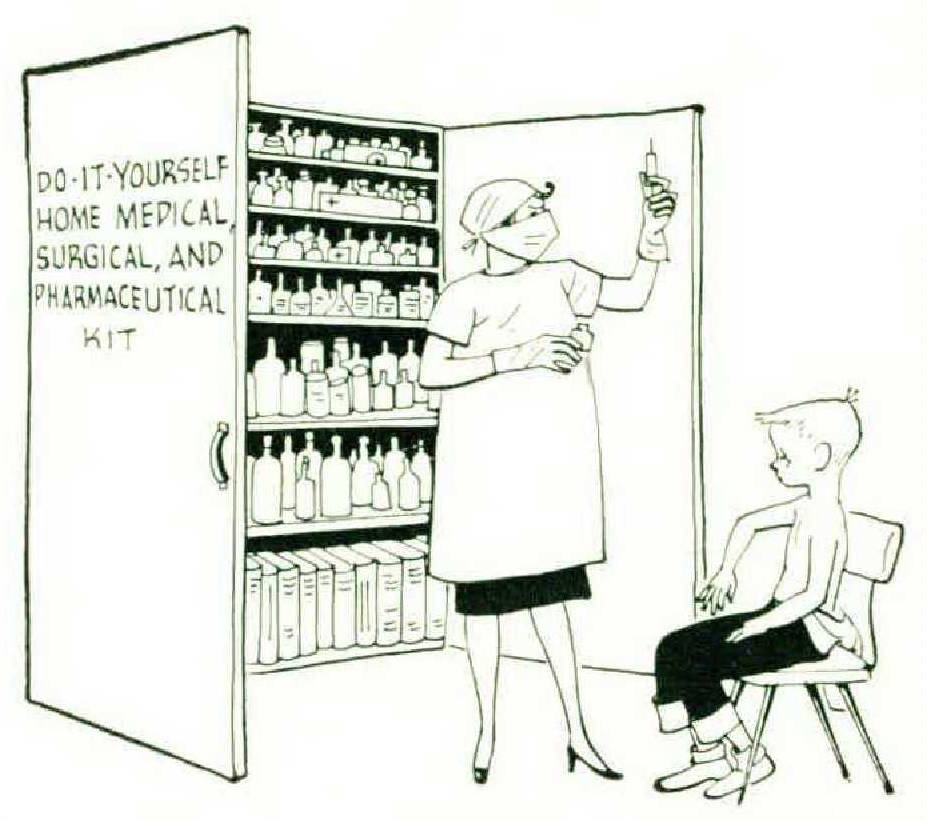
Tell Me, Doctor
ANNE KELLEY lives in Evanston, Illinois, and is a frequent contributor to the pages of Accent on Living, where she first made an appearance in October, 1958.
It may have escaped the notice of the American Medical Association, but I know what has become of the old-fashioned family doctor (you know, the one who’s on call twentyfour hours a day, seven days a week, through wind and storm and sleet and never mind the bill; the one who really cares). I’m it.
And as I come to realize the enormity of my responsibility to myself, my loved ones, my neighbors, and the total strangers who ask me what I recommend for chest congestion, I am increasingly humble. Will I be equal to the challenge?
But perhaps I should first explain how I happened to enter medicine.
Medically oriented by mass magazines over a period of time, I needed only a tiny push in the right direction — and Doctor’s office nurse gave it to me.
Two winters ago, when I had just moved to a new community and had established credit references, I phoned the office of a respected physician to inquire if we could work out some arrangement whereby he would treat me and mine if we fell sick.
Nurse was a bit short with me that day, bless her.
“Well,” she answered briskly, “you’ll have to be very sick. Doctor is heavily booked.”
“Oh, I will, I promise!” I answered breathlessly. “Nothing less than a terminal illness, if I can possibly help it.”
As I slid the phone gently into its cradle, I turned pink with pride. Diagnosis, then, was up to me!
We all grow with new interests, and as I established my residency by the medicine cabinet. I found myself heady with excitement. I clipped a thermometer in tandem with my ball-point pen and look to wearing a starched white uniform around the house mornings. But my first diagnostic attempts were cowardly, as I see now. I attributed everything to emotional causes, because I thought it was stylish.
“Laura’s head aches only because she doesn’t want to go to dancing class; Little Billy’s looking bilious because I repressed his urge to play with matches; Daddy’s backache will go away as soon as he tells off his boss. . . .” Clearly, I had not even begun to glimpse my potential.
Then it was that I began to reach out, to devour hungrily every bit of medical information available. So many specialists were standing by, ready to help. On television I had not only the opportunity to watch spleens and skulls laid open in coastto-coast documentaries, but I had the inspiration of the commercials as well, with their flaming digestive tracts, their dandruff magnified in complex, and their beakers of stomach acid.
Naturally, I soon equipped myself with a nasograph.
But it was only the beginning. For consultation, too, I had the mass media: the worry clinics, anxiety columns, and syndicated advice of kindly physicians who cannot reply to personal letters but who are, nevertheless, gold mines of information on diseases I personally have probably inherited. The magazines, too, I found veritable lodes of lore on dread diseases, new and old, with the odds in favor of having me or my immediate family contract one or more of them, and the odds in favor of our succumbing to the disease when we got it.
Why, I suddenly realized, the number of mortal ailments had become greater than ever before in history! Our selection was virtually unlimited; I had only to acquaint myself with one syndrome when another would appear. Talk about new frontiers! Every little cell and platelet and capillary was just jumping with an urge to go delinquent.
And that’s when I began utilizing my latent resources, not only for diagnosis but for medication and treatment and prognosis. At my home now we keep the pharmaceuticals where the spices used to be. Ours is a constant vigil in search of the white-coated tongue, the twinge, the tic, the hic, the slightest variation in heartheat. Where health is concerned, we take nothing for granted. Is our blood count in the red? Is our cholesterol playing trick or treat? And our reflexes? We take turns tapping each other with little rubber hammers just in case.
If we are not soon able to satisfy Doctor’s office nurse with a really serious ailment, I’ll have only myself to blame. But two very promising developments allow me to hope that any day now I shall come up with symptoms which will not only break down Nurse’s reluctance to put Doctor himself on the line but may even result in a face-to-face meeting of the two of us, possibly inside an oxygen tent.
One is an announcement in a catalogue newly rushed to me by a mail-order house which obviously understands the scope of my new responsibilities. Listed there, along with the world’s shortest nightie (“10 inches long, one size makes everyone happy”) and the plastic headband crowned with mistletoe (“not just for Christmas-great year-round sport, pleasant evening pastime, daytime — any time”), is a treasure of an item for the struggling home M.D. — a sphygmomanometer for just $19.95 plus shipping costs.
“No fuss, bother, or office visits when you want a reading.”the catalogue promises. “Helps you keep a constant check on fluctuating blood pressure, provides needed warning. Complete with zippered case.”
Won’t Nurse be proud of me when I call in with reports both systolic and diastolic?
The second note of cheer is a simple newspaper headline which proves to me that anything can become a symptom of illness if I but have the creativity to make it so. Can I afford to be content with only seven danger signals when an eighth is so readily available?
“Beware,” the headline reads, carrying the warning of one of my most solicitous remote-control medical advisers, “Well-being Often Goes Before a Sickness.”
My own intramural doctor-patient relationship has never been closer. “Patience!” I croon. “I’ll find a dread disease for you yet.”