Records From the Comedians
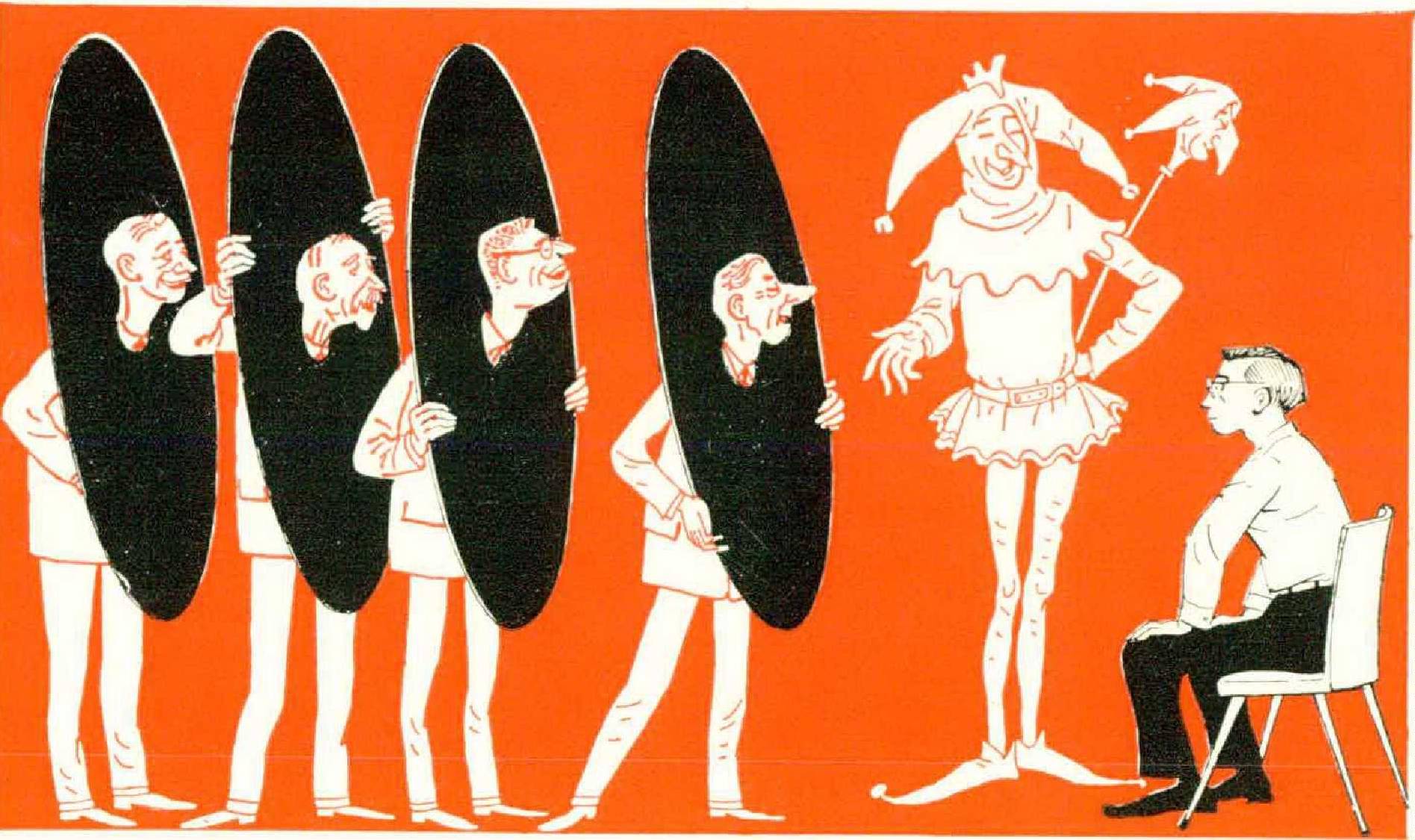
Do people listen to the spoken record more than once? It would seem so, especially as literature, when the voice on the disc conveys the elegiac cadences of Sir Max Beerbohm (Angel 35206) or the beatific mumble of Jack Kerouac reading Japanese haiku against a background of the American jazz blues (Hanover 5006). The first utterance of the phonograph was verbal. “Mary,” said Thomas A. Edison, “had a little lamb.”
Today, however, the infinite variety of long-playing elocutionary albums induces wonder, if not alarm. Who, aside from the scholar, relives golden moments of The Nuremberg War Criminal Trials (Forum 32001)? But there must be a public for the documentary, as there is for the practical “how to" recording: Bowl Your Best (Epic LB-2700), Chinese Health Exercises, The T’ai Chi Ch’uan (Colpix 413), How to Listen to the Heart (Columbia KL-5424). The last, incidentally, is available in Spanish (KL-4380).
Even less durable would be the overtly humorous LP. The law of diminishing returns rules comedy. The man who hears a comedian telling the same joke repeatedly must possess a vast tolerance indeed. In a group it is different; then one can listen, as a wife listens to her husband’s favorite stories, with clenched teeth but with a certain pride of discovery. It is not implausible to conclude that comic recordings are marketed for the group rather than the individual.
Two years ago, a New York Times reviewer, Robert Shelton, attempted to find the common denominator of the then seventy-odd humorous, satirical, and quasi-comic albums of this field. “They range,” he noted, “from the highest in the form (Voltaire’s ‘Candide’ in French on Caedmon) to the lowest (Mickey Katz’ tasteless effusions), from the ultrasophisticated (Noel Coward, Beatrice Lillie, Cyril Ritchard), to a pseudo-naive type of rustic wit (Andy Russell on Capitol). Some are symphonies of words without music (Mort Sahl), others score their points with ‘music’ alone (the Guckenheimer Sour-Kraut Band on Victor), or words and music together (Victor Borge on Columbia).” Mr. Shelton judged that a satiric intent, to a degree, distinguished all.
Granted; yet a precise definition is wanting. Do Edison’s inaugural words provide a clue? This question occurred to me the other day after purchasing four comic records at random from the stock of a small suburban store. Arriving home, I perceived these had been made by persons who, like Edison, disclosed commitments to other pursuits. Like Edison, they were nonprofessional comedians.
If not a common denominator, at least here glimmered a specific. The humor recording is dominated by professionals, Shelley Berman, Jonathan Winters, Nichols and May, whose polished mechanics reflects a background of theatrical skills. Increasingly, however, one encounters unheralded talent emerging from the limbo of a remote trade to challenge the professionals, particularly in this period of the marginal recording firm with a midget budget and high hopes.
Among the established comedians, I could recall offhand only the examples of Myron Cohen, a former New York garment district salesman; Sam Levenson, the schoolteacher; and Milt Kamen, who once played the French horn in the New York Philharmonic. On records, however, the phenomenon of the Sunday humorist began, for me, with the advent of Tom Lehrer.
Lehrer was a mathematician; a jaunty mathematician, apparently, who chanted ruthless song parodies, some clever, others callow, while cheerfully pounding a piano. His primary allegiance a decade ago was to the Harvard Graduate School, instead of records, night clubs, or the stage. And the contrast of Harvard with the night clubs established his niche. He is still a mathematician in terms of his performing identity.
Lehrer’s word-of-mouth success was repeated, in New England, by Robert Bryan and Marshall Dodge, who made an LP called Bert and I, devoted to the pawky vernacular of the Maine Yankee. Both were students, Bryan destined for the cloth, Dodge for medicine. Their material was old — with the dauntless candor of a divinity student, Mr. Bryan once admitted that the anecdote, “Which Way to Millinocket?”, could be traced to the papyrus scrolls of the Nile Valley — or invented by themselves; and in due course a sequel appeared, A Maine Pot-Hellion, involving several other amateurs of folk humor.
Inspired by such precedent, I settled down to savor my purchases, to hear a cross section of the current semiprofessional comic crop. Civilian experience might yield diverse illuminations. The limited sphere of the trained comedian, after all, was not life. Alas, I sat alone, which was like making faces at a mirror, but no matter.
Laugh a Spell with Doug Harrell (ABC 364) seemed promising, for the jacket proclaimed, “A laugh in every groove.” Harrell began residency in obstetrics and gynecology at Grady Memorial Hospital, Atlanta, Georgia, last year. According to the liner remarks, “he is a firm believer in the old saying that laughter is the best medicine and that a person capable of a good, hearty laugh is usually well or getting well.” He turned out to be right. The doctor, delivering his monologues in a robust Southern drawl, provoked peals of appreciative mirth from a large audience. He was recorded live, at what one gathers was a medical convention; and his material, which dealt with the clinical aspects of internship and doctor-patient relations, amused a group not unforgetful of the camaraderie of the student operating room. They were hale enough. It was the layman who felt mounting queasiness. By the time Dr. Harrell had reached “The Exsanguination Blues,” I decided upon less drastic therapy.
This was applied by Alan Bemis and Peter Kilham, who are listed simply as “real old-time Yankees” in Caused by Rum and The Casket Sinkers (Droll Yankees I). In the tradition of Bert and I, their work relies on idiomatic speech. The pronunciation contains innate humor; but unless one subscribes to the premise that down-East dialect is sustainedly hilarious, the record seems interminable. The rambling anecdotes lack point (unless that is the point) or structure. Nor, after Dr. Harrell, did I relish the authentic Yankees’ night thoughts. Bemis and Kilham plan a series of recordings; “This, the first one, gives a number of stories related to drinking, and a number on grave digging.”
The next album introduced an author, Harold Flender, who wrote the novel Paris Blues and who has been “active in French television.” Flender, gagman emeritus for many comedians, exerts a more direct claim to professional standing than either the doctor or the Yankees. On Candid Telefun (United Artists 4075), his device is elementary: the recording of spontaneous telephone conversations in which he has rigged the situation. It is not so much the violation of privacy that causes consternation on this record, but a leaven of sadism. The first Flender routine, for instance, involves phoning the proprietor of a pet shop and requesting a cage of monkeys, to be used in the preparation of a monkey stew.
Comedy, at this juncture, looked indistinguishable from gloom. And the prospect of Connecticut Characters, remembered by Nelson C. White, nurtured wan hope. It was produced by “Bert and I”; and I expected the same mixture. Mr. White is a painter of marine scenes and landscapes, “a trustee of the Lyman Allyn Museum of New London and the Wadsworth Atheneum of Hartford.” Trustee humor has never amused me unduly, and painters’ fun usually is as inbred as doctors’. But Mr. White is also, I presently learned, a very funny man. Manners comprise his forte, comedy of character. Although he reproduces the regional Connecticut accent splendidly, he does not rely on mimicry alone for his effects; he does not exploit a sham, exaggerated archaism. Rather, Nelson White is a raconteur and observer, and the painter’s eye serves him well, as impressively as a good car.
His accurate vignettes of the neighbors he has known throughout the years form a charming and affectionate Spoon River Anthology of Waterford, Connecticut. The social range is wide. The artist limns one vivid portrait after another — of Henry Schofield, the dandyish town pauper; of Tiptoe Gardiner, the farmer; of Turner Hayes, ponderous guardian of the Waterford drawbridge; of Alfred Holbrook, the affluent miser, quavering forlornly as he offers up his last strawberries to a tourist; of the Italians, Nicholas Salegna and Carmine Mariano; and of Henry Goodale, who alternated roles, as Prohibition bartender one week and policeman the next. Each is captured with precision, grace, and warmth. Mr. White describes solid presences in a passing world; his friends belong to the urbanized twentieth century, yet reveal sudden vernal quirks suggesting the Arcadian murmurs of an earlier America.
Do people listen to the spoken record more than once? I paid Nelson White that tribute. Alone.
He did not reveal the secret of the popular comic recording, but he restored a shaken faith in the lay humorist. White not only went back to the Chaucerian source. He was professional, and that, perhaps, affords as clear a common denominator of the successful comedians on records as any.