A New Agriculture in an Old Land
An American authority on soil conservation whose dulies have carried him to China, Africa, Yugoslavia, and Japan, DR. WALTER C. LOWDERMILK has served the United Nations on two extended missions to help solve the land and water problems in Israel.
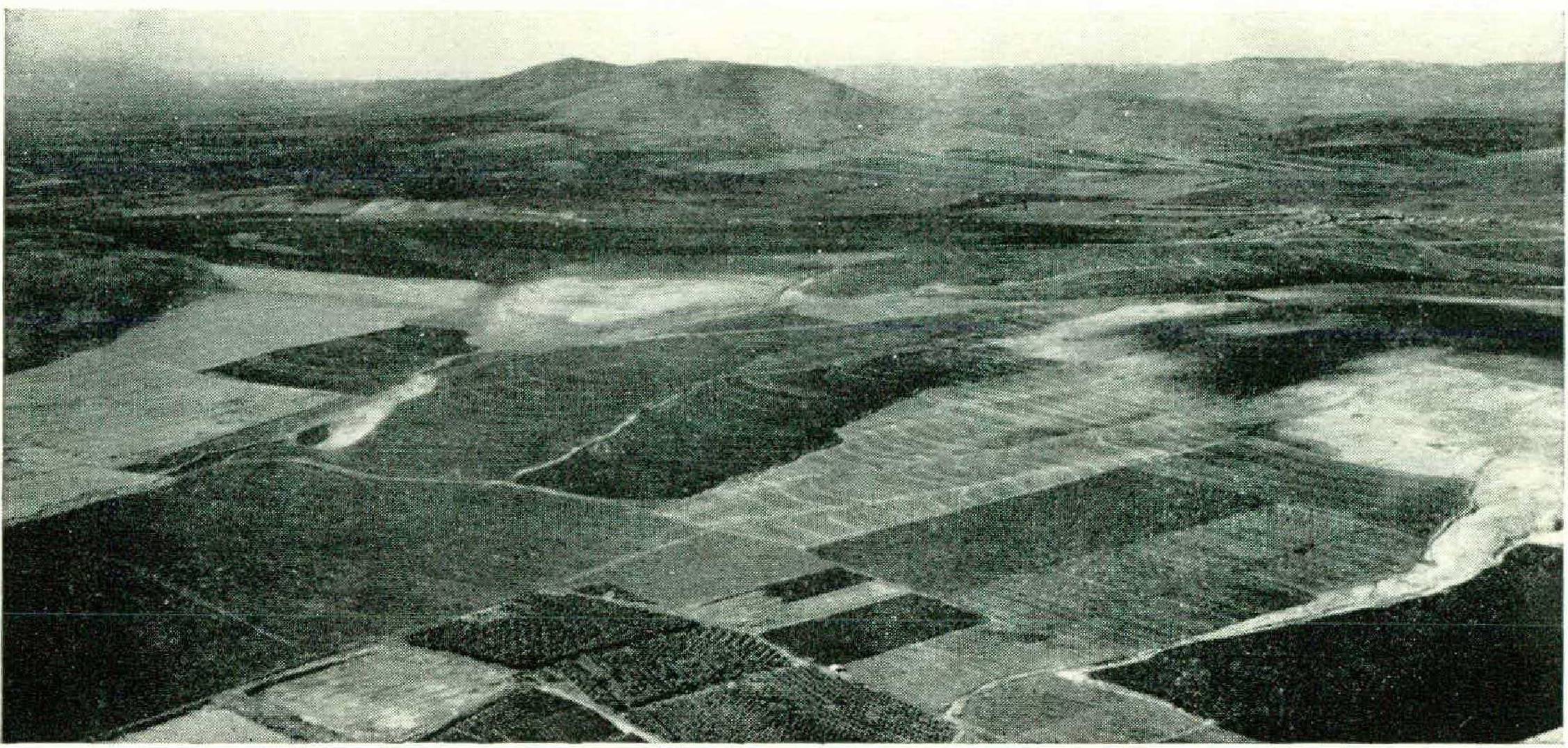
TWENTIETH-CENTURY Israelites, coming back to the land of their patriarchs, did not find the bountiful land Moses had described three thousand years ago as “a land wherein thou shalt eat bread without scarceness, thou shalt not lack anything in it.” Instead, they came to malarial swamps, which killed off many pioneer settlers before drainage was completed. They found rocky hills from which three feet or more of soil had been washed off to bedrock, exposing white limestone skeletons of the hills. Ancient stone terraces built to level land on slopes were generally in ruins. Thousands of former hill villages were heaps of weatherbeaten stones. Surviving villages were grouped about some perennial spring that watered gardens, vines, and fruit trees. Hills were denuded of forests.
Lands once a pastoral paradise had been grazed down to the ground year after year, eliminating the most nutritious grasses except where specimens had grown up in rocky thorn thickets beyond the reach of goats. Gullies had created badlands in rolling country of fertile wind-laid loessal soils of the northern Negeb. Storm waters off the slopes ran together in reddish-brown floods that laid down sediments on flood plains and carried muddy waters out to sea. The highway from Lydda airport to Jerusalem passes over the Saracen Jindas Bridge, which was built on top of a Roman bridge. Archaeologists showed me how the alluvial plain had been raised by sediments of past floods twentyseven feet deep since the Roman bridge was built. All this soil and more had been washed off slopes now covered with stones, west and north of Jerusalem. Sediments carried out to sea were sorted by waves; sands were washed back on shore to be blown inland as marching sand dunes which choked up streams, forming pestilential marshes and overwhelming farmlands. The population of ancient Palestine, including Transjordan, had dropped to one tenth that of thriving Byzantium in the seventh century. Jerusalem had become a run-down administrative center.
This long decline, shared by North Africa and the Near East, began in 640 A.D. with the first invasion of nomads out of Arabia. Then followed more invasions, ravages of wars, and heavy tax burdens laid on by conquerors as feudal landlords cruelly exploited peasant farmers. The remarkable refinements in agriculture and animal husbandry attained by the Roman-Byzantine civilization were blotted out. Wastage of soils and waters set in and destroyed the productivity of the land and reduced survivors to poverty and misery.
Gradually, the Roman-Byzantine economy of intensive agriculture was replaced by nomadism. Destructive, ubiquitous, long-eared, black-haired goats, the “cloven-hoofed locusts” of this part of the world, broke down terrace walls as they destroyed vegetation. What sheep did not eat, goats ate down to the bare earth; and camels finished off what was left, even thornbush. After long dry summers, lands were thus stripped bare and exposed to the dash of winter rains that eroded slopes year after year and century after century. Palestine, by the 1880s, was a man-made ruin of a once flourishing land.
In 1938 and 1939, on a general survey across North Africa and the Middle East for our Department of Agriculture, I discovered that Jewish agricultural colonists had bought “unprofitable” lands from the Arabs, albeit at very high prices. They had achieved the finest reclamation of old lands that I had seen on three continents. Although formerly city dwellers, they had trained themselves to be excellent farmers, eager to do better.
This amazing success of Jewish land reclamation was due in large part to one important ingredient — the dynamic and idealistic spirit of the people. They believed redemption could not be achieved with hired labor but only with intelligent selflabor by those inspired with a passionate love for these rocky, eroded slopes and malarial swamps. They had the courage and indomitable spirit to do what was necessary on a terrain that would have frustrated people with less vision and courage. Now, after almost two thousand years of homelessness, about two million Jews are at last free citizens in their own country, small and half desert as it is. Here they work on their own land and in their own industries.
The base for these undertakings is a narrow strip of land on the eastern shore of the Mediterranean some 265 miles long and from twelve to seventy miles wide, covering 8040 square miles, including water surfaces. This, after two partitions (1922 and 1947), is what is left of the original mandate of some 45,165 square miles allocated for a Jewish national home by the League of Nations. The Israel of today is little larger than the state of New Jersey, and two thirds the size of Holland.
This small country is a picturesque museum of a coastal plain of sediments and good soils, of land uplifts and of spectacular rift faulting. It rises in the north to an altitude of 4000 feet on Mount Meron and drops down in the Jordan rift valley to 2600 feet below the Mediterranean, being the lowest inland sink in the world. This depression is partly filled with the lifeless waters of the Dead Sea, bitter with 25 per cent of salts of fabulous resources in potassium, bromine, and magnesium. Its surface is still about 1292 feet below sea level. The rock of the hills is mostly limestone. Karstic features of subterranean drainage let rain waters collect in labyrinths to issue forth in large perennial springs in the valleys.
The climate ranges from temperate in northern Galilee to subtropical and tropical in the Jordan Valley. As in California, rains come in winter and summers are long and dry, requiring storage of waters for irrigation of summer crops. Annual rainfall averages 42 inches in the north; 26 inches at Jerusalem; and less than one inch at Eilat.
THE creation of a new agriculture in this old and much-damaged land called for an evaluation of many aspects of reclamation. Leaders recognized that redemption of the Holy Land must be founded on science, technology, and thorough training. Experiment stations were established in different areas of the country. The government of Israel also got technical assistance from specialized agencies of the United Nations and Point Four assistance from the United States.
The Food and Agricultural Organization of the UN assisted in developing a soil and water conservation program and a service to administer it. A team of experts, on which I served as leader, was supplied by F.A.O. to work with and to train Israeli soil scientists and to demonstrate measures on the land. An excellent land inventory of the country was completed in three years. It classified all land according to potential use, with precautions for conservation of soil and of the rain that falls on it. The survey also indicated areas best suited to cultivation with irrigation or with dry farming, lands suitable for pasturage and those suitable for forests, and areas that require drainage, destoning, or other types of reclamation.
The inventory revealed the scarcity of class-A land. Thereupon the government, except in extreme cases, prevented urban sprawl and location of industries on class-A land, best suited for growing food. Now cities and towns are required to extend their subdivisions on less productive land, such as sand dunes or stony hills, wherever possible.
Drainage of marshes was one of the first undertakings in reclamation. Early settlers had conquered most of the pestilential marshes and had reclaimed them for agriculture, often with much loss of life until malaria was eradicated. Marshlands of the Valley of Jezreel became the heart of Israel’s agricultural life. The Valley of Zebulum, a swamp bordered by sand dunes, is the Haifa Bay nerve center of Israel’s industry, surrounded by residential suburbs. Marshlands of the Emeq Hefer had been drained and converted into prosperous agricultural villages. The famous and beautiful Plain of Esdraelon still requires some drainage of hydromorphic soils to produce two crops a year. The coastal plains, where sand dunes had dammed up stream channels and created deadly swamps, are now covered with orange groves around prosperous centers such as Hadera, Peta Tikva, Givat Brenner, and Rananna.
To complete swamp reclamation, the new state has drained the lake and papyrus marshes of the Huleh Basin, a physiographic gem. Just across the border in Syria is majestic Mount Hermon (10,000 feet), capped with snow in winter. The Huleh project brought into production some 45,000 acres of fertile soils, a veritable agricultural paradise, expected to support some 100,000 people. A small part of the lake with papyrus growth has been preserved as a natural wildlife habitat.
The F.A.O. group was on hand for the celebration of the first plowing, in 1955, of some 16,000 acres of peat soils derived from former papyrus marshes. Yields of first crops were three times the expected averages. Factories have been built to preserve surplus vegetables and fruits.
Soils irrigated with waters containing small amounts of salts in solution, characteristic of dry regions, must also be drained to prevent the accumulation of salts in amounts toxic to crops. Israel is conducting a comprehensive program of research in the leaching requirements of irrigated lands.
Reclamation of some 75,000 acres of sand dunes moving inland is another challenge to the country. A much larger area of dunes lies inland in the southern Negeb. Research and demonstrations in fixation of coastal dunes are under way and will, in time, convert these wastes into benefits.
DENUDED hills were the most conspicuous feature of the landscape of Israel, but this is being changed, year after year, as forest plantations grow up to turn stark slopes of glistening white stones into emerald expanses. Restoration of forests on the hills has been a popular undertaking for “Redemption of the Holy Land” among friends of Israel in other lands. They finance “gardens” of 100 trees or “forests” of 1000 to 10,000 trees in honor or in memory of friends, relatives, or benefactors of Israel. Projects of large-scale afforestation, such as the Martyr’s Forest of six million trees, are carried out by the government and by the Jewish National Fund.
Work in forest nurseries and tree planting gives immigrants wages and arouses a love of the good earth that helps in their rehabilitation until they become self-supporting. Already, some needs for fuel, poles, wood pulp, and shipping crates are supplied from plantations, reducing costly imports. Trees grow rapidly on stony hills, for their roots seek out residual soil left by past erosion in pockets and crevasses common in limestonecountry rock. Some 50 million trees have been planted to date, and the program calls for 200 million in the next ten years.
To make vast overgrazed rangelands of Israel “flow with milk and honey” again is a spectacular undertaking in reclamation. The task is to reseed the range with good endemic, as well as with imported, grasses and with forage plants from South Africa, Australia, and America, and to apply scientific management. A 500-acre grass nursery was established early, and others were set up later, to grow grass seeds in ton lots for renewal and improvement of grazing capacity of rangelands. At an international conference on pasture and grassland management around the Mediterranean, held in Israel under sponsorship of F.A.O., Israel was cited as having the best examples of grassland management for livestock production of all countries bordering on the Mediterranean.
Reclamation of all kinds of lands was undertaken with a zest that would amaze American farmers. In deep soils encumbered with stones, great tractor-drawn chisels are used to bring stones to the surface. The stones are piled in ridges on the contour to clear interspaces for cultivation. Lands without stones but cut up with eroding gullies are planted to wood lots or to grasses, according to the amount of rainfall; or if topography permits, the area is contoured for cultivation, with broad base terraces to control storm runoff and to lead it around slopes to natural drainage ways.
The beginning in crop improvements made by Aaron Aaronsohn, who first discovered wild wheat in Galilee in 1908, is being followed by modern research in plant breeding and in protection of crops against pests and plant diseases. Israel now grows, besides grains, high-grade cotton, sugar beets, and peanuts that equal or exceed the yields in California. It has converted production of vegetables from grave shortages to surpluses and grows industrial crops for its own needs and for export as well.
Ancient Israel was known as a land of fruits, of pomegranates, figs, grapes, olives, and dates. Modern horticulturists are doing far more today, in introducing and improving new varieties. Israel grows bananas, avocados, persimmons, mangoes, and nuts of several kinds. Moreover, citriculture is a primary industry of the land and yields the highest value in exports, in addition to an abundance for local consumption. The Shamouti or Jaffa orange has an excellent reputation throughout England and Europe. Much is being done with deciduous fruits and with the carob (Ceratoniasiliqua), indigenous to the country, to supplement forage of grazing lands for livestock.
Irrigation, which ensures two crops a year in most of the country and more in areas of year-long growing temperatures, requires thorough investigation of water supplies and development and efficient use of ground and surface waters. Since statehood, Israel has increased its irrigated acreage fivefold. Wells located by geological research made ground waters available more surely and quickly. Moreover, ground water proved to be more bountiful than former studies had indicated. Grids of steel and concrete pipelines have been laid to connect new wells as they are brought in, ensuring dependable supplies.
Development of surface waters called for hydrological and engineering investigations that were begun by the Jewish Agency during the mandate. Many schemes were studied, including my own proposal for a Jordan Valley Authority for irrigation and hydropower. After years of investigation, the Master Water Plan was approved and is now in force. Under this plan, Israel will make use of every available source of water before it is lost to the Mediterranean or to the Dead Sea, and will deliver water to districts where it will yield the greatest benefits in agriculture and settlement. As is the case in California, Israel has much more good land than water for its irrigation, and its water resource development plan vies with that of California in thoroughness and achievement.
The central feature of the Master Water Plan is a great 108-inch prestressed concrete pipe, made in Israel, to conduct surplus waters of the Huleh Basin and upper Jordan River to the excellent loess or wind-laid soils of the northern Negeb, which, when irrigated, produce abundant crops. This pipeline from Dan to Beersheba and beyond will also supply manufacturing centers in the southern Negeb.
There are five satellite projects: the Lake Tiberias (Sea of Galilee) to Beit Shean, under construction; the Western Galilee-Qjshon, completed; the Yarkon to Negeb, with two concrete pipelines; an eastern 66-inch line 60 miles long, completed and in use; as well as a western 70-inch line. Also, flood waters are captured to prevent wastage to the sea. Several dams have been completed and provide for recharge of coastal plain aquifers that are now heavily pumped.
Plans have been made and work is under way to rectify sewage effluent of cities and towns and to reclaim about 50 per cent of the water for irrigation of field crops.
Decentralized industries have been developed as part of cooperative agricultural settlements, and manpower is productive the year round. This has meaning for the beginnings of industrialization in the agrarian economies that are prevalent in about two thirds of the world. Many of the less developed Afro-Asian states are seeking technical assistance from Israel or are sending representatives to study this phase for their own programing. Israel has its own “Point Four Program” to assist these states.
In thirteen years of statehood the government and people of Israel have gone a long way in creating with their own labor a new, forward-looking agriculture. The benefits are shared by 240,000 Arab citizens of Israel, who now have a higher standard of living than the peoples of surrounding Arab states.
Of what remains to be done, I mention only some major activities. Completion of the Master Water Plan by 1970 is expected. This would bring into use practically all the available natural waters within the borders of Israel. Further growth in agriculture will depend on more efficient use of existing supplies and in desalinization of brackish and sea waters. Two plants to convert sea water are soon to be built at Eilat, one using vacuum freezing, and the other, flash distillation in conjunction with a large steam electric-power plant. Hopes are high that Israel will find a way to use atomic power for conversion of sea water to fresh water. Research and development will solve many existing problems and increase efficiency in agriculture, animal husbandry, and poultry production.
The future for industrialization in many other fields is also promising. Israel has resources — vast stores of potassium, bromine, and magnesium in the Dead Sea, and considerable deposits of rock phosphates out of which its chemical industries manufacture fertilizers for home use and for export as well. The prospects for a permanent and sustaining agriculture are very good if Israel is safeguarded in its rights to carry on.
Israel is well located, at the hub of land, air, and shipping lanes, with its own prosperous El A1 airline and rapidly enlarging merchant and fishing fleets. Its population viability is a dynamic geographic relation; it depends on the genius of a people for agriculture, for industries, for efficiency in divisions of labor, and for social justice. The prospects are that, in the new agriculture now being developed in Israel, one acre of irrigated land, or its equivalent, supplemented by livestock products, will support four people. A preliminary estimate can be made on this basis. The unknown is the number of people who can be fed from imports earned by exports of all kinds. In the case of Great Britain, only half of the population is now supplied with foods grown in the country, and the other half by imports, in effect purchased by exports. I would expect Israel to do as well or better.