Quemoy: Variation in Touring
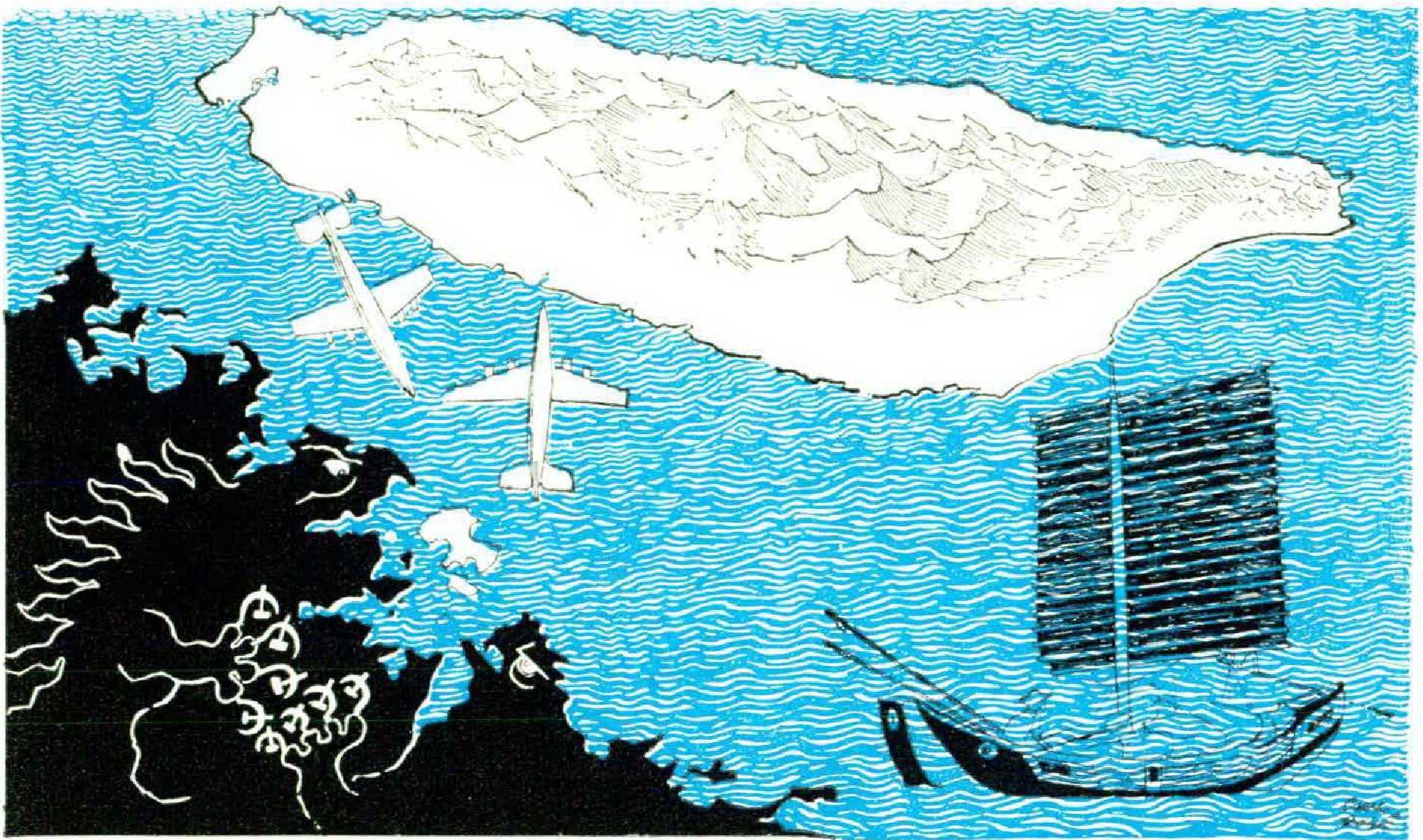
This year is “Visit the Republic of China Year" — Nationalist China, that is, because the other one seems to be too busy visiting throughout Southeast Asia — and while the tourist campaign was originated to get American dollars and other supposed hard currencies into the island of Taiwan, the government is greatly surprised to find that it has a real attraction on its hands. And it is not Taiwan at all, but a group of small islands 120 miles to the west, nuzzling next to the Chinese mainland.
Since the television debates between Kennedy and Nixon, it is understandable that the number of travelers to Quemoy has increased by 425 per cent. Before then, the trade was mainly in reporters, who would arrive singly, dressed for the bush, armed with cameras, stenographer’s notebooks, and pencils. They would square their shoulders, give a small smile of bravado, and in a voice that would only imperceptibly crack, say, “I’d like to go to Quemoy. How can I do it?”
At first, with an Oriental sense of the dramatic, the Government Information Office, together with the Information Office of the Ministry of National Defense, under whose jurisdiction these island fortresses come, would presumably consider this extraordinary request, invariably accede to it, and in a day or two load the heavily insured representative of the press aboard a C-47, appropriately before dawn, and wing him across the Taiwan Strait.
Since November, however, travel has been stepped up. No selfrespecting newsman visiting the Far East can bypass Taiwan, which means, of course, checking on the fortifications of Quemoy. Neither can any visiting dignitary, diplomat, trade commissioner, junketing American congressman, publisher, evangelist, or “people-to-people" emissary with his touring wife. Very, very rarely does anyone go to Matsu, another group of fortified islands to the northward, because Matsu cannot be visited in a day, for it lacks an airfield. And besides, the mainland is a good deal nearer Quemoy, so you can get a much better view across the four miles of water.
The Chinese are masters at improvizing, and then polishing their plans to an unbelievable precision. Their tours can be fitted to any schedule, from a few days to as little as a few hours. This spring, a Midwest publisher and his beautiful young wife were whisked one afternoon to the main island, bundled into a jeep and taken to see the commanding general in his command post carved out of a mountain’s middle, decorated with pins signifying they were “Defenders of Quemoy,” and almost without stopping, turned around and taken to their plane and flown back to Taiwan in time for cocktails.
The publisher and his bride did not see very much, though I am sure their impressions were vivid enough for many conversations back home and — it is hoped by the Chinese officials — favorable editorials in the publisher’s chain of newspapers. Their stay was too short. Indeed, to get a proper perspective of the islands, a week is scarcely enough.
Understandably, the Chinese do not promote long visits. After all, the commanding general has other things to do besides decorate visitors. His command, despite the wide, open roads, the peaceful-looking fields cultivated by 40,000 civilians and many of his 60,000 soldiers, is a battlefield, every inch of which is within range of Communist guns, and which on odd-numbered days of the month usually feels the crash of Communist shells. But the Chinese welcome the one-day treks, for they know that seeing is believing and that anyone who thought previously that Quemoy was indefensible leaves the island thanking his stars that he’ll never be a Communist soldier ordered to invade it.
Quemoy, or the Kinmen Islands, lies about ten miles outside the harbor of Amoy and consists of “Big Kinmen,” “Little Kinmen,” and four small islets. Big Kinmen is the tourist center and looks like a dumbbell. Its area is fifty-one square miles. Little Kinmen is much smaller, only five and a half square miles in size. The smallest, Erh Tan, is little more than a rock of one tenth of a square mile.
The first reaction that the adventuresome tourist has on approaching Quemoy is surprise at its size. Looking nonchalantly out of the window, marked “Emergency Exit,” and rubbing it every now and then with the curtain to clear it of his breath’s condensation, the tourist finds that the land below him, with its fields of vegetables apparently rising up the sides of the central peak of nearly 1000 feet in height, looks much too stolid and peaceful to be democracy’s closest outpost to Eurasian absolutism. If he looks carefully as the plane banks to head into the strip running along the southern part of the island, he will see strange shadows in the water ringing die beach, and before the plane makes its final approach, he will notice revetments carved into the side of the hills along the runway. Appearances are deceiving; he is at war.
It will not be long after the plane has taxied in from the end of the runway and stuck its nose close to the earth bank of the carved-out hollow farthest from the Communist guns that our tourist will find more evidences that the olive branch is not among the many agricultural items cultivated here. If he is a military man or an experienced war correspondent, he will quickly see camouflaged fortifications dark slits in the earth between rocks, humps at the corners of holds; the large bore guns he will not find until much later. And helmets are worn here; not the decorative white or chromium-plated helmets seen back on Taiwan, but the olive-drab, manypurposed head coverings that suddenly have an ominous aspect.
The tourist will be expected, of course, for no one can pay a surprise visit to the front lines; and while he may not realize it, his arrival and everything about him have already been the subject of radio communications between Formosa and the island, the extent of his sightseeing has been decided, and the wheels are in smooth running order. There will be a jeep waiting for him, and a young escort who speaks English — or French or German or whatever is the tourist’s tongue — with a neatly typed itinerary.
If he’s a one-day tourist, as most visitors are, he will see the command post dug out of solid rock, and he will tramp through the hand-hewn tunnels to observation posts, where he will peer over machine guns, across beaches empty save for conglomerations of barbed wire, tank traps, and every kind of impedimenta that can be devised, beyond a short strip of water, at the overwhelming land mass that is mainland China. He will squint through high-powered binoculars at junks fishing out of the port of Amoy, and he will see World War 11 LST’s the big lumbering Landing Ship Tanks —working as they have worked since T arawa, I wo Jima, and Leyte, unloading supplies under the protection of a watchful patrol boat.
After a lunch, marked by his introduction to the sweet-tasting meat of the yellow fish, the smoky and lethal kiaoliang, or millet wine, and a variety of vegetables and soups, all products of Quemoy and its waters, the visitor will be whisked to gun emplacements, a recreation center, and, if there is still time, to the Quemoy Middle School, where over 900 children of high school age study in large airy classrooms whose doors are close to the ready bomb shelters.
Then back to the air strip; and clutching his gifts of red-label kiaoliang, he will climb aboard the plane and leave the island semicircled by the Communist mainland.
He will be impressed. And as he flies across the spume-speckled Taiwan Strait, he will try to sort out his impressions, but they will be crowding helter-skelter through his mind. Being a cynical man of the world, he had prepared himself for persuasive talk before he left Taipeh in the morning. He had expected arguments, a smooth explanation of the righteousness of the Nationalist case; reasons why the acceptance of the Chinese Communists into the United Nations would be catastrophic for freedom’s cause; why the defense of Taiwan, to which the United States is committed, depends upon the security of Quemoy, which is not covered by the Mutual Security Treaty: why in all of Asia there is no more dedicated fighting force against Communism than the Nationalist Chinese, and none more wholeheartedly allied to the United States. He had expected to be told that corruption and the misuse of power had caused the downfall of the Nationalist regime at the end of the World War II, but today, through land reform, as tree a press as can be expected in Asia, and a health program that has abolished plague completely since 1952, the people are living better, more healthily. and with more hope for the future than in any other nation in Asia.
He had expected the arguments, and he had got them. He had been given statistics, most impressive statistics, all confirming the glowing words of the handouts of the Government Information Office, before he left Taipeh. And he had consciously and unconsciously mentally girded himself against them.
And as the miles increase the distance between him and the physical presence of Communism — which should thereby decrease his sense of the urgency of danger in direct proportion to the geographical farness — he finds his head throbbing and churning with impressions that his orderly mind, fighting for plausibility based on preconceived notions, struggles to rationalize.
In 1952 vegetables and pork had to be imported to Quemoy from Taiwan, and today hog production exceeds the local demand and the price of vegetables is 20 to 50 per cent lower than in the markets of Taipeh; the islands are completely self-supporting in food, not only for the civilians but for the soldiers too; the comparatively new Quemoy wine industry now supplies Taiwan with the best kiaoliang; the yellow fish, found only in the waters off the mainland, is a delicacy avidly sought after by gourmets who have once tasted it — all this, and more, he was told.
And to this intelligence were added the sights he had seen and the conversations he had had with those who could not have been part of the Nationalist propaganda brigade: the hundreds of school children, cleaner and fatter than any south of Japan, laughing and squealing louder than the whining of any adult-made shell; the patriarch puffing his pipe contentedly in front of his brick home, while his children and grandchildren worked and played around him, a family unit unbroken by government decree; the American officer, assigned as a military adviser for a four-month “hardship" tour on Quemoy, who has, so far, voluntarily tripled his tour; Father Joseph Duretto, a French priest and doctor of medicine, who refuses to leave the island; the symbols of hope in the thousands of flowers that have been planted alongside the roads; and this plane too, filled with men returning to Taiwan, all on leave and going back to families they have not seen in one or two years, some of them jocular, some of them quiet, most of them bearing two or three yellow fish, quick-frozen by the Quemoy Refrigeration Plant and wrapped carefully in newspaper.
Very shortly, it seems, the lights of Taipeh, the capital of the province of Taiwan, are spread out below, and the plane starts its approach to the Sung Shan airport. It sets down gently on the runway from which jet liners take off twice a week to fly to the United States in less titan a day, and the journey to Quemoy is over.
To most of the tourists it has been a memorable trip; it is made mostly by those with a conscious or unconscious desire to demonstrate their virility, their courage, not necessarily to themselves but to others — their bosses, constituents, neighbors, or their blonde companions at dinner or at cocktails. Quemoy is an outpost of civilization as we presently know it; it has taken the place in popularity of going on an African safari, lowering oneself to kiss the Blarney stone, ogling the beauties of Bali, scaling the Matterhorn, and climbing up the Washington Monument.
It is a very successful tourist spot, more successful, I think, than even the Chinese realize. For the six little islands, together with those of Matsu to the north, are the Asian equivalent of Berlin, in the heart of Communist Europe. Each has something which we, so afraid of discomfort, so hesitant to commit ourselves for a moral principle, so hopeful that danger may go away if we disregard it, unconsciously grope for and want to identify ourselves with.
In years gone by we kissed the Blarney stone to give us the gift of the gab. Today, thanks to the mass production of Madison Avenue hucksters, we are getting more and more immune to blarney. But deep within each of us is the desire to cut through all these words and get back to the basic ideals that we believed in so strongly in our youth. There are precious few symbols of this idealism today, of dedication to a cause, of belief in its righteousness, of conviction that the majority of the earth’s population is basically friendly and just wants to be left alone.