James Michael Curley and the Last Hurrah
A native of Woonsocket, Rhode Island, and a graduate of Notre Dame in 1939, EDWIN O’CONNOR is on his way to becoming the most distinguished novelist in New England, THE LIST HURRAH winner of the Atlantic Fiction Contest in 1956, was received here with national acclaim and has since been translated into a dozen foreign editions Five years have gone info the planning and writing of his new novel, THE EDGE OF SADNESS, a pensive, penetrating study of the dedication of a Catholic priest. The ATLANTIC published Mr. O’Connor s first short story and is proud to be the publisher of his books.
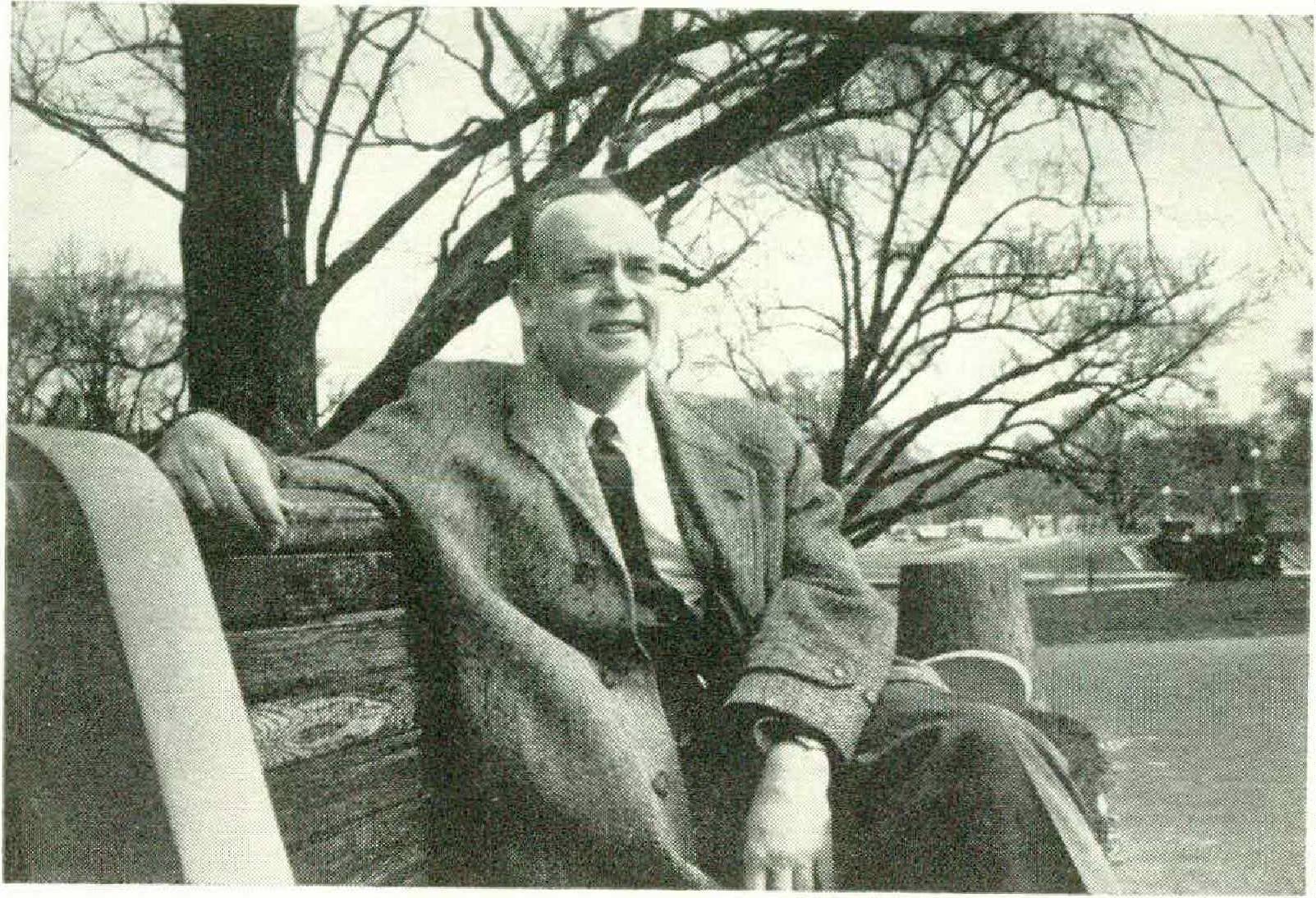
THERE is more than a touch of finality to a publication day — at least, there is for the writer. By this time he’s done just about everything he can do. He has written his book; he has corrected it; he has been interviewed about it; he has been photographed holding it in his hands, as if it were some kind of peculiarly defective child.
But by publication day all these preliminaries — some of them of great value; others, I suspect, of no value at all — have come to an end, and there is nothing for the writer to do but sit back and wait. Unless, of course, he wants to go on television.
I am occasionally told that a television appearance does wonders for a writer — the idea seems to be that it can’t miss driving people into bookstores, with money in their hands — but there are a few things I am told that I don’t believe, and this is one of them. Most of the writers I have seen on television look fairly unhappy, sandwiched in somewhere between an underwear commercial and Mr. Clean.
They want, naturally, to talk about their books, but the only one they can talk to is their host, an agreeable enough man, but one who — well, who just doesn’t read much. He can’t. He hasn’t the time. He’s too busy with his hobbies. (All television hosts seem to have hobbies, such as playing around with powerboats, or building putty cathedrals in the basement.)
So there is really not much for the writer and the host to talk about, but they talk anyway, and every once in a while the host gives the writer an additional lift by holding his book out to the camera — upside down — and pretty soon it’s all over and the writer can go home.
Where, of course, he might just as well have stayed in the first place. Stayed there and, as I say, waited. Waited for what? Well, waited for whatever is going to happen. For what is called “public response.”
The only trouble is that there is no guarantee that the public will respond very well. Or — worse — that it will even respond at all. A book can be launched and slip quietly into the waters and sink without ripple or witness. It has come and it has gone, and nobody knows but the writer. And, of course, his publisher.
At such moments it is the custom of the publisher to take the writer out to lunch. These lunches are always expensive and always sad; the writer chews on a piece of miraculous prime beef and wonders morosely what he will be eating the rest of the year. He may shake his head and say that he just can’t understand it.
In this case the publisher will nod sympathetically and say that he can’t either. He will add that sometimes it happens this way. He may talk about similar failures of the past. Somehow, this is of no great consolation to the writer.
In 1951 I published a novel called The Oracle. Publication day came and publication day went — and so did The Oracle. In silence. Total silence. Weeks went by; no one said or wrote a word. Finally, one day, a friend came up to me on the street waving his arms urgently; he said, “Hey! About your book!”
That was it; I said, “Yes? Yes?”
He said, “When does it come out?”
And this, more or less, was the public response to The Oracle. At the time it seemed a disaster to me, possibly even a conspiracy on the part of my then publisher to conceal me from the public. Now, though, I know that what happened to The Oracle was precisely what happens to most first novels: it simply got lost.
In the great and endless flood of books that comes cascading from the publishers every day of the year, the chances of a first book by an unknown writer receiving more than minimal attention are extremely remote. I know this now; I didn’t know it then — and it was then, of course, that counted.
STILL, history does not always repeat itself. Five years later I had another publication day, and this time The Last Hurrah came out. The public response to this was wildly different. From almost the moment of publication I had a hunch it would be, for no sooner had it been released than two men prominent in Massachusetts political affairs paid it conspicuous attention.
These two men were not much alike, I think, but they had at least two points in common: both were former governors of the Commonwealth, and both reacted at once with vigor to The Last Hurrah. The first promptly threatened to sue because, it was alleged, he was in the book; the second just as promptly threw the book into a Florida swimming pool because, it was alleged, he was not. I took these simultaneous tributes as a possible good omen.
And so it turned out. By good fortune, The Last Hurrah became a best seller. I say “good fortune" because it seems to me that this is the ingredient, perhaps above all others, which determines the best seller. A book can be a good book and sell badly; a book can be a bad book and sell well. One of the worst and most unconvincing novels I have ever read has been one of the greatest best sellers of the last ten years.
Which is not to say that good books can’t sell well. Some do, and it is always permissible for the writer to persuade himself that his is one of these. Still, if he is a sensible man, he will also admit to himself that great sales rarely depend on intrinsic merit. It is much more likely that they depend on factors over which the writer has little or no control.
For example, while I have no temptation to talk down The Last Hurrah, and while I think that, all in all, it is a decent book, nevertheless I also think that much of its success was due to what might be called accidents — to developments, that is, on which I hadn’t calculated at all.
There was, for one thing, the fact that, quite by chance, the book was published during an election year; this undoubtedly helped. There was the fact that no book quite like it had appeared in a long time; had another book, of whatever quality, dealing with an Irish-American politician come along a month or two in advance of mine, the edge of the public appetite for this subject might well have been dulled. And then, too, there was the fact that the aging but picturesque and highly vocal James Michael Curley entered the picture to a degree never dreamed of by me.
Over the last five years I have spent much time in denying that Frank Skeffington was a fictional version of the late Governor Curley. Not that it matters now, but he wasn’t. For a long time I made periodic and dutiful efforts to convince people of this, but while some were convinced, others were not, and foremost among these was Governor Curley himself.
I met him, for the first and only time in my life, about a month after the book had been published. He was getting into a cab, just outside the Parker House; he was alone. It seemed too good an opportunity to miss; besides, I was curious. Those were the days when threats of lawsuits were coming regularly from his house on the Jamaicaway, all filtered through a succession of middlemen, whose appearance, to put it mildly, did not inspire trust. I wanted to hear what the principal himself had to say. And so I put my head in the cab window, and as he looked up, slightly startled, I introduced myself.
There was a long pause while he looked at me; then suddenly he laughed. “Well, well,” he said, putting out his hand. “Nice to see you. You’ve written quite a book. I like that book.”
I said that I was pleased to hear this; rumors to the contrary had been reaching me with some persistence.
“No, no,” he said, waving all rumors to one side. “That’s a fine book. I enjoyed it. Do you know what part I enjoyed most?”
“No,” I said. “No, I don’t.”
He said, almost dreamily, “The part where I die.”
I thought I had better nail this down quickly; I said, “Isn’t it strange, Governor, that so many people confuse fact with fiction? Skeffington with yourself, for instance. I know, and you know, the difference between the two, that the one isn’t like the other —”
“Yes,”he said, nodding gravely. “Yes, there I am in my bedroom, dying. Breathing my last. I’m lying flat on my back with my eyes closed, when suddenly into the room comes. . . .”
And he went on to give me the complete scene from The Last Hurrah, more or less as I had written it, except for the insertion of himself wherever Skeffington had appeared in the original. It was quite a performance, completely engrossing and not a little eerie. When it was over, he shook my hand once more, congratulated me again, and we parted on the most cordial terms, agreeing to have lunch together one day in the future.
I should add that this pleasant encounter in no way diminished the threats of lawsuit. They continued; out of the shadows came the by now familiar voices of the middlemen, muttering darkly of financial ruin for me and all those associated with me.
Gradually, however, these threats shifted rather than ceased, and were directed not at me but at the company which had bought my book for motion picture production. It was in Hollywood, traditional happy hunting ground for litigants, that the matter was finally settled to the satisfaction of some and the discomfiture of others, but in this I was blessedly not involved.
The governor and I never did have that lunch together, and this is something I regret. I don’t know why we didn’t, but I rather suspect it was because we both had become too preoccupied with our own activities: I with my book, he with my book.
For by now the governor had taken on The Last Hurrah as a full-time occupation. He was asked to speak about it everywhere; he did not decline. He was, of course, marvelously at home on the public platform; he was vastly entertaining; and, as time went on, because he was both an imaginative and a creative man, he took to making small and personally advantageous alterations in the book.
Thus, a minor villain, who in my book was an insurance man, became in the Curley version the publisher of a Boston newspaper for whom he had always had small regard. It was a slight change, but one which appeared to give him enormous satisfaction.
As no one understood the uses of publicity any better than Curley, and as no one was more successful in securing it, these talks were widely covered and discussed, and it would be foolish to pretend that they did not further the sale of The Last Hurrah. Although this was perhaps not entirely a one-way street, it is possible to argue, I think, that The Last Hurrah — again, quite by accident — did something, in return, for him.
For, although he was a remarkable and a popular politician — indeed, perhaps the most remarkable and popular ever to appear on the Massachusetts scene — he was by now in his eighties, and, while certainly far from forgotten, he was not in the limelight as once he had been. For some months before his death, I believe this book helped to push him back there. It was not my intention to have it do so — but I am not sorry that it did.
These, then, were some of the circumstances which surrounded The Last Hurrah after its publication day; which, properly speaking, had no connection with the book at all, and yet to which at least a part of its success was due.
And now, another five years later, another publication day has come, and with it the same old speculation and wonder. Not about what I will do, for, as I said earlier, all that I can do I have already done: the book is written; it pleases me more than any of my previous books; and that, really, is what matters to me.
But, about the rest — what circumstances may arise to speed it along, or, on the other hand, to slow it down — I have not the faintest idea. Which is perhaps just as well. Although, one thing I do know: that whatever those circumstances may be, they will not resemble those which were such untiring auxiliaries to The Last Hurrah.
And this, all things considered, is perhaps just as well, too.