Fez
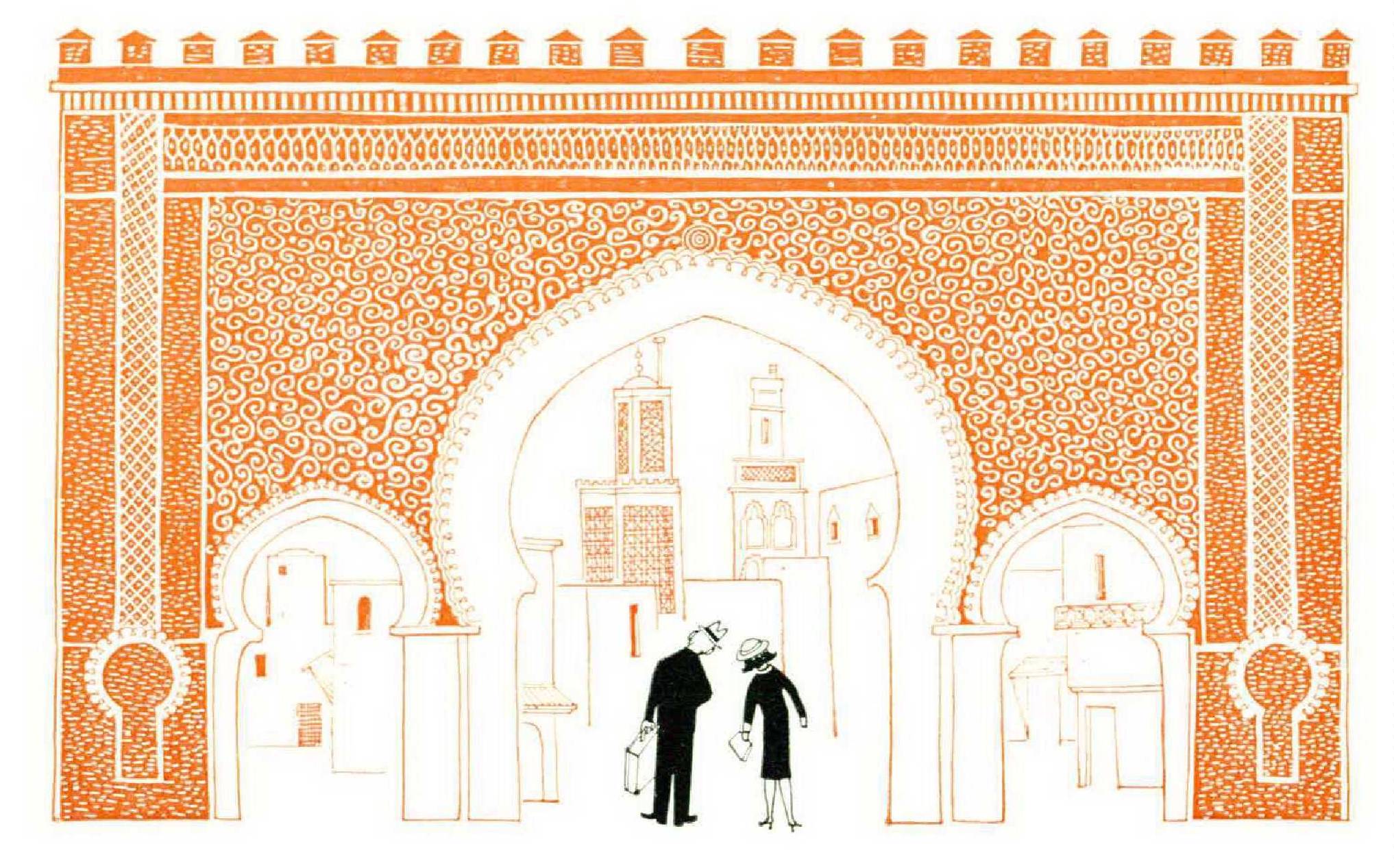
Morocco is a land which should be visited in winter. It is in November, when elsewhere in the Northern Hemisphere the yellow-brown leaves have fallen and the plants have tucked themselves into their beds of cold earth, that the flowers of Morocco come to life. The walls don capes of crimson and purple bougainvillaea, the gardens spill over with red-blossomed hibiscus, pink laurel, green myrtle, and lily-white arum, while the air grows heavy with the fragrance of jasmine, orange blossoms, and trumpet lilies.
I think it was Arnold Toynbee who once said that the two most romantic cities in the Arab world are Aleppo, at one end of the Mediterranean, and Fez, at the other. As regards Fez, this is no exaggeration. Here one can savor a bit of that exotic mystery which is normally associated with Harun Al-Rashid’s Baghdad. For the last eight hundred years, Fez has been the center of the intellectual and religious life of North Africa, and it is the only Moroccan city which has the right to the proud name Fās-al-’Asima — “Fez the capital.”
The guidebooks list a number of hotels in Fez. Most of them are situated in the modern, and totally uninteresting, European city which the French built alongside the old walled medina, the Arab city, when they established the protectorate. But for the discriminating traveler there is really only one - the Palais Jamai, which is located next to the northernmost gate of the medina.
I once asked an official from the Moroccan State Tourist Office in Rabat why the Palais Jamai rated only four stars, instead of the five accorded the elegant El Minzah in Tangier or the monumental Mamounia in Marrakech, where Winston Churchill often spends his winters. “It’s simple,” he replied. “It has no elevator.”
There is little point in arguing with the conventions of international tourism. But one of the charms of the Palais Jamai is that it has no elevator; just as it has no ballroom and no television set in each room. It is, as the name suggests, a genuine palace, built by a grand vizier at the turn of the century, when the sultans spent much of their time in Fez.
Later, when the French bought the palace and transformed it into a hotel, they put in a few essential conveniences, such as central heating, and turned the women’s quarters and dependences into guest rooms. Today it has forty-five rooms, each with its own bath, and accommodates seventy guests; and there are even two rooms on the ground level for those who cannot negotiate the steep tile steps. But in its general design, the palace, with its elegant mosaic walls, its thick Moroccan carpets, embroidered poufs, octagonal coffee tables, and its three descending garden terraces filled with banana trees and aromatic shrubs, has remained as it was.
The grand vizier’s bedroom, which can be occupied if one makes the reservation far enough in advance, is virtually unchanged. (Its price is twelve dollars. An ordinary room at the Palais Jamai costs around six.) It is a lovely, luminous chamber with a domed, inlaid ceiling and painted cedarwood cupboards. Its three barred windows look out onto the roof terrace, from which, over the ornate stucco crenelations, there is a splendid view of the congested medina.
Or if the visitor prefers, he can ask for the apartment once occupied by the vizier’s “favorite,” which is located at the opposite end of the palace, on the level of the lowest of the three gardens, formerly reserved for the women’s quarter, or harem. Its two lancet windows trimmed in dainty cedar fretwork open on a pillared veranda and a small tiled pool.
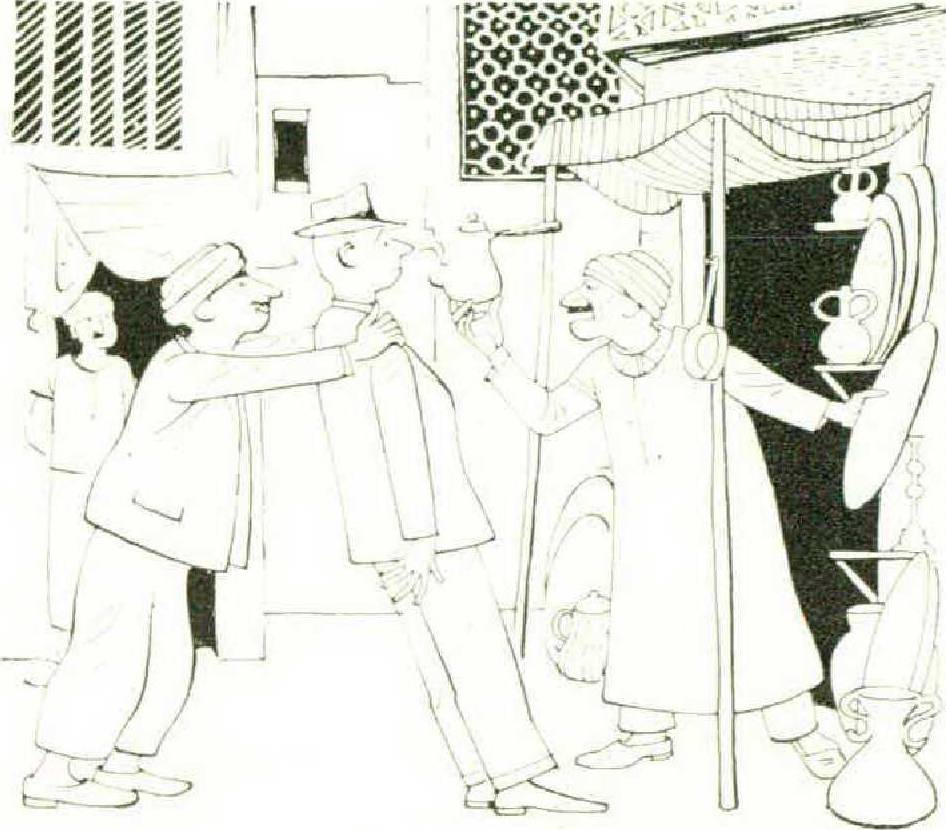
It is when he descends from the Olympian heights of the Palais Jamai into the teeming world of Fez’s old and new cities — both of them in existence for many centuries — that his troubles begin. A few hardy souls have been known to make the plunge unaided. If a tourist is of this pioneer mettle, all he has to do is to walk out through the massive front gate, turn left down the first alleyway — and get lost. He finds himself suddenly engulfed in a labyrinth of narrow passages which twist and turn between blank stucco walls, pierced here and there by a bolted door or a small, high-up window. The tourist can search in vain for the many landmarks the guidebook tells about; instead he is jostled by donkeys, tripped by running children, solicited by crouching beggars, importuned by jabbering hawkers, and ambushed by bazaar merchants, who dart out of their cellarlike dens, take one gently but firmly by the arm, and say: “Venez, monsieur, venez voir -jolis tapis!” And if the shopper is as strong as a horse and doesn’t mind looking slightly ridiculous, he can walk out of one of these Ali Baba caves with a forty-pound carpet neatly humped over his left shoulder.
But there is an easier way out. The front court of the Palais Jamai, which now serves as a parking lot, is usually well stocked with guides, in red fezzes, gray jelabs, and white babouches (slippers), who are more than eager to offer their professional aid. Unfortunately, a large proportion of them are charlatans, with a dim knowledge of local history, a shaky command of French, and an ill-contained desire to race one past a couple of mosques toward the particular sook where Cousin Ali or Uncle Mohammed peddles embroidered wallets or brass trays. (The brassgoods bazaar, be it said in passing, is particularly good. There are 150 artisans’ guilds in Fez, and each has its particular quarter.)
The surest way out of this predicament is to address oneself to Monsieur Jean Bonin, the jovial, bespectacled Frenchman who spends his winters, from November to May, running the Palais Jamai and his summers presiding over a country club in Vichy. He can book a reasonably reliable guide; and should the traveler understand no French or North African Arabic, Monsieur Bonin can put him in touch with a Mr. Theodore Reindollar, an American living in Fez who is glad to pilot beleaguered groups of English-speaking visitors through the maze of the medina.
Fez’s grandest monuments are the Mosque of the Andalusians — so called because it was founded by Moorish refugees from Spain — and the Karueein Mosque, which was built by refugees from the city of Kairouan, in Tunisia. Both are more than a thousand years old. Of the two, the Karueein, with its 13 gates and 270 pillars, is the more important. This mosque is, in fact, the hub of the university for which Fez is famous throughout North Africa, and almost every day scholars flock to its courts and receive the traditional training in Koranic law, Islamic religion, and Arab letters.
Dotted around this intellectual and religious center are some seven médersas, or Muslim colleges, where needy students are given monastic, cell-like rooms, which sometimes overlook the inner patio used for meditation and study. Several of these, like the Bou Anania, Attarine, and Sahrij médersas, are little jewels of Islamic decoration. All of them can be visited, except on Friday (the Muslim Sabbath), as can the Karueein mosque, though most guides are reluctant to take non-Muslims into the inner courts, particularly if thev are carrying cameras or are too casually dressed. (Bermuda shorts are not recommended Fez attire.)
After the sightseer has visited one or two of these places, he should ask his guide to take him to see the shrine of Mulai Idris, the holy founder of Fez, who is worshiped as a saintly great-grandson of the prophet Mohammed, and whose tomb is still invested with miraculous powers.
If he is not worn out by this time, there is more to see: it is all listed in some twenty pages of fine type in Hachette’s Guide Bleu for Morocco. The list includes several of Fez’s 150 palaces, or town houses. A typical one is the Batha, which has been turned into a museum of ancient weapons and embroidered robes. It is really two palaces, or pavilions, facing one another across a beautiful garden bordered with dark cypresses and perfumed with roses.
By this time the tourist is probably hungry, which poses a problem. For, though Fez is reputed to be the gastronomic center of Morocco, the choicest dining is done behind carefully closed doors, at one of those traditional méchouis, where six or eight people sit around a low table on divans or poufs, digging into a mountain of mutton and couscous, eating with their fingers. There are a few chophouses down by the Bab Boujeloud (“Gate of the Skins”), but the fare is not up to the redolent atmosphere. The Palais Jamai, which boasts a French-trained chef, can, with a bit of warning, lay on a few native specialties, such as poulet au citron, or various kinds of stews, made with beef, mutton, chicken, or, occasionally, pigeon.
The only other gastronomic establishment — if we omit the restaurants of the French city — is a place grotesquely baptized La Maison du Touriste. It is not as bad as it sounds, and it has the advantage of being a mere stone’s throw from the Palais Jamai. The view from its great arched windows is even more spectacular than that from the vizier’s terrace, and if the tourist goes there at night, he should get the manager to switch off the irritating electric light bulb which hangs over the alcove and have him put two candles on the low table. He can then savor a pastilla, a flaky kind of Moroccan quiche Lorraine made with pigeon and egg, and admire nocturnal Fez.
If he has come to Fez by carand Fez is only three hours from Rabat, four hours from Casablanca, by road or rail - there are plenty of interesting excursions to be made in the neighborhood. He can begin by driving around the ten miles of crenelated walls encompassing the medina, and then go on, over a winding mountain road through olive orchards, to visit the quaint old holy town of Mulai Idris, precariously perched between two camel-hump hills. Just two miles further on are the noble ruins of Volubilis, once the capital of Roman Mauretania. It still boasts an impressive, though weather-beaten, arch of triumph, built in honor of Caracalla.
But let us get back to Fez, for the magic hour of sunset is at hand, and stop for a moment by the tombs of the Merinide sultans, buried on the northern slopes overlooking the city. The great walled medina has crept into the shadow of twilight, but the sky is still bright with flecks of ocher and rose. In the dusky distance a snow-capped peak of the Middle Atlas mountains is suffused in a soft pink glow. The flag is going up on the square minaret of the greenroofed Karueein Mosque, and this is the signal for the muezzins on all the other towers to summon the faithful to the evening prayer. A sudden hush descends on this teeming world, broken only by the far-off lament of Allah’s messengers. Their voices rise up, infinitely faint and distant, dissolving like wisps of incense into the flushed, golden air.