A Woman of Ninety Looks at Her World
The first woman ever to teach at the Harvard Medical School, ALICE HAMILTON, M.D., was a pioneer in industrial medicine, working as a young assistant to Jane Addams in Hull House. Dr. Hamilton devised ways of prelecting our immigrant workers in the dangerous trades with such success that she was commissioned by President Wilson to pursue this quest with federal authority. Now in her nineties, she reviews the enormous progress in her chosen field.
ALICE HAMILTON, M.D.
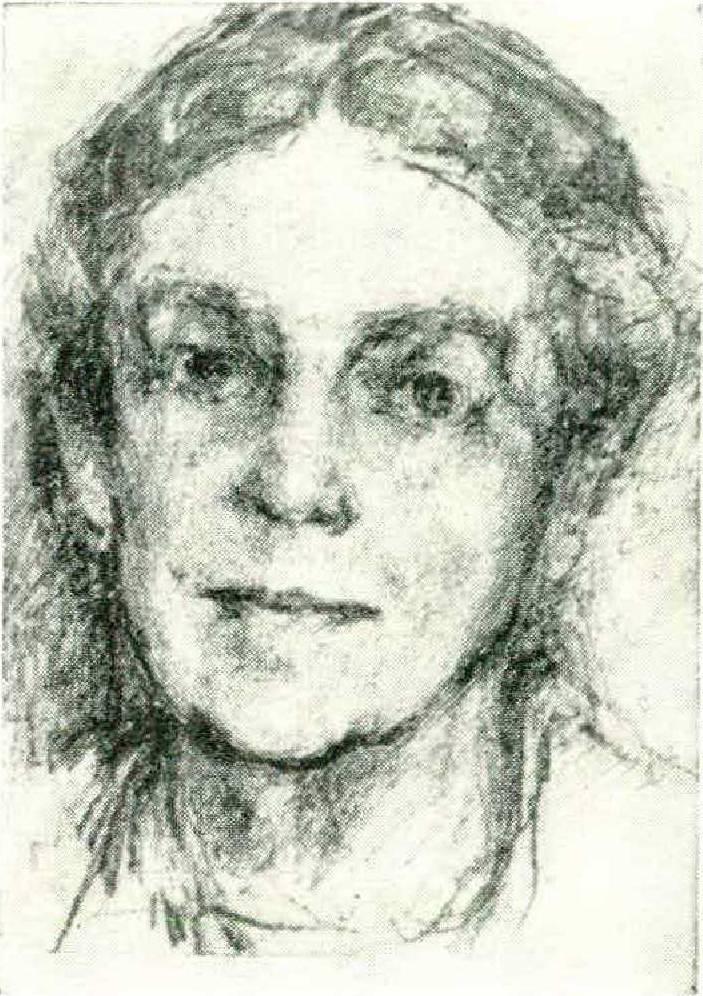
NINETY years gives one a long view of the past, and one is tempted to compare it with the present, either with thankfulness for the advances we have made or with regret for what we have lost. I find that much of the nostalgic literature that comes my way now is written by people who, in my aged eyes, are young, and therefore quite inexperienced. They never lived through and saw with their own eyes what this country was like in the so-called good old days. I am a bit puzzled to know just which period is the one they look back on with admiration and longing, but I think it must be the post-Civil War years, those from 1870 to the end of the century. That was when our Industrial Revolution had reached its height, when laissez faire and free enterprise ruled. We had conquered a continent by peaceful means, and we were proud of it and of the pioneer virtues that had made it possible. It is this period, with its virtues, ideals, and achievements, that the “new conservatives” seem to long to bring back.
But a woman of ninety years has lived through that period, has seen it with her own eyes, has seen not only the front door and the parlor and master bedroom but the cellar and the back yard with the garbage pails. To her the country as it is now seems much better, has shed many injustices, much blindness, ignorance, arrogance, even ruthlessness, Perhaps it is worth while for an old woman, much of whose life was spent among the submerged working class, to tell what life was really like underneath the pleasant, comfortable Victorian surface.
This does not mean that my childhood and youth were spent in surroundings of poverty and distress. On the contrary, Fort Wayne, Indiana, was prosperous and healthy and, so far as we knew, quite free from any social problems. And I went through the University of Michigan with no idea of “how the other half lived.”
So, it was not in a spirit of youthful rebellion against things as they were that I went to Jane Addams’ Hull House in 1896. I had had my curiosity aroused by reading some of the exciting books then appearing, books by Jane Addams, Father Huntington, Richard Ely, Franklin Giddings, Jacob Riis, and others, and I had begun to realize how narrow had been my education, how sheltered my life. I wanted to go into that underworld and see for myself. What I learned came to me from firsthand experience, clear-cut and inescapable.
What first opened my eyes to the helplessness of the working class here in America, when disaster came through no fault of their own, was a startling occurrence in Chicago. It had the same effect on two young men then living in a social settlement in the great Polish quarter of the city, Raymond Robins and William Hard. This was it. A group of workmen were sent out in a tug to one of Chicago’s pumping stations in Lake Michigan and left there while the tug returned to shore. A fire broke out on the tiny island and could not be controlled. The men had the choice of burning to death or drowning. Before rescue came, most of them had drowned. The contracting company volunteered to pay the funeral expenses, and nobody expected it to do more. Widows and orphans had to turn for temporary help to the county agent, then to private charity. It was part of the system of “private enterprise, without government interference.”
The second eye-opener for me in those early days came from a group of Hungarian women, wives of steelworkers in one of the great plants east of Chicago. There had been an accident, and the injured men had been hurried to the company hospital, where they were kept incommunicado. Their wives were told the men were alive and well cared for. How badly they were hurt and whether they would recover, nobody would tell their families. Worst of all, and this had brought the women to Hull House for help, they were not allowed to see their husbands. It took an appeal from Jane Addams to the Austro-Hungarian Embassy in Washington to clear that situation.
Hull House was surrounded by immigrant families, mostly newly arrived. Sweatshops were then an important part of the great clothing industry in Chicago. Often, as I walked down South Halsted Street, I would meet groups of Italian women carrying bundles of men’s and boys’ clothing for finishing in their tenement homes. Even the children could help: the five-year-olds could pull out the basting threads. Of course, they as well as all the factory workers were unorganized; wages were at the will of the employer; hours — well, that was decided by family need and women’s endurance. The men took the lowpaid jobs of the unskilled, and the women took home work.
I SAW much more of the darker side of our highly developed industrial society when in 1910 I began to investigate, first for the state of Illinois, then for the federal government, the industries in which poisonous substances are used or produced — lead, arsenic, mercury, dangerous gases, fumes, dusts. All the other important industrial countries had legal control of such plants, and provision for medical care and cash compensation, but we did not. Unions were in their infancy, and union leaders were too absorbed in the struggle for basic rights to pay any attention to what they and the workers accepted as a necessary part of the job.
My work took me into many parts of the country and into contact with working people in their homes as well as in their work places. I saw many industries, some well safeguarded, some recklessly neglected. For it was a period of unrestricted liberty for the employing class. The worker was as truly under the power of his employer as was the peasant under the power of his overlord in the Middle Ages, with one exception: he could quit his job, but often that meant starvation.
More and more I became impressed by the great contrast between the two classes, by the power of the upper, the employing class, and the weakness of the lower, the working class. “Industrial feudalism” was a phrase coined by a young radical writer in those days (later, I think, he became a good conservative). It seemed to me a fair description of our society. Under our freeenterprise system, the place of the medieval landlord, the nobleman, had been taken by the big industrialist, but the relation between the two classes, upper and lower, was the same.
I had a vivid illustration of this feudal system when I was investigating lead poisoning in storagebattery works. This industry was recognized in England and all European countries as one of the most dangerous of the lead trades. I had visited English plants and had seen how they controlled the chief danger, lead dust in the air, by wetting down every dusty job — “swilling,” they called it.
One American plant, a big important one, which I visited soon after had never even faced the fact that there was danger of lead poisoning, and conditions were as bad as possible. I could make no impression on the management, nor on the state labor office. Then I went on to a plant in a state that had no labor department, no inspectors; the free-enterprise system was undisturbed. But I found a model plant, quite as good as any in England. The owner was not only humane but unusually intelligent. He had discovered that it was the lead dust which caused poisoning, and so he kept everything as wet as he could and warned his workers by printed wall placards to look out for early symptoms of poisoning and go to the doctor.
What was my dismay when I heard that this model plant had been bought by the big company, taken over by men with neither humanity nor intelligence? The workmen were helpless; they had lost their good master; they had been sold down the river.
When, in 1921, Charles Cabot of Boston, a stockholder of U.S. Steel, started a movement to abolish the twelve-hour day and seven-day week in that industry, he was opposed by many stockholders — even some clergymen — who defended the right of the steelworkers “to labor as long as they pleased.” The system was given up in 1922, but not by law; it was at the urging of President Harding that Judge Gary consented to make the change. Of course, we were thankful for this, but we could hardly rejoice that it was in the power of one man to alter so the lives of hundreds of American workmen.
Doubtless many stockholders were conscientious adherents of the theory of free enterprise, but one could not help wondering, freedom for whom? Surely the workers, with no union behind them, supposedly free to make their individual bargain with the employer (U.S. Steel, the stockyards, American Smelting and Refining, and so forth), were as helpless as any peasants of the Middle Ages. There were, of course, some lords of the manor who were just and generous, but the peasant could not seek them out and leave the tyrant for a kind lord.
WHEN our Industrial Revolution had reached its peak, the leaders of big business or manufacturing, of mining and smelting, of oil production and refining, had behind them all the forces of law and order, which meant not only state police but their private police forces, and also the law courts, the injunction judges, even the Supreme Court. How could unorganized workmen, leaderless and scattered, carry on a successful struggle against such a strong, organized force? It was the day of labor spies, of the dreaded black list, hard to escape, for even if a man left home and neighbors and went to a strange town, it followed him; the employers shared their lists of troublemakers.
It is small wonder that sometimes the workers felt that even the government in Washington took a side against them, as it did in the Pullman strike. I found that out when I went into the steel country in my study of carbon monoxide gassing. It was just after the great strike that followed World War I. Up until then I had always, as a representative of the federal Department of Labor, met with a cordial, sometimes an eager reception by labor. This time, after a complete defeat of the union, I met only sullen hostility, because I represented a government which had “ganged up” against them, had taken the side of the employers. Even my search for cases of gassing made no difference. Usually I would visit union headquarters and pick up histories of cases. This time there was no headquarters, at least none that a government employee could find. The men even believed that Washington had sent agents provocateurs into the steel towns to stir up violence so that law and order could intervene. Maybe there was some truth in this. All I know is that a group of White Russian exiles who used to meet at Hull House told us that some of their number were doing work of that kind in Gary. But who paid the wages, they did not know.
During these years of their uncontrolled power, what was the attitude of the employing class? As I met them and discussed with them the many questions of employer-worker relations, I usually found little or no sense of responsibility on their part. An extreme instance of this was provided when a man of breeding with philanthropic interests exclaimed, “Why, that sounds as if you thought that when a man gets lead poisoning in my plant, I should be held responsible.”
Not so common, perhaps, but not rare, was a contempt for the working class, which in those days, especially in the heavy industries, consisted of newly arrived immigrants. I would be told that they were not only ignorant but uncivilized, used to living like animals. Whatever they found over here was far better than what they had had at home. But they were just the sort of men the employers wanted; men who were eager for any kind of job, who never protested against heavy, dangerous work, who were undemanding, submissive. I remember asking a man of the stockyards, where many nationalities were working — Lithuanians, Slovaks, Serbians — which group gave the most trouble. “The Americans,” he said. “We haven’t many of them, luckily, but the few we have start more trouble than all the others.”
The conscientious, humane employers, of course, were there also, and I look back with gratitude to several of them who recognized their responsibilities; but they had no leadership. There was never a concerted effort on the part of the employing class to remedy the evils which industry in foreign lands had recognized and dealt with, in some cases for decades. After we reached the point of working for laws to regulate the poisonous trades, it was often my job to go before state legislative committees to testify about the need for protective laws. Always I would meet the same opponent, the representative of the National Association of Manufacturers.
It is true that a worker injured in an accident (not crippled by industrial disease — that came much later) might sue his employer for damages and might find a lawyer willing to take his case on a gamble, claiming, if successful, one third, oftener one half the damages awarded. But the employer had some strong defenses. There was the “Assumption of Risk” clause. The worker had known the job was dangerous and had deliberately taken it. There was the “Negligence of a FellowWorker,” not of the employer, which had caused the accident. Rarely could it be proved that the employer was responsible. The worker’s freedom to take a dangerous job was assured.
Pennsylvania was the slowest of all the industrial states to recognize occupational sickness and did not pass legislation until 1938, and then limpingly. A foreman in a big factory where lead dust and silica dust were quite uncontrolled told me that his Slovak workmen did not stand this work long. “Four years is about all,” he said. “Then they have to quit, and mostly they go home to Slovakia.” “To die at home?” I asked. “Well, I guess that’s about it,” he answered. And even when Pennsylvania did provide compensation awards, it was on condition that none of the money should be sent out of the country. Widows and orphans should turn to local charity in their Magyar or Slavic countries.
My own profession was also imbued with the ruling-class attitude. Nowadays it is passionately against any move to lessen the freedom of the sick to choose their own doctor. But it never protested against the system which gave the worker in mine, mill, or smelter no voice in the selection of the company doctor, whose salary was paid out of compulsory deductions from the men’s wages. Again and again I met men who so mistrusted the company doctor that they went to an outside man and so paid twice for medical services. That their mistrust was sometimes justified, I am sorry to report, but I do remember an elderly doctor in a huge smelter who was always ready, in the case of a badly injured workman, to testify in court that the cause of the accident was not faulty equipment in the plant but spontaneous heart failure in the worker.
As I look now at our safety-first campaigns, our array of well-trained and high-principled industrial doctors, our overgenerous compensation laws, the work of the industrial insurance companies and of the state labor and health departments, it is hard to believe that all those changes have come just within a few years. But these protective measures were all passed into law by state or federal governments and enforced by the courts. Trade unions were absorbed in the struggle over hours, wages, black lists, and so forth, and their first leader, Samuel Gompers, was as much opposed to any government interference as are modern conservatives. Had the country waited till the unions were strong enough to force reforms, we would have waited many more years, and even then, poor and weak unions would have been left out.
Do THE conservatives really wish to go back forty years, to those days of free enterprise, of individual initiative unhampered by government control? Again one must ask, “Freedom for whom?”
Of course, nobody could deny that the situation now is not only a righting of early evils but the bringing in of new ones. Labor has attained power to a degree that is alarming, and often misuses its power. But it is well to inquire what led to a rebellion which was at first justified, then, like most rebellions, became intoxicated by its new power. It is only fair to look into the conditions that led up to this rebellion.
A widespread revulsion against compulsory union membership has resulted in the passage in a number of states of the so-called Right to Work laws. This attitude is quite understandable on the part of the great majority of Americans who are outside the trade-union world. And yet, equally understandable is the attitude of the workers themselves. They remember what many people of the middle class have forgotten, what more never knew about — the days of the “yellow-dog contract,” when the would-be worker had to sign a promise never to join a union.
Now trade unionists defend their insistence on the opposite; they hold that it is they who, through years of struggle, have raised the lot of the worker from that of a helpless victim of employer greed to his present state of independence and prosperity. They say that the newly employed take advantage of these hard-won gains, but refuse to take their share of the responsibility and the expense. It is as if a group of pioneers in the early days had, after many dangers and hardships, succeeded in establishing a town, safe and prosperous. Then there comes an individualist who insists on living there but refuses to take on any of the duties of a citizen or to pay taxes. I do not cite this as a defense of the unions’ demands, only as an explanation of their firmly held attitude.
And are they completely wrong when they insist that there is a well-concealed system in the employing class which enforces a law of compulsory acceptance of decisions made at the top? I found evidence of this kind, usually not outspoken, but sometimes admitted. The head of a mining company told me during a strike that he had been willing to settle with his men but dared not to. “I simply would have had no credit when I needed it if I had deserted the ranks.”
Of course, what labor does is inescapably out in the open, often disastrous to the community, crude and unsightly, but in essence it is not so different from the well-concealed and outwardly well-mannered conduct of the employing class.
Limitation of output, some forms of featherbedding are among the practices employed by the unions which are widely criticized. But what led up to such practices? In the old days, the rate of output was based on the work of the most capable, the pace-setter, and fixed by the foreman. I saw a clear picture of what this sometimes meant. It was in the men’s clothing industry, before the bigstrike led by Sidney Hillman. A young Italian girl, Filomena, had come to Chicago to get a job and earn enough to pay for the passage of her family from Southern Italy. It seemed incredible that a peasant father would send his young daughter on such a perilous mission, but this was not the only instance I knew. When I met Filomena, she was working and making good wages, sewing buttonholes on the coats of dress suits. She was established as the pace-setter for her group. At that time, the big houses used to let out parts of the work to subcontractors, and she was working for one of them.
One day the foreman asked her, “How many needles do you thread a day, Filomena?”
She answered, “About three hundred.”
“Why don’t you take needles and thread home with you and thread them in the evening? You’d make big pay that way.”
Filomena did, and the foreman let all the girls know what a big pay envelope she had at the end of the week. The other girls began to copy her. and when almost all were threading their needles in their free time, the foreman cut their wages back to the old rate. When the strike broke the next year, Filomena, the pace-setter, joined it.
That picketing in strikes has reached unbearable proportions today, nobody would deny. But what led up to it? And did the earlier situation meet with anything like the protest that the present one does? I used to go on the picket line now and then, and I remember one day, during the famous clothing strike of 1915, when I approached a picket line outside a big factory. Suddenly I saw a group of pickets, men undersized and shabbily dressed, running before men armed with clubs, the strong-armed guards of the factory, who overtook them and beat them as they ran. A group of Chicago policemen looked on impassively. I had just come back from German-occupied Belgium, and I had seen nothing there as brutal as this, in my own country.
Another time, it was a strike of a restaurant waitresses’ union. A young Irish girl, gentle and well bred, had joined the union on my advice, so I felt responsible for her. She was striking against her job, which required a work week of six nights of twelve hours each, then quite legal. I went to see what was happening on the line and was just in time to see her hustled into a patrol wagon by a brutal, cursing policeman, to be jailed for disorderly conduct.
We heard Mother Jones tell of her experiences during a coal miner’s strike in West Virginia. She had had to approach the picket line by wading along the bed of a brook, because all the land belonged to the mine owners and was patrolled by the private police. That was the period when the great coal companies had their own police crew in Pennsylvania, where they already had a state police force. One of their representatives, speaking before a congressional committee, declared that it was absolutely necessary to keep arms and guards; they all did.
It is part of the program that the new conservatives offer us to abandon the idea that the government has any responsibility for the suffering caused by a national depression, by unemployment, incapacitation, or death of the head of the family, or by low wages. Private charity used to deal with all such emergencies, and it should do so now. I think that those who hold such views must have been young during our great depression. I was in my sixties and saw it from the world of the working class.
Many pictures come to mind as I think back over those days: pictures of men on foot on the road between New London and Lyme, men who had left their families because the presence of an able-bodied man in the household made it impossible for the family to get relief from the charities. I think of the crowds in New York streets waiting their turn at the soup kitchens; the apple vendors crouched along the curbs; I see the Hoovervilles which sprang up on the outskirts of the big cities. Private charity in the cities simply broke down under the load, and in the small towns it was even worse.
One of the most poignant experiences I had during the depression was in Lawrence, Massachusetts, that single-industry, textile town. There, one evening, I faced a crowd of men and women who had been on strike for weeks, a strike called at the worst possible time. What little money they had had for strike benefits was used up; they had no hope of a settlement with the employers, for the industry had passed under the control of a group of New York bankers so remote that a distraught mayor could get no answer to a plea he wrote them for the terms which they would accept.
As I looked at them, I wondered what I could say. Where was there any help for them, any hope? Private charity already had more calls than it could cope with, and generous individuals, except for a few radicals, were unwilling to “meddle in an industrial dispute.” They could not get help from their national union, for there was none; there were only small, scattered groups such as theirs. As for help from bigger unions, in the form of sympathetic strikes, that came much later.
When, nowadays, I read denunciation of union arrogance, of unreasonable demands made with threats of violence and blackmail, that picture of Lawrence rises before me, and I wonder which system, that of forty years ago or that of today, causes the greater amount of human misery.