Pamela, Paula, and Chung
H. F. ELLIS is widely known for his light prose and is a frequent contributor to the pages of the ATLANTIC.
I don’t know what other people’s banks do, but mine sends me a typed monthly statement, with a column headed “Particulars,” in which appear the names of those to whom I am believed to have paid money (plus an occasional “CHQ,” meaning that somebody has paid me), two further columns of figures headed “Dr.” and “Cr.” respectively, and finally a “Balance” column in one color or another. It seems to me a friendly, well-thought-out service, and I am grateful for it. Efficient, too, up to a point. Every so often I compare the bank’s statements with the entries in my own tattered little account book, and I have never yet caught them out in an error. Their figures, the real meat and bones of the business, are beyond cavil. It is the names of the people to whom they think I pay money that surprise me.
My handwriting has a good deal of character. It is not a laboriously acquired Italian script, nor one of those miserable noncursive letterby-letter affairs taught in schools. It flows, takes permissible short cuts, admits a loop now and then where a more hackneyed hand would be content with a straight up-and-downer. It conveys, I think it would be fair to say, the general sense of a word or name without getting bogged down in detail.
So it is really quite understandable that my bank should for years have read Davies as Dennis, Bell as Bule, and Lang as Lavy. My doctor, to whom I pay ludicrously small sums from time to time, has appeared in various monthly statements as Wills, Miller, Willis, Buller, and once, rather confusingly, Ellis. None of these is his real name, but I made allowances. Sooner or later the bank would hit it, and in the meantime I knew what they were trying to say. Martin into Maith was reasonable, in a dim light, and even when the well-known London insurance brokers, Sedgwick Collins, were metamorphosed into Selquires College (£11 14s. 6d.), I was prepared, on scrutinizing the canceled check, to admit the possibility of genuine error. Many men would have complained, but to tell the truth I was a little proud of having indirectly invented so likely a college as Selquires, and I made a note to myself to write a short mystery story one day involving the death of its principal.
I had not, at that time, begun to feel uneasy. So long as I was able to identify, by comparison of dates and amounts, the real payees with my bank’s attempt to render their names, no great harm appeared to be done. Then, about a year ago, I was stopped in my tracks by the reputed payment of £13 5s. 8d. to a man with the extraordinary name of Toores. I don’t know why I should have resented this particularly, but I did; and when it became clear that this Toores was in fact Davies, hitherto regularly known to my bank as Dennis, I began to realize that there was more behind this business than inability to decipher an educated hand. The bank had ceased to care. There was no individual or institution so bizarre, or so palpably fictional, that my bank would not deem me capable of paying money to him or it. This suspicion became a certainty when, in my next monthly statement, an entry against Brodrick turned out in fact to refer to the Rugby Football Union. I have the corresponding check in front of me now, and there is no light so dim, no angle at which one can hold it, no pair of pebble spectacles prescribed for somebody else — in short, only utter indifference or active malevolence could possibly turn the words Rugby Football Union into Brodrick.
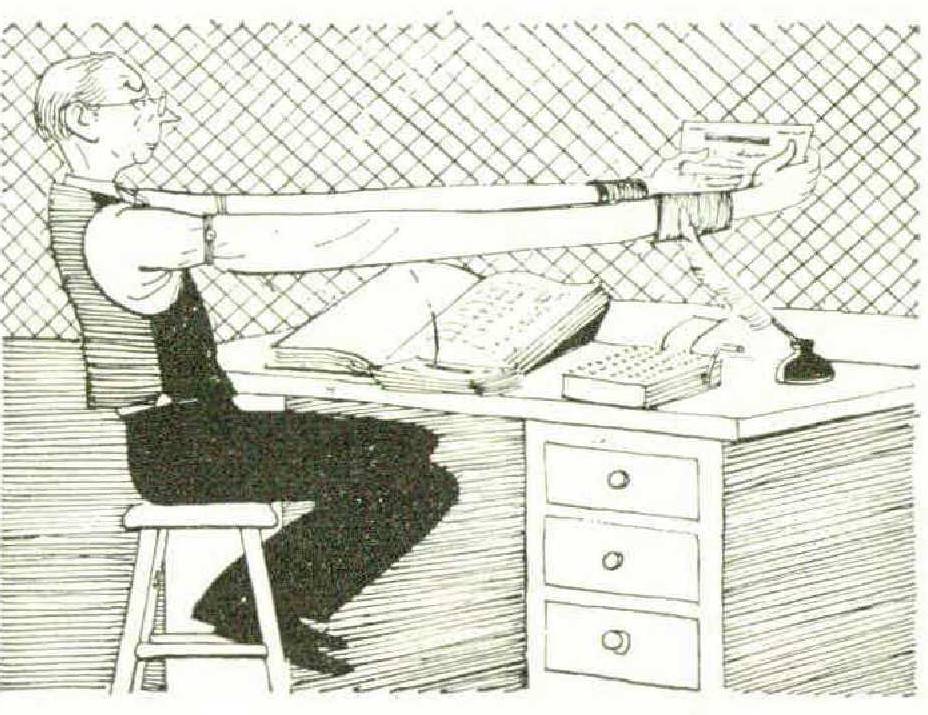
I see now that I should have called a halt at Brodrick. A man’s whole life and character are reflected in the persons with whom he has financial dealings, and I ought to have realized that unless the process were checked, I might soon become an utterly different personality in the eyes of my bank — and even, so insidious is the power of suggestion, in my own. That, at any rate, is how it has turned out. Things have reached such a pitch in the last few months that I am beginning to live in the dream world my bank has built up for me.
Take the case of Pamela, Paula, and Chung. Of course, I know well enough, when I am actually checking the statements against my own accounts, that the sums said to have been paid to Pamela and Paula were in fact paid to a humorous weekly which is good enough from time to time to cash checks for me. I can equate Chung, by a process of elimination, with the settlement (in my clearest hand) of a bill for sherry from Magdalen College J.C.R. But I cannot so easily get these three characters out of my mind. And even if I could, what does the bank think I am up to?
Paula, to whom I paid £10 in April of last year, is tall and dark. She might, of course, be a hat shop, for it is normally only with institutions of that kind that one is on first-name terms on checks. But, then, where is the hat? My wife certainly hasn’t got it. And why, if I am in the habit of buying expensive hats from Paula, should I suddenly switch to Pamela’s establishment in July — and spend a mere three pounds there, at that? I do not believe that they are hat shops, and I don’t believe my bank thinks so either.
Pamela is fair and, on the evidence, less grasping. But I don’t want to be saddled with either of them.
Chung is a deeper mystery. If it is conceivable that my bank honestly misread College as Chung, what becomes of the rest of the payee’s style? Did they conclude that Magdalen was in fact Mandarin, and J.C.R. not, as it is usually interpreted in this country, Junior Common Room, but some littleknown decoration given for political services in China? Do they seriously believe I am the kind of man who, on the twelfth of June, 1960, would pay £4 3s. 3d. to Mandarin Chung, J.C.R.?
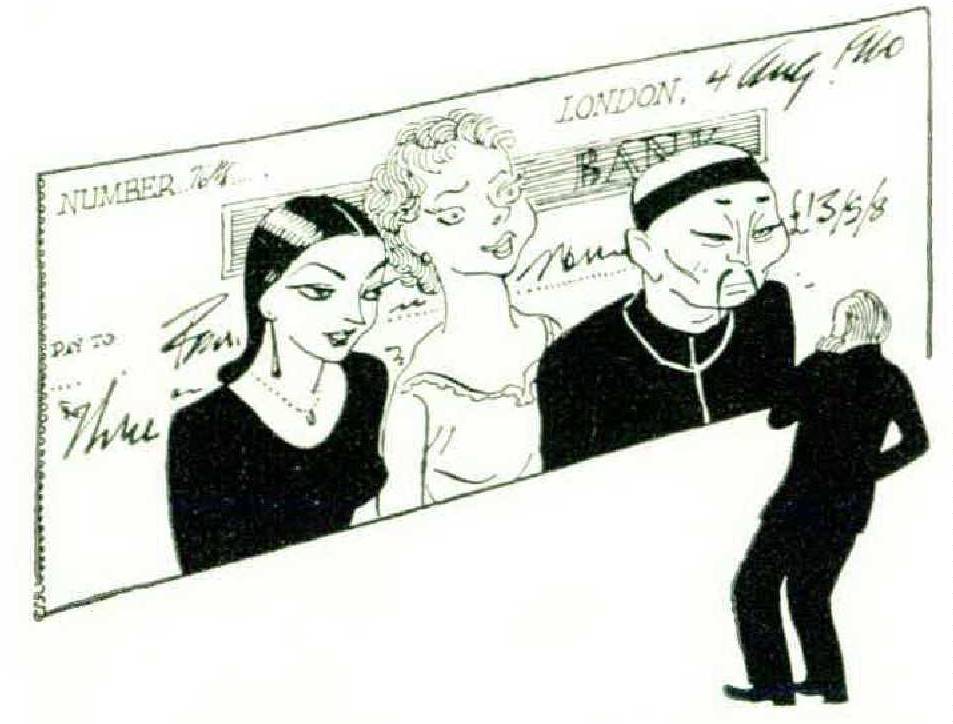
I would not put it past them. Their idea, I suppose, if they take the trouble to follow my financial dealings at all closely, is that I am being blackmailed. It was Paula who must have led me astray in the first place and finally induced me to visit Chung’s notorious opium den down Limehouse way. How I got into Paula’s clutches is anybody’s guess, but my bank would, I think, attribute the beginnings of my downfall to that correspondence course I took at Selquires. Probably the principal advised that what my writing needed was more meat, background: I ought to get out and about more and mix with characters on the seamy side. Or Toores may have acted as an intermediary. There are days when I begin to think that he and Brodrick and I were up at Selquires together in 1926.
At any rate, once Paula had got me to Chung’s, she started threatening me with exposure to my family, and like a fool, I gave way. That was only the beginning of my troubles. Chung would be the center of a spy ring, very likely, and under the influence of the baleful drug, I must have talked. Goodness knows what I said. I know no military secrets of any consequence, but my bank wouldn’t be aware of that. Nor would Chung. Anyway, as everybody knows, once you have talked to a spy, you are doomed. You get in deeper and deeper. “You bling me plans of seclet submaline,” the inscrutable mandarin must have said, gently caressing a priceless Tang bowl, “or I tell polees.” Well, naturally, I begged and implored him for mercy. I told him I had no access to the Admiralty’s secret files. I even tried to bribe him with a gift of 325,000 People’s Community Dollars (or £4 3s. 3d. in our money). And much good it did me. Pamela, who fills the pipes, makes tea, and tidies up generally at Chung’s place, overheard the conversation and decided to do a little blackmailing on her own account. “Three quid down,” she whispered in her vulgar way, “or else — !” So there I am, in the clutches of all three of them.
What is really frightening is that these thugs are so sure of themselves they are willing to take checks.
It is curious how infectious the idea of blackmail can be. The thought has crossed my mind that, by attributing these extraordinary payments to me and entering them in my monthly statements, where they may easily be seen by my fainily, my bank is guilty ol a grave libel. How would it be if I threatened to sue them for defamation unless they made me regular payments of, shall we say, £17 3s. 3d.? Banks will do a good deal to avoid appearing in court. Besides, it gives me pleasure to wonder what explanation they are going to give their auditors when, in their own monthly statements, appear these mysterious payments to Elsie, Elise, and perhaps even Li-poo.