Dog Days
NEWTON F. TOLMAN,with his wife, Janet, lives on a thousand-acre farm in New Hampshire, where he fishes and hunts, trains bird dogs, and communicates, when necessary, with the hermits and hedgehogs. His humorous account of life in the country, NORTH OF MONADNOCK, will be published next month by Atlantic-Little, Brown.
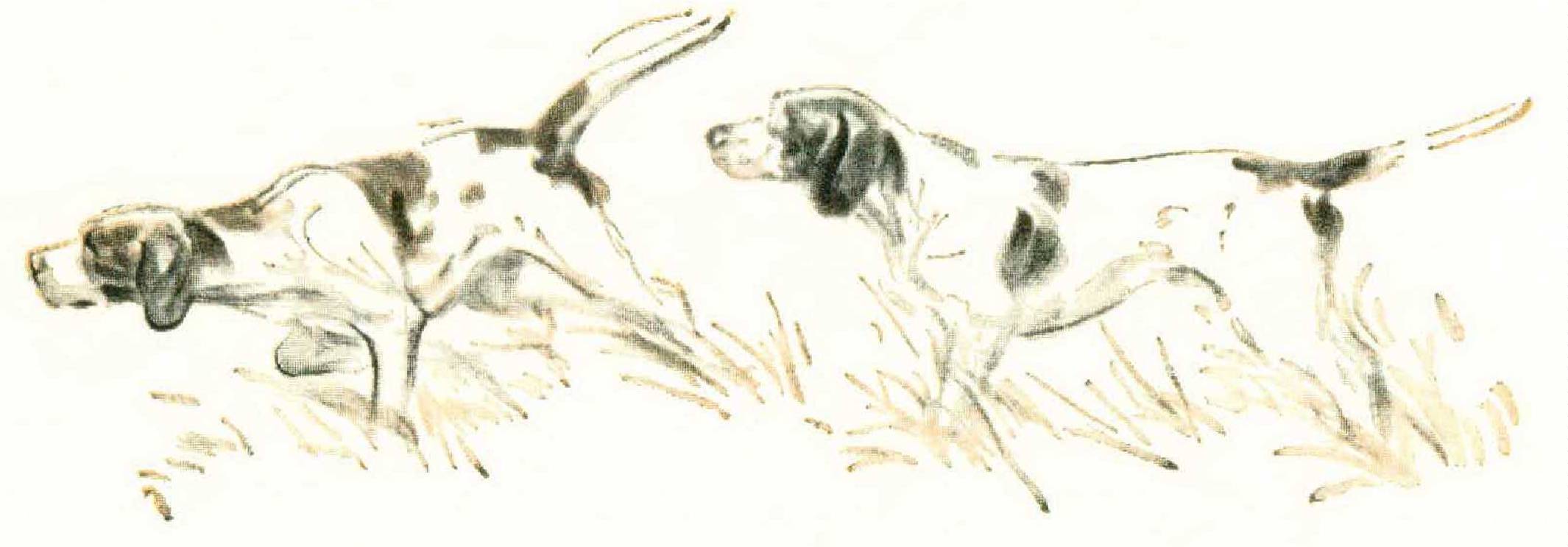
THERE are those who hold that in the heat of summer bird dogs are better left in the kennel. What sane person would not prefer the cool shade of the side lawn to the green hell of a brambly, insect-ridden bird cover? Better for dog and man to wait for cooler weather.
We disagree with this theory. In fact, like most bird-dog people, we disagree with all other birddog people. Havilah Babcock, master storyteller of the southern quail country, writes about a surefire trick to make the hardest-jawed young dog give up a retrieved bird. Blowing in the dog’s ear is the great secret — but we at once take exception. How about that jack dog from Vermont? Why, you could blow at him till you were black in the face; he would just shut his eyes and clamp down harder.
Take the common opinion that pointers are hardheaded, while setters are gentle. With our dogs, it is the other way around. Our big pointers come from a line that’s just about the most sensitive in the world. We hardly dare raise our voices during their whole education. But our little white setters? Wild and fearless. The toughest, most intractable, stubborn, unmanageable, and belligerent of bird dogs. Once I was bitten by three of them at the same time. While I knew they were trying to bite each other, not me, their mistake did not make their fangs feel any less businesslike. After making sure her sweet dogs were not injured, my wife finally turned her attention to me and decided that all I needed was an antitetanus shot. When I went into the clinic and the girl at the desk said, “Sit right down here,” I remarked, “Thank you very much, but I guess you don’t know where I’ve been bitten.”
We used to think summer training was a pretty tough job — thrashing around in briars and swampy jungles with a wild dog on the end of a long rope, sweltering and getting eaten alive by flies and mosquitoes, day after day, while everybody else was swimming or sailing or loafing around the tennis court. But as years passed, working the dogs became a sport in itself, looked forward to with something of the enthusiasm we used to feel only for shooting. As for the dogs, they get almost as excited when we shoot the blank pistol as they do with the real thing.
We learned not to train dogs that were too old and hardheaded, the kind that would be sure to jerk you flat on your face in every thornbush and run away for an hour if you lost hold of the rope. We learned it doesn’t pay to work dogs that have not first been taught to obey — above all, to come in to a whistle. And we got to know all the places where grouse or woodcock could be found quickly, within easy distance of the car, so the dogs could be taught to point with a minimum of effort.
The most pleasant aspect of summer training is that there are always people who are glad to come along for the ride. Bird watchers can have a fine time; also mushroom fanciers and orchid hunters — anybody, in fact, who likes to roam the woods in summer. Provided they like dogs.
My favorite companion is a neighbor of recent years who always says, “If you ever put me in one of your stories, just call me the Poet.” The anonymous poet must have done a good deal of shooting in his younger days. You can tell by the way he moves through thick cover, watching the dog work. Now he comes up to his big house in the village only in summer, but he is always ready to explore the old covers or to prospect for new ones. And whenever I see him, he pulls out a crumpled bit of paper and stuffs it in my pocket.
The paper will be a copy of his latest poem. I have quite a collection, but they don’t take up much space. The Poet plans to publish his entire output sometime in a two-page book. Sample of one of his longer efforts:
WRITING VERSE
Is a myth.
I get four lines
From a fifth.
On days when my wife is busy at home and I start out alone, I drive past the Poet’s house, and if his car is there, I stop. There is a broad lawn with two beach chairs under an apple tree. I sit down and wait, watching some half-tame pheasants, two or three cats, a beagle, a sleek whippet, and an ancient springer.
Presently the Poet appears. He is a small man, and his usual summer costume consists of rubber boots, baggy knickerbockers, a heavy flannel shirt, and felt hat. But if it is very hot, he wears nothing at all except shorts and a straw cap.
Without a word he trots down the stairs of the open cellar bulkhead, coming back with two cold beers. He hands one to me, sits down, and then is ready for conversation.
One bright August morning the Poet and I were heading for a cover some distance to the north. Much of the way we could follow old abandoned roads, narrow and grass-grown, putting the jeep in low low to get over ledgy places. Now and then the Poet would ask me to stop while he fixed his binocs on some rare warbler. It always turned out to be just another myrtle or chestnut, but we saw some interesting hawks. And the Poet told me again about his setter bitch, Belle Whitestone, and some field trial back in the twenties.
At the cover — a vast hillside solidly grown into poplar whips and other brush, with a rocky little river along the bottom edge — we drove across a rickety wooden bridge and ran the jeep into a thicket. We let the dogs out for a drink and a good soaking. We had Buck, a very large thirteen-month-old pointer, and our little white female setter, Track. An oddly matched pair, but as it has since turned out, a rare combination of dog talent.
We worked Buck first. It was plain the Poet didn’t expect much of him, because Buck looks like a show dog. But after several long, solidly held points, one after another, on some young partridge with no birds flushing wild — Buck keeping one eye on me the whole while for directions — the Poet was impressed.
“Here, take the pistol yourself,” I said, knowing he always carried a whistle. “I’ll keep back, and you try handling him. Just point your finger where you want him to work.” By the time we had circled back to the car, the Poet was ecstatic.
All the way home he talked about Buck’s performance. Some weeks later I happened to see the Poet in the village store, and as usual he shoved a piece of paper into my pocket. When I got home I took it out and read:
DOG DAY
And a gun,
Hunting birds,
Having fun.
In summer, dogs need to drink and dunk themselves very often. Every cover should be close to a beaver pond, stream, or at least a spring hole. It is also thirsty business for the handlers, and to maintain morale we appreciate something more invigorating than spring water. To this end, the Poet’s well-stocked cellar is but one of many such ports of call. Our training covers for miles around have been carefully selected for their refreshment potential as well as for their bird population.
In fact, Cousin Buzz, who often goes along with us, says that, whereas in the fall we move about a lot so that we won’t shoot out our covers, in summer we move about so we won’t drink them out.
But Buzz thought he was in for a pretty dry run one afternoon when we set off with the dogs and drove to a cover about thirty miles back of nowhere. My wife and I had agreed not to tell him that a small cottage beside the cover happened to be the weekend retreat of an old friend.
After a long, hot session in the underbrush, we finally emerged with our tongues hanging out almost as far as the dogs’. And when Buzz saw that tray loaded with tall iced glasses topped with mint, he was sure it must be a mirage, if not a miracle.
To THE public at large, the bird-dog world is thoroughly confused. Distinctions are never clear between show dogs, field-trial dogs, and gun dogs. Breeders, owners, handlers, and trainers only add to the confusion.
Show-dog people assert that their dogs make the best hunters. The rest of us maintain that show dogs are bred entirely for appearance and a disposition solely adapted to their standing still endlessly, doing absolutely nothing, and being stared at.
The field-trial crowd, on the other hand, care little for appearance. They drive all over the country with truckloads of dogs, and most of them look as though they had never had a bath or a hair combing in their lives. (You can take this to apply equally to the dogs and their handlers, though certain owners affect natty gelups of high boots, riding pants, and wide sombreros.) The dogs are trained to take off like whippets and race madly to the ends of the course. There the handlers shoot off their pistols, pretending their dogs have pointed while the judges were looking the other way.
Like the show people, field-trial people also maintain that their dogs make the best gun dogs. And so they might, if the buyer intended to use them gunning for gazelles instead of grouse.
As for the dogs themselves, most of them are more confused than any person about all this. And as we train only for shooting, we have learned to have nothing to do with dogs which have had any previous training. We prefer to start from scratch, with a dog well under a year old, from whatever lineage, so long as the pup shows brains and ability. Then, by the beginning of its first hunting season, the pup should have a pretty good idea of what is expected. But this is only because we have been out working every day through the spring and summer.
This first-year pup has been working in thick covers, too, not out on the lawn with a bunch of feathers tied to a fishing pole. And for those who may be interested, a well-educated gun dog at two years of age is worth today, at the very least, upward of three thousand dollars. With rare exceptions, however, this class of dog just isn’t bought and sold on the open market. There are not enough of them.
Even the most eminent of writers go off the deep end when they get inspired by their pets. Louis Bromfield’s book about his boxers, for example, seems to me a work that only the dogs themselves would have really enjoyed; and despite the author’s sentimental estimates of their intelligence, I don’t think they knew how to read.
T. S. Eliot’s effort about cats sounds like something written by a precocious seven-year-old who had been experimenting with the contents of papa’s liquor closet. And there are several other conspicuous examples, even in our own modest library. All of them, it may be noted, were published only after the writers had become so famous they could call their own shots.
With this warning in mind, I have said little about our own house dog, old Sandy; but one incident comes to mind which may not greatly strain the patience of those who are not ardent pet-dog lovers.
A golden retriever is never happy unless carrying something. Long ago we got into the habit of letting Sandy carry a flashlight, held like a cigar with the lighted end pointing straight ahead. It is not only a useful trick at times, such as when we are bringing in firewood at night; it also makes a good gag when visitors arrive after dark — Sandy rushing out to meet them with his flash, his great plume tail wagging happily, and lighting their way to the door.
One August afternoon my wife set off for her usual swim at the lake, down the trail from the house, with Sandy and a couple of the kennel dogs. When she was ready to start home, at six o’clock, Sandy was absorbed in trying to dig his way into a muskrat burrow. He was having such a good time she didn’t call him along with the other dogs, thinking he would follow her up the familiar trail when he tired of his digging.
That evening we were giving our Big Party of the season, and I was too busy to notice that Sandy was not around. At about midnight some of the guests who had to leave early started looking for Janet, but she was not to be found. An hour or so later she finally came back into the house, accompanied by Sandy with his flashlight.
Janet had begun to worry when Sandy had not appeared all evening. So she sneaked off and clambered all the way down the steep, ledgy halfmile trail to the lake. And there she found Sandy, lying forlornly where she had left him. Darkness must have come on while he was busy with his muskrat hole. It was a pitch-black night, and he just had not dared to make his way home without his flashlight.
As we grow older, there may be summers when, because of too much other work, we will take no young pups to train. For our own shooting, we always seem to have more trained dogs around than we need. But when warm weather comes, we will be back roaming the covers, because, even for an old dog or an old hunter, from autumn to autumn is too long a time to wait.
I found a scrap of paper in my pocket just the other day:
AUGUST UPLANDS
For hunters, dogs, and secret lovers.