The Devil Child
KONSTANTINOV LARDAS was born in Ohio, received his B.A. from the University of Pittsburgh, his M.A. from columbia, and is now studying for his Ph.D. in comparative literature at the University of Michigan. Mr. Lardas parents came from Icaria, one of the Aegean Islands, and the setting of the story which follows.
BY KONSTANTINOS LARDAS
THE children of the village, each one related somehow to the other, crouched close together in the back room of the house. The shutters were tight, keeping out the moonlight and the cool night breezes, which were bad for children, which stunted their growth and sometimes drove them mad. Through their patched clothes they felt the cool contact of the earth-packed floor. Its dampness chilled their buttocks, crept along their thighs, and cut into their backs. Only their faces and their chests were warmed by the thin fire burning in the corner. Their eyes reflected flames.
Everyone had entered this ghostly silent house from the back door. The mothers and fathers had gone on past the kitchen and the bedroom into the front room to see Stamatoula, the oldest woman of their village, the spinster matriarch of their island.
They were alone in the back room. They were locked from the front part of the house and from their parents. They did not speak. Some of the children rubbed their palms over the floor, feeling its firmness, feeling the cold strength of the countless years of trampling which had polished it so that it shone like glass. The youngest children sat on their hands, keeping the dampness from their thighs. None stood. None moved. They were quiet. They listened reverently to the strange sounds which came from the front room; the wild cries of Stamatoula’s sister, Philio, and the voices of their mothers comforting the frenzied woman.
Philio was old, too, so old that no one knew her age. She was one of those born in the dark days, in the terrible days of the Turks. She had been born into the prehistory of the island. From the beginning of time, everyone remembered her. The sisters had been in the village before anyone else. They had outlived the oldest people, and now Stamatoula was dead.
The children sat silent, afraid to talk or move in the dark house, feeling the presence, but not seeing the cold dead woman. Their eyes flitted about the room from the woodpile in the corner to the meathooks next to the door, to the water pump, and to each other, comforting each other in the silence with their stares.
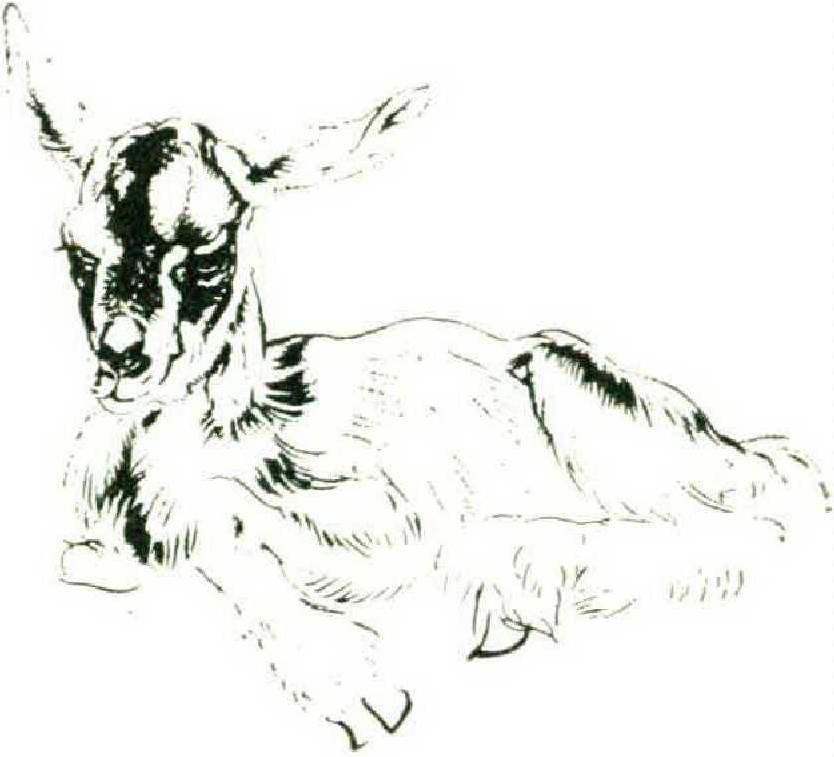
The kitchen door swung open. Yanni walked in, quietly, as the rest had done. He held his pet goat tightly coddled in his arms. His eyes sparkled, not of the thin corner flames, but of an inner fire; unafraid of the silence, unafraid even of the broken silence, of Philio’s shrieks, or of parental lamentations. The children pushed close to Yanni, their tall, gaunt leader. They touched him on the knees, and he, like a great wheatfield bending to the wind, bent down to them. They fondled his young goat. They smoothed the coarse black fur, held out the white-tipped ears, and felt the growing horns admiringly.
Yanni sat cross-legged on the floor, surrounded by his friends, the black goat in his lap. He smiled at them. Then, striking at the air, he shook his head. “Why are you quiet? Are you still frightened of that beast? She’s dead. She’ll never bother us again.”
Yanni laughed; laughter of wild winds blowing. “Dead. Dead. She’s dead.”
All of his friends and cousins looked at him and smiled and nodded. “Yes. Yes. She’s dead.”
“Remember how she chased us from her trees and told our mothers when we stole her pomegranates, her lemons? Remember how she chased me when I passed this house? She cursed my mother once. Me, many times. But she’ll not bother me again,” Yanni said. “And our mothers won’t come to see her any more. Won’t come to tell her stories. Won’t bring her food. She cursed us all. Mother told me, ‘Take care. Be kind.’ But she was an old old woman and a beast.”
The children looked at Yanni. They spoke in agreement. “She always wanted something from us. Now she won’t bother us again.”
From the depths of the house, Philio cried out, “Sister, Sister Stamatoula, who will love me now that you are gone?” Philio sang the deep, longsounding chant. “Sister, Sister, who will love me now?”
The children were silent at these cries. They looked again to Yanni. Yanni held the goal tighter in his lap. He was not afraid. He was not afraid of Stamatoula. “She was too mean. God must have killed her. Our mothers said that she was old and wise, but we knew better, didn’t we?”
“Yes, she was bad,” his friends replied.
“Last week, my kittens slept in the oven in her yard. She killed them. Burned them. She said she didn’t know. She wanted to bake bread. She hated me. My kittens. All of us. God killed her so she wouldn’t bother us again.”
Yanni stroked his goal. He ran his hand along the neck, across the bony back. He felt its blood pounding, felt its warmth. Not warmth of fire: of life. It spread from his caressing hands to his whole being, warming his lap, rising into his stomach, to his chest, his heart. He turned and smiled at the curly-haired girl whose shoulder fleetingly touched his.
Silent, Tears shone in her eyes. Black lashes glistened in the fire, but she held back her tears. Protruding lips tightened to a smile. Her smile infected Yanni. He hummed, breaking the spell that held them both.
The tune that Yanni hummed was a familiar one. Yanni had made it up. Little by little his friends had learned it long ago. They joined him in the humming. They clapped their palms together, gently, to the rhythm of the tune.
Philio’s voice came to them again, but they did not hear her cries of “Sister, Sister Stamatoula, you are gone.”
Yanni sang the words of his song. At first they were hardly heard above the humming of his friends. He sang louder:
The lemon trees are broken,
Picked clean by all the birds.
Stunned by the orchard token,
Stripped naked by the birds.
Yanni sang in his craggy voice. He sang his song over and over again. The children clapped to the quick tune. Yanni jumped from the floor. He twirled, on cat feet, all about the room. He danced. Stamping his feet in quick, staccato steps, he paused; then leaped over the head of the seated, curly-haired girl whose eyes had smiled on his. The children clapped approval. They clapped their hands harder. They sang the words of Yanni’s song as Yanni danced more wildly.
The lemon trees are broken,
Picked clean by all the birds.
Stunned by the orchard token,
Stripped naked by the birds.
And fear the words they’ve spoken;
Or else fear all the birds.
Yanni’s body swayed dizzily in the circle of his friends. His feet danced nimbly to the song. They seemed not to belong to Yanni. First, hands on hips and elbows outward, then arms flying in the air, he spun around the room. His head tossed back, face staring at the cobwebbed ceiling, then down again, meeting the eyes of all the children. His body glowed in the heat of the dance, in the frenzy of the flying steps. His arms and legs whirled faster, faster. His body was a vibrant, whirling wind. His friends waited to see him drop exhausted to the floor.
“Look. Look,” Philio shouted from the kitchen door. Yanni stopped, arms dangling at his sides. “Look. The teacher and his school. He comes to dance. He stops. Like a dead bird he folds his wings.”
He stopped there, clipped-winged, in the midst of all his friends. His eyes met the old woman’s. Philio waved her arms above her head in a sudden, frantic motion as if ready to finish the dance which Yanni had begun. She flung her arms up, clutching at the air. Exhausted, she leaned against the door and sighed, “Oh, Sister, Stamatoula. Still he mocks us.”
She could not outstare his glance. The flashing brightness of his eyes tormented her. Philio rushed into the room and swung at Yanni, the obsessed.
Yanni sprang past her. He ran out into the cool night. His friends sat in semicircle, hands open in prayer, in uncompleted clapping.
“Out. Out,” she screamed. “Get out. You boy. You shameless one. You evil thing. You devil.”