The Vanishing Salmon
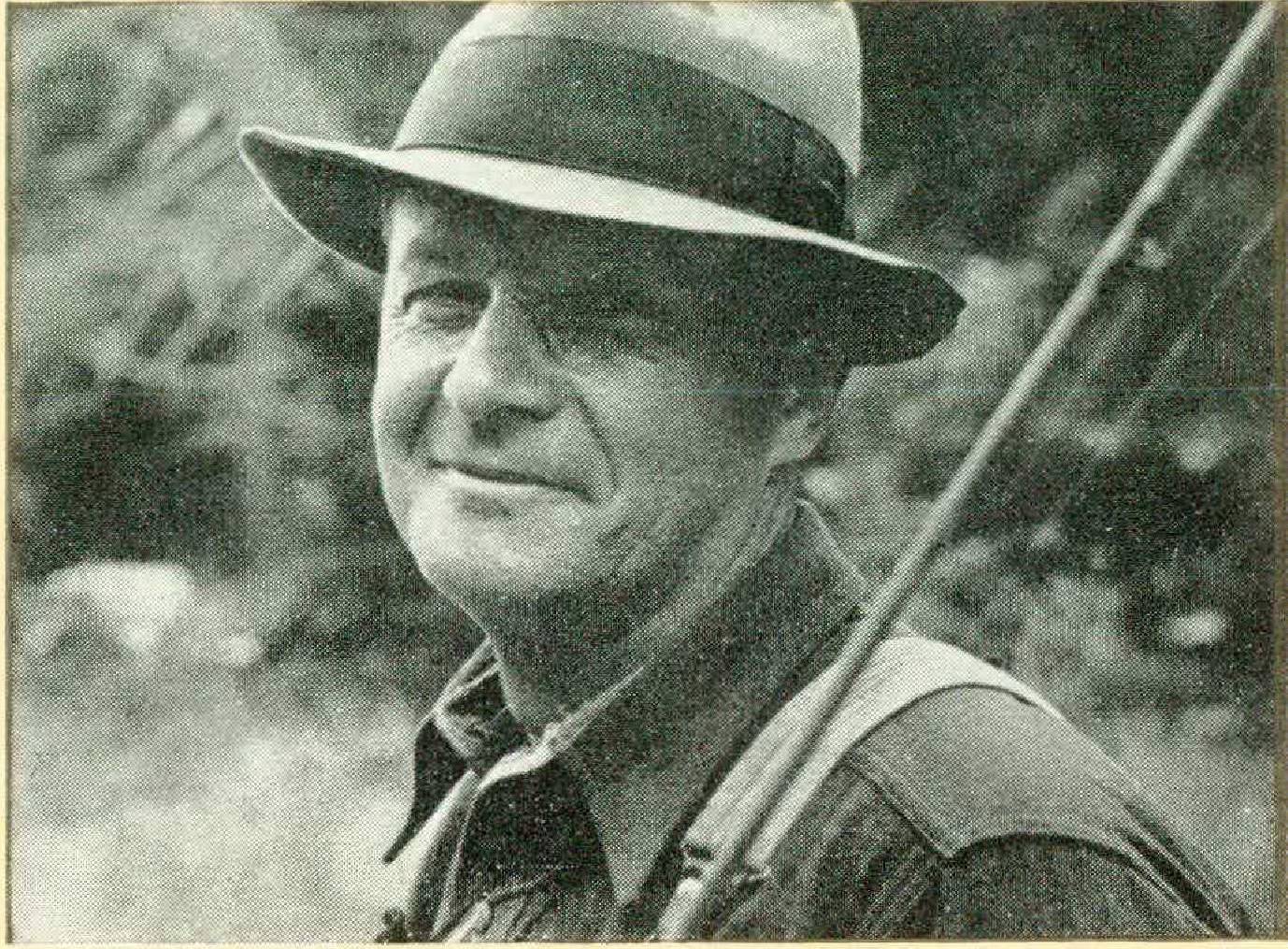
Sportsman, author, and conservationist, CLARK C. VAN FLEETis a native Californian who for five decades has roamed the forests and fished the streams of the West Coast. Some of his experiences he described in his book STEELHEAD TO A FLY,and throughout his career he has kept a constant, watchful eye on our natural resources.
BY CLARK C. VAN FLEET
THE Latin generic name attached to the five species of Pacific salmon found on the Pacific Coast of our nation is Oncorhynchus. In common terms the salmon are named as follows: 1) the king, tyee, Chinook, or spring salmon, depending on what part of this country you are from; 2) the silver or coho, the first in the United States, the second in Canada; 3) the humpbacked salmon; 4) the sockeye salmon; 5) the dog salmon, so-called because it is the staple diet Eskimos freeze to feed to their dogs.
Each is a little different in feeding habits, span of life, and spawning grounds, but all have something in common. All except the dog salmon are anadromous fish (maturing in the ocean but returning to their natal streams of fresh water to spawn), delicious to eat and great sport to catch, and each species dies immediately or soon after its only reproductive effort. The salmon complete their life cycle in this last dramatic effort, which often takes them hundreds of miles into the interior, and then their carcasses lodge in the shallows and sink in the eddies and holes to provide food for the next generation.
Our salmon are exceedingly fat and strong when the homing urge strikes them and they enter the rivers. Once in fresh water, they seldom if ever feed. By the time they have reached the spawning beds, their stomachs have atrophied and, empty of food, no gases form, so that they remain on the bottom as their bodies disintegrate. Practically speaking, they melt away with the active assistance of copepods, animalcules, various larval insects, crawfish, trout, and other predator fish. I well remember my first sight of a stranded carcass in a deep eddy in the McCloud River in California. I was probably twelve years old. A phalanx of trout two pounds and less jostled each other in the current below. The thick, leathery skin of the salmon still held the body together, but the flesh was slowly melting away. Occasionally a big trout would leave his place in the line and, at speed, strike the side of the carcass with a sharp thump, then dart with exceeding agility back to his vantage point at the rear. A veritable cloud of flakes and numerous insects would drift downstream after each blow, and below them, the trout, and further down, young salmon, were busily darting here and there picking up the morsels of food so released. I watched all this with fascinated absorption, not realizing until years later how nature had provided that, even in death, the mature salmon was to become a banquet table for its own progeny in preparation for the long and hazardous journey back to the sea.
In the days before the American came to the West Coast of the continent, our rivers and streams from Monterey in California to Blaine in Washington were literally filled with homing salmon seeking the gravel beds of their birth. There were millions, followed by millions more. As the spawning season went on, the shallows, the riffles, the eddies, and the holes were clogged with carcasses and remnants. Yet, the next year the river migrants were as plentiful as ever.
Today, within one man’s lifetime, one tick in the clock of eternity, this plenty has been changed to scarcity, this abundance has come close to zero. Callousness, greed, voracity, ruthlessness, bad planning, bad management — a thousand reasons for failure, but not a single excuse, have brought this tremendous natural resource to an end along the West Coast of the United States (not including Alaska).
UNTIL 1900, no particular diminution of the fishery could be noticed. Most of the salmon rivers were clear and unfouled; dams were few and well scattered, erected mainly on the headwaters of the streams affected. As the “iron chink" replaced hand labor in the canneries and more and more fish could be handled at these factories, traps increased in number and size, drift and set nets were hauled in by horses instead of by men, and the canneries ran both day and night during the season. Cases of salmon were turned out by the millions, instead of the few hundred thousands, yet the silver hordes came back each year in apparently undiminished numbers.
The above refers to the fisheries as a whole. In California, affairs were not so rosy. Panning for gold in the early days, although it increased the turbulence of the streams during the spawning months to some extent, was a relatively negligible factor in smothering the redds. It was not until flume mining, followed by hydraulic works, became prevalent and the resultant wash of silt was deposited on the gravel beds of the egg-laying grounds that serious effects on the salmon population in the state could be noticed. Many of the smaller tributaries to the main salmon rivers lost their runs entirely, and in others the runs were seriously diminished.
The hassle between the downstream users of water and the hydraulic and dredge miners became bitter because so much of the state’s flow of water became “too thick to drink, too thin to cut.”Finally the quarrel reached the floor of the legislature. and a law was passed that all effluent from mining operations was to be ponded and clarified before being dumped into any flowing waters of the state. This substantially curtailed, although it never completely stopped, the fouling of our major streams. It was only when gold became too cheap in the market for the high cost of extraction that there was a real cessation of the above practice. Final relief was afforded in the World War II years, when all gold mining in the state was halted by government ukase, and it has never been resumed.
On the surface, it would appear that the detritus problem in California had been solved for good. Such, unfortunately, is not the case. Today graveldredging operations on many of the main streams, the building of superhighways throughout the state, and the maintenance of all the roads within the counties and state territories are a constant source of mud, detritus, and scourings, which are incontinently dumped into the nearest stream. Besides, raw walls of uncovered dirt are left at the mercy of the elements to continue to foul the waters of the state during the rainy seasons. The effect on the lives of the stream dwellers can well be imagined.
Since the thirties, logging practices in the hills have undergone a profound change. The logging railroads, stationary donkey engines, spar trees, and high-lining have given way to trucks, caterpillar tractors, and mobile loaders. A network of main roads, side roads, and spurs lace through the timber in all directions. The cats drag the logs to loading points, leaving deep gouges in the scarred earth from the falling and bucking spot to the loading yards at the nearest road. The earth in newly cut-over land is left mounded and churned and gullied, the humus disturbed and buried, bare soil exposed, littered with debris. During the winter rains, these areas become seas of mud and washes of muck which flow to the stream beds and choke them with silt, limbs of trees, and abandoned logs. The earth is turned into a desert waste, and former living streams become unusable for spawning salmon or trout. The destructive floods of the last few years in California on the Yuba, the Feather, the Klamath, and the Eel have been the result of bad logging practices in their respective basins.
At about the same time in this century, water power in the Far West became an object of increasing interest to the rapidly growing populations of the area involved and the nation as a whole. Everywhere there was a clamor for more dams, more water conservation, and more irrigation. The race was on between the private power companies, the Bureau of Land Management, the Army Engineers, the Bureau of Reclamation, the public utility districts, the advocates of another T.V.A., and the Rural Electrification Administration. All who had a desirable site to peddle jumped into the act. First came Coulee Dam, that vast obstruction that blocked off nearly 80 per cent of the Chinook salmon spawning beds on the Columbia River, an important salmon-producing stream. The fishing industry battled this proposal fiercely but was eventually defeated by cunning propaganda. For weeks before the decision to build this monster dam was made, the Sunday newspapers of the Northwest were filled with suggestions for transporting the migrating fish over this obstruction. (Not one of the suggestions was even tried after the dam was completed.) A tacit promise was made, though never underwritten, that no dams downstream from Coulee either in the main river or on the tributaries below that dam would ever be erected. Let us see how well this promise has been kept.
SINCE Grand Coulee was begun and completed in the thirties, four additional dams have been erected on the Columbia: Bonneville, The Dalles, John Day, and McNary, below Grand Coulee. Ice Harbor, Oxbow, and Brownlee have been built on the Snake River. Others proposed on the Snake are the 690-foot Nez Perce Dam, below the confluence of the Salmon and Snake, and the High Mountain Sheep Dam, offered by the Pacific Northwest Power Company, some three miles above the mouth of the Salmon. The battle is joined between the Northwest Public Power Association, which demands the Nez Perce project, and the Pacific Northwest Power Company, which advocates High Mountain Sheep. At stake are the 172,500 migrant salmon and steelhead that run the Salmon River, which is free of dams to its headwaters. and spawn in its watershed. These salmon represent the last substantial migration of anadromous fish in the whole Columbia Basin. The quarrel is centered now in the United States Congress. If Nez Perce wins, we can write off the Salmon River as a producer of fingerlings for the perpetuation of these fish. Here again an implied pact is being broken: that the Salmon, the Imnaha, the Clearwater, and the Grand Ronde rivers would be excluded from any dam program, so that their runs of anadromous fish would be undisturbed. Slowly, the ring is closing on the last of the tremendous salmon runs that formerly graced the vast basin of the Columbia. A great and irreplaceable resource is going the way of so many others that have suffered from the exploiters of our public domain.
As disastrous as the policies of the government and the private power companies are in the Columbia Basin, they are by no means as serious as those practiced by these same agencies in California. Some 75 per cent of the water gathered by the great Sierra Nevada Range in this state is dumped into the two river systems that flow through the Central Valley. From Shasta on the north to Tehachapi on the south, a veritable chain of streams and rivers debouch into the Sacramento River to the north and the San Joaquin River to the south, passing eventually through the Golden Gate into the Pacific. At appropriate times in the past, huge hordes of salmonoids seeking the gravel bars of their birthplace traveled these highways to the interior to deposit their eggs and renew the cycle of their destiny. The brooks, streams, and rills were replete with them.
Today the picture has radically changed. The Pacific Gas & Electric Company alone, in its major complex from Siskiyou in the north to the county of Kern in the south, has fifty-seven dams, which impound the headwaters of every stream of any size that flows down the slopes of the Sierra Nevada to the west. Now these obstructions are compounded by projects of the federal government itself that have locked the lower gates to the former travelways for these anadromous fish — Shasta, Folsom, and Friant dams. It is true that the government has built hatcheries below these dams in an attempt to preserve the runs of fish, but the race for the survival of this former fine selfrenewing natural resource is gradually being lost. Nimbus Dam and Nimbus Hatchery afford an excellent example of the fumbling attempt of the bureaucrats to arrest this decline.
When Folsom Dam was planned to impound the American River, it was acknowledged that the finest run of Chinooks left extant in the Sacramento River Basin would be shut off. Therefore, the federal government allotted one million dollars to build Nimbus Hatchery just below the regulating dam at Nimbus. Assurance was given that the temperature of the water taken from the bottom of Nimbus Dam would never exceed 44 to 45 degrees, which was amply cold for hatchery purposes. The hatchery was built, the first salmon eggs taken and fertilized, the first fry produced and placed in the troughs. In July the warning was sounded. The temperature of the incoming water was rising alarmingly. In August and September the temperature of the water continued to rise, and serious losses of fry were experienced. By the middle of October, 96 per cent of the fry had turned belly up. The hatch for that year was a failure. The temperature of the incoming water had reached nearly 70 degrees. It is, of course, an axiom that as temperature rises, dissolved oxygen is driven off. The salmon fingerlings simply died of asphyxiation.
The whole affair was hushed up, and it was said that conditions would be better the next year. But this went on for seven years. Today the salmon run of the American River is gone forever. Nimbus Hatchery stands as a monument to bureaucratic futility and muddling.
Frankly, I suspect that, had someone acted, the complete loss of these California river runs would only have been put off a few more years. From Redding, where Keswick Hatchery is located, to Rio Vista, where the brackish water meets the river, some sixty-five canneries dump their wastes into the Sacramento. Raw sewage filters into this river from a dozen large and many small cities and towns along its banks. A great quantity of water, robbed of its oxygen content, flows into the river from numberless drainage ditches, which are high in temperature at places where the water drains off irrigated land. And the very time that the migrant fingerlings are drifting downstream to their free life in the ocean, this condition is at its worst. After Rio Vista comes the concourse of industrial plants from Pittsburgh to Richmond, with their dumped industrial wastes; then the Bay area, with its twenty million gallons a year of raw sewage added. The surprise is that a few fingerlings seem to get through this mess every year, although the number is noticeably dwindling. In 1960 the coast of California suffered the worst fishing season ever for salmon. The going price for salmon at the docks was seventy-five cents a pound wholesale, eighteen pounds and up, with under-thetable premiums running the price to ninety cents. Yet the commercial fishermen had a bad year.
IN OUR unregenerate race for industrial expansion along the Pacific Coast from San Diego to Blaine, Washington, with the rapid increase in population throughout the region, we are declining from a have to a have-not area at an alarming pace. The extractive industries are hard put to find additional supplies. More and more oil is being imported to supply a burgeoning demand. Gas is being brought from as far away as Texas and Alberta to enhance our own failing supply. Our nonrenewable resources are definitely falling off.
Furthermore, our renewable natural resources are diminishing with even greater acceleration. For every board foot of timber grown, we are cutting down two board feet. Square miles of terrain formerly bearing noble stands of ponderosa pine, white pine, Douglas fir, Port Orford cedar, and a host of other evergreens are now blackened stump yards, expanses of impenetrable brush, or jack and lodgepole pine thickets. The steeper hills and mountains are raw and streaked with gashes and slides where the earth has slid to the valley below and washed into virgin streams.
In the California of my youth, every stream, creek, and brook teemed with trout. I have seen the Garcia River, near Point Arena, so full of rising fish that the surface seemed peppered with raindrops from a heavy shower. The rivers and tributaries were black with salmon, packed in the holes and breasting the shallow riffles in avalanches of broaching fish. I have driven in a buggy along the roads of Marin County and counted sixty-eight cottontails to a mile—just along the road—of an early morning, while the occasional bare hillside was covered with quail, often six to eight hundred in a flock. I have hunted ducks near Colusa in the Sacramento Valley, where, as dawn revealed the scene, the view of them was obscured by the myriads of wild fowl flashing from the first gunfire. All of this, only forty years ago.
Now the trout streams of the state are mostly bare of fish until the Fish and Game Commission truck edges up to the bank and empties into the holes “chamber of commerce” trout which are classed as catchable size (seven to eight inches). Following the truck is a line of cars, whose occupants rush to the bank to be the first to drop a line. A grand sport for women and children, but hardly man-size. For gunners, pheasants are raised in pens for each fall’s shooting season, released just before the opening, and, often, about every two weeks during this season. Then the pheasants, not yet acquainted with the habitat, never having heard a gun, scarcely having learned the use of their wings, come under the guns of the doughty hunters. The grandest sport of all for the scattergun enthusiast is duck shooting from a blind — the wait in the darkness for the light to break, the whisper of wings, the quacking of unseen birds, the hurtling bodies in the half-light, the swing, and the trigger pull. But nowadays most of the good marshes are pretty crowded, and the birds are spooked before they come into reasonable range. Hence, magnums have begun to replace standard range shells. The magnums drive the birds higher and spoil any chance there might be for a decoy to work. Besides, limits have been cut to the bone, lease blinds on flyways are very costly, and owning your own lake is only for the quite wealthy. Still, the pheasant and duck population can be rehabilitated by care, stringent regulation, and good sportsmanship.
With the Pacific salmon, the case is entirely different. Dying, as they do, after completion of spawning, access to their native streams must be continuous and unimpeded. If the chain is broken by filth, pollution, obstructive high dams, or continuous harassment, that run of salmon in that particular stream or watershed never returns. The cycle is broken forever.
In my estimation, the former great wealth of the salmon fishery in California is doomed. In Oregon, the main runs are badly crippled but not entirely gone. In Washington, the runs are diminished along the coast and in the waters around Puget Sound, but careful husbandry could even bring about an increase. My advice to Alaska is to heed the lesson so well portrayed in the states to the south of it.