The Tender Mercies
A Vassar graduate and mother of three children, MAY DIKEMAN tells us, “I now belong to an amateur theatrical group, paint portraits and street scenes, ride horses, and read Paul Tillich silently when not reading ‘What Happened to Piggy?' aloud.”
by
MAY DIKEMAN
HAVING been schoolmates, and after a marriage and divorce apiece, Doug and I should have drifted apart or worked around to each other. So, like every motiveless relationship that lasts, I prized it as pure and grudged it as a waste of time, like a volunteer job, and I presume Doug felt the same way, if Doug’s feelings ran in anything like the same channels as other people’s. But the very absence of tension gave our closeness a kind of vital embarrassment which made us considerate of each other — more so, probably, than either of us was to others.
There was one way in which we did use each other — as family to bring people up to meet (better than family, for we were completely unjudicial), and it was as Doug’s “folks” that I was hostess to her the first time that I ever saw Dorothea.
Vivacious, simple girls — often with some minor creative introversion, like oil painting on paper plates — appealed to Doug. They could handle him, or could take him, I suppose, and they were graceful in a trio, asking me where I got an ash tray or what I did to the deviled eggs. It was almost as if Doug or Dorothea could have known that she was the last of these playmates, whom he always got married off, as he put it. Dorothea nearly was what Doug said of them all. He always said, “She’s probably the most completely honest human being I’ve ever known.” And since Dorothea would deal with a case in hand, not its implications, she would ride it out when Doug got obstreperous. Doug could, although with me he usually watched himself. I remember one night when he sat in a Columbus Avenue bar called Crazee Babee, proclaiming, “I’m lonely. I want to be created a Companion of the British Empire.”
When they arrived at my place, Dorothea had a foundling kitten in her pocketbook and Doug was carrying the stuff she had cleared out of her pocketbook, with a lipstick brush and a purse atomizer in his breast pocket. “Precious?” Dorothea greeted me. ”Could we heat some milk?”
Doug and Dorothea had opposite coloring, which I’m sure is preferred in couples, even if matched couples are statistically shown to work out best. Doug was a hazel-eyed blond man, and Dorothea had dark hair with blue eyes, the combination, it has always seemed to me, which could give nuance to idiocy. A few white hairs standing out in her dark hair had the effect of making her look younger than twenty-six. All three of us were twenty-six. That I often thought of later.
Besides picking up kittens, they had been buying shoes for Dorothea (white high heels) and discovering that the old comfort station in Union Square was a Spanish mission, but you could only see this from the doorway of S. Klein’s (“Shop at S. Klein’s for a glimpse of Old Mexico!”). All this certainly sounded solid, and I knew Doug once more had found the most completely honest human being.
But the kitten didn’t take the milk. The drops rolling down his fur, which wasn’t quite fur yet, and the languishing look all newborns have, had the same effect on us a colicky human infant would have on a party. “He’s getting weaker by the minute!” whispered Dorothea. Her dark hairbreadth eyebrows knotted fiercely with anxiety.
The rest of the evening was devoted to first aid to the kitten. Doug couldn’t take the smell of sweetened condensed milk heating and opened the window, which Dorothea said caused a direct draft on the kitten. Then she began addressing the kitten as Boodles.
“Boodles!” said Doug. He lay back with his drink, muttering “Boodles.” As we passed in the hall, he said to me, “She does it to get at me.” Then, when they were going, Dorothea took a long time showing me her hat, which she had made and which could go two ways. “Or should I carry it?” she asked Doug. Doug was rocking himself by one shoulder against the door jamb. The outside lines of his mouth were white. I knew Dorothea was one Doug would take a while to get married off. Not only her feeding kittens, but her making hats, trying them on, and even not wearing them after all, enraged him. I helped Dorothea bed the kitten down in her pocketbook again in a nest of Kleenex. Doug lined up her lipstick brush, purse atomizer, and lipstick in his breast pocket as if arming himself and murmured an apology that would have covered vandalism.
THAT visit must have been in the fall, because it was on a moist spring night — I could hear the drips through my screen — that Dorothea called me and said, “I don’t know if you even remember me; it’s been six months.”
After I said that of course I remembered her, I asked her how she’d been. Dorothea’s voice was not loud but breathy, as if she were in the room. “Not too good,” she said. “I haven’t been too good at all.”
All the effects created by a shock happened: the temperature changed, the things on my desk became a clutter I had to sort at once, I looked at my calendar as if it bore delivering information — that was my conviction when Dorothea told me in the words people normally pay no attention to that she was sick. My conviction couldn’t make her sicker, but I felt it could and it had.
She went into cool detail. She had been in the hospital for seven weeks. “My strength I need to get back!” she announced, combatively, as if it were something she were going to court for. It turned out that, as on routine occasions with Doug and his girls, they wanted to come up right then. I said fine.
Doug came on the phone. Being a professional free-lance Ph.D., Doug did academic stints, and now he spoke in a proctor’s voice, in formally abbreviated imperatives. “Prepare not to know her. You will not know her. We will bring oranges, a squeezer, and a strainer. No, we carry our own supply.”
I got ready to meet literally a new person. And if they had not phoned, I would not have known who Dorothea was. Actually, this was easier than finding her recognizable through a great change.
Although she was so thin that her features belonged to another person, Dorothea did not look really sick, her skin and hair had sheen (the few white hairs were gone), and the size of her eyes made the whites shine. She had on the white shoes, and she slid them off and on all evening, apologizing, “I’ve got to get back to a good, normal weight.”
“No, from the beginning, Dotty!” Doug interrupted her hospital story occasionally. If I tried to divert it, Doug would say, “Now, let Dorothea finish her story.” There were details they both laughed at. There was a Japanese doctor who, even if you said good morning to him or could you get up to go to the bathroom, replied, bowing, “But never mind, never mind.” There was a doctor whom Dorothea asked, “Have I got a fighting chance?”, and he took out an ItalianEnglish dictionary.
Dorothea fixed her own orange juice in my kitchenette. They told me she had lived on orange juice and milk since Christmas.
“Well, it’s supposed to constitute a complete diet,” I said.
“It is,” said Dorothea. “Oranges and milk!”
“The oranges adding the vitamin C,” said Doug. Doug and I spoke of a rhyme they had given us in first grade about oranges and milk are good health twins, and that is how the day begins. As we sat extolling oranges and milk, the perfect diet, tears came into Doug’s hazel eyes. It was the only time this happened.
In the morning, Doug sent me a Candy gram, followed by an anxious call asking me if I liked candy and explaining a hitch about wiring flowers. I never understood what he was grateful for.
Just before I was due to pay a return visit, Dorothea called me and said she had had a setback. She spoke with resigned annoyance, as if of having her apartment painted. She asked if I would take her to the clinic. “Doug can’t, because he says they herd them like sheep,” she explained. Doug called me and said the same thing. I was pleased they had thought of me separately. As he always did when he spoke of Dorothea’s condition. Doug sounded as though he were reading mimeographed instructions. “Prepare to see a now really quite sick person,”he said. Then he added, in the mellow, ingratiating lecturer’s tone in which, I suppose, he did seminar readings, “All my tears are shed. For Dorothea there is no exit.”
TO GET to Dorothea’s, I took the cross-town bus at 8 A.M. Swinging through the signal-green spring park, between the oiled concave ads for sherry and personal loans, in streaming sunshine — sunshine exploding like growth from a pod, so that transmittal, bloom, sonority seemed the only substances, and seeds and instruments unable to do what they had done; the small sun in the sky could not have made this sunshine — I realized I was establishing a route.
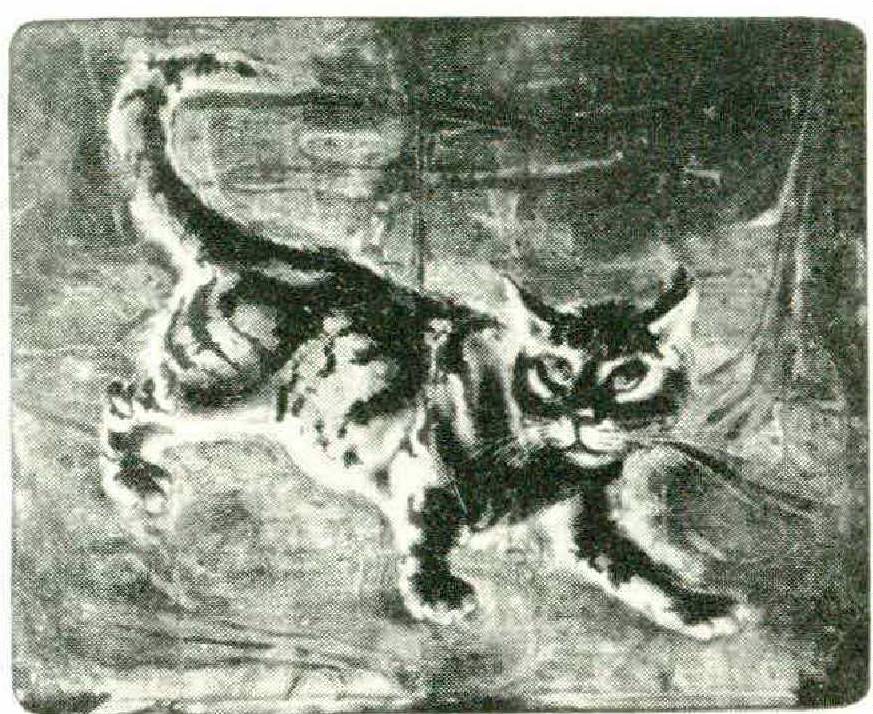
By contrast, Dorothea’s apartment was a cave, although it was the back, garden apartment of a drop-entrance, improved brownstone. The light in her bathroom, where her tub water was running out, made the living room cell-gray, and beyond the window guards a circle of sunshine on the fence and ailanthus tree looked like the end of a tunnel. There was a smell of oranges, and a big black cat with white on him leaped to the back of a chair. “Is that Boodles?” I asked.
“Yes,” said Dorothea. “Here is my clinic card.”Written on it was the word “Special.” To my relief, since I wasn’t sure how to assist her, Dorothea walked by herself, like a toddler who intends to achieve his quota of steps before he falls.
In the pink-marble waiting room everyone sat on folding chairs like audiences facing each other, under signs saying “Shelter” with an arrow pointing both ways. Dorothea pushed her curlydark bangs off her forehead. Her head lolled back. I thought she was fainting, but the position other body stayed alert. From the audience facing us there were low cries. Dorothea was sitting with her head bald as a doll’s, holding her whole head of hair, a glossy, waved wig that looked as if it would have smothered her doll’s head, on her knee.
“Do I embarrass you?” Dorothea suddenly whispered anxiously. “It gets hot.” I forced myself to touch the faceless head of hair on her knee, and said, as matter-of-factly as I had admired her handmade hat, “It looks so real.”
“It cost eighty bucks,” said Dorothea. “Doug had it made for me. He wants me to have another. Maybe auburn. A soft auburn.” She added apologetically, “It was the fever.”
While Dorothea was seeing her doctor, she sent me to have her prescription refilled. I had not known pills were kept in bins like beans and were shoveled with scoops, and this concerned me, like something I should not have seen, as if antibiotics had been exposed as palliatives. Dorothea’s pills looked like navy beans. She came out of die examining room with an expression of concentration. “The doctor says the calcium count is getting high in my blood,” she said. “He says this could be serious. I’ve got to lay off all that milk.”
Then she said she felt nauseated and walked ahead of me to the ladies’ room. She retched without getting sick. This affected me more than anything previously. When she was better, I took her back to the elevator and got her home.
Like all latecomers, I was full of practical ideas. I wanted to call in another doctor, but Dorothea already had the doctor all other doctors called in. It seemed to me a misfortune she had not started lower down and worked up to this doctor. I asked Doug about her relatives. “Oh, very tenuous.”he said. “Just scattered siblings, and married.” Doug always referred to marriage as if it were a moral disqualification. I even asked him her religious background, if any, and he said he believed the family had been reformed-evangelical something. The modern and all-embracing sound of this made us both dejected. I wanted to get somebody from Community Service, but Doug said they sent homemakers. The word “homemaker" was even more disheartening than reformed-evangelical.
Doug and I stayed with Dorothea, sometimes in shifts and sometimes together. The three of us would sit and watch the twenty-one-inch screen Doug had bought her and listen to the back-yard life. There was a singer who had an evening lesson with her instructor. Evidently he lost patience, and banged the top of the piano while she shrieked a high note over and over, and Doug remarked that this sounded as if he were beating her and she were screaming, and we always laughed when this went on. Doug was editing an anthology, and pages lay all over the rug. When Boodles would prowl among the pages, Doug would declaim, “Boodles, Boodles, burning bright!" Dorothea particularly loved the poems of Tennyson and Allen Ginsberg. Dorothea and I discussed Boodles. “Look at him sleeping: doesn’t he lie like a seal?" Dorothea would ask. “He walks like a polar bear in the back,”I remarked. Doug would shout, “Look at Boodles! Doesn’t he look like a goat? Doesn’t he look like a Doberman pinscher?” When Boodles scattered the poems, Doug muttered, “Stick around, Boodles, we’ll open a keg of nails.”
Then Doug and I had one for the road at the Crazee Babee. “Who would do this for us?” he kept asking me. “Who, who, would ever do any of this for you or me?”
“She would,” I’d say. “I would for you. You would for me.”
But he itemized. “She has everything! The twenty-one-inch screen. The new Simmons by the window for a change from the alcove!”
“You’ve been terrific to her, Doug,” I said.
But Doug began to breathe strongly. I could see the spokes in the irises of his eyes. “She has no worry about her rent. I got her the air conditioner. She thinks it doesn’t cool, but she doesn’t know what it’s like outside. Isn’t it a twentydegree difference? Isn’t it?” Doug really seemed to want to go through what Dorothea was going through without any of these things, as the only way to make up for whatever we weren’t doing for her, although we couldn’t think of what it was.
But riding the cross-town bus back through the dark park, with summer now built up solidly outside us, Doug read the ads to me in a low voice. All that summer he wore a tweed sports coat the color of his hazel eyes, which gave him a sufficient look. He read to me lullingly, “A brand name you trust,” “For dryness and body,” “When you need money,” “When you think of cheese.”
NIGHTS I was alone with Dorothea she sat on her pillow wearing nothing but a towel which she corded around herself, and told me about her men. The name Bertram stuck in my mind. She would say, “That one was a love thing,” or “That one wasn’t a sex thing.” I was alone with her the night the pain started. She rolled the length of the bed in a formally vigorous rhythm as if it were an exercise, gasping, “Oh, God, God,” and “Mama, Mama,” I had to look away from this, but my eye caught the shoe bag on her closet door with the white shoes sticking out. In between, she said, “Sorry!” and then lay motionless as if listening intently. Then I kept quiet too, and we both listened for the pain to come back.
After a hard bout, Dorothea flopped herself backward over the edge of her mattress so that I saw her face upside down. The big whites of her eyes shone. She flapped a slip of paper at me. “Honey,” she said, “could you get this filled for me?”
In great relief I took the piece of paper. I looked at it and saw that she had given me a dry cleaner’s receipt. I felt that if she did have any prescription, she would not know where, and I went on out without knowing what I would do.
I went into a Columbus Avenue drugstore and phoned the clinic, said it was an emergency, and asked for Dorothea’s doctor’s number. As I knew he would, he sounded as if I had got him out of surgery or a shower, but I wished only that I might have thanked him for getting Dorothea absorbed in her calcium count. He said to give him the pharmacist. In a few minutes the pharmacist gave me the pills. I asked him if it would hurt my patient if she accidentally took too many. He looked at me across the counter and said, “What difference would it make?” I took the little box back to Dorothea. She took a pill, and both of us sat listening for the pain, but it did not come back. When I went, she whispered, “Why are you so good to me?” I said she’d do it for me, and I left. All night I felt that I had failed her.
In the morning, by special delivery, I got a letter-envelope containing a jade necklace and a slip of paper saying, “Your true goodness to me will never be forgotten by me.”
Differences came up between us. Doug wanted Dorothea to go to the hospital, but he wanted my approval, and I objected, although Doug was paying her bills. Dorothea told me Doug told her she was staying home to torment him. She told me Doug was sicker than she was; Doug told me Dorothea had been deeply unstable before she ever got sick. Then the two of them got together and became cool to me. This was the hardest time, because Dorothea now started to forget the names of things. She forgot the word “orange” and kept telling me she was out of what-do-you-call-its. Then the three of us got close again in a new atmosphere of certitude which absorbed whatever any of us said.
One night when Doug and I stopped at the Crazee Babee, I had a bad cold, and Doug had bought me a green plastic lime containing pure lime juice. He put lime juice in my beer. I asked him if Boodles were the original Boodles.
“Yes,” said Doug. “No! I don’t know! To me, all cats are boodles. This could be a new Boodles. People name cats like cruisers. Boodles II, Boodles III. There’s a Chris-Craft at the Seventy-second Street Yacht Basin named Mousie IV.” Doug sat on his bar stool with the thermometer he had bought me in his teeth. “Think of having four women named Mousie. Or maybe he had four mice. Maybe he only saw four mice. Maybe he named his cruiser after his dt’s. Drink your lime juice; vitamin C evaporates at barroom temperature. Here, check your barroom temperature.”I told him I wished he would stop using the expression “For Dorothea there is no exit.” Doug debated this line seriously, as if it were a line from a poem. He recorded our temperatures on a coaster, sterilized the thermometer in his beer, and urged the bartender to check his temperature. He suggested we walk over to the Seventy-second Street Yacht Basin and see the Mousie IV. I asked Doug if there were anybody Dorothea might especially wish to see. He said he had contacted a list of names months before, but they all said they couldn’t bear to see her in such condition. Then he urged two Puerto Rican men drinking beside us to check their temperatures. They declined graciously in Spanish. One seemed to remark that he combed his cheetah in pestilence, and the other saluted all valid morsels. I said to Doug, “Who was Bertram?” “He was years before I came in,” said Doug. When Doug put me in a cab, he said he did feel we were making a serious mistake in not looking at the Mousie IV. Through my cab window I saw him standing in the middle of Broadway, with taxis and buses sideswiping him, obliterating him, and casting him up again. With his light jacket and light hair he looked illuminated, like a kind of channel buoy, a Bondexed human safety-zone marker. I never thought I would see him alive again. At 5:30 A.M. my phone rang, and Doug’s voice asked me gently if I had got home safely and urged me to get plenty of bed rest.
FLU kept me away three days, and when I called Dorothea there was no answer. Although if there was once no answer, there would not be an answer again, I kept calling, because the continuous ringing kept my mind blank. Then Doug called me, ceremoniously asked how I felt, and explained that Dorothea had been taken to the hospital because her pelvis became paralyzed. He said she had been good about going and said now maybe they were finally getting somewhere. I felt a panic of loss, as if I had left something in a public place now locked up. “Boodles is here with me,” Doug added, as if this were hopeful news. “He’s sitting in my fireplace, as a matter of fact.” We worked out a schedule for alternating visits to Dorothea. I found Dorothea pleased at the hospital because her hair had started to grow back. She wanted a mirror to see it, but the day I brought her the mirror she was asleep. She was now emaciated, but she looked sunburned. I said to Doug, “Why does she look sunburned?” Doug said he had thought she looked pale, but both of us said that the other might be right.
Doug called me and said his relationship with Boodles was not a happy one. He said Boodles watched him. “He can’t really see you,” I said. “Cats are very nearsighted. At any rate, he can’t see you in color. Cats are color blind.”
“That makes it almost worse,” said Doug. “Perhaps he sits and thinks, ‘In the day, all men are gray.’ ”
I offered to keep Boodles, but Doug said he hated to ask this and would talk it over with Dorothea when he could catch her awake. Dorothea said Boodles could stay by himself in her apartment if Doug or I went by to feed him and change his litter, so we took Boodles back to the empty apartment in a wired orange crate.
Dorothea now looked like a little boy. She looked younger each time I saw her, a boy fourteen, twelve, nine. Doug remarked that she looked like an aged woman, but each of us deferred to what the other said she looked like. Since she had stopped being anything we could connect with Dorothea at all when her blue eyes were shut, we had to specify something she had come to be like. The case probably was that she did not look like a person by then, but she was something that was there, that twitched slightly and could grow rings of new black silk hair, birth hair. Dorothea said the hospital was mean. She cried and said they gave her hot water in a glass with dirty fingerprints and threw her shoes at her. It was obvious to Doug and me from everything we observed that everyone was devoted to Dorothea. Something that pained me about her being in the hospital was that no one looking at her asleep would suspect that her eyes were blue.
Every morning, whether I was visiting that day or not, I called to ask about her condition. One morning in the middle of August the switchboard operator asked me if I were a relative. We went through the whole form. I said no, a friend; the operator said, then you haven’t heard the sad news; I said no, what? Dorothea had been dead for fifteen minutes. She died that morning at 9:15.
As we always do when told the time of a death, I thought this was a wrong time to die, when people hang their hats in their offices and open the mail. I wished for Dorothea that she had died at dawn, midnight, dusk, or high noon, a time solarly defined without numerals, and she seemed the more unidentified behind her closed blue eyes.
There was no answer on Doug’s phone. I tried him all day, while worrying that this was preventing his calling me. He called in the evening. I never knew where he spent the day that Dorothea died. He said, “We’ve got to get Boodles.”
I agreed, although I was alarmed.
“There’s a problem,” said Doug. “I can’t find a pet shop. We need a carrier.”
I thought of the orange crate Boodles had traveled in before, but I didn’t mention it. “I think I can borrow one,” I said.
“No, a new one,” said Doug. “A new carrier!”
I said I would find one. Doug remained considerate and asked if it would inconvenience me to advance the money until we met at Dorothea’s apartment.
I was very apprehensive about seeing Doug, although I also felt this necessity for postponing our realizing that our job was finished. But when I got to the apartment, Doug had a man with him, an elderly Middle European. Boodles was walking on the window sill. The man explained to me, “I am Mr. Meyers from the typewriter company where the poor lady rent my typewriter. My niece does not have an apartment nine years. Nine years! So I see this poor lady is sick, a very sick girl, only I do not like, I only ask the super, my niece does not have an apartment nine years, he tells me 1B is very sick, but what can he — ?”
“The apartment will be available on the first, Mr. Meyers,” said Doug.
“Only, if I could ask one thing, my niece has the feeling. If something has happened in a place —”
“We won’t tell your niece, Mr. Meyers,” said Doug.
“Outside is like a garden?” said Mr. Meyers.
“Somewhat,” said Doug. “Somewhat like a garden.”
“You go out there once?” said Mr. Meyers.
“We go out there once,” said Doug.
“You mind?” asked Mr. Meyers. He went toward the French doors quite diffidently. If he had opened the doors suddenly, we would have been likelier to have stopped him in time. Boodles flashed past Mr. Meyers out into the night.
Doug let out a roar and rushed into the garden. If there had been any hope of coaxing the cat in, it was gone now. Doug blundered wildly around the garden, knocking over a rustic chair. He shouted, “Boodles!” This word, shouted, probably sounded as if he had shouted “Burglars!” with a gag in his teeth. The singer and her instructor stopped their banging and screaming, a window opened above us, but I did not look up. “How do you call a cat?” Doug implored me. He crouched down and began to hiss. “A cat is called Poodles?” said Mr. Meyers. The garden was full of little blotches and glints, it seemed filled with cats, but the cats’ fronts were old socks from clotheslines, the cats’ eyes were bits of broken bottles. “Be quiet! I said to Doug. “He may still be around.” Doug pulled himself rigid with the strain of keeping quiet. He looked seven feet tall. Without raising his voice over a whisper, he said, “You bastard, you bastard, you bastard.”
“What do I do?” said Mr. Meyers.
I said, “He wanted his girl’s cat very much; he didn’t want him to run away and be lost.”
“I am sorry,” said Mr. Meyers.
WHEN I could get Doug away from there, we wandered over to the Crazee Babee.
We sat in a booth. Doug drank without glancing at me. His blood-filled eyes did not appear to see. Suddenly he threw his cupped hands across the table, knocking over his empty glass, which I caught surreptitiously with my lap. His hands, cupped in seizure, supplication, shook. He broke into hard tears. His shoulders shook and shook the booth. I looked in alarm that people would believe he was only drunk, but nobody made this mistake. A churchly pall fell. I saw the backs of the other drinkers bowed in the purple and beryl reflections of the jukebox. “He was in my hands,” he said. “I had him in my hands.” Without pausing, he said, “She said to me. ‘They took my orange.’ I opened the drawer of her bedside stand, I showed her her orange, I showed her that her orange was still there! She said, ‘No, they took my orange.’ That was the last thing she said to me. Those were her last words.” Doug threw out his arms. With his arms strained back in the wide V, the jugular tubed out on his throat. His face lit up with sweat. He hit his fist into his cupped hand with impact that made a clean click of bone like a knockout. “The world becomes an orange!”
In a gentle, normal voice, he added, “I went away, then, and I found myself ten hours later walking on Eighth Avenue.” He stood up slowly and said, “I’m going back to get him. Are you ready? Here are your cigarettes.”
Mr. Meyers and the superintendent met us. “Young people, good news!” said Mr. Meyers. They showed us a small female tabby. “No, no, that’s not ours,” I said. “It is a cat,” said Mr. Meyers.
Doug and I went out into the garden. Doug checked our supply of cigarettes and suggested I go in and make us some coffee.
While I was boiling the water in Dorothea’s kitchenette, I heard rustling outside. I went to the windows, and saw, like a huge grass insect bending a blade, Doug climbing the ailanthus tree. Standing on the fence near the tree, his tail flailing, was Boodles.
I ran to the cabinet and got a can of cat food and the can opener. I ran back out into the garden, up to the fence, and showed Boodles that I was opening the can. Boodles sniffed down toward it and drew back. Hanging to the bowed trunk of the ailanthus tree, Doug pulled himself higher. Climbing this spindly tree to catch a cat was the first action I had ever seen Doug engaged in. I wanted to cry, “Dot, look what Doug’s doing!” His weight seemed all buoyancy, like a performer’s in a slack-wire act.
As Doug hung, watching his timing to grasp the cat, for which he would need both hands, the tree swung over the sunken concrete floor of the yard.
If Doug dropped on the cement, the fall could break his back.
I held the opened can up to Boodles. As he leaned down to sniff, Doug grasped him. Boodles screamed like six lighting cats. He lashed in Doug’s grip so that I could not even see him; I only realized that the twelve-pound cat was hanging by all twenty nails from Doug’s hand and wrist. Doug slid and leaped down and ran inside holding the cat down from his eyes. We slammed the doors after us.
The back of Doug’s hand was torn open. Between the ripped veins were blue punctures which already showed they would become infected regardless of any precautions. Boodles became a domestic cat again as soon as he was indoors, and he mewed and rubbed our legs sympathetically. Doug calmly washed his hand and methodically tried to squeeze the bite punctures, but these would not bleed, and he let me paint his whole hand with antiseptic. “Dorothea would never let him out, in case he should get hurt,” said Doug, and he laughed quite naturally.
Doug seemed a little disappointed at the smallness ol the carrier. I told him it was the biggest I could get, but actually carriers had cost more than I had expected, and one really roomy for Boodles would have cost twenty dollars. When we got Boodles in, he would arch his back and push the top up, but this made Doug laugh. Finally we pressed him down and got it latched. By the time we left the apartment for the last time, Doug’s whole hand was already swollen. I pictured him losing his hand, his arm, dying. As it was, Doughad to soak his hand for twenty-four hours and get penicillin. We took turns housing Boodles till his adoption appointment came up at the Bide-a-Wee.
The Bide-a-Wee opened at ten, and Doug wanted to get there when it opened. I stayed on the curb with the carrier while Doug hailed a cab. Boodles got wild outdoors in the carrier, yowled and bounced until the carrier fell over on its side. We got in a cab, but we struck traffic snarls, and Doug sat forward and argued with the driver. I thought of the only funeral I had ever ridden in, when a car cut into our cortege and angered my uncle, and my aunt had said of her dead sister, “Sarah will wait for us.”
I was afraid something would go wrong at the Bide-a-Wee. But they found Doug’s name promptly in the black notebook with the pencil tied to it and wrote out the receipt, and Doug signed it. An attendant carried Boodles away in the carrier and told us to wait for the carrier, which we automatically did. It was all completed as decorously as a funeral.
Doug pushed the heavy modern glass door open lor me. As he took the now weightless carrier from me, it dropped and sprang open, and we both shut the empty black box quickly. The ringing sunshine filled the street, lighting the airlines terminal, the street, the East River, where a tug and barge were under way. In the strong sunshine after the strain, and with the necessity for smiling, Doug’s face looked as if it had been skillfully aged by a colorless make-up pencil. “What enabled me to keep up at all, all through it.” he said, “was that you could do so much for someone whom, of course, you never even loved.”
I looked at him, but he was still smiling at me. Standing in the sunshine pouring over these channels of lading, embarkation, and take-off, I thought of how I had given Dorothea my time, my energy, movie magazines, and Riviera pears, every personal and commercial image of love, while now the very sunshine tolled, whom you never even loved, whom you never even loved.