Zoological Notes
For the past thirty years MONA GARDNER has spent most of her time in the Orient. She now lives in Johannesburg, where her husband represents an American bank.
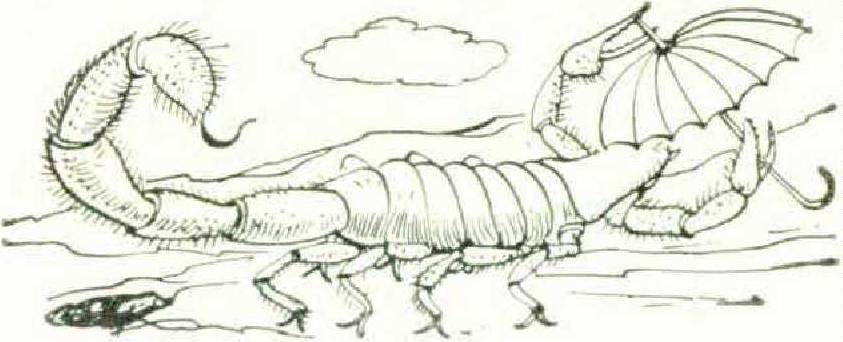
Monster crickets from the Kalahari regions have begun a slow but persistent invasion of the vast western desert above Cape Town, where flourishing karakul and merino flocks are being raised these days. Called “barbers” because their favorite diet is human hair and they nibble a sleeping man bald in a couple of hours, these glossy black giants have a leg spread which covers a tennis ball, yet they do not hop, but only crawl at the slow-motion pace of a foot a minute. Because their present excursion south is through sparsely settled regions which provide scant human hair, the creeping barbers are making do with karakul and merino hair. Herdsmen are swapping data on an all-out search for natural enemies that will exterminate the fleecers, but so far have only established the dismal fact that birds refuse to eat them.

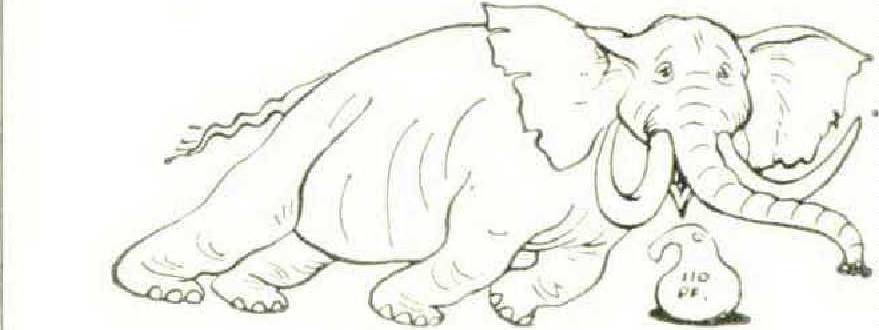
Bull elephants have a fondness for the sap of the lala palm, which provides native villages with a seasonal liquor supply. Toward the end of the rainless months these palms are trimmed down to stumps, a circular groove is cut below the top, and a leaf is inserted to act as a spout, which drains into a hanging calabash. Shortly after, a sweetish, tangy fluid begins to flow, which makes an invigorating drink when fresh, but when fermented is said to have the kick of a giraffe. During this season old bulls regularly make the rounds of native villages, toss off the contents of all available calabashes, and then go crashing through the bush squealing and trumpeting boisterously. Native calendars appropriately call his the “ho.-ho month.”
Rains are sometimes eighteen to twenty-two months apart in the Western Cape, but settlers there claim they have an infallible weather forecast provided by the trek of insect armies from the dry pans which fill with water during one of these infrequent downpours. Hours before the first drop, millions of scorpions, beetles, and tarantulas, who inhabit the baked and cracked mud of these saucerlike depressions, start moving out toward high ground.
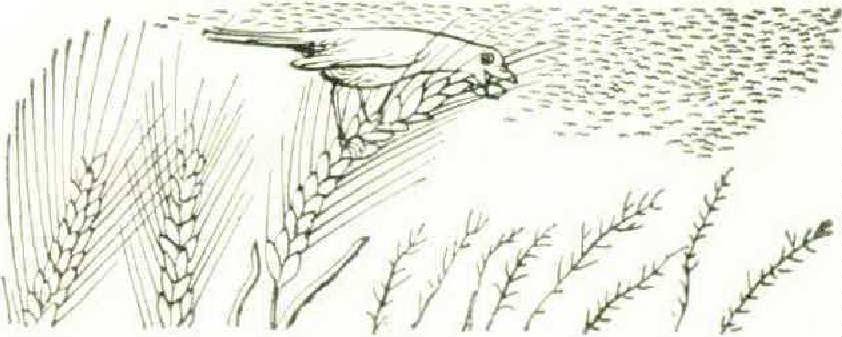
The red-billed weaver of the finch family is a very formidable invader. Flying in solid clouds three miles long and one mile wide, these devastating millions eat their way through wheat fields and leave them as barren as an ant army on the march would. Only two ways have been found to interrupt this grim migration—dynamiting the trees where they roost at night, and nocturnal sorties by aircraft spraying poison on these roosting spots.
Hottentot legend is that baboons can talk but don’t because the white man would make them work. These brown-haired, dog-faced Chacma baboons are the most cunning and daring crop robbers that veld farmers have to contend with. They will maneuver and deploy in troops for hours to confuse pursuers. Baboons can readily count to six, farmers maintain, and they say that if five armed men disappear into a corn patch and four come out, leaving one behind to kill marauders, the baboons know and won’t enter that patch. It is the same if six go in and five come out. But raise the number to seven, and evidently it does something to baboon computation, for they will charge in as soon as six men leave.
Baboon tribes still flourish on the peninsula below Cape Town, which is now a nature reserve. One colony of over a thousand has been cut off from other colonies for more than a century by a motor road and railway line. They are bold, playful, and intelligently adaptable, often throw rocks at passing motorcars, and have learned to scoop fish om of rock pools and to bait lobsters. Curiously enough, they are afraid of men but not of women. Let a man in woman’s dress come toward them, and they will scatter. But if a woman appears in slacks, even though she is carrying a gun, they will charge her ferociously.
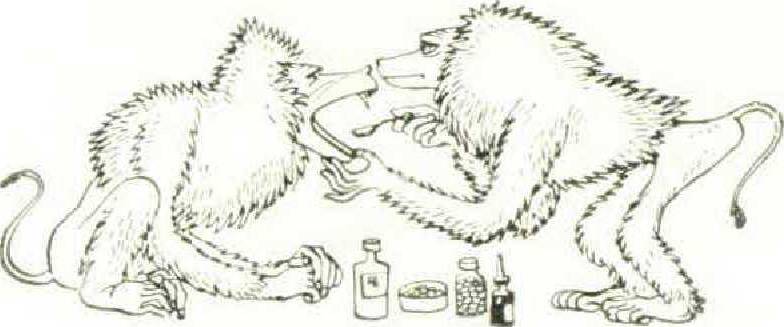
Baboons suffering from gastric ulcer, rheumatism, influenza, and malnutrition have taught medical men several effective remedies. During the 1918 flu epidemic, sick baboons were seen tottering from their mountain caves to burrow for wild garlic and gorge on it. When stricken farm families ate the same raw bulbs, they found both congestion and fever were relieved. The sight of rheumatic baboons stuffing themselves with willow leaves led Cape householders to brew a strong infusion of willow leaves, which they drink to alleviate rheumatic pains. These same willow leaves are the basis of one of today’s world-famous specifics for rheumatism.
During hot, dry weather, farmers hunting stores of wild honey go into the bush and wait for an unerring honey diviner to lead them to a well-stocked hive. This small brown-gray bird does a series of anxious fluttering passages to and from the man in one direction, meanwhile keeping up a loud insistent chatter. The note changes exultantly when the man reaches the hive and cuts through the hard sugary shell, which the bird’s beak cannot penetrate. Hottentots always leave a share for the honey guide, because they say it has a vindietive nature and if cheated would probably lead them next time to a leopard or to the deadliest of snakes, the black mamba.