Accent on Living
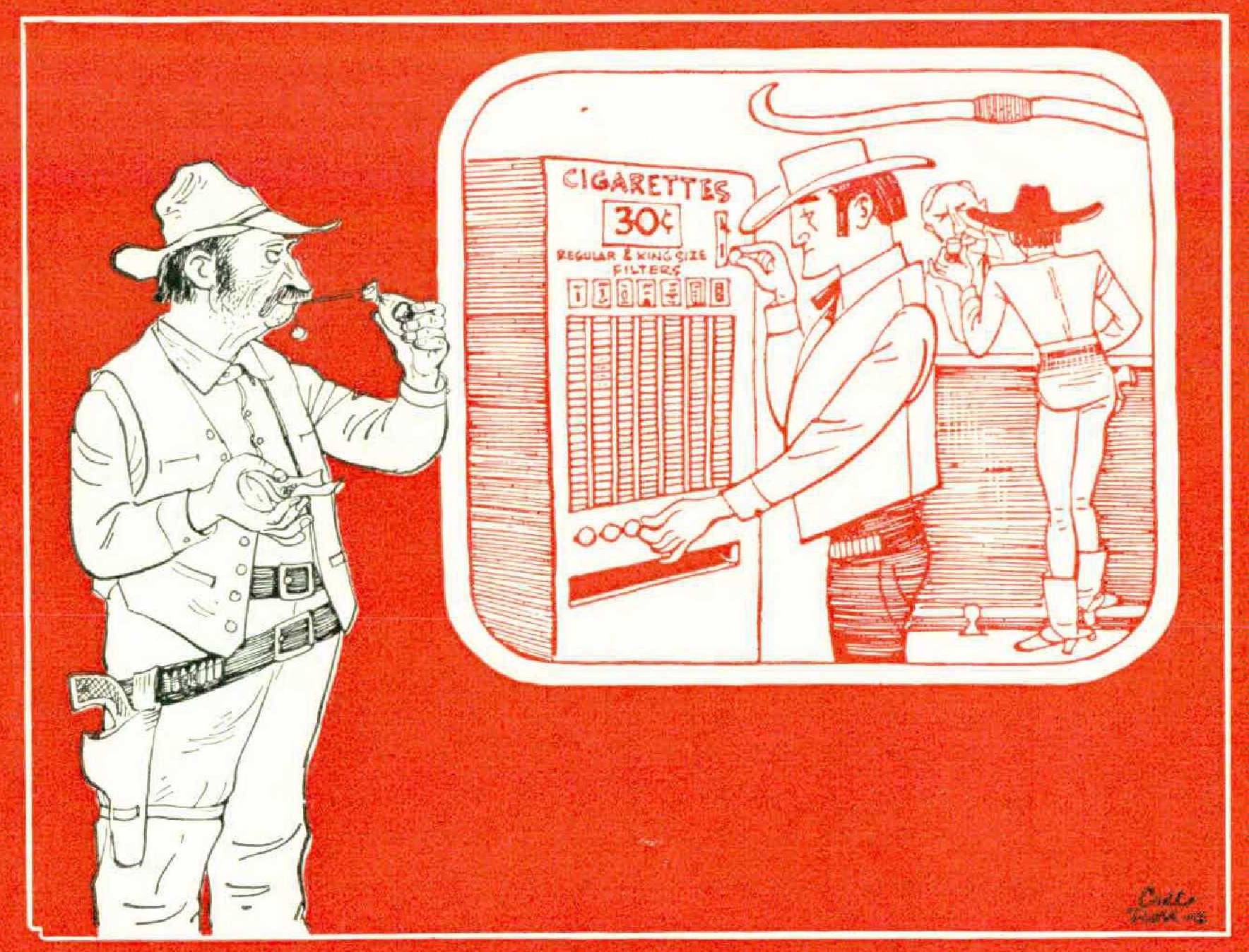
THE Old West continues to undergo various modern improvements at the hands of the script writers. We know from the television commercials that the up-to-date, successful, he-man type from Tombstone or Cheyenne was intensely vitamin conscious, deeply concerned with the lanolin content of his hair cream — in that hot sun and dry air, you know — fond of explaining the virtues of nosedrops or pills, and downright learned on the subject of his filter-tip cigarettes.
But we know that when one of the stars of the Old West is giving us the commercial, we are really meeting him between scenes, off stage, in the Green Room, so to speak. As he holds up the bottle of nosedrops and points to it, we see him as an actor, a well-paid citizen with a family, a swimming pool, a collection of Bartók recordings, and a considerable background in summer stock. He is still wearing his Dodge City costume, guns and all, but we realize he doesn’t mean it. It will be a different story as soon as the commercial is over: he’ll be back in the Old West again, in his ceaseless round of belting people backward over card tables and staring down belligerent strangers.
How long the distinction between the ways of the Old West and those of the commercial will last is doubtful. It has been many months, for instance, since I last saw a real star in a Western — a man big enough to qualify for a personal appearance in a department store’s Thanksgiving Day parade — fish the makings out of his shirt pocket and roll himself a cigarette. I may have been watching the wrong programs, but any such action as this in a cigarette-sponsored show is unthinkable. The characters smoke cigarettes in great quantities in the Old West of the cigarette show, but no one is ever seen rolling his own, nor are any handy Bull Durham tags dangling from their pockets.
The fact is that, as recently as the days of World War I, a store-bought cigarette of any sort in the cattle country was a rarity. For a man to smoke them was considered dudish or effeminate or both. Only women used them, and the only women who smoked were prostitutes. In polite circles, the cigarette that came in a package was called a “tailor-made,” but the old-timers referred to it as a “pimp stick,” and there was always great cackling and merriment when some newcomer broke out a package and offered it around. The idea of a famous peace officer kneeling beside a mountain rill and explaining his concerns over the location of the filter in his filter-tip “tailor-made” would have convulsed even the chore boy. One pictures him addressing the saloon crowd: “I find my cigarettes (tailor-mades) stay 44 per cent fresher in the new airproof pouch-pack.” And far up the trail that night, full of body-building minerals, his decongestants working nicely, he is bringing to a brown in his skillet a slab of the bakingpowder bread known as sheepman’s loaf. “I use only pure vegetable oil,” he croons softly as he squats by the fire. “Never hydrogenated!” His horse, fully caparisoned, tries to graze nearby, impeded somewhat by the huge ornamental bit. (Never unsaddle a horse in the Old West: you can never tell when you might need him again.)
So far, most of these unions of then and now are in the commercials, but, like the store-bought cigarettes, innovations are bound to creep into the Western itself. Any day now we can expect to see a revised motto for that wide-ranging Private Eye, bold, indestructible, and always ready for a dangerous new assignment: “Have Nosedrops, Will Travel.”
CHARLES W. MORTON