The Rock Carvings of the Sahara
Science editor of the Swiss magazine WELTWOCHE, GEORG GERSTERover the past few years has undertaken several extensive trips into the Sahara Desert. The article which follows has been drawn from his book SAHARA, to be published this month by Coward-McCann.
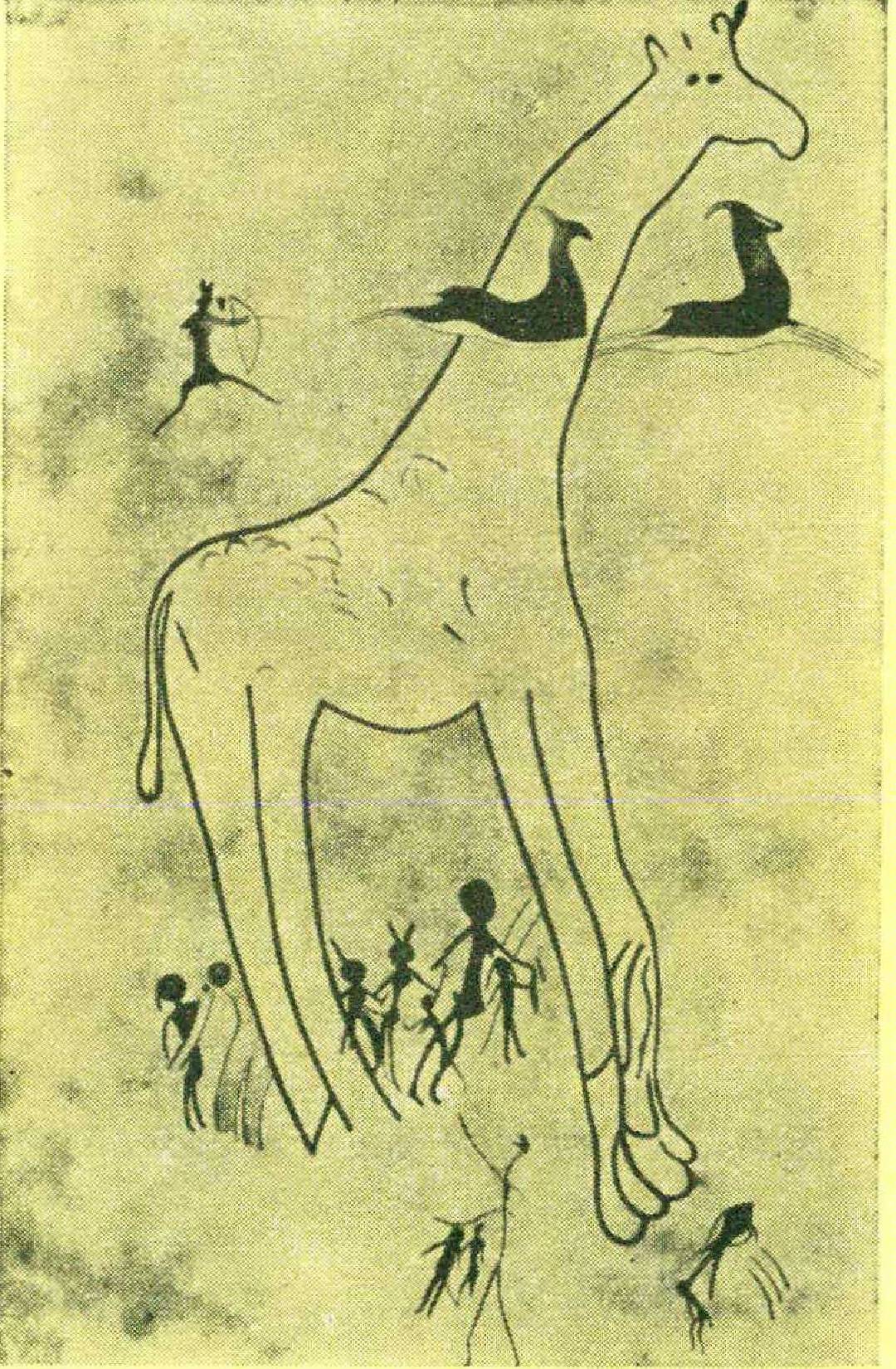
IF ONLY I were down there now,” I burst out. “You would be disappointed,” replied René Mossu dryly. “The reproductions you saw in the Louvre in Paris are much more striking than the originals. Since Lhote was there, they have become coated with a fresh patina. You would be sadly disillusioned.”
We were on our way by plane from Djanet to Fort Flatters. Directly below us lay the new mecca of prehistoric art, the largest open-air museum in the world. The Noratlas, commonly known as “the flying truck,” droned low over Tassili-n-Ajjer. Isolated mountains drifted past like islands washed by a sea of sand; the deep gashes of canyons, their sheer walls vanishing from sight in great heaps of rubble; massif after massif, each one corroded by time, standing out boldly on the high plateau; gloomy clearings amidst tree trunks of stone, domes, needles, and pyramids of rock; abandoned towms in whose ruins one can still pick out the market place, the streets and lanes, the houses and the palaces — the crazy, unpredictable patterns of erosion.
I had met Mossu in Djanet and taken him at first for an American who spoke excellent French. He moved about the desert as if it were a golf course. Faced with a problem, he seemed to weigh an invisible driver in his hand and, eyes narrowed, gauge the distance to an invisible green. Though born in Paris, he had in fact come from the States and was spying out the Sahara on behalf of an American mining company. Had I been his employer, I would have sacked him at once. He showed only mild interest in the things that were everyday talk in the Tassili and Hoggar: diamonds, platinum, asbestos, thorium, and uranium. But he would go to endless trouble to see one rock carving. The frescoes of the Sahara were his hobby.
Remembering Lhote’s magnificent exhibition in Paris, I remarked that the paintings from Tassili had enormously enriched the world’s store of artistic beauty. A new province had been discovered, in which the art lover is dazzled and amazed, yet which is somehow not altogether unfamiliar.
“As long as he’s interested only in form and color,” Mossu agreed. The specialist is also naturally excited by this discovery. But he does not feel quite so happy in his mind. For he is faced by a great many new and unsolved problems, unanswered questions. He is rather like an accountant who wants to draw up a balance sheet, but is confronted every now and then by a new item in the inventory which he had not noticed before. Lhote’s discovery at Tassili, to which further material was added in 1959 and 1960, was the biggest and most spectacular of those items. But it is by no means the only one. Lhote himself provided additional material when he made the first systematic inventory of the rock carvings in the Oued Djerat in 1959. His team copied 4000 of these, partly by means of a new process using fluid rubber. Amongst them are the largest prehistoric carvings ever known: giraffes more than 20 feet high, rhinoceroses 25 feet long, and elephants 15 feet high. But quite apart from Lhote’s discoveries, ever since the desert woke from its Rip van Winkle sleep not a month has passed without another set of rock carvings being unearthed. In the last few years alone, about twenty thousand figures have been discovered on the rock walls of the Sahara. And that, added Mossu, is an underestimate rather than an overestimate.
THE Sahara picture gallery tells a story of constant coming and going in the desert, of successive civilizations, races, peoples, tribes, and clans, who may have brought their own art with them or may equally well have taken over an artistic tradition already in existence and carried it on. But what do the many different styles represent? Is each one the expression of an individual artist? Or of a school? Or of a clan? Did these styles develop simultaneously and independently, or in some chronological sequence? Can any chronological order, relative or absolute, be traced? Which civilizations, races, peoples, tribes, and clans are involved? Was the Sahara inhabited by black, brown, red, or white people?
Four groups of carvings have been identified which correspond to four periods of time: the hunter, the herdsman, the horse, and the camel. The archaeologists are well aware that the net they have cast over their quarry is a very wide one, but this crude classification has so far stood the test.
The hunters portrayed the hunted: elephants, giraffes, rhinoceroses, ostriches, and — a characteristic of this period—stags, hippopotamuses, crocodiles, and fish. At this stage there is no attempt at composition; the animals are shown not in herds but, for the most part, singly. And the dimensions are significant: the animals, even the giraffe, were frequently carved and painted life-size. The treatment is naturalistic. Where the figure is sculpted, the lines are deep, mostly V-shaped, and with a black, or at least dark, patina. Human figures are rare. When they do occur, they are wearing masks, mostly of animals. They are armed with clubs and crooked throwing sticks, which were possibly boomerangs. The only domestic animal which appears during this period is the dog, the hunters’ constant companion.
In the period of the herdsmen, the pictures are smaller, and naturalism gradually gives way to abstraction and formalism. Instead of individual figures there are spacious group formations; the incisions in the rock are U-shaped and less deep, and the patina is lighter, frequently even the same color as the rock face itself.
The herdsmen also portrayed game: rhinoceroses, ostriches, and mouflons, gazelles, wild pigs, lions, wild asses, antelopes, and fish. Only occasionally one sees a hippopotamus. The real star of this period, however, is the ox. Whole herds of oxen are portrayed, accompanied by sheep and goats driven by herdsmen and dogs, and their mottled hides, ears, hoofs, and tails are reproduced in the greatest detail. But the most striking feature of these carvings is the enormous variety of horns, some of which even curve forward and downward like an elephant’s tusks. This seems to point to very active and varied breeding.
Men are often portrayed in the carvings and paintings of the herdsmen’s period, usually naked, but sometimes wearing a loincloth. We see them looking after their animals, taking part in ritual ceremonies, or engaging in domestic chores. A number of scenes point to agriculture, and it seems a fair assumption that cattle breeding was combined with nomadic farming. The main weapon is the bow and arrow, which they must have used either to protect their herds against attack or in occasional raids on other herds. Many of the pictures show them fighting.
It would be a mistake to imagine that there was a sudden transition from the period of the hunters to that of the herdsmen. The cattle breeders almost certainly made their way up from the southeast, and they may well have established some kind of modus vivendi with the hunting tribes. The herdsmen themselves could not live without hunting if they wanted to preserve their livestock and at the same time maintain a fairly varied diet. Moreover, the herds had to be protected against wild animals. It is not unlikely that the indigenous hunters became the herdsmen’s gauchos and cow - boys, especially as about that time the supply of game began to grow scarce. There is certainly no evidence to show that the herdsmen subdued the hunters by force of arms. There is good reason to suppose, on the other hand, that the conflict was decided by the relative prosperity and security of cattle breeding as against the hand-to-mouth existence of the hunter.
When we come to give a date to the herdsmen’s period, we begin to see daylight. Although we still have a great deal to learn about the early history of domestic animals, it is believed that between the fifth and the fourth millenniums cattle breeding was introduced, by way of the Bab el Mandeb at the southern end of the Red Sea, into Africa, and from there into Egypt and the Sudan. This does not, of course, rule out the possibility an indigenous species of wild cattle became domesticated and that these were the ancestors ol the longhorns in the rock carvings.
By the third period the elephant, the rhinoceros, and the hippopotamus have disappeared, The artists confine themselves to antelopes, gazelles, ostriches, giraffes, the small Berber lions, and mouflons. The men carry shields, lances, and spears. Both animals and men are reproduced almost geometrically, a style that is characteristic of the third period. But the dominant feature is the horse and chariot. The chariots have two or four spoked wheels and are drawn by two or four horses, which are always at a gallop. The axle carries a platform to which a shaft is fixed. The driver stands with the reins in his hand. Most of the pictures show war or hunting chariots, but there seems little doubt that chariots were also the normal form of transport.
Toward 1700 B.C., the Hyksos, an Asiatic people, invaded the Nile Valley and liquidated the Egyptian Middle Kingdom. It took the Egyptians almost a century and a half to put their house in order again. The Hyksos invasion brought about a revolution in Egypt. The “Princes of the Strange Lands” had brought horses and chariots with them. Whether they found their way westward into Libya is not known. But it has been established that the Libyans, who were constantly raiding Egypt’s western border, were using horses in the thirteenth century B.C. A text of the New Kingdom mentions that Pharaoh’s soldiers in a skirmish in 1229 B.C. captured fourteen single-span chariots from a Libyan chief and his sons.
Such evidence as there is suggests that the horse and chariot reached the countries west of Egypt not from the Nile Valley but from the north. In the closing centuries of the second millennium, a wave of so-called maritime peoples broke over the Mediterranean from the Black Sea. They probably landed in Cyrenaica and were responsible for pushing the Libyans eastward against Egypt. It is quite possible that the Garamanti, who were white and were keen warriors, formed part of this invasion. This would explain the Mediterranean features in the Garamanti rock carvings: the new male and female fashions (tunics lor men, short bell-shaped dresses for girls, long dresses for women), the narrow thighs and broad shoulders of the charioteers, the horses in full gallop.
The one-humped camel is the most characteristic feature of the pictures of the second epoch. Gompared with the masterpieces of the hunters and herdsmen, most of the camel drawings are poor. From an archaeological viewpoint, however. they arc extremely interesting.
At what stage die camel first appeared in the Sahara is not known. Camel bones have been found amongst early Stone Age remains, and the patia and vitality of some camel pictures seem to place them in the herdsmen’s, or even the hunters’, period. But in neither ease is the evidence conclusive. The champions of the African camel find it hard to explain why there are no references to it in literature. The Egyptian texts and monuments include not a single camel. At the same time, none of the ancient authors omits to write about the horse and the part it plays in war and desert life.
The first mention of the camel on African soil is in the account of Caesar’s African War. In 46 B.C., at Thapsus, Caesar defeated Juba, the ally of his enemy Pompey. Part of the booty captured by the Romans was twenty-two dromedaries. In the course of the next few centuries, the camel population of North Africa increased substantially. In the fourth century A.D., the tow n of Tripoli contributed 4000 camels toward a campaign against its enemies.
lhe horse was gradually superseded by the camel. The chariot appears to have fallen out of use before the camel appeared, but the horse survived for some time after that. There is no evidence that a horse-breeding and horse-riding people was driven out or subdued by camel riders. Not a single rock carving so far found shows a meharist in combat with a horseman. The camel was simply more suited to the desert than the horse was.
The rock pictures of camels frequently carry inscriptions. The symbols belong to LibyanBerber script systems derived from the PunicPhoenician script which was in use throughout the Mediterranean when Carthage was at the height of its power. Tifinagh, the script of the Tuareg language, is particularly in evidence.
The chronological classification into periods — the hunter, the herdsman, the horse, and the camel — is, of course, largely relative. Pictures of horses and chariots are older than camel pictures and more recent than those depicting cattle. Scholars have also worked out an absolute time schedule based on the knowledge that the hunters were in their heyday from 5000 to 3500 B.C. and the herdsmen from 3500 to 1000 B.C. In the last millennium B.C., horse-driven chariots were racing across the Sahara. The camel appeared at about the beginning of the Christian era. The Arab hordes, who invaded the desert in the seventh and eleventh centuries, dealt the art of rock carving, which in any case was on the decline, its death blow. They destroyed, pillaged, and converted in the name of the all-merciful God and His Prophet, who teaches: “Oh, ye faithful, forsooth, wine, games, pictures, and lotteries are abominable works of Satan.”
Reliable data on the hunters’ and herdsmen’s periods are almost nonexistent. Some archaeologists, including Lhote, believe that the first rock carvings date from several millenniums earlier, but it has now been fairly well established that they do not go back beyond the beginning of the early Stone Age. In other words, the oldest of them are about 10,000 years younger than the paintings in the Grotto of Lascaux, the “Sistine Chapel of Ice Age art.”
I ENVIED Michel Turland his find, a magnificent rhinoceros carved deep and firmly in the rock. The animal is about a yard high; from its stubby tail to the points of its powerful, vicious-looking horn it measures two yards. It is carved on the lower half of the rock face in a slanting, climbing position. The hind legs are like great pillars, whereas the fore legs are almost like a piglet’s.
The previous evening, shortly before nightfall, 1 had arrived at the platinum miners’ camp. The dry valley, filled with tents, lies about 3000 feet above sea level and takes its name from the black granite mountains that border it: Oued Tihaliouine. An ordinary map of the Hoggar gives no indication that there is any human habitation in this area. The camp existed only on the maps of the General Staff and the headquarters of the Algerian Office for Ore Prospecting, as a tiny green flag which now and then was moved a few centimeters.
Before sunrise, Turland. one ol the prospectors, woke me up, and tingling with cold we walked a short distance up the valley. The mountains, which a few moments before had been dark and menacing, were now flaming scarlet. We arrived at the rock face just in time. The first rays ol the rising sun were shining through a gap in the mountains on the solitary rhinoceros.
A closer examination of the rock and its surroundings showed that the first impression was somewhat deceptive. The rhinoceros dominates its whole environment, but it is not alone. At its feet a second animal, which is an exact copy but only a quarter of the size, is cut in the rock. And between the back of the smaller animal and the neck of the giant, a third is just visible. The body and legs are barely discernible. The head was obviously carved, then erased, for the rock has been rubbed smooth. This animal, which is somewhat smaller than the second, is hardly recognizable, but is almost certainly another rhinoceros.
Over the stone run vertical columns of Tifinagh script of various lengths, some of them across the outlines of the large rhinoceros. Tifinagh, the ancient script of the Tuareg, has one peculiarity: it can be written and read in any direction, from left to right or right to left, from top to bottom or the reverse, and even in a circle. Presumably the inscriptions on this particular stone are in an archaic Tifinagh, which is midway between a conventional script and hieroglyphics. These inscriptions, which are to be found on innumerable rocks in the Tuareg country, are for the most part untranslatable. Just around the corner, on the north side of the rock, is a camel with '1 ifinagh symbols. The carving is stilted, small, and stylized. Over thin legs and a squarish body, the hump rears up like a pyramid.
There are more carvings in the immediate vicinity. A fourth rhinoceros on a piece of granite is small, beautifully preserved, but not particularly graceful; on a stone is an animal difficult to identify, possibly a gazelle or antelope, only lightly cut, barely visible, and obviously the work of an undistinguished artist.
Michel Turland had found this batch of carvings quite by chance two weeks before, while on a brief reconnaissance trip. Since then, he had spent every free moment searching the rocks in the neighborhood — without the slightest success, he told me. There was no trace of carving implements, only a few remnants of prehistoric pottery, most of them decorated and delicately patterned with bone awl, engraving tool, comb, or nails. But no one is interested in such fragments. The Hoggar is full of them. Anyone with the necessary endurance could collect tons of them.
I went back to look at the rhinoceros when the sun was at its zenith. The rock was the color of honey, and the carving could now be seen in all its beauty. I felt quite certain that originally there had been only this one animal on the rock; all the other works arc from later periods and by different hands. The patina of the outlines of the two smaller animals is much lighter, and the incisions are not so deep. The Tifinagh inscriptions, which also seemed to have been added later, probably at the same time as the camel on the north side, are not cut but are punched in the rock.
That evening, shortly before sunset, I saw the rhinoceros from a new angle and in a new light. I had spent the afternoon, internally hot as it was, with the platinum prospectors. When evening came, I wandered back to the rhinoceros, but not up the floor of the valley as before; this time I made my way along about thirty yards above the valley. The granite mountains opposite were reddish gold. Three black goats, wild and emaciated, trailed gigantic shadows across the dry flat ground below. A narrow strip in the middle of the wadi, where the bleached sand still retained some moisture from the last fall of rain, stood out green and fresh, The orange-yellow and bottle-green tents under the twisted acacias looked in the clear evening light like a holiday camp, not a prospectors’ base.
With this panorama before me, I realized how much is lost if one sees the rhinoceros only from close at hand. One has to look at it from a distance to become aware of how magnificently it blends with the landscape.
In the middle of the wadi, a sort of rocky plateau rises out of the alluvial rubble which fills the rest of the valley. This small plateau is roughly circular in shape and surrounded by large boulders. From the center towers the sculptured rock.
The whole setting reminds one ol Stonehenge, although here there is no question of a deliberate arrangement of the rocks in some artistic formation. Moreover, in the case of Stonehenge, the stones must have been brought from as much as a hundred and fifty miles away; the island of rocks in the Oued Tihaliouine is an accident oe nature, an example of the artistry of erosion. It is all that remains of the granite barrier through which the wadi slowly and relentlessly broke its way. And there is also a considerable time gap between the two monuments. Only the oldest parts of Stonehenge go back to the early Stone Age. If, as I believe, the rhinoceros dates from the period of the hunters, then when Stonehenge was erected the rhinoceros must have been centuries, and possibly even thousands of years, old. But both Stonehenge and the rhinoceros rock have one thing in common: both are clearly linked with the sun. On June 21, the first ray of the sun falls on the altar stone; in the Oued Tihaliouine the first ray touches the rhinoceros about the time of the winter solstice.
Other signs of sun worship have been found in the Sahara. Yolande Tschudi speaks of a place called Ti Bedjadj in Tassili, where two footprints are hewn in the rock, together with other indentations. Obviously, this had originally been a place of sacrifice. The Ajjer-Tuareg still pour milk over the rock face and smear it with butter, which explains why the stone looks so smooth and shiny. Asked to explain this ritual, the natives merely shrug their shoulders. It has simply been practiced since time immemorial. But one fact they are aware of: that in summer this particular stone catches the first rays of the rising sun.
FIRST Lieutenant Montague is the S.A.S. officer in the oil town Edjeleh. The S.A.S. officers I had already met in the course of my journey formed an elite of which France could be proud. Without exception they were “men against the desert,” cultured, sincere in their affection for the natives, not a military so much as a social elite. S.A.S. stands for “Section Administrative Spécialisée.” This corps of administrators is a product of the Algerian War. In areas with a predominantly peasant population, the S.A.S. officers are available, often at the risk of their lives, to render all kinds of services. They are expected to be familiar with the local land register, to be able to lay out a palm grove, to deal with irrigation questions, and to know all about cattle breeding. In other words, they have to solve all the problems that arise, day in, day out, in a population that is both sedentary and nomadic.
That Sunday morning at Edjeleh, Lieutenant Montagué was anxious to show me his treasures. Yet, when we set out it was not in the direction of Gour Laoud, twenty-five miles away, where the rock carvings had become a permanent attraction for visiting oilmen. Instead, the jeep clambered up through the rocky hills behind the camp. The sandstone ridge is broken every now and then by a long tongue of sand that runs down like a glacier. We made our way up one of these, higher and higher into the mountains. The weird shapes of the sandstone, each one a fresh source of surprise, arc mostly wrought by the wind. I got out and examined two rocks which were so close together that they looked like the walls of a huge tunnel. For thousands of years the wind has whistled through this cavity like water through a spout. A column of rock immediately in front has been polished as smooth as a billiard ball by the action of wind and sand. But we did not spend much time on these quirks of nature. “Just round the corner” (my companion had his own peculiar method of finding his way about the desert) we would come upon the first carvings.
There are, in fact, two collections, about two minutes apart by car, but otherwise identical. A long reef, corroded by wind and weather, rears up from the ocean of sand. It is covered with carvings. There must be hundreds of figures cut into the rock, without order or pattern: oxen — many oxen — antelopes, gazelles, a small lion, ostriches, and little men, about the size of dinner plates, with round heads, hunting the ostriches. Some of the animals, an elephant and a rhinoceros amongst them, are unfinished. Most of the carvings are of medium size, and there is no patina; the incisions are the same color as the rock. It is just as if these rocks had been used as a sort of communal sketchbook by a large group of herdsmen-artists. One of the sculptors, however, had a style of his own: in carving animals he turned the hind legs, sometimes even all four legs and the tail, into windblown flags — a mannerism not without elegance and grace.
One feature of both collections that particularly struck me was the remains of an overhang of rock. Both cave dwellings, for that was almost certainly their original function, lie, rather surprisingly, on the windward side. The wind, which always blows from the same direction, has played havoc with the carvings, and the overhang has been whittled away to a mere stump of rock. i was immediately reminded of the southern façade oF the Roman triumphal arch at Orange in the Rhone Valley; there, too, the reliefwork has been sadly worn by the moist sea wind.
Could it be that, when these rock cavities were inhabited, the prevailing wind came from another direction? Or were the Stone Age people forced to make do with any shelter, however uncomfortable, that nature provided?
Lieutenant Montagné had left me to satisfy my own curiosity and had begun to burrow in the sand a short distance from the cliffs. Suddenly he called me over. An enormous skull had appeared, bleached and corroded. We spent the next half hour tracing the backbone. It was a good twenty yards long.
“A whale fossil,” he said unhesitatingly. It sounded ridiculous. A whale in the middle of sand which in two hours’ time would be too hot to touch with one’s bare hands? And yet before long I found myself accepting the idea.
During the millions of centuries of the earth’s history, the desert has several times been flooded, either partially or entirely, by the sea. For a long time the Sahara was, in fact, considered to be a dried-up ocean bed; a theory based on the association of desert sand with a seashore. The salt lakes and swamps in the desert, so-called shoTts, were taken to be the last remains of the sea, which the sun had not yet evaporated. The modern geologist will laugh at you if you come out with this old wives’ tale, yet as recently as thirty years ago, reports of a “Sea of Timbuktu” were being seriously investigated.
In 1899, the botanist Auguste Chevalier was wandering around the Timbuktu area, when to his surprise he found a snail’s shell in the sand. His surprise was understandable: this particular species of snail lives only in the sea. The natives were completely baffled by the foreign visitor’s excitement. They showed him places where he found other shells, some of which belonged to a second maritime species. Chevalier published a report of his discovery in 1901 and came to the conclusion that in the Quaternary period, less than 800,000 years ago, the sea had advanced as far as Timbuktu. As Timbuktu today is almost a thousand miles from the Atlantic coast, this theory caused a considerable sensation. Other scientists, who regarded Chevalier as a charlatan and made on-the-spot investigations, also found snails’ shells of the same species, but the sheer quantity of them strengthened their suspicion that this was not the work of nature.
It was not until 1935, however, that these suspicions were finally confirmed. Theodore Monod collected 10,133 shells and examined each one separately. The result: these shells were a form of currency brought by caravan from Mauretania to Timbuktu. Oddly enough, they show no signs of wear; presumably they were exchanged only in bulk. The exchange value of each shell seems to have been very low, and on the Atlantic coast they were passed from hand to hand in quantity. Toward the end of the Middle Ages they went out of circulation, when caravans from Morocco started trading in cowrie shells from the Indian Ocean, which the Venetians had built up to one of their major exports. Timbuktu adopted the new currency and joined the cowrie area. And one result of this currency reform was that the old coinage was buried, though whether spontaneously or on the orders of some finance minister is not known.
Once the myth of the “Sea of Timbuktu” was exploded, all hope of tracing a Quaternary sea in the Sahara disappeared. The last time the Mediterranean and the Gulf of Guinea formed one ocean across the Sahara was in the Upper Chalk Age, perhaps seventy million years ago, when the primeval rocks of the Hoggar Mountains were washed by its waves.
Lieutenant Montagné’s whale may, therefore, have had its place in the prehistoric desert. That it lies, so to speak, on the doorstep of Stone Age man is a rather whimsical trick of nature, a joke without any real point. The whale had been dead about eighty million years when a Neolithic flint made the first incision in the rock. We searched the area around the skeleton and unearthed gigantic fossilized mussels and fins.
“This makes me feel like a plate of bouillabaisse,” said Lieutenant Montagné ironically, but not without a certain nostalgia. For a moment the man of the Sahara had become a Frenchman from the Midi again, whose mouth watered at the very thought of sea fish in saffron sauce.