Resorts or Wilderness?
John Muir ,Theodore Roosevell ,and Stephen T. Mother fought to establish our national parks ,and men like. DEVEREUX BUTCHER are fighting today to preserve them. Mr. Butcher is the author of EXPLORING OUR NATIONAL PARKS AND MONUMENTS, which has sold more than 100,000 copies, is former executive secretary of the National Parks Association, and is presently editor of NATIONAL WILDLAND NEWS.
DEVEREUX BUTCHER
SUMMER crowds had gone, and we had Yellowstone National Park almost It) ourselves. As we stood watching Old Faithful Geyser, 1 wondered how many among the more than a million people who saw that beautiful display last summer had ever heard about the attempts of local water users, in 1920, to dam Yellowstone Lake. Had the irrigationists had their way, underground water levels might have been so disturbed as to alter or destroy completely the geysers and other thermal features of the park.
Our national parks today are under ceaseless attack, ranging all the way from the demands of powerful commercial interests to those originating in departments of the government.
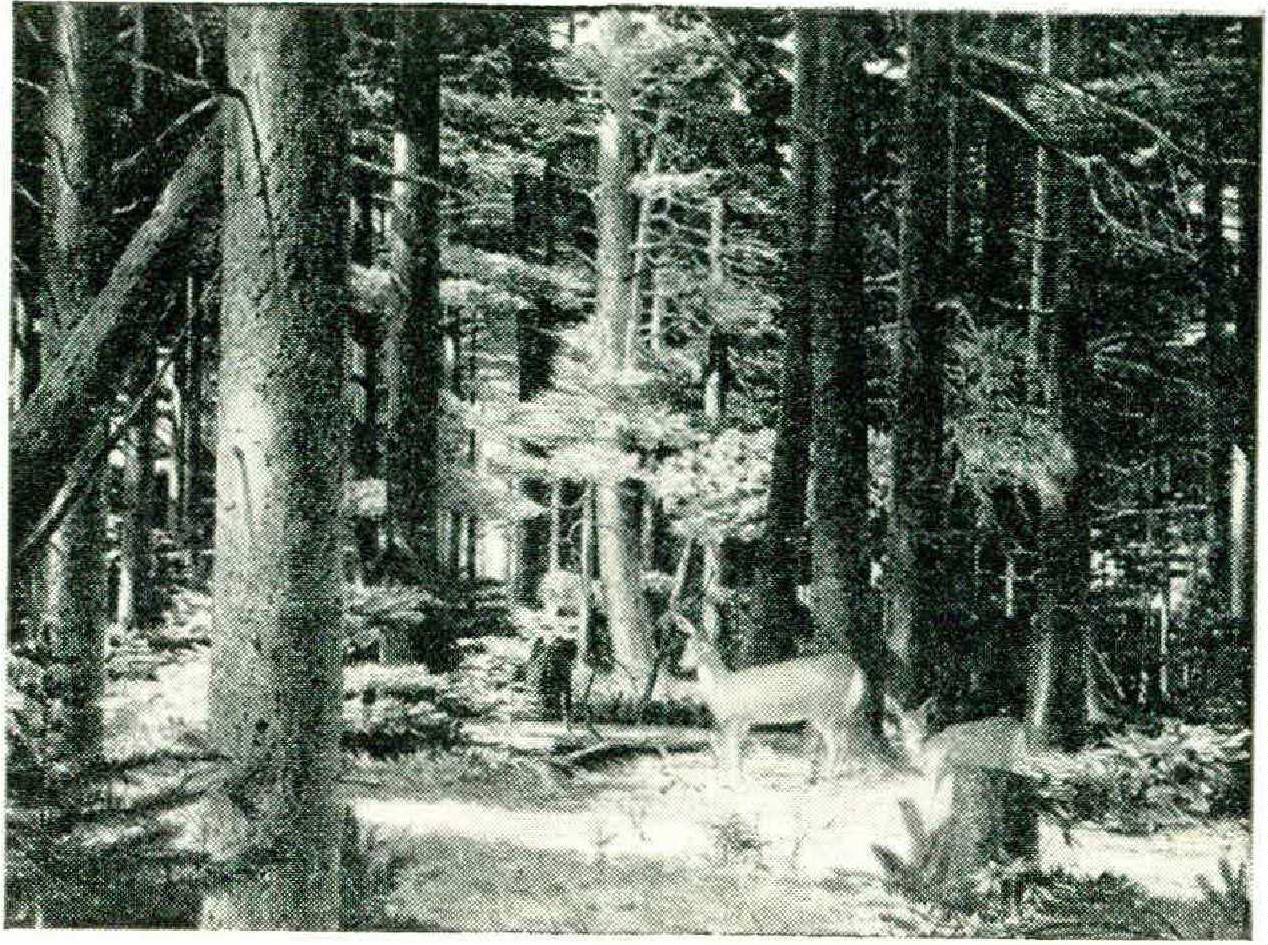
I remember one walk I took along a trail through the rain forest of Olympic National Park, Washington. Cushioned with moss and gay with ferns, the giant trees towered close around, and there was no sound but the drip, drip of water from the foliage. This was the forest primeval, and it seemed the more impressive to realize that it was only a remnant of what once was. Yet, save for the vision of certain public-spirited men and women, these 200-foot Sitka spruces, western hemlocks, red cedars, and Douglas firs would have been leveled. At the time of my visit, in the late 1940s, the local lumber industry had succeeded in having no fewer than eight bills introduced in Congress to sever this forest from the park and make it available for logging. Public opinion became aroused, however; hearings were held; and in the upshot Congress defended the park and not one of the eight bills was passed.
Similarly, in the early 1950s public opinion thwarted the Bureau of Reclamation’s scheme to dam the Green River in Dinosaur National Monument, Utah-Colorado, which would have turned the magnificent canyons of the Green and Yam pa into a reservoir five hundred feet deep and forty miles long.
I hrough the years there have been many attempts by commercial interests to utilize national park and monument lands. Today there is a new menace, the more dangerous for being so human; the pressure of numbers is threatening the validity of the act of 1916 creating the National Park Service. This act directs the service to “conserve the scenery and the natural and historic objects and the wildlife therein and to provide for the enjoyment of the same by such means as will leave them unimpaired for the enjoyment of future generations.”
(Italics mine.) The directives to “leave them unimpaired” and to “provide for the enjoyment of the same” are rapidly becoming irreconcilable.
No one in 1916 could have foreseen the great numbers of people who would visit the parks three or four decades later, to sleep there and to camp. In 1959, 22,392,000 visitors were recorded in the national parks, and 5,269,000 in the national nature monuments, an increase of 14,000,000 over the highest pre-World War II figure. Stated starkly, the question is whether we can continue to provide more beds and more meals and still keep the parks “unimpaired.”
Millions of city dwellers go back to nature at every opportunity. We crave the unfulfilled refreshment and spiritual uplift that only contact with nature can give. Our objective, then, must be to keep the national parks, as nearly as possible, as nature made them, so that they can supply this human need for generations to come. That, clearly, was what Congress meant by the directive to “leave them unimpaired.”
MOUNT MCKINLEY
Let’s see what is happening in Mount McKinley. My wife and I first visited Mount McKinley National Park, Alaska, in June, 1958. We drove the 180-mile round trip to Wonder Lake, and it took all day. We passed through verdant valleys and over barren passes, saw the flower-strewn tundra, encountered birds new to us, and had the thrill of watching a pair of the big Toklat grizzly bears, as well as caribou, Dall sheep, and red foxes. But all of these were only part of our experience. What made that trip even more memorable was that we were driving through a scenically magnificent wilderness unblemished by man except for the road that took us there. The park hotel, headquarters, powerhouse, employees’ dormitory, railroad station — all were at the park’s eastern edge, and as we drove west, our pleasure was enhanced by the knowledge that no hotel, nor visitor center, nor even a power line was out there ahead of us. Nowhere in all that vast rugged landscape was there any impairment of the natural scene.
At the time of our visit, a “development" program was just being started. The road was scheduled for widening and surfacing to take care of traffic coming in over the newly completed extension of the Denali Highway. This widening, including construction of “minor roads and trails,” might have been done at a fraction of the estimated $7,178,600, had it been limited to sheering off the sharper curves and extending shoulders in the narrower places. Twenty miles of the road now have been widened to twenty-six feet, with fills up to twelve or more feet deep. The first visitor center has been built at Mount Eielson, sixty miles out. Except for two or three necessary ranger cabins hidden in the trees, this is the first building to intrude on the park’s heartland wilderness.
Another visitor center is planned close to the hotel for the convenience of guests. This one should suffice for the park, but the planners have other ideas. Their prospectus for Mount McKinley calls for an expenditure of $9,700,000. It says that the development of this park is still in its infancy but that facilities and services are being installed for the fullest enjoyment of the area “by an increasingly mobile public.” This is anything but reassuring. What does the service consider to be an experience of “fullest enjoyment”? The prospectus further says that the program should be carried out so as to maintain “wilderness integrity.” How can such encroachment on the natural scene help to maintain wilderness integrity? Can anything less than the unblemished scene provide a richer experience? Has the point been missed that every man-made intrusion on the scene will reduce the quality of the visitor’s experience? No effort should be spared to retain the ideal conditions that still prevail at Mount McKinley, for here, perhaps more than in any other national park, the two directives of the 1916 act have been kept in close harmony.
THE EVERGLADES
When Everglades National Park, Florida, was established in late 1947, under a 1934 authorization act, the area was an unblemished wilderness except for a few patches of agricultural land on the eastern side and a winding dirt road that ended forty miles away at a little group of weathered fishermen’s shacks known as Flamingo, overlooking Florida Bay. The park was, in fact, as much an unblemished wilderness and wildlife sanctuary as Mount McKinley at the time of our visit.
Newton B. Drury, who was National Park Service director in 1947, said that before starting any development in Everglades, the area would be studied to make sure that whatever was done would not disturb the wildlife, which constituted the park’s principal, and perhaps most fragile, feature.
A new administration came into office in the early 1950, and since then the forty-mile road has been improved and it fills its purpose well; but at its southern end, where the shacks once stood, there is now a fishing-yachting resort of the kind that is a dime a dozen in Florida.
There is a sixty-room motel, a dining room seating two hundred, a marina, fifty-seven boat slips, with dockside electric power and water, accommodating boats up to a hundred feet in length, and a hoist for boats up to five thousand pounds. A channel dug across part of the park’s Florida Bay provides access for yachts. Marine supplies — gas, diesel fuel, bait, tackle, and ice — are for sale.
There is a launching ramp for boats brought in on trailers. Sightseeing trips run daily to the Cuthbert rookery, when the birds are nesting, and to Cape Sable, White Water Bay, and Florida Bay; inboard and outboard boats are for rent with or without guides, as are thirtyand forty-foot selfpropelled houseboats that sleep four to six persons. Fifteenand sixteen-foot Fiberglas boats also are for rent, with or without motors. The supplies and personnel required for this operation must be trucked forty miles through the park.
Is this big commercial resort in accord with the authorization act? Congress specifically directed that the area “shall be permanently reserved as a wilderness, and no development . . . for the entertainment of visitors shall be undertaken which will interfere with the preservation intact of the unique flora and fauna and the essential natural primitive conditions now prevailing in this area.”
Why, may we ask, were the overnight accommodations not located at the park entrance, where they would not interfere with the habitats and feeding areas of the birds — and where, incidentally, the buildings would have been less exposed to hurricanes? A snack bar, a small visitor center, and a quiet launch or two for naturalist-conducted cruises would have been adequate to meet visitor needs at Flamingo, and bird life and the natural scene would have suffered a minimum of disturbance. In September, Hurricane Donna destroyed Flamingo, but it is being rebuilt on the original site as these words are written.
In this comparatively new national park, the National Park Service had an opportunity to show that it had benefited from past mistakes and to demonstrate how a great nature sanctuary should be cared for. Did it?
Even before construction, the Park Service recognized the hazards to wildlife. It also foresaw obstacles such as the need to build land above water level for roads, a limited supply of fresh water, and a serious problem of sewage disposal. To implement the program, the service asked for $12 million, and here, as at Mount McKinley, the new building was part of an overall plan.
When the National Park Service administration took office under President Eisenhower, roads and accommodations throughout the system were inadequate, with the demand for meals and beds far exceeding the supply. On the evening of February 8, 1955, the American Automobile Association and the Department of the Interior sponsored an American Pioneer Dinner in Washington, D.C. The occasion marked the launching of Mission 66, a ten-year park rehabilitation program to be carried out by the National Park Service and to be completed by 1966. The purpose was to provide enough accommodations and facilities inside the parks to take care of an expected 80 million a year by 1966. While the need for action was understandable and the program was widely acclaimed, there were some even within the service who sensed trouble ahead.
YELLOWSTONE
Yellowstone is the scene of one of the most expansive and elaborate of Mission 66 projects. A lodge and cabins were torn down on the south rim of the spectacular canyon of the Yellowstone River. Well rid of the unsightly structures, this beauty spot is being restored to nature; but across the canyon and back in the woodland, a whole new village has been built, complete with lodge, dozens of boxlike cabins for visitors, two two-story dormitories for employees, a concessioner’s office building, store, visitor center, and a large parking area.
As elsewhere, the Park Service built a case to justify this big development. It is said that Yellow - stone is so vast and remote that it cannot be experienced in a single day, and visitors need facilities to enable them to remain in the park either overnight or for a week or more. The park prospectus explains that Yellowstone visitors will reach an estimated two million by 1966 and that overnight accommodations must be expanded from the 8500 capacity of 1955 to 15,000 in 1966; and this calls for increased housing, food, medical supplies, and other services of a “small city.” More visitors’ facilities require more employees. Together with utilities, this project has cost $70 million. Concerning the removal of the earlier development, a Park Service release quoted Director Conrad L. Wirth as saying, “The old development is an intrusion on the natural scene which the Service is charged by law to preserve.” How could the director fail to sec that the new village is an even greater intrusion on the natural scene?
Two more villages are scheduled for the park: Grant Village, to be even larger than Canyon Village, at the west side of Yellowstone Lake; and Firehole Village, near Old Faithful.
One thing leads to another: Up to now, the Park Service and the concessioner have supplied the park’s electricity with thirty diesel-powered generators. Because of the expansion, commercial power, says the service, has become a necessity; and as this is written, Yellowstone’s forests are being cut to make way for power lines, many miles of them — further marring the park’s beauty.
Yellowstone was our first national park, established by Act of Congress in 1872. It was made accessible during the stagecoach era. Long distances and slow travel required that hotels and camps be located at the end of each day’s journey. Today, smooth roads and fast automobiles do away with the necessity to stay in the park overnight; yet the National Park Service still administers it as though we were living in the old days.
GRAND CANYON
On May 6, 1903, according to the Theodore Roosevelt Cyclopedia, our twenty-fifth President wrote, “In the Grand Canyon, Arizona has a natural wonder which, as far as I know is in kind absolutely unparalleled throughout the rest of the world. I want to ask you to do one thing in connection with it in your interest and in the interest of the country — keep this great wonder of nature as it now is. ... I hope you will not have a building of any kind, nor a summer cottage, a hotel, or anything else, to mar the wonderful grandeur, the sublimity, the great loneliness and beauty of the canyon,”
Today, at Grand Canyon Village, the rim is cluttered with buildings — a hotel, lodge, and cabins, souvenir shops, grocery store, garage, gas stations, post office, community hall, railroad and station, mule corral, park headquarters, hospital, and behind these the maintenance shops and concessioner and government residential areas — and a number of new residences are about to be built. Already Mission 66 has had its effect here. The village has been extended eastward a half mile by construction of a new big motel, restaurant, and campground.
With Park Service approval, the village is planned also to be extended westward, where a Shrine of the Ages, a million-dollar church, is proposed to be built on the rim. Opposition to this has been vigorous and nationwide, both as to site and design. In 1955, a Shrine of the Ages Corporation was formed, made up of members of the clergy of three denominations, park concessioners, and members of the National Park Service. A National Chairman’s Steering Committee composed of a number of Arizona businessmen, the clergy, and members of the National Park Service was organized. A National Advisory Board was created, and a nationwide fund-raising drive was launched and has been carried on now for several years, not with entire success.
Dr. Harold C. Bradley, a director of the Sierra Club, one of many groups that opposed the shrine, considered it a highly controversial issue. He questioned whether it would violate the letter of national park law, as well as its spirit, and he warned that we the citizens, owners, and users of the parks, the ultimate dictators of national park policy, need to decide what the future of these dedicated areas is to be, or we shall find ourselves standing by and watching a small but potent pressure group decide that policy for us. He considered that any edifice on or near the rim of the Grand Canyon would be out of place and a distraction, and that a million dollars to clear away the present clutter of structures would be a worth-while investment. Such clearing would conform to a stated objective of Mission 66.
The sprawling village on the south rim should indeed be cleared away, and a new one established a half mile or more back, close to the park ‘s southern boundary. Here the railroad would end and the entrance road would fork to east and west to join the rim road at points perhaps two miles apart. The road between these points would be removed, and the new village would be at the apex of a triangle formed by the forks of the road and the rim. No roads or buildings would mar that triangular area, but a footpath would cross it from the village through the forest to the rim. I like to think of the impact the canyon would have on visitors who, free of urban sights and sounds in the peace and quiet of the forest, would stroll down that path to the rim for their first glimpse of the canyon.
GRAND TETON
Grand Teton National Park, Wyoming, is being given a Mission 66 treatment that is costing an estimated $8,400,000. Plans called for visitor service facilities, expanded campgrounds and picnic areas, improved roads and trails, adequate water, sewage, and other utilities. Much of this has been done.
The largest development in the park is at Colter Bay, on the eastern shore of Jackson Lake. It contains about 150 cabins, a cafeteria, a Laundromat with showers for men and women, a store, snack bar, boat and tackle shop, picnic area, campgrounds, boat dock, unloading ramp, and parking area. The largest single item is a de luxe trailer park, complete with all the comforts of home. Various kinds of boating are provided, including speedboating, with its inevitable accompaniment of water skiing. Not far away is the plush, concessioner-operated Jackson Lake Lodge and cabins, accommodating 1100 guests.
The Park Service considers the Colter Bay development “an inspiring example of what can be accomplished under Mission 66 through cooperative efforts of the federal government and private enterprise”; but where is all this to stop? Arc we to go on spreading the Colter Bay development over an ever-wider area of land dedicated to the preservation of natural conditions? Shall wec someday double the size of Jackson Lake Lodge?
Under Mission 66, too many of the parks are being cluttered with buildings of freak and austere design. No longer are the architects concerned with producing structures of beauty and charm that help to create a proper atmosphere and are inconspicuous and harmonious with their surroundings. Rather, they seem obsessed with designing monuments to their own inventiveness. Widely criticized, these buildings are unlike any others in the parks and are creating a hodgepodge where, instead, there should be uniformity.
There are several parks with buildings of fitting design, such as Shenandoah and the Blue Ridge Parkway. Cecil J. Boty, a Park Service architect, formerly showed good taste. He should be proud of his headquarters and concession buildings at Bandelier National Monument, New Mexico, built in the 1930s. Constructed of simple, inexpensive concrete block faced with stucco, these handsome buildings not only create a suitable atmosphere but also harmonize with the prehistoric Indian dwellings that once existed here. Yet Doty, like many other Park Service architects, has abandoned the appropriate for what is termed “contemporary.” The public, which pays the bill, has a right to demand a return to harmony in park architecture. A national park is not the place for fads and experiments; it should not be intruded upon by eye-catching architectural monstrosities.
In recent years, a number of nonconforming amusements have been finding their way into the national parks. I recall, in the summer of 1952, rowing across Grand Teton’s jenny Lake to explore and photograph the wild western shore. At no time during that otherwise pleasant occasion were we free of the roar of concessioner-operated speedboats. Even the National Park Service, which has been giving way to pressures for resorttype amusements, seems to be showing alarm over the use of powerboats, one of the most destructive enemies of wilderness atmosphere. On August 4, 1959, Yellowstone’s superintendent, Lemuel A. Garrison, described the use of powerboats on Yellowstone Lake in these words: “They create a commotion and a racket that destroys any shred of belief that this is the forest primeval or that it is other than a boating racetrack. The occasional visitor who desires to paddle a canoe along shore or to row quietly is run out of the lake entirely, for these motor boats control and dominate the environment.” And he concluded, “We have unknowingly built up some loathsome messes of camp debris and garbage around the lake from boating camps.”
The service suggested closing the three southern arms — 20 per cent of the lake area — to powerboats. This seemed an excellent way to begin to remedy the problem, and it brought the service nationwide support from those who seek to uphold national park integrity. As would be expected, opposition came from the local boaters, who stirred up such a hue and cry that Senator Gale McGee of Wyoming held a public hearing at Cody, on February 3, 1960.
The service had outlined a development plan to go into effect along with the closing of the southern arms of the lake. Essentially, the suggestion was to build a launching ramp or two and install a number of campgrounds and parking areas to assist boaters. This seemed fair, since powerboats were to be eliminated from only a small part of the lake, at least for the present, and park defenders felt that at last the service recognized its past mistakes.
Then, on June 29, the full scope of what the service had been planning came to light. The service announced that a contract had been let to begin construction of a new development in Yellowstone: a full-scale boating resort, the first phase of which was to cost $354,623 and would involve beautiful little Bridge Bay, south of Lake Hotel and Fishing Bridge.
The development “will be located along a lagoon that runs into the forest from Bridge Bay itself.” says the report, and because the lagoon is shallow, a sixto eight-foot channel will be dredged; but “before this can be done, bulkhead and piling construction must be completed to allow construction of docks and other facilities.” The plan calls for a new bridge and approaches across the neck of the bay, a modern marina for 250 boats, a parking area, access roads, a ranger and information station, and later, overnight accommodations, a store selling camp and boat supplies, a second marina for another 250 boats at Grant Village (the latter to be part of the second phase), campgrounds for boaters, wilderness camps in zoned areas, and a lake patrol. We are told the reason for all this is “to relieve the extreme boating congestion at Fishing Bridge.” Bridge Bay Marina was begun last summer.
These facilities, while they will temporarily relieve congestion, can only serve to entice more boaters. The development, to be far larger than the Flamingo resort in Everglades National Park, must inevitably cast doubt on the sincerity of the service in making its show of alarm in 1959. Were the words of Superintendent Garrison and the proposal to close the lake’s southern arms only a smoke screen to forestall expected objections by supporters of national park integrity when the full scope of the plan would be made known?
With countless lakes, rivers, and coastal areas open to boating of every kind, we seem unable to hold the wilderness atmosphere on the few waters of our national parks by keeping them closed to all but canoes, rowboats, or quiet launches for naturalist-guided sightseeing cruises.
YOSEMITE
The introduction of winter-use facilities — specifically, mechanical ski lifts — in some national parks constitutes another disruption of wilderness atmosphere and of the natural scene.
Yosemite’s Badger Pass ski resort, granddaddy of several national park ski developments, was approved during the previous park administration. Like the others, it is in accord with the service’s revised winter-use policy, adopted in 1946 and reaffirmed in 1953, Here are four T-bar lifts and engine buildings, a restaurant, infirmary, ski rental shop, parking area, and several ski runs cut through the forest. The national parks need no such extraneous diversions or artificial embellishments to make them attractive. They are sufficient in themselves. Preservation of the magnificence that nature has lavished here is the sole reason for their being national parks.
At Yosemite, slalom races are advertised and held every winter in spite of the Park Service s stated policy to keep the parks free of organized competitive sports and spectator events, which attract abnormal concentrations of visitors and require facilities, services, and manpower above those needed for normal operation.
Shall we have resorts or wilderness? In 1953 the Park Service authorized a full-fledged ski area in Rocky Mountain National Park’s Hidden Valley in response to a local chamber of commerce request. In 1954 certain commercial interests in the state of Washington brought pressure for government approval to install a cable tramway to run from Mount Rainier’s Paradise Valley, at 5000 feet elevation, to the 10,000-foot level at Muir Cabin. Rejecting the tramway proposal because of a flood of letters from all over the nation opposing it, the service compromised again with local commercial interests by authorizing a “tandem rope tow 2000 to 3000 feet long; and an advanced slope with several alternate ski runs served by a T-bar lift from 3000 to 5000 feet in length,” in addition to new buildings, a new access road, and a new parking area.
Lassen Volcanic National Park. California, which for some years had a portable rope tow, now has a permanent ski lift, together with buildings and parking area; while Crater Lake, Olympic, and Sequoia national parks have portable rope tows, indicating that, unless this trend is stopped, they too in time will have permanent lifts installed, ski runs cut through their forests, and all the other facilities that are considered necessary for the maintenance of such resorts.
It cost approximately $55,000 to keep the road to Paradise Valley in Mount Rainier open, mostly for local use, during the winter of 1958 to 1959, for instance. Even if such use of the national parks were not a violation of the 1916 act, does limited use by local communities justify this federal expenditure?
All national parks with sufficient snow are open to ski touring and snowshoeing — the winter equivalent of walking the trails in summer; but the installation of mechanical lifts, which attract crowds primarily interested in downhill skiing, is a misuse of the parks and a violation of basic principle.
Yosemite National Park still holds the dubious honor of being the classic example of overdevelopment, and famous Yosemite Valley is the problem spot. Cluttered with buildings, it is a resort amusement center in every sense. According to the park’s Mission 66 prospectus, there is no area in the national park system that is confronted with more difficult and complex man-made problems.
Such is the beauty and cool summer climate of the park that on summer holidays population rises to nearly 70,000 visitors, most of them concentrated in the valley. In Yosemite, through the various seasons, one may participate in dancing, pool swimming, golfing, skating on a man-made rink, and skiing at Badger Pass.
Then there is the firefall. which also draws crowds, and which, like other artificial amusements, has nothing to do with the beauty and wonders of the park and has no rightful place there. Who would dare to say these attractions are not partly responsible for the overcrowding?
The more such pastimes are allowed in the parks, the more difficult it will be to get rid of them, for they are misleading people to regard national parks as resort amusement centers. Speedboats, ski lifts, swimming pools, golf courses, and the like serve only to swell the concessioner ‘s bank account. They have the undesirable effect of drawing people not primarily interested in the parks and encouraging them to stay longer. One does not have to come to a national park to enjoy these facilities. They are abundantly available elsewhere and are as out of place in a national park as a rollerskating rink in the National Gallery of Art would be.
If the service continues to violate its trust as the people’s guardian of the national parks, ceases to recognize preservation of the natural scene, wildlife, and wilderness atmosphere as its foremost duty and responsibility, the upbuilding of the system, as originally conceived through nearly a century, will be lost in all but name.
Road building under Mission 66 has given rise to greater alarm than perhaps any other phase of the program. Disregard of the natural landscape in the construction of the new Tioga Road in Yosemite, for example, has been especially serious. Describing it, a nationally known photographer, Ansel Adams, said: “The old road in a sense ‘tiptoed’ across the terrain; the new one elbows and shoulders its way through the park — it blasts and gouges the landscape.”
True, the twenty-one-mile narrow stretch of the old Tioga mining road needed to be made safe, and Mission 66 gave it priority. Totaling $1, 145,175, the contracts for it involved “clearing, grubbing, excavating and filling,” said a release for July 10, 1957, but no mention was made of the blasting to be done along the shore of beautiful Tenaya Lake and on slopes covered with the polish of ancient glaciers.
There was such a flagrant disregard of natural beauty here, not only in the selection of route but in the right-of-way width, that Sierra Club, and later National Parks Association, officials visited the project with Department of the Interior personnel in an effort to avert further excessive damage. The controversy went on for months, but the net gain amounted to no more than the tightening of two curves that would force speeders to slow to the park speed limit of forty-five miles an hour, a fill across a high granite bowl planned to be twenty-seven feet deep reduced to twelve feet, the grade steepened, and the line moved forty feet farther down the slope. According to the Sierra Club, the view west from Tenaya Basin and north from Clouds Rest has been scarred permanently, and the most spectacular and most exquisite exhibit of glacier polish along the Tioga Road is destroyed for all time.
The first eight miles of Grand Canyon’s south rim road to be reconstructed under Mission 66, in 1956 and 1957, bypassed half a dozen curves of the old road and went almost straight across the country. No attempt was made to follow land contours or to make the road inconspicuous. Credit goes to Director Wirth, who, when he saw the new construction, issued an order in early 1957 that from now on the old alignment must be followed and the new width reduced. Well may we ask what had happened to the service’s road-building policy.
This sampling of Mission 66 in action shows the trend that is occurring throughout the whole national park and monument system and emphasizes the extent to which the taxpayer unknowingly is taking part in the impairment of those masterpieces of nature’s handiwork. To popularize and commercialize the national parks is to cheapen them and to reduce them to the level of ordinary playgrounds. To cherish them for their primeval splendor and give them the kind of protection the pending Wilderness Bill would afford is to realize the enduring value they have for us and those who will follow us.
The enormous increase of park visitors in the future must give us concern. There is only one answer: To adopt now a policy, to be enforced by legislation, to build no more facilities in the heartlands of the parks, and as additional facilities are needed and existing ones become obsolete, to build new ones at the park entrances, either just inside by concessioners or, better, just outside by local private enterprise. In many more instances than at present, local communities could supply the necessities of park visitors and would increase community income by doing so. Local communities which are already doing this and doing it well are Port Angeles, near Olympic, Estes Park, near Rocky Mountain, and Gatlinburg, near Great Smoky Mountains. Several national parks, notably Acadia, Olympic, Kings Canyon, Wind Cave, Great Smoky Mountains, and as yet Mount McKinley, either have no overnight accommodations in them at all or else on their perimeters only; yet these parks are adequately accessible for public enjoyment.
There are those who contend that only 5 per cent of the land in the national parks is developed and that this is so little that it can do no harm, but this argument ignores the very purpose of the areas, The quality of wilderness is fragile. Manmade blemishes anywhere reduce the value of the whole.
Readers whose concern for our national parks has been aroused by this and the following articles are encouraged to write to their representatives in Congress and to the Chairman of the Interior Appropriahons Committee,House Office Building,Washington 25, D.C.