The One-Person Discussion
C. S. JENNISON, who lives with her husband and three daughters in Shelburne, Vermont, writes light verse and prose with equal facility for the ATLANTIC and other magazines.
The other day I had an unsettling experience. I was driving the cleaning woman home and singing to myself, in lieu of conversation. The tune I sang was I’ve Been Working on the Railroad; but, since I was lost in an absent-minded reverie concerning my sins of omission as a housewife, I don’t recall what words I used.
Quite often, while I am driving and singing to myself, I shift the verse of the song around a bit and ad lib, so that the result is somewhat as follows:
All the livelong night.
I forgot to clean the cellar.
Golly, it’s a sight.
Rise up and clean the cellar good.
Call the garbageman and trashman.
Also order wood.
Now this kind of lyric is all very well when I am alone, but it is not the sort of thing I plan to sing in front of casual acquaintances. When the cleaning woman got out of the car — rather more hastily than usual, it seemed to me — I wasn’t certain whether I had just thought the words or whether I had actually sung them. The worst of it is, I’ll probably never know.
This substitution of song lyrics, though not dire enough to warrant my being institutionalized, is only a hop and a quick dance step removed from the more serious offense of talking to myself, which I also do. My indulgence in the latter practice is something I keep pretty well curtailed in the summer months, when the house is full of people. Around the middle of October, however, when the children are back in school and the doors and windows are closed against the eavesdropping of chance visitors, I gradually slip back into the habit of lone discussion. My autumn approach to the renewal of this vice is circuitous and, I suppose, sneaky.
I generally begin by talking to the dog.
“Well, Bruce,” I remark casually, “shall I bake brownies for the PTA or not? What do you think?”
All I have to do is mention Bruce’s name, and he thumps his tail and looks steadily at me, thereby giving the impression of undivided attention.
“Of course,” I continue, “if I simply forget the brownies, I won’t be asked to bake them again. Did you ever think of that?”
There is a short silence, during which Bruce eyes me reproachfully.
“Oh, all right,” I say, lighting the oven, “I’ll bake them. But you know what will happen from now on, don’t you? I’ll be making brownies every week. There’s nothing more foolhardy than being dependable.”
During the last weeks of October and the early part of November, I refer to myself in the first person singular and am careful to address the dog. Occasionally, in spite of its low audience reaction, I even direct my remarks at the cat. But as fall progresses into winter and my inhibitions diminish, I eventually throw caution to the winds and slip into the second person singular.
“Let’s see,” I remind myself aloud, “you ought to write that thank-you note to Louise today. And the silver needs shining. Remember, the Smiths are coming to dinner tomorrow. You’d better do the silver first.”
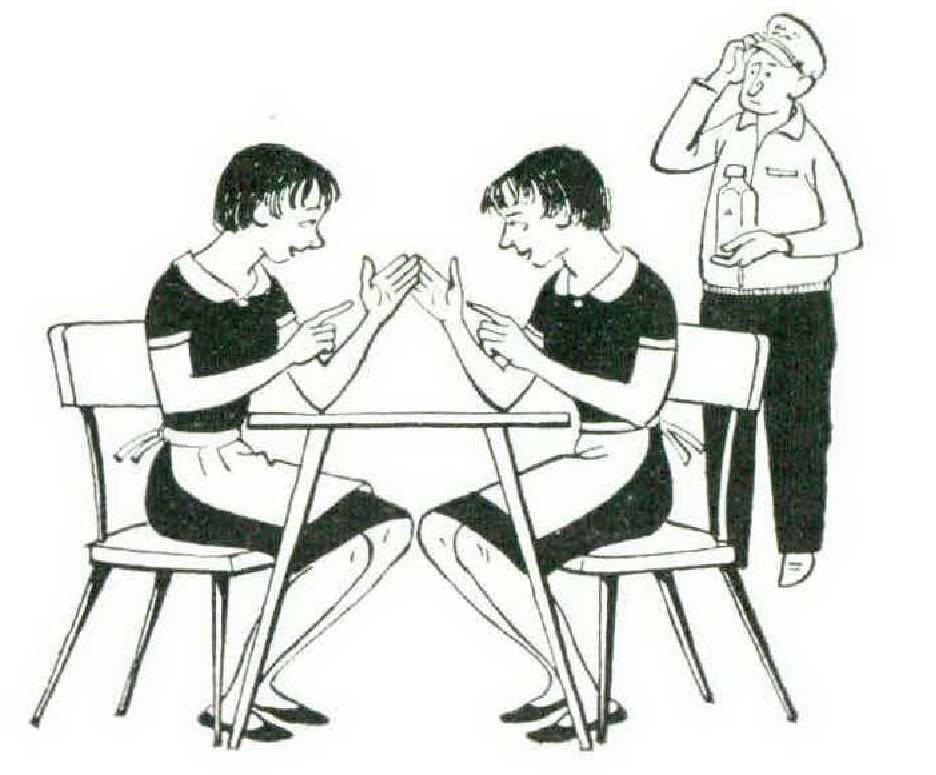
By February I probably vary this monologue by adding, “Yes, I guess you’re right.” After a long, lonely winter, the worst has happened. I am carrying on both parts of a spirited, if uninspired, two-way discussion.
For the most part, I proceed with confidence, secure in the belief that my little dialogues are my own business. But awkward occasions do arise from time to time. At least twice a winter, the milkman clatters in unannounced while I am conversing with the steam iron. In a situation of this sort, I find the easiest way to save face is to hurriedly turn the conversation into a hum. If the milkman is too fast for me or I get too rattled to think up a tune, I try to create the impression that I am speaking to some unseen member of the family lurking around the corner in the dining room. I suppose if I wanted permanently to avoid embarrassment, I could join the local theater guild and pretend I was rehearsing a part in a forthcoming play. But it seems like a lot of trouble to go to just to fool the milkman.
Socially, solitary talking seems to fall into much the same category as solitary drinking. I imagine a poll of lone conversationalists would turn up three main groups. The first and largest would be the Certainly Not or Teetotaler group. The second would be composed of individuals who admit to swearing at the washing machine when it breaks, alcoholically known as the Sometimes-Itake-a-glass-of-sherry group. In the last group would be the incorrigibles like me — in short, the real Skid Row solitary talkers.
Frankly, I cannot see any reason for the stigma that has heretofore been attached to one-person discussions, and I feel I am doing the world a service, getting the subject out in the open, where it can be reappraised. I, myself, intend to go on freely admitting to my little domestic dialogues with my invisible alter ego. Sure I talk to myself. You wouldn’t want me to go around talking to just the empty house, would you? People would think I was queer.