The Cat Hotel
PAUL JACOBS is staff director of the Fund for the Republic Trade Union Project and has written articles and books about labor. He is a staff writer for the REPORTER and a correspondent for the ECONOMIST.
Julius, our cat, who is at least eight years old, received his first Christmas card this year. It came, naturally enough, from Los Angeles and was sent to him by the owner of a cat hotel where Julius had been a guest for some months while my wife and I were out of the country last spring.
The cat hotel had come to our attention while I was searching through the Los Angeles classified telephone directory for the number of a cat motel where we were considering leaving Julius while we were gone. But somehow, since Julius was going to live there for four months, a cat hotel sounded more substantial than a motel, with its obviously transient, flighty, overnight trade.
After talking to the hotel proprietor on the phone, I was convinced that my assumption had been correct. There was only a slight twinge of doubt in my mind, growing from the owner’s assuring me that my “kid” would be very well cared for in our absence. After all, I pointed out to my wife, a kid is one thing and a cat another, and the two really shouldn’t be confused. But on the other hand, it was also obvious that anyone who thought of cats as kids would probably take good care of his charges.
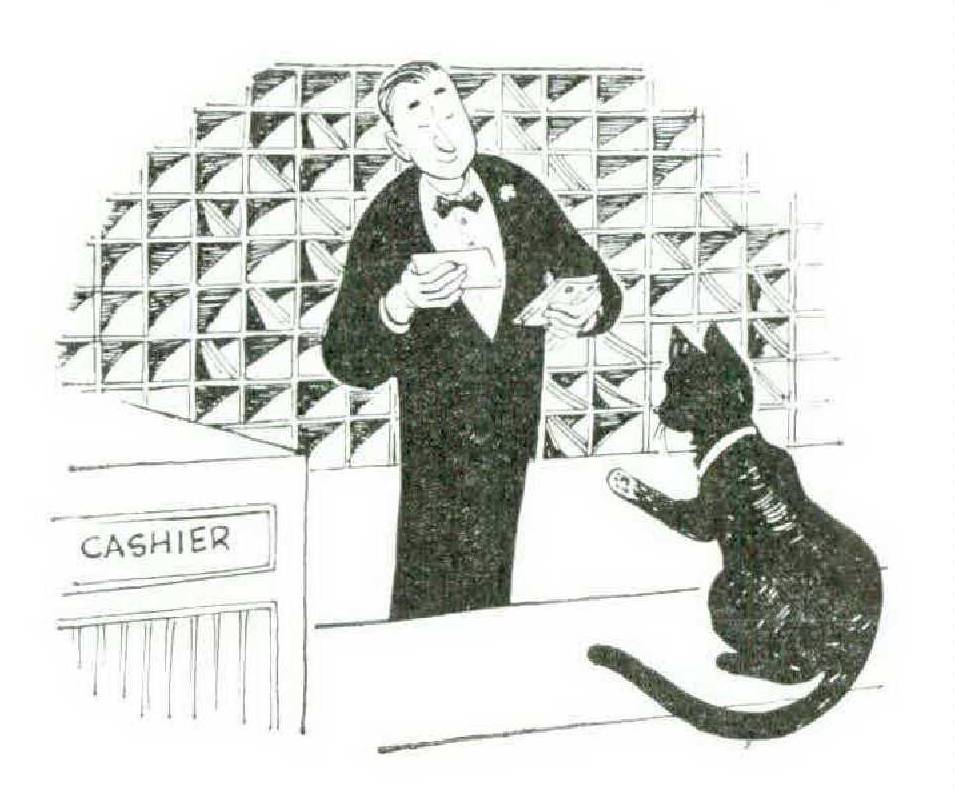
This turned out to be completely accurate. When I took Julius, protesting, to the hotel in West Los Angeles, the hotelier took me on an inspection tour of the premises after having first admired Julius, telling him how happy he would be with the rest of the kids, and congratulating me on having such a finelooking kid.
Julius’ accommodations were, indeed, almost elegant. He had a large cage, described at the hotel as a private room, complete with his own tree stump and a shelf for sleeping. He also had a long runway outside the room for promenading and patio privileges, this latter shared with a number of other cats, all of whom sat contentedly warming themselves under the California sun in the closed-off patio area.
Before we left the patio, the hotel operator insisted on introducing me to a few of his more select guests, including one cat that he was especially proud to have staying with him. This cat, unlike Julius, had both a first and last name, and I shall call him Henry Adler, although this is not his real identity. Henry, I was informed, knew many movie stars and always spent his owners’ vacations at the cat hotel.
After paying for Julius’ room and board in advance, which seemed perfectly reasonable to me, I left the hotel grounds content in the knowledge that Julius was in the best of hands. For the next four months my wife and I traveled outside the country, only occasionally thinking of Julius but never doubting for a moment that the kid was being well cared for and was probably fairly happy. Once, in fact, while on a lovely Greek island, I did transmit greetings to Julius via another cat who regularly sat beneath my chair when we dined at a wharfside café. But, I must confess, this was our only contact with Julius during the entire trip, and I am not sure he got my message.
Before leaving Los Angeles, where we had lived for ten years, for Europe, we had sold our house and put all our possessions into storage in preparation for moving our residence to San Francisco when we returned to the country. When we finally did get back to the United States, we stopped in Los Angeles overnight to visit friends. I called the cat hotel to tell the hotelier that we had returned and would want him to send Julius up to San Francisco as soon as we had rented a house there.
“How is Julius?” I asked after identifying myself.
“Great,” was the answer. “The kid’s just great. We had a birthday party yesterday for Henry Adler, and f took some great pictures of the kids. I got a wonderful shot of your kid, and I’ll send it to you after it’s developed.” Suddenly, his voice changed. “Say,” he said accusingly, “you were gone for four months.”
“Yes,” I answered, “but we paid you in advance for the whole trip. Do we owe you any more money for Julius?”
“Oh, it’s not the money I’m thinking about. Here you were gone four months and you never wrote Julius even once! Not even once! And Henry Adler got a post card or a letter almost every day!”
Shame flooded me, followed by guilt. Immediately, I conjured up a vision of mail call, like at camp or in the army, with all the kids lined up waiting for their letters. Every day something had come for Henry Adler or one of the others, but never even a postal card for poor Julius, who obviously must have felt rejected and unwanted.
Weakly, I made a few feeble excuses, explaining that I had never been a good correspondent but that I had really thought about Julius often. And, gladly, I escaped from the reproving phone after assuring the hotel owner that I would send for Julius just as soon as we had rented a house.
Three weeks later, I wrote to the hotel and asked that Julius be sent up to us when convenient, since we had found a house. Three days later, a telegram arrived from the keeper of the kids, informing me that Julius would arrive on a flight the next afternoon and peremptorily ordering me to meet him at the airport.
The next day I was at the airport in plenty of time, awaiting Julius’ arrival. It was only after the plane had taxied to a stop, the door opened, and the very last passenger filed down the steps that I suddenly realized Julius had probably traveled as cargo, rather than occupying a seat next to the window from which he could look down at the California countryside.
I rushed to the air freight office and there found Julius inside a cat carrier case. Moments later, I signed a receipt for “one cat, orange” and left with Julius, who had been given a sleeping pill and tucked into a pillow inside the carrier box.
On the surface, at least, Julius seems perfectly adjusted to our new San Francisco home. Nevertheless, I do not intend to tell him that he received a Christmas card from the cat hotel. It may not be nice of me to keep this information from him, but I see no reason to bring back unpleasant memories of the fourmonth period when he didn’t receive a single letter or post card from us. What good would it do, anyway, to remind him of those bad days?