A Touch of Autumn in the Air
SEAN O’FAOLAIN, unlike many of the leading Irish writers of this century (including George Bernard Shaw and James Joyce), has elected to remain in Ireland. He is a Dubliner who is generally regarded as one of the very best short-story writers of our time and is a sympathetic yet realistic interpreter of contemporary Irish life.
A Story by Sean O’Faolain

IT WAS, of all people, Daniel Cashen of Roscommon who first made me realize that the fragments of any experience that remain in a man’s memory, the bits and scraps of a ruined temple, are preserved from time not at random but by the inmost desires of his personality.
Cashen was neither sensitive nor intelligent. He was a caricature of the self-made, self-educated nineteenth-century businessman. Some seventy years ago he had set up a small woolen factory in County Roscommon which, by hard work from early morning to late at night and by making everybody around him work at the same pace, he developed into a thriving industry which he personally owned. His Swansdown Blankets, for example, were the only kind of blankets my mother ever bought. Though old when I made his acquaintance, he was still a powerful horse of a man, always dressed in well-pressed Irish tweeds, heavy countryman’s boots, and a fawn, flattopped bowler hat set squat above a big, red, square face, heavy handle-bar mustaches, and pale-blue, staring eyes of which one always saw the complete circle of the iris, challenging, concentrated, slightly mad.
One would not expect such a man to say anything very profound about the workings of the memory, and he did not. All he did was to indulge in a brief burst of reminiscence in a hotel foyer, induced by my casual remark that it was a lovely, sunny day outside but that there was a touch of autumn in the air. The illuminating thing was the bewildered look that came into those pale, staring eyes as he talked. It revealed that he was much more touched and troubled by the Why of memory than by the Fact of memory. He was saying, in effect: Why do I remember that? Why do I not remember the other thing? For the first time in his life something within him had gone out of control.
What he started to talk about was a holiday he spent when just under fifteen in what was at that time called the Queen’s County. It had lasted two months, September and October. “Lovely, sunny weather, just like today.” What had begun to bother him was not so much that the days had merged and melted together in his memory — after so many years that was only natural — but that here and there, from a few days of no more evident importance than any other days, a few trivial things stuck up above the tides of forgetfulness. And as he mentioned them I could see that he was fumbling, a little fearfully, toward the notion that there might be some meaning in the pattern of those indestructible bits of the jigsaw of his youth, perhaps even some sort of revelation in their obstinacy after so much else had dropped down the crevices of time.
He did not come directly to the major memory that had set his mind working in this way. He mentioned a few lesser memories first, staring out through the revolving glass doors at the sunny street. There was the afternoon when, by idle chance, he leaned over a small stone bridge near Uncle Bartle’s farm and became held for an hour by the mesmerism of the stream flickering through the chickweed. As could happen to a great number of busy men, who normally never think at all about the subjective side of themselves and are overwhelmed by the mystery of it if once they do advert to it, he attached an almost magical import to the discovery that he had never forgotten the bright pleasure of that casual hour.
“No, John! Although it must be near sixty years ago. And I don’t believe I ever will forget it. Why is that?”
Of course, he admitted modestly, he had a phenomenal memory, and to prove it he invited me to ask him the telephone numbers of any halfdozen shops in town. But, yet, there was that red hay barn where he and his cousin Kitty Bergin played and tumbled a score of times — it was a blur.
“I can’t even remember whether the damn thing was made of timber or corrugated iron!”
Or there was the sunken river, away back on the level leas, a stream rather than a river, where one warm September Sunday after Mass he saw, with distasteful pleasure, the men splashing around naked, roughly ducking a boy who had joined them, laughing at his screams. But, whereas he also still possessed the soft, surrounding fields, the imperceptibly moving clouds, the crunch of a jolting cart far away, the silence so deep that you could have heard an apple falling, he had lost every detail of the walk to and from the river, and every hour before and after it.
A less arrogant man might have accepted the simple explanation that the mind wavers in and out of alertness, is bright at one moment, dim at the next. Those mad, round irises glared at the suggestion that his mind could at any time be dim. He pointed out that he knew the country for miles around, intimately, walking it and cycling it day after day; what clung to him of it all, like burrs, were mere spots — a rusty iron gate falling apart, a crossroads tree with a black patch burned at its base, an uneventful turn off the main road, a few undistinguished yards of the three miles of wall around the local demesne. He laughed scornfully at my idea that his mind became bright only for those few yards of wall.
“Well, perhaps it became dim then? You were thinking hard about other things up to that point in your walk?”
Here he allowed his real trouble to expose itself. He had not only remembered pointless scraps, but, I found, those scraps had been coming back to him repeatedly during the last few days with a tormenting joy; so that here he was, an old map, fondling nothings as lovingly as if he were fondling a lock of a dead woman’s hair. It was plain, at last, that he was thinking of all those fragments of his boyhood as the fish scales of some wonderful fish, never to be seen, sinuous and shining, that had escaped from his net into the ocean.
WHAT had started him off was simple. A few mornings before our meeting, fine and sunny too, he had happened to go into a toy shop where they also sold sweets. He was suddenly transfixed by the smell peculiar to these shops — scented soaps, the paint on the tin toys, the sprayed wooden trucks, the smell of the children’s gift books, the sweetness of the sweets. At once he was back in that holiday, with his cousin Kitty Bergin, on the leas behind her father’s farmhouse (his Uncle Bartle’s), one sunny, mistified October morning, driving in a donkey cart down to where his uncle and his cousin Jack were ditching a small meadow that they had retrieved from the rushes and the bog water.
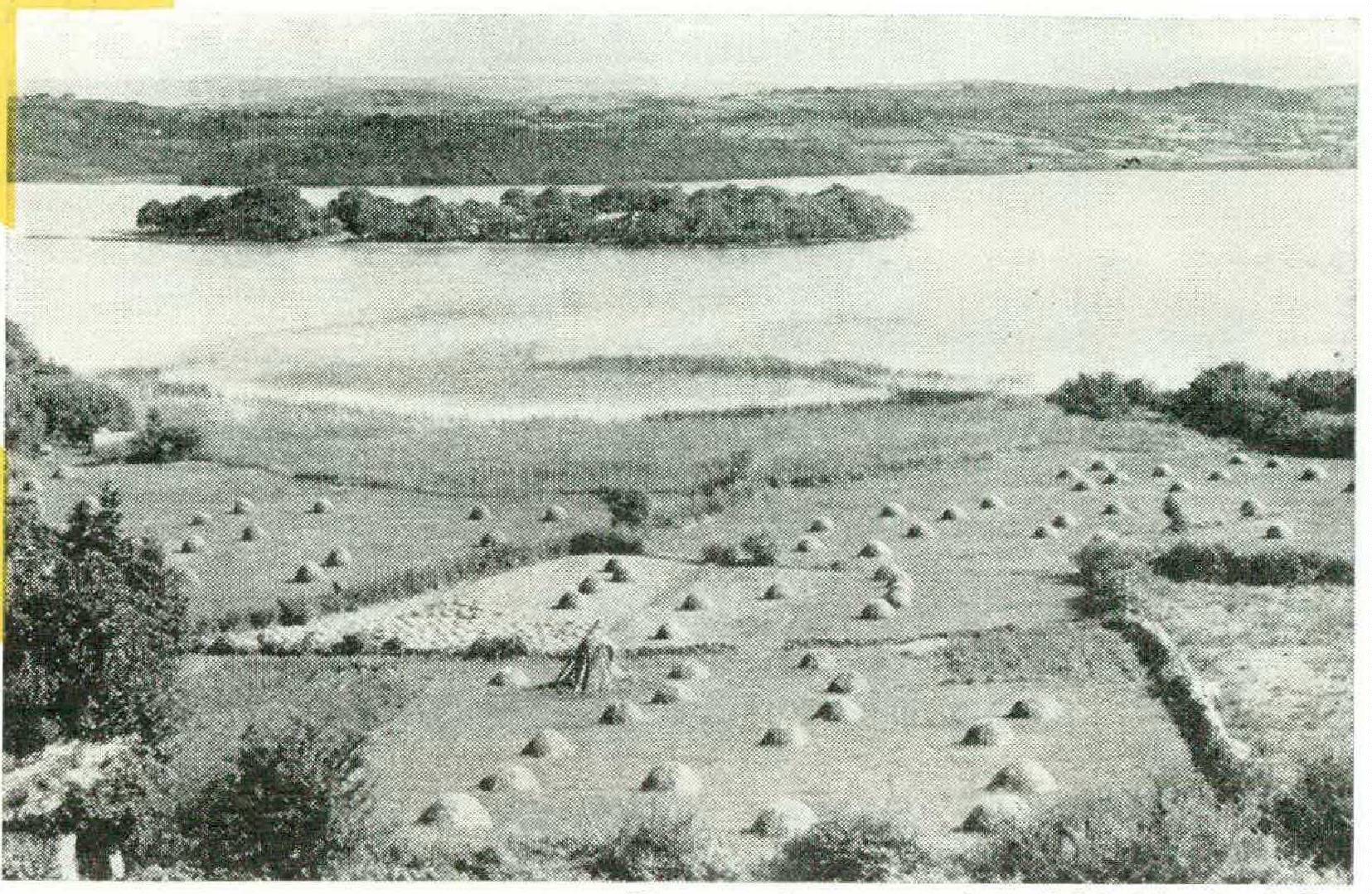
As Kitty and he slowly jolted along the rutted track, deeper and deeper into this wide, flat river basin of the Barrow, whose hundreds of streams and dikes feed into what, by a gradual addition, becomes a river some twenty miles away, the two men whom they were approaching looked so minute on the level bog, under the vast sky, that Dan got a queer feeling of his own smallness in observing theirs. As he looked back, the white, thatched farmhouse nestling into the earth had never seemed so homely, cosy, and comforting.
Ferns crackled at the hub. When he clutched one, its fronds were warm but wet. It was the season when webs are flung with a wild energy across chasms. He wiped his face several times. He saw dewdrops in a row in mid-air, invisibly supported between frond and frond. A lean swath of mist — or was it low cloud? — floated beneath far hills. Presently they saw behind the two men a pond with a fringe of reeds. Against an outcrop of delicately decayed limestone he saw a bent hawthorn in a cloud of ruby berries. Or could it have been a rowan tree? The sky was a pale green. The little shaven meadow was as lemon-bright as fallen ash leaves before the dew dries on their drifts, so that it would have been hard to say whether the liquid lemon of the meadow was evaporating into the sky or the sky melting down into the field.
They were on a happy mission. Mulvaney the postman had brought two letters to the farmhouse from two other sons: Owen, who was a pit manager in the mines at Castlecomer, and Christopher (who was, out of respect, never referred to as Christy), then studying for the priesthood in a Dublin seminary. Aunt Molly had sent them off with the letters, a jug of hot tea, and thick rounds of fresh, homemade bread and homemade apple jam smelling of cloves, a great favorite of Uncle Bartle’s. They duly reached the two men, relieved the donkey of bridle and bit, and winkers, so that he could graze in the meadow, spread sacks to sit on, and while Kitty poured the tea into mugs Bartle reverently wiped his clayey hands on the sides of his trousers and took the letters. As he read them aloud in a slow, singsong voice, like a man intoning his prayers, it was clear that those two sons had gone so far outside his own experience of the big world that he stood a little in awe of them both. It was a picture to be remembered: the meadow, the old man, the smoke of the distant farmhouse, patriarchal, sheltered, simple.
When he laid down the letter from the priestto-be he said: “He’s doing well. A steady lad.”
When he had read the letter from the mines he said: “He’s doing fine. If he escapes the danger he will go far.”
While Jack was reading the letters Kitty whispered to Danny, thumbing the moon’s faint crescent: “Look! It says D for Danny.”
“Or,” he murmured to her boldly, “it could be D for Dear?”
Her warning glare toward her father was an admission.
“I see here,” Jack commented, while his father sucked at the tea, “that Christopher is after visiting Fanny Emphie. Her name in religion is Sister Fidelia.”
Dan had seen this girl at the Curragh Races during the first week of his holidays, a neighbor’s daughter who, a few weeks later, entered the convent. He had heard them joking one night about how she and Christopher had at one time been “great” with one another. He remembered a slight, skinny girl with a cocked nose, laughing, moist lips, and shining white teeth.
“Read me out that bit,” Bartle ordered. “I didn’t note that.”
“ ‘I got special leave from the President to visit Sister Fidelia, last week, at Saint Joachim’s. She is well and happy but looked pale. She asked after you all. Saint Joachim’s has nice grounds but the trams pass outside the wall, and she said that for the first couple of weeks she could hardly sleep at all.’ ”
The two men went on drinking their tea. It occurred to Dan that they did not care much for Fanny Emphie. He saw her now in her black robes walking along a graveled path under the high walls of the convent, outside which the trams at night drew their glow in the air overhead. It also occurred to him, for no reason, that Kitty Bergin might one day think of becoming a nun, and he looked at her with a pang of premonitory loss. Why should any of them leave this quiet place?
“Ha!” said old Bartle suddenly, and winked at Danny, and rubbed his dusty hands, and drew out his pipe. This meant that they must all get back to work.
Kitty gathered up the utensils, Danny tackled the donkey, the others went back to their ditching, and she and Danny drove back to where the fern was plentiful for bedding. Taking two sickles, they began to rasp through the stalks. After a while she straightened up, so did he, and they regarded one another, waist-deep in the fern.
“Do you think,” she asked him pertly, “would I make a nice nun?”
“You!” he said, startled that the same thought had entered their heads at the same time.
She came across to him, slipped from his pocket the big blue handkerchief in which the bread had been wrapped, cast it in an arc about her fair head, drew it tightly under her chin with her left hand, and then with a deft peck of her right finger and thumb cowled it forward over her forehead and her up-looking blue eyes.
“Sister Fidelia, sir.” she curtsied, provokingly.
He grappled with her as awkwardly as any country boy paying the sort of homage he thought was expected of him, and she, laughing, wrestled strongly with him. They swayed in one another’s arms, aware of each other’s bodies, until she cried, “Here’s Daddy,” and when he let her go mocked him from a safe distance for his innocence. But as they cut the fern again her sidelong glances made him happy.
They piled the cut fern into the cart, climbed on top of it, and lay face down on it, feeling the wind so cold that they instinctively pressed closer together. They jolted out to the main road, and as they ambled along they talked, and it seemed to him that it was very serious talk; but he forgot every word of it. When they came near the crossroads with its little sweetshop they decided to buy a halfpennyworth of their favorite sweets, those flat, odd-shaped sweets — diamonds, hearts, hexagons — called conversation lozenges because each sweet bore on its coarse surface a ring-posy in colored ink, such as Mizpah, Truth Tries Troth, Do You Care?, or All for Love. Some bore girls’ names, such as Gladys or Alice. His first sweet said, Yours in Heart. He handed it to her with a smile; she at once popped it into her mouth, laughing at his folly. As they ambled along so, slowly, chatting and chewing, the donkey’s hoofs whispering through the fallen beech leaves, they heard high above the bare arches of the trees the faint honking of the wild geese called down from the North by the October moon.
IT WAS to those two or three hours of that October morning many years ago that he was whirled back as he stood transfixed by the smells of the sweets-and-toys shop. Forgetting what he had come there to buy, he asked them if they sold conversation lozenges. They had never heard of them. As he turned to go he saw a nun leafing through the children’s gift books. He went near her and, pretending to look at a book, peered under her cowl. To his surprise she was a very old nun. On the pavement he glanced up at the sky and was startled to see there the faint crescent moon. He was startled because he remembered that he had seen it earlier in the morning, and had quite forgotten the fact.
He at once distrusted the message of his memory. Perhaps it was not that the smells had reminded him of little Kitty Bergin eating Yours in Heart, or pretending to be a nun, or wrestling with him in the fern. Perhaps what had called him back was the indifference of those two men to the fate of the young nun. Or was there some special meaning for him in those arrowing geese? Or in the cosy, sheltered little farmhouse? Maybe the important thing that day had been the old man humbly reading the letters. Why had the two men looked so small under the open sky of the bogland? “D,” she had said, “for Danny. . .”
As he stared at me there in the hotel foyer my heart softened toward him. The pain in his eyes was the pain of a man who has begun to lose one of the great pleasures of life in the discovery that we can never truly remember anything at all, that we are for a great part of our lives at the mercy of uncharted currents of the heart. It would have been futile to try to comfort him by saying that those currents may be charted elsewhere; that even when those revolving glass doors in front of us flashed in the October sun the whole movement of the universe since time began was involved in that coincidence of light. Daniel Cashen of Roscommon would get small comfort out of thinking of himself as a little blob of phosphorescence running along the curl of a wave at night.
And, then, by chance, I did say something that comforted him, because as he shook hands with me and said he must be off, I said, without thinking: “I hope the Blankets are doing well?”
“Aha!” he cried triumphantly. “Better than ever!” And tapped his flat-topped hat more firmly on his head and whirled the doors before him out into the sunny street as imperiously as any man accustomed to ordering everything that comes his way.
Through the doors I watched him halt on the pavement. He looked to the right, and then toward his left, and then, slowly, up around the sky until he found what he was looking for. After a few moments he shivered up his shoulders around his neck, put his two hands into his pockets, and moved very slowly away, out of sight.
Poor man, I thought when he was gone; rash, blunt, undevious man — yet, in his own crude way, more true to life than his famous French contemporary who recaptured lost time only by dilating, inventing, suppressing, merging such of its realities as he could recall, and inventing whatever he could not. Cashen was playing archaeology with his boyhood, trying to deduce a whole self out of a few dusty shards. It was, of course, far too late. My guess was that of the few scraps that he now held in his hands the clue lay not so much in the offer of love and the images of retirement, the girl’s courtship, the white farmhouse snuggling down cosily into the earth under the vast dome of the sky, and the old man left behind by his sons, as in the challenging sight of his own littleness on that aqueous plain whose streams barely trickled to the open sea. He said he hadn’t thought of it for sixty years. Perhaps not. But he was thinking of it now, when the adventure was pretty well over. As it was.
A week later a friend rang me up and said, “Did you hear who’s died?” I knew at once, but I asked the question. The voice over the telephone said, “Daniel Cashen.”
He left nearly a hundred and fifty thousand pounds — a lot of money in our country—and, since he never married, he divided it all up among his relatives by birth, most of them comparatively poor people and most of them living in what used to be called, in his boyhood, the Queen’s County.
Oh, yes. . . . He may have been what we would nowadays call a kind of schizophrenic; but I like to think, at least I hope, that at the end he put the two halves of his broken globe together and made of them a complete round — all at the flick of a memory, a faint touch of autumn in the air.