The Fragrance of Pines
A Siberian who attended the Institute of Forestry in St. Petersburg. NICHOLAS T. MIROV immigrated to the United States after World War I and earned his graduate degrees at the University of California. For the past thirty years he has been affiliated with the California Forest and Range Experiment Station in Berkeley and in 1958 received a gold medal from the Secretary of Agriculture for his work on pines.
NICHOLAS T. MIROV
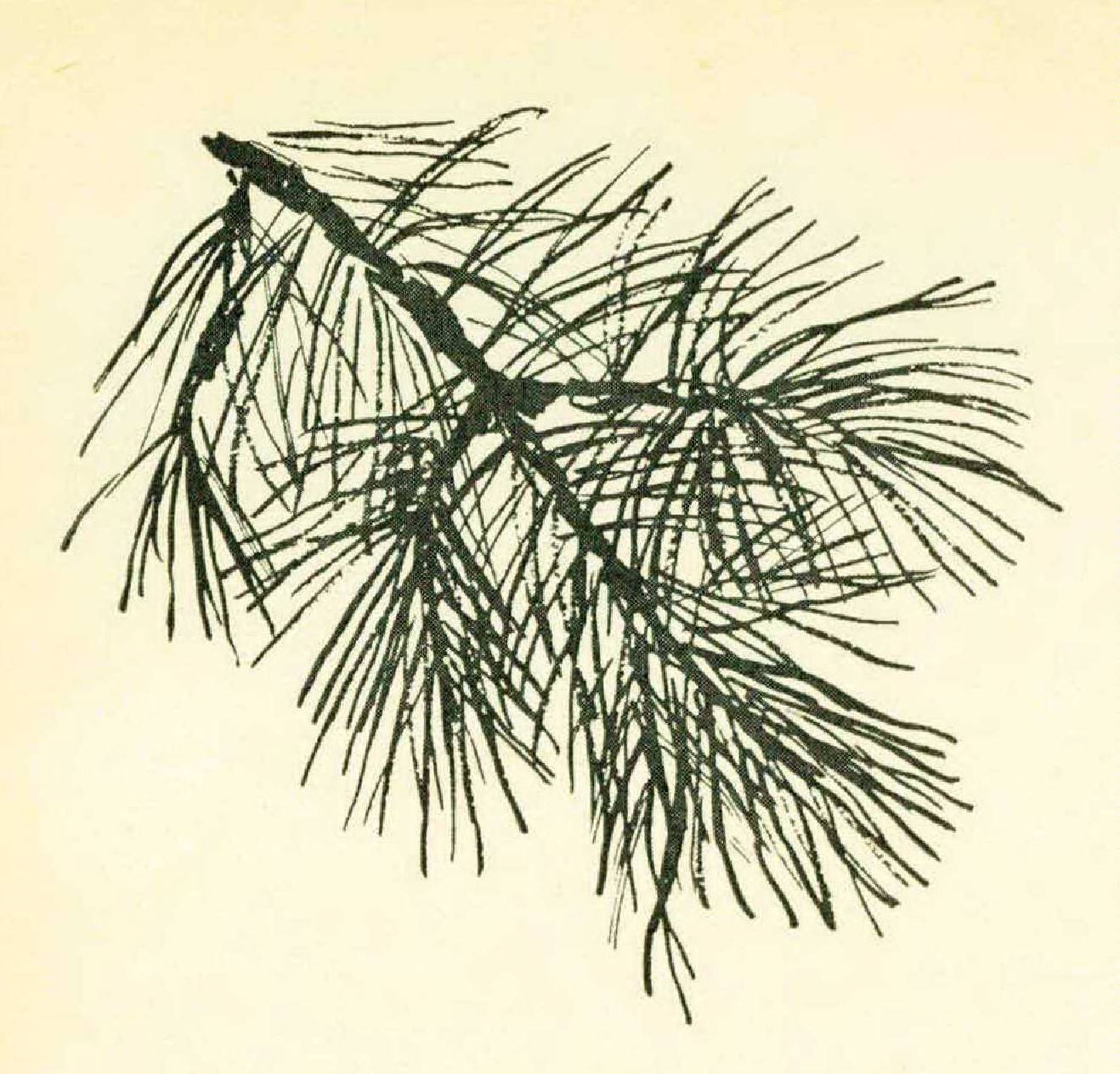
WALKING through a pine forest on a hot summer day, or sitting by a campfire made of pitchy pine wood, perhaps you have wondered why pine trees smell “so good.” Their tangy fragrance is reminiscent of something that is difficult to describe but unforgettable — almost nostalgic.
Pines do not possess bright flowers; they are not frequented by bees and butterflies. They do not need an alluring aroma to attract insects to assure their pollination. Their pollen is discharged from small, inconspicuous catkins; gentle breezes carry golden clouds of pollen grains from one pine tree to another, to those destined to produce seeds. Maeterlinck once called grains of pollen “those kisses of distant and unknown lovers.” Foresters call those distant trees pollen parents.
The fragrance of pines is primeval. Compared to flowering plants, pines stand low on the scale of evolution. When they originated some 200 million years ago, fragrance had not yet developed to that exuberant degree which we find in flowers — in lilacs, in violets, or in mignonettes. In flowering plants there are hundreds of fragrant substances; in pines there are just a few.
The aroma of flowering plants is a complex blend of alcohols, esters, aldehydes, ketones, and many other oxygen-containing compounds. The fragrance of pines comes from much simpler molecules of hydrocarbons called terpenes, with a mere sprinkling of oxygenated, more odoriferous derivatives. The difference between the fragrance of flowers and the fragrance of pines is about the same as the difference between an aquarelle painting and a wood engraving. In one the desired effect is achieved by using a palette of many brilliant colors; in the other the artist is limited to the black and white and to the elegance of his graver’s strokes.
The fragrance of pine trees comes both from their bristly emerald crowns and from their predominantly brown trunks. The fragrance of pine foliage is derived from essential oils emanating from the small breathing pores of the needles. The hotter the weather, the more essential oil is discharged to the atmosphere. The composition of pine needle essential oil is very simple: mostly a pine terpene appropriately called pinene; to which sometimes is admixed another terpene, limonene, a common ingredient of citrus rind essential oil; and a dash of a terpene alcohol, borneol; and a couple of its esters. The result of this blend is a delicate and ephemeral piny fragrance.
The evanescent nature of pine needle oil is caused by its volatility. If you put a drop of pine essence on your handkerchief, the oil disappears almost at once without leaving a trace of scent. It lacks what perfume manufacturers call fixatives those substances like ambergris which hold essential oil, releasing it but gradually.
Pine trunks also exhale essential oil, but in addition they exude resin. A minute injury to a tree, a tiny hole bored by a busy barkbeetle, a small wound made by a restless woodpecker, a wind-broken branch — all these unavoidable adversities cause resin to ooze from pine trees. Sometimes, perhaps too much pressure inside the tree’s resin passages may force droplets of resin to the surface of branches, cones, and even the trunk itself. These little pendants of resin hang on the tree, refracting sunlight, breaking it into rainbows of color, and giving off a piny fragrance.
Resin, as it comes from pine trees, consists of three kinds of substances: volatile oil, commonly called turpentine; the nonvolatile part called rosin; and the high-boiling ingredients, which theoretically are volatile but which evaporate very slowly. They not only hold back the volatile oils, causing them to be more lasting, but they also, as perfume fixatives, have an unexplained and almost mysterious power to bring forth the full fragrance of the volatile ingredients and to soften their harshness. These natural fixatives also give off, themselves, a faint and pleasant fragrance— just like the fixatives of the perfume industry. The fixatives become more volatile with the increase of the outside temperature. When pitchy pine wood is burned, not only the volatile oils but also the fixatives evaporate completely, and the rosin itself begins to sizzle and burn and decompose, giving off its fragrance of incense. The Maya Indians of Guatemala still use pine rosin as an incense in their religious rituals. The Aztecs called Teocote pine the pine of the gods, and to burn its rosin was a privilege of priests and kings.
Volatile oil composition is different in each of the hundred existing pine species. In some it is very simple, consisting of the two most common terpenes, alpha and beta pinenes. It is sold in stores as paint thinner under the name of turpentine and is a product of the Landes region of France and of our own piny woods of the Southeast. Often, however, volatile oil of pine resin is so unusual in its composition that it can hardly be called turpentine. Volatile oil of lodgepole pine growing in the Rocky Mountains is almost pure phellandrene. Its fragrance is grassy. Italian stone pine, and some of our American pines, possess a strange and unexpected fragrance, the volatile part of the resin consisting almost entirely of limonene. The fixative part of this Italian pine is a sesquiterpene called maderene, which occurs also in one desert pine of northeastern Mexico. Then there is the magnificent ponderosa pine of our Western states, whose fragrance is determined by the presence of an unusually sweet-smelling terpene with a charming name — carene.
In the Sierra Nevada of California there grow two pines: Digger pine of the dry, hot foothills, and Jeffrey pine of the cool, high altitudes. Volatile oils of their resin have not a drop of pinysmelling terpenes; their fragrance comes from several aldehydes much diluted with a gasolinelike substance called heptane. Heptane alone possesses no more fragrance than cigarette lighter fluid. With the addition of the aldehydes it becomes pleasantly fragrant, filling the whole forest with a mellow odor which is described by some as vanilla and by others as pineapple.
Far above the Jeffrey pine forests, where patches of alpine meadows intermingle with huge granite boulders, grows a stunted white bark pine. It is called whitebark pine; its botanical name is Pinus albicaulis. Its exquisite scent comes from its resin containing terpinyl acetate, a common product of the perfume trade. Mellowed and refined by an unusually high amount of a gently fragrant sesquiterpene fixative and tempered even more by a bit of diterpene, the whitebark pine volatile oil gives forth fragrance not found in other pine communities.
On the dry and arid plateau of the Navajo country there grows a pine known by its Spanish name, piñon. Piñons are very fragrant, and their sweet scent is largely determined by small quantities of a chemical called ethyl caprylate. Strangely enough, this compound is also found in the higher boiling fractions of zinfandel grape brandy. Carefully blending ethyl caprylate with other fragrant substances, nature created a bouquet not found in any pine forests except those composed of piñons.
Carene-bearing ponderosa pine often grows together with aldehyde-fragrant Jeffrey pine. Some other pines with their specific fragrance may be intermingled with these two. The blended fragrance of several species of pines becomes so complicated that it cannot be adequately analyzed and described.
Why is there fragrance in pine forests? If it does not help pines to reproduce themselves, what then is its function? We do not know for sure. If we attempt to explain its purpose, our explanation would be no more than an anthropomorphic guess. Scientists may tell you that when a tree is under stress, when it is forced to shift from aerobic to the anaerobic type of respiration, then volatile oils and resins are formed and are an inevitable byproduct, and their fragrance is just an attribute to the structure of their molecules. This might be true, but there is another function of fragrance in pines perhaps not even useful to the trees themselves and not intended by nature: to give soothing pleasure, what Goethe called süsser Friede — sweet peace to men.