Say That Again
R. G. G. PRICE lives in Sussex and is a regular contributor to PUNCH, He writes for the ATLANTIC on a variety of subjects.
Whether Emerson or Elbert Hubbard or somebody else said it, the sentence still puzzles me. Listen to it just once more. “If a man write a better book, preach a better sermon, or make a better mousetrap than his neighbor, then, tho’ he build his house in the woods the world will make a beaten path to his door.” If the way you know it there is a wilderness instead of the woods, you must have a different dictionary of quotations.
I see these woods as rather like the woods in fairy-tale illustrations, the tree trunks all gnarled and the atmosphere secret and sly. The man and his neighbor, call them Hans and Pieter, live in two little gabled houses that are almost like trees themselves. Though Hans and Pieter help each other in a neighborly way with the chores that come from living in a wood — pushing fallen trees off the roof, driving herds of wild pigs away, that kind of thing — they are fiercely competitive. As they do not have any normal work to keep them busy, bar a bit of woodcutting or charcoal burning, they compete in anything that occurs to them. One morning Pieter wakes up in a literary mood. He calls good day to neighbor Hans and mentions that he is starting work on a book called Distribution of Edible Fungi in Softwood Areas. “Oho!” says the good Hans to himself and immediately begins Foiled: A Tale of the Crusades or Morgue for Two or After Democracy, What?
Writing keeps them both busy for months, but when the books have been sent off to a publisher the days seem to drag. Then Hans sends across an invitation to attend a sermon he is preaching. I am not quite sure where he preaches it. Perhaps he is one of those nature mystics who think woods are like cathedrals and he delivers the sermon from the fork of a tree. Perhaps he just opens a window and preaches out of it. Or, of course, he might leave the wood and hire a small church, possibly paying for it in truffles. However he delivers it. Pieter will insist on preaching too. The critics will decide which is the better book, but some kind of adjudicator will have to be appointed for the sermons. They choose a clergyman in reduced circumstances who is glad of the fee. He plumps for Hans, who has cheated by making his sermon shorter.
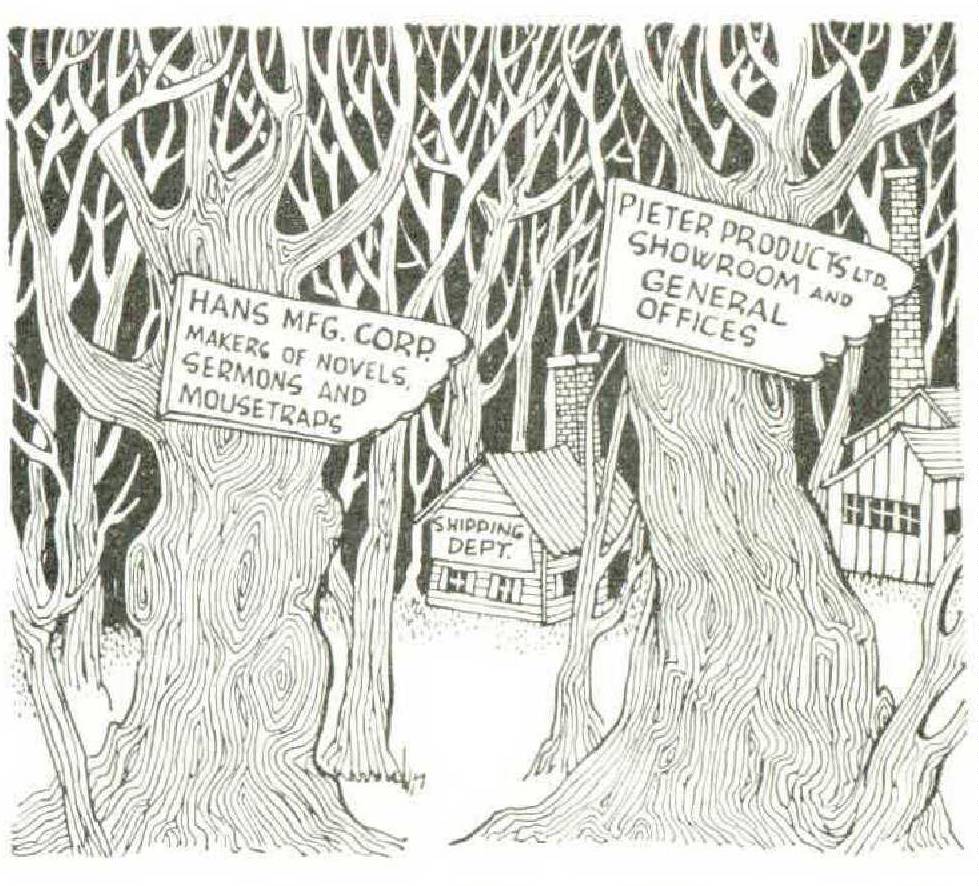
Pieter is furious. He decides to put Hans in his place once for all. He has always believed in his powers as a maker of mousetraps. One morning, when an occasional shaft of sunlight strikes between the thick boughs upon the twisted roots and mossy sward, he calls out, “Bestir thee, neighbor, gaze upon my beautiful mousetrap. Thou wilt not be able to make the equal of it in a hundred years.”Coldly competitive, Hans hisses acceptance of the challenge.
The traps are made, but testing them is difficult as there are no mice. The little houses have little cats, and these keep mice away. Beyond the wood are fields, and these might contain field mice, but neither Hans nor Pieter knows what field mice eat. They unsuccessfully bait their traps with cheese. Although there are several odd-looking, furry creatures about the wood, unfortunately the rivals are not zoologists, and they agree that the test of a mousetrap is not whether it catches any small mammal but whether it catches mice. Finally they decide to write to a mail-order firm that deals in mousetraps.
At some stage the rivalry ceases to be private. Perhaps the sermon adjudicator talks. Hans’s book wins a prize, while Pieter’s book is dismissed by critics as “Milk and water.”“The longest yawn since the invention of printing.”and “The world’s worst buy.” The mail-order firm scents publicity and dyes the mice before dispatch. They crowd into Hans’s trap.
Hans and Pieter originally built their homes in the woods because they wanted solitude. They have always been proud that the wood is trackless. In front of their little homes stretches a tangle of roots, beech mast, moss, forest flowers, and woodland weeds. Suddenly the world invades their privacy. But the good Pieter is avenged. At least he is slightly better off than his neighbor. The noise of the world disturbs him, but it is not making a beaten path to his door, while everything in front of Hans’s is trodden down flat.
What a life Hans leads now. As soon as he begins work on a second sermon to prove to himself that his success was not a mere flash in the pan, there is a knock at the door and there stands a publisher demanding a new novel. Hardly has he wearily begun to write a new novel when the social secretary of a leading hostess arrives to say that her employer in future intends to have all her mousetraps handmade and is sending a weekly order for ten. Scribbling, preaching, fumbling with the screw driver, Hans tries to persuade his callers that it is all a mistake: Pieter is the better man. He even sends a message across to him, humbly asking him to slip in the back way and lend a hand. Pieter is not to be caught.
In the version where the neighbors live in a wilderness, not in a wood, I suppose they would be less like gnomes and more like hermits. Their sermons would probably be better, anyway. The damage would be worse. The world would spoil a wilderness even faster than it would spoil a wood. The moral of the passage seems to be that if you want solitude you should never be good at anything, though I am not quite sure whether its author realized it. Commune with nature or be good with your hands. It Thoreau had been good at mousetraps, what might have happened to Walden?