Vulture Country
Author and playwright, still in his thirties, JOHN D. STEWART derates his leisure time to writing and his tvorking days to the British civil service. For the past eight years he has been stationed at Gibraltar, where he has had a chance to observe some of the mysterious flights and habits of the great vultures that constantly swoop down from the sky in southern Spain.
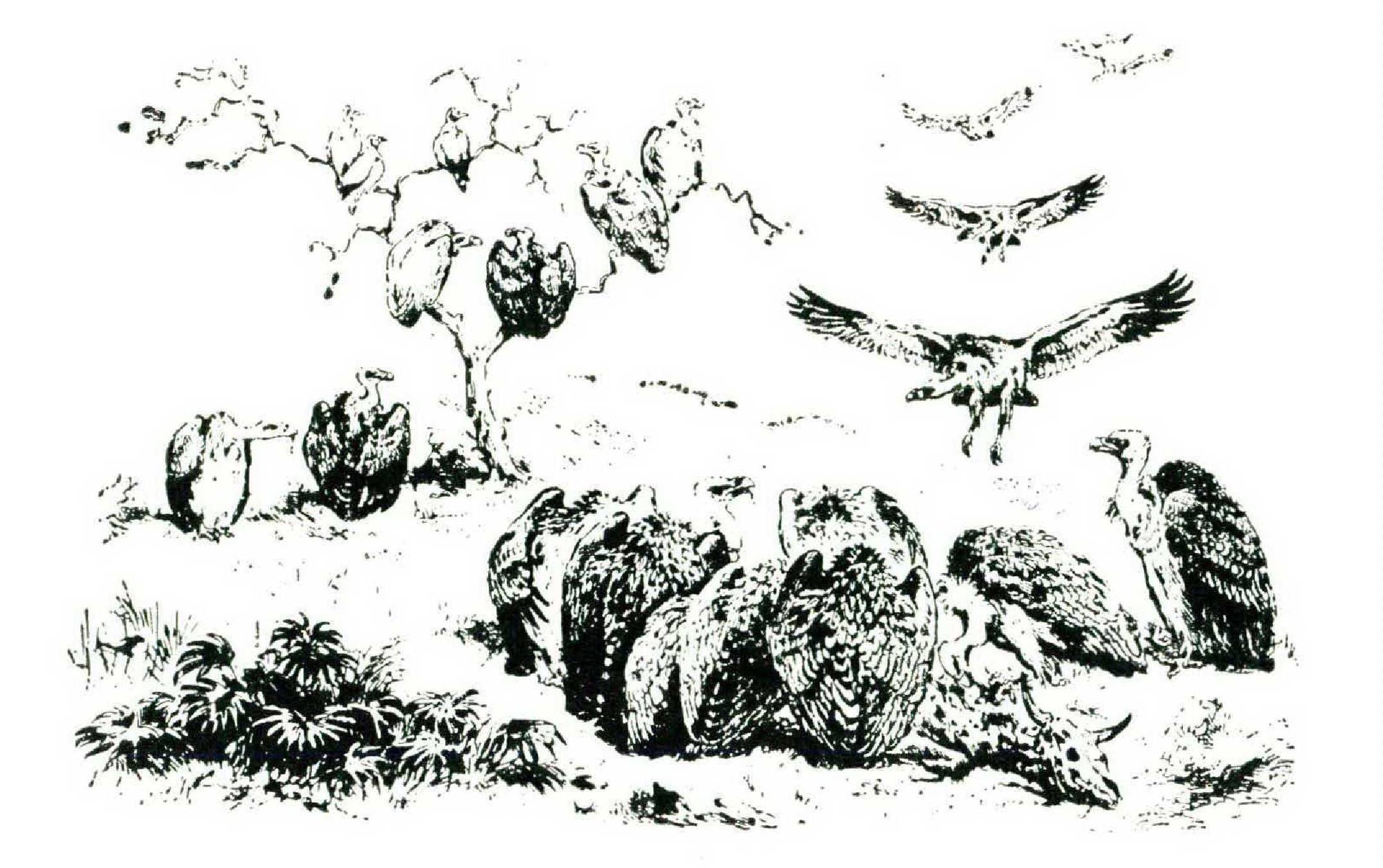
SPAIN is the stronghold of the vultures. There are four listed species in Europe, two common and two rare; if they are anywhere, they are in Spain. The bearded vulture and the black survive there, the Egyptian flourishes, and the great griffon swarms. The further south you go the more numerous they become, until you reach the hot grazing plains of Andalusia. There, summer and winter through, they hang in hordes in the roofless sky, for Andalusia is the vulture country.
There are three essential qualities for vulture country: a rich supply of unburied corpses, high mountains, a strong sun. Spain has the first of these, for in this sparsely populated and stony land it is not customary, or necessary, to bury dead animals. Where there are vultures in action such burial would be a self-evident waste of labor, with inferior sanitary results. Spain has mountains, too, in no part far to seek; and the summer sun is hot throughout the country. But it is hottest in Andalusia, and that is the decisive factor.
The sun, to the vulture, is not just something which makes life easier and pleasanter, a mere matter of preference. His mode of life is impossible without it. Here in Andalusia the summer sun dries up every pond and lake and almost every river. It drives the desperate frogs deep into the mud cracks and forces the storks to feed on locusts. It kills the food plants and wilts the fig trees over the heads of the panting flocks. Andalusia becomes like that part of ancient Greece, “a land where men fight for the shade of an ass.”
All animals, both tame and wild, weaken in these circumstances, and the weakest go to the wall and die. The unpitying sun glares down on the corpses and speeds their putrefaction, rotting the hide and softening the sinews and the meat, to the vulture’s advantage. But the sun plays a Still greater part in his life. Its main and vital function, for him, is the creation of thermal currents in the atmosphere, for without these he would be helpless.
The vulture must fly high — high enough to command a wide territory, for, except at times of catastrophe, dead animals are never thick on the ground. His task is to soar to ten thousand feet, more or less, two or three times in a day, and to hang there and keep constant survey. A male griffon weighs up to sixteen pounds, so that to hoist himself up to that necessary viewpoint would call for fifty-three thousand calories, the equivalent of fifty pounds of meat. To find and eat three times his own weight in a day is clearly impossible; a short cut must be made. In the dawn of any day, in Andalusia, you may see the vulture discovering that short cut.
The eagles, buzzards, kites, and falcons are already on the wing, quartering the plain fast and low, seeking reptiles and small game. But the vulture sits on a crag and waits. He sees the sun bound up out of the sierra, and still he waits. He waits until the sun-struck rocks and the hard earth heat up and the thermal currents begin to rise. When the upstream is strong enough, he leaps out from the cliff, twists into it, and without one laborious wingbeat, spirals and soars.
By the time the vulture reaches his station, a half hour later and maybe more, the sun is blazing down on the plain and betraying every detail to his telescopic eye, and the updraft is strengthening as the day approaches its zenith. His ceiling for this day is fixed by two factors. One is the strength and buoyancy of his chosen thermal, which will vary with the strength of the sun and the behavior of the upper winds. But the more important factor, for it fixes his horizontal bearings as well, is the distribution of neighboring vultures in the sky, his colleagues and competitors.
He cocks his head from side to side and checks their various positions. There they hang, dotted across the clear sky at intervals of a mile or so — at the corners of one-mile squares. Height and lateral distances all adjusted, the vulture settles, circling slowly on his invisible support, and begins his long and lonely vigil.
THIS griffon vulture, which I select from the four species as being by far the most prevalent and typical, is almost sure to be a male. The female rarely leaves her nest from early March, when she lays her rough white egg, until August, when her huge poult is fledged and flying. The father has to feed and carry for all three.
At first glance, from below, he appears as one great wing, ten feet from tip to tip and two feet broad. His tail is square and very short, which is all it needs to be, for there are no sharp or sudden quirks in his flight that would call for a strong rudder. His movements are premeditated, stressless, and leisurely, for his energy must be conserved at all costs and never wasted on aerobatics.
The vulture’s head and neck, too, protrude very little in front of his wing plane, and this distinguishes his flight silhouette from the eagle’s. His neck is, in fact, some two feet long, but since it is bare — and must be bare — he folds it back into his collar to keep it warm. His head, apart from its nakedness, is like an eagle’s; his yellow claws, which never kill and rarely carry, are shorter and not so strong. His plumage is a uniform sandy color, faded and tattered by work and waiting and, perhaps, by old age. It is relieved only by his coffee-colored ruff and the broad black primary wing feathers fingering the air.
The vulture sails in silence, for no vocal signals could serve him at such a distance from his fellows. He croaks, growls, and whistles only in his family circle, and at his feasts. He circles by almost imperceptible adjustments of His wing planes, aided by slight twists of his tail. But his head is in constant and active movement. He swivels it from one side to the other, bringing each eye in turn to bear on the earth. Then he bends his neck to right or left to check on one of his neighbors to north, south, east, or west.
The whole vulture network is interdependent. Each vulture can give and receive two signals or, as the scientists call them, “visual stimuli.” Circling means “Nothing doing”; dropping, or its resultant hole in the sky, calls “Come here!” Like all other vultures, he rests reassured by the first and is rapidly and relentlessly drawn by the second.
It is demonstrable how, with a special density of nerve endings on his retina, the vulture can see a small animal from a great height. Many other birds — gannets, for example — have the same propensity. Their eyesight is surprising only when we compare it with the poor standards of our own. But a mystery remains: how does the bird know that the animal is dead? The sense of smell is to be ruled out straightway. It is impossible that it would operate at such a distance, even allowing for the upward current of air. Birds are not, generally, well endowed in this respect, and in the vulture’s case this may be especially fortunate.
No book, no expert, could answer this question for me, and I carried it through the vulture country for years, the one tantalizing imponderable, the broken link. Then, one hot afternoon, I lay down beside an old swineherd in the shade of a cork oak on the foothills overlooking the great plain of La Janda. For fifty years, he told me, he had watched pigs on that plain — the pigs, yes, and the vultures. I put my problem to him.
The swineherd’s theory is not to be proved, but it is a wise one and I shall hold it until I find a better. No, he said, it is not the white belly skin that distinguishes the dead animals. White fur may fix the vulture’s eye, but it does not offer him evidence of death. All herds and flocks, said the old man, lie down together and at one time. They have their place and their hour of rest. When a vulture secs an animal lying alone and apart, he is bound to notice it. The next time he crosses, the same image strikes his eye and startles him again. Over and over again he marks it and waits and watches; but now, alerted, he watches it more closely.
The next day the animal is still there; his attention is fixed upon it now, so he circles a little lower, his eye riveted, seeking the slightest movement of limb or lung. He sees none, but he continues to wait, said the old man. It takes him two days, at least, to confirm death. He goes on circling, but lower. He becomes more engrossed, and more sure. The other vultures note his behavior and move over a little in the sky. Every time he falls, they move closer. Now he is very low. He seeks the heaving of the flanks or eye movements; he sees neither. At some point, perhaps, he receives a visual stimulus in some death sign — the protruding tongue or the wide and whitened eye. Then he falls quickly, landing heavily at a little distance from the corpse.
THE swineherd and I watched the first vulture land. We watched him sidling and circling the dead goat, standing erect to see better, wing tips trailing, naked neck stretched to the full, head swiveling rapidly to bring alternate eyes to bear. He hopped closer and paused, peering intently. If he could smell, even as well as we, his doubts would have been over. But he stood there, irresolute, famished yet fearful, with his bill open and his wings ready for use.
Then a big shadow swept across the brown grass, and the vulture glanced upwards. His involuntary signal had been answered, and a tall column of vultures wheeled overhead. He hopped to close quarters, stretched forward, pecked the corpse, and leapt back. He watched it for a second more; no movement. Then he croaked once, as though to bless himself, and threw himself on the body. He struck his heavy beak into the flank, flapped for balance, and thrust backwards with feet and wings to strip the hide from the ribs and belly.
Almost immediately there were eight more vultures at the corpse, and we saw that all of them sought and fought for the same place. Their aim was to penetrate, their object the viscera. Watching them thrusting their long necks deep into the belly cavity and withdrawing them befouled and bloodstained, I saw why those necks must be bare. Yes, said the swineherd, and that is the one part the vulture cannot reach to clean. His mate may clean it for him later, for pure greed, but if he had feathers there he would have maggots in them.
Now sixteen more vultures swept down, landing heavily in their haste and flap-hopping to the feast — the second square from the sky pattern. The corpse was covered, submerged in a heaving, struggling mass of broad brown wings. A new column wheeled above us, circling lower. There should be twenty-four up there, I reckoned. There were twenty-three.
The latecomers landed on nearby trees, including ours, and their weight bent thick limbs to the ground. From points four miles distant, we could expect thirty-four more, and at the height of the carnival I counted just short of one hundred birds.
A mule lasts two hours, said the old man, and an ox, three. This goat became bones in the sun in half an hour.
As the hundred fed, or hoped and waited, many more vultures circled high above, assessing the situation and the prospects and treasuring their altitude. Toward the end, when the feasters scattered and exposed the small skeleton, the watchers flapped and drifted wearily away to resume their distant stations. But they had fulfilled their function. They had marked the spot and drawn the Egyptian vultures and the kites.
Now the little Egyptian vultures landed daintily and dodged nimbly through the throng of giants. They are bare on the face and throat only, with well-feathered head and neck, and so, perforce, they are cleaner feeders. The dirty work has been done; now the long and delicate beak comes into play. The Egyptian vultures attack the skull, the large joints, and the crevices of the pelvic girdle — all parts inaccessible to the griffon’s heavy beak. They extract brains, membranes, and the spinal cord, and clip out tendons and ligaments. They dodge out through the encircling griffons with their spoils, gobble them swiftly, and dance back for more. The griffons, gorged with meat and panting in the sun, pay them scant attention.
Finally, when all but the whistling kites have left the scene, comes the great solitary bearded vulture, the fierce lammergeier. His whole head is feathered, so he despises carrion. He lives aloof from all the rest of the vulture tribe, but they serve his interests, so he keeps them within sight. The old swineherd calls him Quebrantahuesos — the bone smasher — and Aeschylus noted him, long ago, for the same behavior. The lammergeier seizes the largest bones, carries them high, in his claws, and drops them on the rocks. Then he swoops down and rakes out the marrow.
Like an eagle, he can kill as well as carry with his claws, and he has not the true vulture’s patient, soaring habit. He attacks flocks and herds and carries off the lambs and kids and piglets. After his work has been done nothing will remain except an empty skull and some small bones, which the ants and carrion beetles pick and polish.
Our griffon, first on the scene, will not be the first to leave it. He is sure to have gorged himself with his advantage. Crop, throat, and neck distended, he squats back on his tail, with his wings spread to steady him and his beak hanging open. From time to time he chokes and belches and gags, and it is an hour, maybe, before the meat subsides in him.
When he is ready, the griffon runs and leaps across the plain, thrashing heavily with his big wings, and labors into the air. He finds a thermal, circles in it to his altitude, then slips sideways and sweeps gently across the sierra to his distant nest.
The griffon vultures are gregarious in nesting, with colonies throughout the mountains at fairly regular intervals of thirty miles. They are said to pair for life. Certainly they return every year to the same nest. In January they begin to repair the nest, a broad and battered saucer of strong branches, topped with twigs and grass. They are careless builders, and many nests have bare rock protruding in them. No attempt is made to cover it. The egg is laid in late February and incubated for forty days. The new chick is bare and blueskinned and looks as though he might become a dragon, but soon he sprouts white down and begins to assert the characteristics of his race. In a month he is voracious, and by the end of April he will demand four pounds of meat every day. Before he is Hedged he will need eight pounds. Providentially, his demands coincide with the heyday of death.
When the male vulture arrives at the nest he settles on a nearby ledge, vomits, and sorts out the result with his beak. The female helps with this assessment, feeding herself hungrily on the larger relics. Then she offers her gape and crop to her cowering, whistling infant. The chick gobbles madly. With vultures it can never be “little and often,” for animals die irregularly, as they must, so the birds, young and old, must gorge to the neck when opportunity offers. That is their instinct and their nature.
A male vulture with family responsibilities cannot rest for long. Now that his load is delivered and eaten, he is likely to be the hungriest of the family. This, too, is as it should be, for the hunger sends him out and up again, however little daylight may remain, to circle in the sky until the sunset reddens the sierra.
Time was when the summer drought killed thousands of beasts every year and the floods of winter hundreds more. Nowadays there are fewer casualties, but the vultures still have a fairly constant food supply in the charnel gorges, which lie below most mountain villages.
Grazalema, Arcos, Casares, and a hundred more were built, for protection from the raiding Moors, on the edge of the precipice. All dead and dying animals, as well as all the garbage of the town, are simply pushed over the cliff and left to the birds. There is a bird in Andalusia for every class and size of refuse. From the escarpment you can watch all the scavengers of the air, soaring below you or fighting on the feast. The great black vulture may be here, the griffon and Egyptian for sure, and two kinds of kites. The cunning ravens and carrion crows wait on the outskirts, dashing in to snatch their choice. Clouds of choughs and jackdaws wheel and cry above them.
There is a new feeding ground in the unfenced highways of Andalusia. As motor traffic increases, these offer more and more dead dogs, cats, kids, pigs, and rabbits. If you are abroad at dawn, it is a common thing to run down a vulture intent on scraping a dead dog off the asphalt. Even so, with an apparently limitless population of these great birds, each looking for some thirty pounds of meat every day, one wonders how they flourish.
Their wonderful feeding system has, it seems to me, one fatal flaw. They can signal “Food here,” but not how much. At the feast which I have described only some succeeded in feeding at all, and only two or three ate their fill. A majority came the distance and lost their height for little or for nothing.
In Africa, also vulture country, there is no such difficulty, for there all the game is big game, and every funeral is worth attending. It may be that some of our Andalusian vultures go there in the winter. Certainly our vulture population increases here, but that is because the vultures from further north crowd in as the heat decreases and the air currents weaken in their homelands. Fortunately, there is a seasonal food supply ready for them all, for it is the time of birth, with all its failures and fatalities. After the winter storms, too, the torrents offer up their toll of corpses. And in winter, each bird has only himself to feed. But you would not doubt, if you knew the constant panic for food which dominates him summer and winter alike, that the vulture leads a competitive and anxious life. He has strong forces for survival. It is held —and we know it to be true of eagles — that the vulture has a very long life. If this longevity is a fact, then the solitary chick each year may add up to a good replacement rate.
The nest is inaccessible, and the hen guards it constantly against the only possible natural enemy — other vultures or raptors. So the survival rate must be high, as is proved by the evident increase toward saturation point.
At times, lying on my back on the plain with binoculars trained on the sky, I have seen vultures circling in two or three layers, each one high above the other. What can this mean? A hungry duplication, or triplication, hopelessly covering the same feeding ground and using the only available thermals? Or the opposite — idle and well-fed reserves standing by for surplus?
No one can tell me. But here in the vulture country there are no birds more spectacular, more fascinating to watch and to study. In time we may find out the last of their secrets. I lie on the plains and keep on watching them. And they, I know, keep on watching me.