The Hot Rain: An Atlantic "First"
MICHAEL FISHER
An Englishman, aged twenty-five, who has spent many years in South Africa, DR. MICHAEL FISHER is now a surgical resident at Doctors Hospital in New York. His first novel, THE SHARP EDGE OF THE SUN, has been accepted for publication in London, and he has completed a second.
WE PICKED her up at Beit Bridge. She stood by the customs counter, small and thin, her head on one side. It was early morning but already hot. She was wearing a tweed skirt.
“Please,”she said, smiling.
Van Rensburg stood with his feet apart, his thumbs in his trouser waistband. Even he seemed amused. He snorted down his nose and turned to the man with her.
“Ja, we can give her a lift to Salisbury,” he said and walked out of the customs house down to his truck. The man had no time to thank him, so he thanked me instead. He shuffled his feet and said he had brought his sister-in-law up from Durban. She had arrived from England to join her husband, who had come out to a new job in Salisbury a month before. But now he had business to do in Bulawayo, so if we could take her on the straight road to Salisbury through Fort Victoria . . .
“Well, that’s fine,” I said. “Glad to have her.”
He put her suitcases in the back of the truck, thanked us again, and kissed her good-by.
A thought came to him. “She’ll be all right, I suppose. I mean, you will look alter her, won’t you?” I don’t know why he hadn’t thought of it before.
“She’ll be all right,” I said. “Yes, I think she’ll be all right.”
The three of us got into the cab of van Rensburg’s half-ton open truck. The woman sal in the middle. With a lurch we started off. “Now,”she said, “l think we should introduce ourselves. I’m Mrs. Gibbs, Beatrice Gibbs. How do you do.”
“Van Rensburg,” said van Rensburg. He was an Afrikaner, burned and thick. He was returning to his farm east of Salisbury after a week’s trip to Pretoria.
I told her my name. I didn’t tell her that I was hitchhiking to Salisbury and that van Rensburg had only picked me up at Messina early that morning. I didn’t want her to know yet that I was not necessarily on van Rcnsburg’s side.
“Oh, I do like this country!” said Mrs. Gibbs. “I’ve never been outside England before,” and she went on to tell us what a wonderful country South Africa was and how nice the people were. Her features were sharp, bony, but her skin was draped over them softly. Her eyes were dark and deep-set, giving her face a look of intelligence I was not sure it deserved. She carried a tweed coat matching her skirt. ‘Through her white blouse you could see the mechanics of her underwear. She was very English. With no other woman around for comparison, she looked good.
She stopped talking suddenly and looked at us. “Actually I feel quite nervous here with you two strange men.” She laughed. “I don’t know what my husband would say!”
Van Rensburg looked at her a minute. “You’ll be all right.” he said. He reached across her and took a bottle of brandy from the glove box and drank from it. His neck muscles stood out like a bull’s. He wiped the neck of the bottle with his hand. “You want a drink?” he said to her.
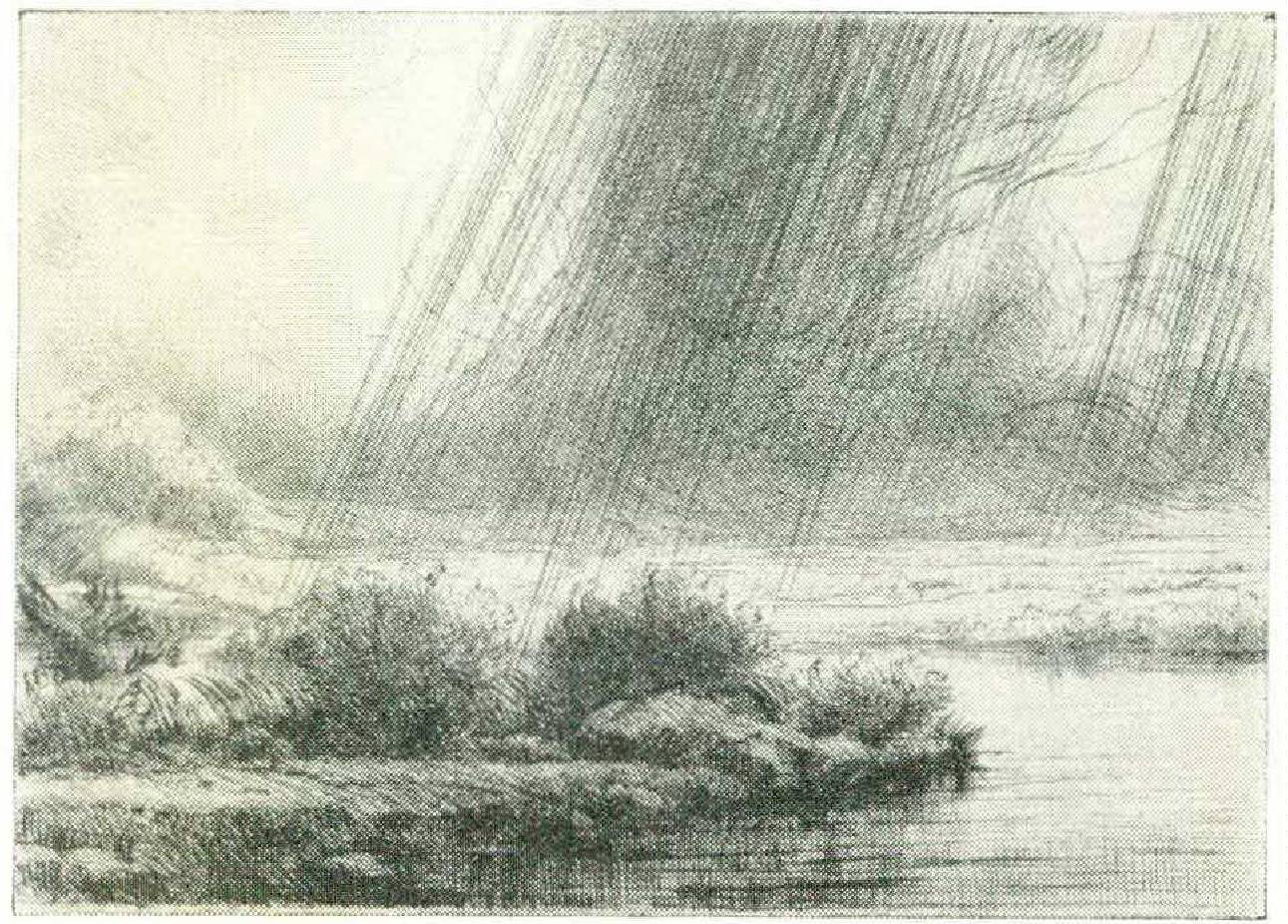
Etching by
Mrs. Gibbs didn’t say anything.
“Don’t worry,” he said, “I got a whole case in the back.”
She still didn’t say anything, so he passed the bottle to me. She didn’t say anything for ten minutes after that.
I watched the road. The road was hammering the truck. It was asphalt strips, twin strips, one for each set of wheels, and whenever you met another car you had to skid off into the dust at the side. The government had put them down just before the war as a temporary measure. They were meant to last three years. They were still there.
The bush we were going through was tall, thick, and green. Ahead on the horizon there was a mass of blue clouds. There was a lot of rain there. “We going to get through? I asked. The customs man said the rivers were up way over the bridges.”
“We’ll get through,” said van Rensburg. “The customs man is a fool.”
A scorpion scuttled across the road ahead. I pointed it out, and Mrs. Gibbs got excited. “What! You don’t get scorpions here, do you? The things that sting you and you die?”
said van Rensburg. “We also got crocodiles,” and he told her how the crocodiles ate anyone that went near a river.
“And if the crocodiles don’t get you the bilharzia will,” I said, and I told her of the worms in the water that get under your skin into your blood and lay eggs with spikes on that tear your insides to bits. Then van Rensburg told her of the hyenas that would snatch a man’s face off while he was sleeping round a campfire, and I told her about mambas and he told her about tarantulas. We had a great time. We certainly got her scared. But she didn’t say much. She only poked at her untidy brown hair a little faster than usual.
The clouds ahead did not look good. Even where we were there were signs that the rivers had been over their banks, and that meant over the road too, for there were no proper bridges on this road, nothing but cement causeways a few feet above water level with two-foot guardrails at either side. This made driving tricky at this time of year, January, for rain upcountry could change a small stream inside half an hour into a torrent roaring six feet over the guardrails. I had seen a three-ton diesel truck swept a hundred yards downstream by a small river the driver had underestimated. But in another half hour you might find the river back to normal again.
Many miles on, an African got up from the side of the road and waved to the truck. Van Rensburg stopped. “This is my boss boy from my farm,” he said. “I brought him with me when I came down a week ago. He’s been recruiting labor for me.” The boss boy stood like a sergeant and showed six Africans he had with him, who looked at the ground and moved their feet in the dust. They were very black against the forest burning in the yellow sun. Van Rensburg leaned out of the window and shouted at them, “You will work on my mealic farm near Inyazura. I will pay you thirty-seven shillings a month. I will give you a. hut and meat and mealie-meal. All right?” The six nodded without looking up. “Get in then,” and he started the truck at once, so that two of the six had to run fast and fling themselves on. With a sudden relief of tension the others shouted with laughter.
“My boss boy’s good,” said van Rensburg. “He always gets labor. They are too scared to say no to him.” He laughed.
“Thirty-seven shillings doesn’t seem very much,” said Mrs. Gibbs.
“Oh, they’re happy. They think they arc going to farm maize. That’s easy work.”
“Don’t you grow maize then?”
“No,” he said. “No, I’m a tobacco farmer. That’s hard work for them. That’s why I pick them right down here. When they find they have got to work tobacco they are three hundred miles from home. They won’t leave you then.”
Mrs. Gibbs gave van Rensburg another of her silences. This one went on for fifteen minutes.
Then she said, as if thinking to herself, “Three weeks ago I was having morning tea at the vicarage in Bctchworth. It was something to think about, too.
WE ARRIVED then at the White Rhino Hotel on the banks of the Lundi, a hundred and ten miles from Beit Bridge. We stretched ourselves on the long wooden chairs on the veranda. It was twelve o’clock now and very hot. The shade where we sat was blue and cool as running water, but the white huts of the hotel burned in the sun. I had a beer, van Rensburg brandy, and Mrs. Gibbs ordered, of course, tea. It was good to stretch and feel the beer go down cold on the throat. There was a torrid, sensuous feel to the place. After a few minutes I realized what it was. The frangipani in front of us were in bloom and were filling the place with their strong voluptuous smell. I think even Mrs. Gibbs felt it, for she turned to van Rensburg and said almost gaily, “Actually I think I would like a drink. Please, would you get me a shandy?” He brought it to her without a word. For a moment she seemed warmer and almost to belong with the sun and the smell of frangipani. Then she contracted again. “Whatever would my husband say!”
The owner of the hotel came and scratched his head and told us that we might get across the Lundi, although it was high, but we hadn’t a hope with the Tokwe forty miles on. He said we should stay at the hotel till the Tokwe went down.
We crossed the Lundi all right. The water came up to the floor boards, but the truck didn’t stall.
The country got wetter from then on. Pools lay at the side of the road. The storm clouds were like fat women sitting naked and dirty on the land. We were almost under them now. Occasionally the natives in the hack had to push the truck through a swollen stream.
Then we were into the rain. The drops spat on the cab roof, then came down like hammers on an anvil. The Africans in the back of the truck didn’t look happy. Van Rensburg stopped and took a blanket from under his seat and gave it to his boss boy to cover himself with.
About one o’clock we pulled in to the side of the road and ate sandwiches. Van Rensburg was putting down the brandy. The bottle looked like a natural growth coming out of his thick burned face with the white area at the top of his forehead where his hat usually came. He wiped the sweat off his forehead and the brandy off his mouth with the back of his hand. He passed me the bottle.
“You have some,” he said to Mrs. Gibbs. “It won’t bite you.” His teeth showed white against his face when he smiled.
So she had some. She coughed. “It tastes awful,” she said. But she took another mouthful.
As we battered out some more miles over those roads she said, “You know, this is quite an adventure for me. I’m not used to the company of strange men. Not that you are so strange any more,” and she smiled at us. “But I met my husband when I was sixteen, and we went out together for four years, and then wc got married, and we’ve been married for twelve years now. I’ve hardly known any other man —except the vicar.”
We laughed, and she laughed with us. Van Rensburg said, “I was brought up on a farm in the Free State. Lxccpt for my sisters I never saw a girl till I was twenty-two. Man, but I’ve made up for lost time since then though,” and he roared at that. I put his age at forty, so he had had some time to do it in. “But I never got married,”he added with satisfaction.
The cab was becoming uncomfortable. The truck banged us about a lot, and I had to watch out for my head hitting the roof. With the hot rain wc started sweating heavily. 1 watched Mrs. Gibbs’s arm lying next m mine. Ii looked cool and white half-seen through her blouse. She was sitting silent, a little tense, her head turned away from me. I wondered what she was looking at, but all I could see were van Rensburg’s arms and hands gripping the bucking wheel. They were matted with hair and thick as a bull’s haunches.
The rain fell, gray, monotonous, noisy. There was nothing to see but the hot rain.
IT WAS halt past two when we came to the Tokwe. We got out and walked past the twenty-odd waiting cars and lorries down to the water’s edge. The river usually ran at the bottom of a deep ravine, Now the water was so high above the trees growing in the river bed that nothing broke the surface and the water flowed smooth and brown and fast.
A group of men stood looking at a stone in the road which the water was lapping. “I put that there two hours ago,” said a man. “The water’s not going down.”
“How long you been here?” we asked.
“I been here three days,” said another man.
We walked around. Some of the lorries had tarpaulins out from the sides and fires going underneath. In the cars the people were huddled up sleeping or they were sitting on the running boards looking at the river, for the rain had stopped for a moment.
Van Rensburg had been rubbing his chin in silence, and now he said, “Man, I know what we must do.” We followed him back to the group.
“There’s a track turns off left back there to Chibi police station,”he told them. “It crosses the river thirty miles up, comes back to Fort Vie. There’ll be less water there, and the river is wide, so it will not be deep. That is where we must go.”
So we formed a convoy. There were eight cars and three trucks that chose to come with us. We waved good-by to the rest of the Tokwe crowd and set off up the track. And after that for hour after hour we struggled up the bush track, splashing through pools and stopping for people who stalled in them and for one man who, of all things, ran out of gasoline, and always there was the hot rain. The drive was getting grim now.
In the truck none of us had much to say. Every ten minutes van Rensburg would pull out a box of cigarettes from the pocket of his khaki shirt and pass them round. Mrs. Gibbs had stopped her flow of small talk and sat leaning forward, biting her knuckles. Her eyes were darker than ever in her pale face, I felt bad about her. For her first day in her new home country she was having a rough time of it. Van Rensburg must have felt the same, for once he leaned forward and patted her knee, not saying anything. She didn’t draw away from him cither, but put her hand on his arm, white against the dark.
It was six and the sun was low when van Rensburg said we should be getting near the river crossing.
“Once across the river,” he said, “and we’ve got a clear thirty-mile run to Fort Vic.” Long ago we had given up the idea of getting to Salisbury that night. Now all we wanted to do was to get to Fort Victoria.
“Think of a plate of steak and eggs,” I said, “with chops and sausages and kidneys.”
“Make that two,” said van Rensburg.
“Think of a bed at the hotel to sleep in,” said Mrs. Gibbs. Well, she must have been tired by then.
We sat and thought of these things for a while. It was one of the best thoughts I had had for a long time.
“We’ll get to the river any minute now,” said van Rensburg.
And then we saw it. We came round a wide bend in the road to sec the river two hundred yards across, gleaming silver in the evening light. There was no sign of bridge or guardrails. The water covered them by several feet.
We sat in the truck. Nobody said anything. Then we got out and went down to the water. The river was wide and deep and fast. White crests smashed past, riding the brown waves. It roared like the sea. We turned back to the truck.
“All right,” said Mrs. Gibbs. “So we spend the night here.” She smiled at van Rensburg.
THE other cars in the party arrived, and people milled around. They didn’t look happy. Already men were putting rocks at the water’s edge to be watched hour after hour to see if the water was rising or falling. Van Rensburg established himself as the head of the group. There was a knot of men grouped around him where he stood, his feet apart, his thumbs in his trousers. But there was no need to tell them what to do, for their wives were already getting out their thermos flasks of coffee and ail the food they had — sandwiches, biscuits, oranges — and were dividing it among us: fourteen men, ten women, eight children. That meant half a cup of coffee and half a sandwich or its equivalent each. The children got a bit more. Mrs. Gibbs saw to that.
Van Rensburg marched up and down the line of cars. He had a bottle of brandy in one hand and Mrs. Gibbs in the other. He told everybody to drink and everybody drank, even Mrs. Gibbs, and he laughed at her because her eyes were bright and she was laughing. Her arm was round his waist, her fingers digging under his trouser waistband. People thought they were husband and wife, but van Rensburg roared, “No, we’re just lovers,” and Mrs. Gibbs said, “Really, what would my husband say!”
The clouds had cleared in the west, but the sun had gone down behind a hill. The evening sky was green, a deep emerald green. The hill was alive with glowworms. They were emerald as the sky. They looked like pinpricks in the hill through which gleamed the sunset sky. I saw van Rensburg and Mrs. Gibbs, standing away from us, as one shape black against the green.
We gathered at the water’s edge and smoked and talked and listened to the water’s roar. In the half darkness lit by glowworms wc were unreal people talking of unreal things.
Then the hot rain came down again, and we went to look for somewhere to sleep. I walked over to some native huts away from the road. Three of them were dark and probably full of snakes. The fourth was lit by a fire and looked warm and red and comfortable. Inside with the owners of the huts were van Rensburg’s Africans, eating, drinking, and laughing. He may have stolen them from their homes, but they were at home anywhere in this land where still we were alien.
I went back to the truck and climbed in. Van Rensburg had his arm round Mrs. Gibbs, and her head with her hair tangled was on his chest.
“Hullo,” they said, and “Have a smoke,” said van Rensburg, and “Have a drink!” said Mrs. Gibias.
I had them, and for a long time there was silence. Wc could hear the roar of the water. Then van Rensburg said to Mrs. Gibbs, “Are you thinking about your husband?”
“No. No. I’m thinking about the river.”
“The river will not hurt you. I will see that the river docs not hurt you.” His voice was soft and deep. He moved his arm further round her.
I’ve had enough of tins, I thought. The rain had stopped, so I got out and put my coat on the road and lay down. There were several men lying on rugs on the wet road, leaving room in the cars for their wives to sleep. The line of ears looked black and lifeless in the night.
After a while the hot light rain started again. I got up and went down to the water. The water was high and loud as ever. The clouds did not cover the sky, so a few stars could be seen. In their light the river gleamed silver and black. Walking back, I saw there were still a few glowworms setting their green sparks against the yellow sparks of the stars.
As I passed the truck I heard them moving inside. There was an intensity to the movements that made me stop. There was the sound of heavy breathing; then I heard two quick sighs and a longdeep shudder from the throat of a body tense and straining. Then there was a heavy silence. I went and lay down on my coat again.
In the morning the sun shone and the river was down. Most cars got across by themselves, and the rest we pushed. On the far bank everyone stretched and laughed and shook hands and said what a lousy night it had been but good fun and we must meet again in Fort Vic over breakfast. Breakfast!
Van Rensburg came over to me. He had Mrs. Gibbs in low. “I’m sorry,”he said. “I cannot take you further. One of these cars will give you a lift.”
“You ‘re not going to Salisbury after all?" I said.
“No,”he said, and grinned, “My business in Salisbury must wait. We are turning off at Fort Vie and going straight to my farm.”He put his arm round Mrs. Gibbs. She looked like a pebble under a boulder. “We arc going together. We are not stopping for breakfast. Wc are going there as fast as we can.”His body shook as he said it.
I gripped their hands and said I thought that was fine. I looked from the Africans in the back of the truck to the English Mrs. Gibbs. So he had kidnaped them all. They would all go to the farm from which there would be no return.
But then I looked at Mrs. Gibbs again and wondered which of them in fact had won. Her face was like a new morning.