The Day Everything Went Wrong
An Englishman who moved with his family from his native land to British Columbia, RODERICK L. HAIG-BROWNis a master angler who can also write. In his two books, FISHERMAN’S SPRING and FISHERMAN’S WINTER, he revealed his keen observation of the woods and the streams he has known. The following essay is drawn from his new volume, FISHERMAN S SUMMER, which will be published by Morrow in September.
RODERICK L. HAIG-BROWN
MOST anglers have a parent stream and a home river, which may or may not be one and the same. The parent stream is the river of youth, the scene of boyhood endeavors, successes, and failures; it nursed the fisherman and taught him and in large measure formed the angling side of his character. The home river of his later years may be this same stream, changed much or little by the passing of time, the hand of man, or its own flow; or it may be another stream altogether, in some near or distant part of the world to which his life has taken him. All that really matters is that it should be the stream he knows best, fishes most regularly, and has adopted as his own.
Whether it be the stream of youth or the adopted stream of later years, a fisherman’s home river is of ultimate importance to him. It is a familiar place, full of memories and associations. It is well beloved, or he would not have persisted in it. It may yield fish freely or grudgingly. It may produce large fish or small ones. It may be difficult or easy. These things do not really matter. Any good fish from it is worth a dozen better and larger ones from some distant place. Any new discovery is an impressive triumph. The measure of a disaster can be exactly calculated, for this is the true testing ground.
My own home river is the Campbell on Vancouver Island, beside which I have now lived for twenty-five years. It heads in the high mountains of Strathcona Park and used to come down through three good-sized lakes to the two-hundredfoot drop of Elk Falls, some two and a half miles from the salt water of Discovery Passage. This last two and a half miles is now all that is left of the Campbell proper because of the building of a hydroelectric dam. The river has not improved, as I had hoped it might, from the higher and steadier flow below the turbines. But it has changed. There are new things to be learned in its familiar places, some of them surprising and exciting. And this is important compensation.
Most of my days on the Campbell arc full of accident, and many of my triumphs have hung on threads much finer than 4x gut, but there was one clay in my search of the changing river that I shall always remember. Nearly everything I did, with one exception, was done as well as I could do it. It should have been a day of immense triumph instead of disaster. I recall it vividly and with delight—though still with a sense of frustration. And I can readily recognize it now as the turning point in my struggle to understand my changing home river.
It was an early September day in 1951, bright and sunny, and the river was in perfect shape. I managed to get away at about three in the afternoon for what I thought would be a quiet hour or two in the Main Island Pool, which always holds something that will move to a fly.
In spite of the rather high proportion of small — and occasionally large — steelhead I had happened on in the previous two or three summers, I was still thinking in terms of the thick-bodied, golden cutthroats that had disappeared from the Canyon Pool when the dams and turbines look over. I was fishing for cutthroats, expecting to find cutthroats, and geared for cutthroats. Now a cutthroat, even one that is fresh from the sea and of good size, is generally rather a slow and dogged lighter. He does not often run wildly or jump repeatedly, and he rarely takes out more than ten or fifteen yards of backing in his longest run; quiet and careful handling will usually bring him to terms within the length of a thirty-five-yard fly line.
Woodcut by
I don’t say I had weighed this before I started out — I didn’t need to; I knew it in my bones after twenty-live years of fishing for cutthroats, So it never occurred to me to worry about my reel. The line I wanted was on a little narrow-drum Hardy Uniqua which just held it with some twenty yards of fine backing. I took the little reel along without the least hesitation — in fact with some satisfaction, because it nicely balanced the Lambuth spiral rod 1 intended to use.
I started in at the lower end of the bar in the Main Island Pool with 2x gut and a new 11 y pattern — a variation of the Mackenzie River Brown and Yellow Bug, tied Wulff fashion with fox squirrel wings and tail on a No. 6 hook.
I BEGAN fishing at the very first ripple that could be considered a holding spot, right down near the tail of the bar, as I had trained myself to do in case any fish should be foolish enough to lie there in the bright sunlight. It was an exercise to make sure my gear was working right rather than a cast made to catch a fish. But a fish rose almost as soon as the fly landed, a good one, and I missed him. He would not come again, so I moved on and cast to the head of the first real run. The fly danced back toward me over the darker water. A broad-backed streak of brown and silver came down after it, lunged at it, and took it away in an upstream run as sudden as an explosion. He jumped three or four times, still running, then turned downstream in the heavy current. He jumped again, handsomely silver, and the reel was still running when the 2x leader broke at the fly.
I was upset but not warned. 1 simply tied on another fly and continued the job. Another good fish rose in the same run, but 1 missed him and he would not come again. In the next run my fly disappeared in a perfect head and tail rise, and 1 was fast in a fish exactly like the one that had broken me. He fought with the same violence and determination, but just a fraction more slowly. Somehow he always stopped short of taking out all my backing, though twice he turned when there’ were no more than a few feet left on the reel: somehow I got him into the net, clutched net and fish against my waders, and stumbled to dry land. He was a perfectly fresh run steelhead, fwenty-lwo inches long and four and a half pounds. I was so shaken that I tried to kill him with a rap on the head from my pipe, as f would a one-pound trout, but all I accomplished was to break the pipe and persuade myself to take stock for a moment.
Here I was, less than halfway up the pool, not even into the best of the water yet. I had risen four fish, all good ones, missed two, broken hi one. and killed one more by luck than good management. Obviously this was a day of days, and heaven only knew what lay ahead of me in the rest of the pool. 1 had nothing heavier than 2x gut, and it was obvious that the little reel simply was not up to the job. In the first place it did not carry enough backing, and in the second place the friction of the ratchet alone, without any help from me, was enough to break 2x gut when a strong fish was running with only a few turns left on the spindle. The smart thing to do would be to go home and get another reel. But I had an appointment to be met in less than two hours, so I dried my fly and went on to my fate.
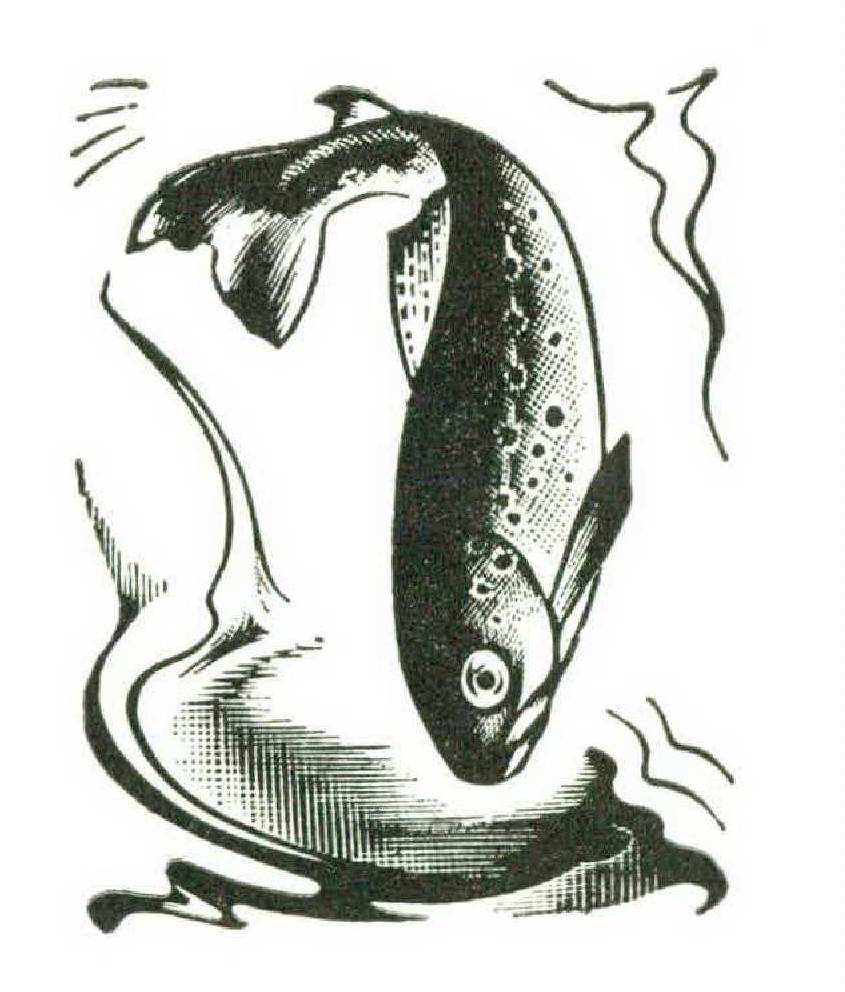
It came promptly. The next run I had to fish was what I call the second main run, and is perhaps the most dependable lie in the pool. It is cpiite a wide run, and I drifted the lly some half a dozen times without a rise. Then, in the broken water right up on the shallows, an enormous head and back and tail rolled out, and the fly was gone —engulfed. So slow, so calm, so dignified was that rise that I had plenty of time to admit to myself that I was thoroughly scared to set the hook. But I did set it, and the effect was immediate and awesome. The fish went away like a bullet, straight upstream with the reel screaming. He jumped forty or fifty yards upstream and came back just as fast, without the slightest pause. Somewhere opposite me he turned, and the next thing I knew he was jumping by a brush pile under the far bank. Then he was back again, almost at my feet. I cranked the reel frantically, caught up at last, and tightened on him again. That was all he needed. He ran down and across this time, just as fast, still jumping, toward the deepest part of the pool, where I could not possibly follow. I touched the reel to try to slow him, and that was the end; it was also the end of the backing — there were not half a dozen turns left on the spindle when I looked.
I knew then that I was completely out of my league on my own home stream. Here were fish — big, beautiful, fresh run fish — begging to take and be taken, and I just couldn’t handle them. I was shaken not only metaphorically, but physically. My hands shook, my knees shook, and I was breathing as though I had climbed a mountain. As soon as I was partially recovered, I broke my 2x leader back to what I judged to be 9/5, or about double its previous breaking strain. I did the same with another leader and tied the two together to give me a reasonable length again. Then I put up another fly.
While I was going through this performance, I had seen what I very seldom see in the Campbell: another good big steelhead break water, i covered him, and nothing happened until the fly had drifted ten or twelve feet past him. Then he came back after it, very fast, right along the top of the water, and took going away. He was considerably smaller than his partner but just as wild, and I treated him to all the pressure the rod would stand, which probably made him jump more. There was no question of netting him, but I worked him back down the length of the bar and finally got a finger in his gills and lifted him out. Just as bright and fresh as the first one, and a little over seven pounds.
That made me feel better, and I went back for more. They were in the main run, too; a wild fish of nine or ten pounds broke me with all the backing out. I missed one, perhaps two, and then killed a four-pounder. As nearly as I can remember, I had risen at least twelve good fish, all to the dry fly, had missed six or seven, been broken by three, and had killed three. So far as I know, they were all steelhead — not a cutthroat among them.
Of course, I was up there again the next day, with all the right rigging. I searched the pool back and forth and up and down, but all I could find were two sixteen-inch fish - one a cutthroat, one a steelhead. It was quite clear that I had happened on a run of fish straight in from the sea; they had been holding briefly in the rather open water of the island pools and had passed on up — presumably to the deep pools in the canyon, which had a slight flow of water through it at that time.
Losing the run did not really matter, though it would have been nice to find them with a good big reel and plenty of backing. I promised myself that time would come on another day in another season. Meanwhile I was completely satisfied that under the right conditions summer steelhead would come better to a floating fly than to a wet fly; and from that day forward I found myself going out on the Campbell in the late summer and early fall months to look for steelhead first and cutthroats second.
Eight seasons have passed since that famous day, and each year I have caught fewer of the big harvest cutthroats; in fact, I do not think I have had a cutthroat of over three pounds, and not more than one or two over two pounds, in the past three seasons. Presumably the changing water conditions have had something to do with this, but I doubt if they are the whole story. Intensive fishing in the estuary and all over the river during the winter steelhead season, when the cutthroats are spawning, has taken a heavy toll. With salmon roe a legal bait again and with the average fisherman’s spinning gear infinitely more effective than it used to be, it seems likely that very few fish manage to survive through the four years necessary to produce three-pounders.
But the summer steelhead are there every season and in increasing numbers. They are still hard to find and hard to predict — more like a few passing strays than a regular run — but they make wonderful sport for someone who lives on the river and can get out for an hour or two at regular intervals between late July and late September. I miss the great golden cutthroats and still hope that f may one day find a few of them again. But the steelhead arc more exciting fish, and their wild fast water rises are as rough a test of the mixture of skill and luck that makes fishing as any man could want. And their fighting qualities are extraordinary.