Yachtsman
JOHN J. HOWLANDS lives at the water’s edge of Massachusetts Bay on the rocks at Cohasset. A new edition of his delightful book, CACHE LAKE COUNTRY, is in preparation.
Nothing makes some men happier than just owning a cabin cruiser, and by the same token nothing can change a man so quickly. From the carefree fellow who spent days on the water when he had a skiff with an outboard, he becomes the master of a streamlined complex of mahogany and machinery tied for weeks at a time to four hundred pounds of concrete.
After yawing and yearning for years, the yachtsman finally wrings $19,000 out of his bank for the craft of his dreams. She has twin engines, makes twenty knots, and sleeps four. The stainless steel galley has a gas stove and refrigerator. Electric head, too, and all the instruments for finding depth, distance, and direction provided under the sales terms, “completely equipped and ready to go.” Ship-to-shore telephone, of course.
The cruiser is delivered at his mooring in the middle of May.
“What’s the use of putting a lot of money into a boat if you don’t take advantage of a long season? I say, get her into the water early!”
The owner takes a little time getting the feel of the new boat. As a matter of fact, he doesn’t even move her off the mooring for the first week, although he spends hours just sitting in the stern, looking her over and puttering about. No impetuous rushing to sea like certain people he could mention. At the end of the first week he ferries the family out for their first supper in the cockpit.
“Why rush? We have the whole summer ahead of us.”
Like every man of the sea, this one is a disciplinarian and takes things seriously. No one ever questions the captain’s decision. An order, he explains to friends unfamiliar with the sea, is an order whether or not you like it. It is obeyed without question.
Every boatowner has his little taboos, if not prejudices — but don’t we all? This one will not permit guests to bring egg salad or tuna fish sandwiches aboard if he can help it.
“As deadly as banana skins underfoot.” Yet lie delights in carving a watermelon in the cockpit, although the little black seeds on linoleum are just as slippery. Children accompanied by chewing gum are unwelcome. He has a special hate: the sight of gulls perched on the cruiser’s cabin invariably triggers off explosive comments.
The yachtsman is a believer in environmental psychology. He encourages the family to join him aboard the cruiser as often as possible to share the magic spell of twilight at anchor in the cove. The children take turns sitting on the helmsman’s seat to twirl the wheel and pretend they are under way.
Once in a while, when he is not too busy working on the boat, he springs a surprise by dropping the mooring and running down as far as the first channel buoy at sunset. It is his fond hope that from such happy associations his children — and eventually, perhaps, his wife — will develop an enduring love for the sea and all it means to him.
As a prospective fourth vice president in his firm, he has little time to spend on the boat during the week, but every evening after dinner he takes advantage of the long twilight to keep her in top shape. Once a week he sponges her down — fresh water, of course — edging along her sides in the dinghy until every inch of the hull is glistening. On Sundays he waxes the cockpit, mops the deck, polishes brass, and checks the fire alarm system. On Saturday mornings, if the barometer is high, he airs the cushions in the cockpit and checks the engine bed bolts.
Like any fellow with a boat, he has lots of friends, and he is almost certain to invite you for “a run to sea on the first good Saturday or Sunday.” He will give you a call. That’s that, but you must remember that the boat keeps him pretty busy;
At first some of us thought he was rather hard on the family, for the children were always begging for a trip on the bay — “just a teeny weeny one, Dad.” As he explained it to me one lovely Sunday morning while he painted the dinghy on the dock: “If you have salt in your blood and really love a boat, you naturally want to keep her shipshape and in top condition. That means constant attention to every detail, and you don’t have much time left for just running about for the fun of it.”
Later, after two or three drinks on my veranda, he picked up the subject again. “To see what I mean, take that blue cruiser at the yacht club anchorage. The slime at her water line shows she’s hardly been out this summer. Sure, as a thirtyfoot, fifty-horsepower, snub-nosed, and top-heavy cocktail lounge, she’s a whiz, but she’s not shipshape and she’s not seaworthy. Now take mine — fit for the sea any time. Fact is, we could take off for Maine on a minute’s notice if there was any reason to.”
We noted that the yachtsman softened as the season wore on, and it was pleasant to see him bring the cruiser in to the dock on a Saturday or Sunday afternoon to let the children romp in the cockpit while he cleaned the bright work and his wife mopped.
It is only fair to say, too, that several times the family ran out and anchored to watch the finish of the sailing races a mile offshore. And, say what you like, it is to the yachtsman’s credit that twice he took us with his family for lunch in a cove on Blacksmith Island. They also went out as far as the Light Ship, which is a round trip of fully an hour.
There was a lot of talk about spending a night on the boat, but as he said: “By the time you lug all your food and gear out to the boat, make up the bunks, get the refrigerator down to moderate cold, adjust the stove burners, cook supper, wash greasy dishes in two quarts of tepid water — sometimes without soap because you forgot it — check the bilge for gas, and drop the cockpit curtains, it’s a question whether it makes good sense. Cruising? Well, man! Now that’s something else again.”
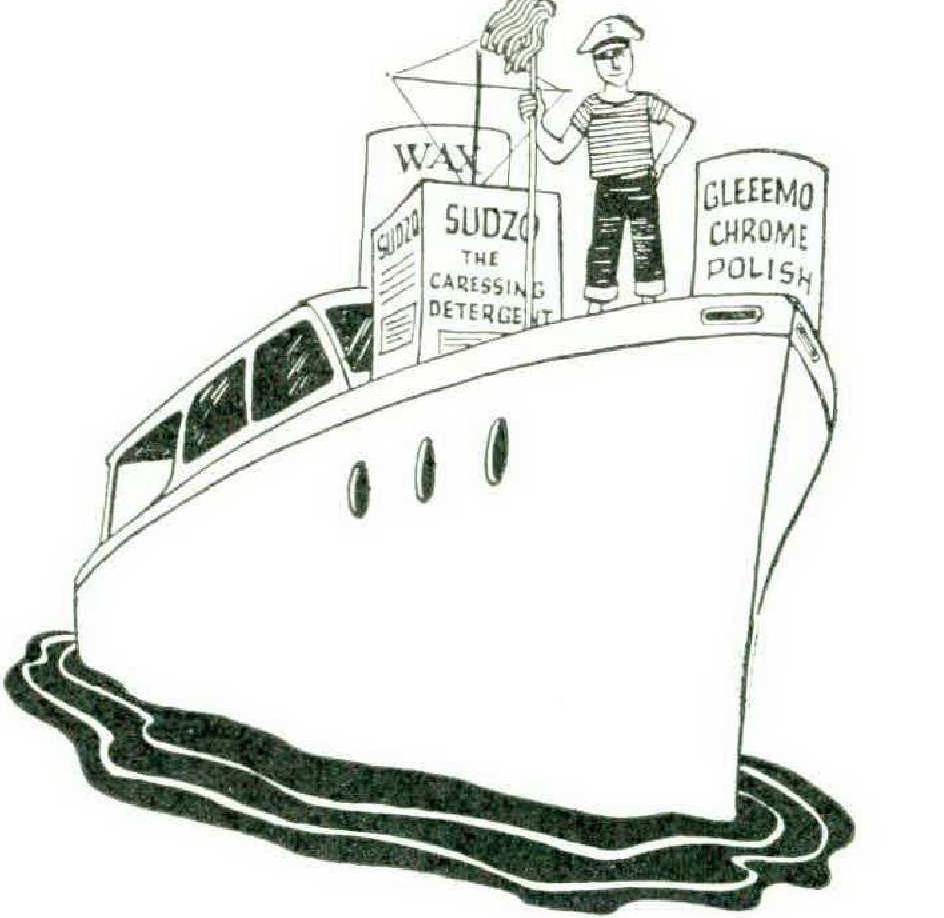
There are many signs that indicate a man may own a boat. One is early symptoms of perfectionism. If the engines purr like a pair of wellsynchronized cats, he has got to find out why. He generally stops the purring by fiddling with the carburetor or timing.
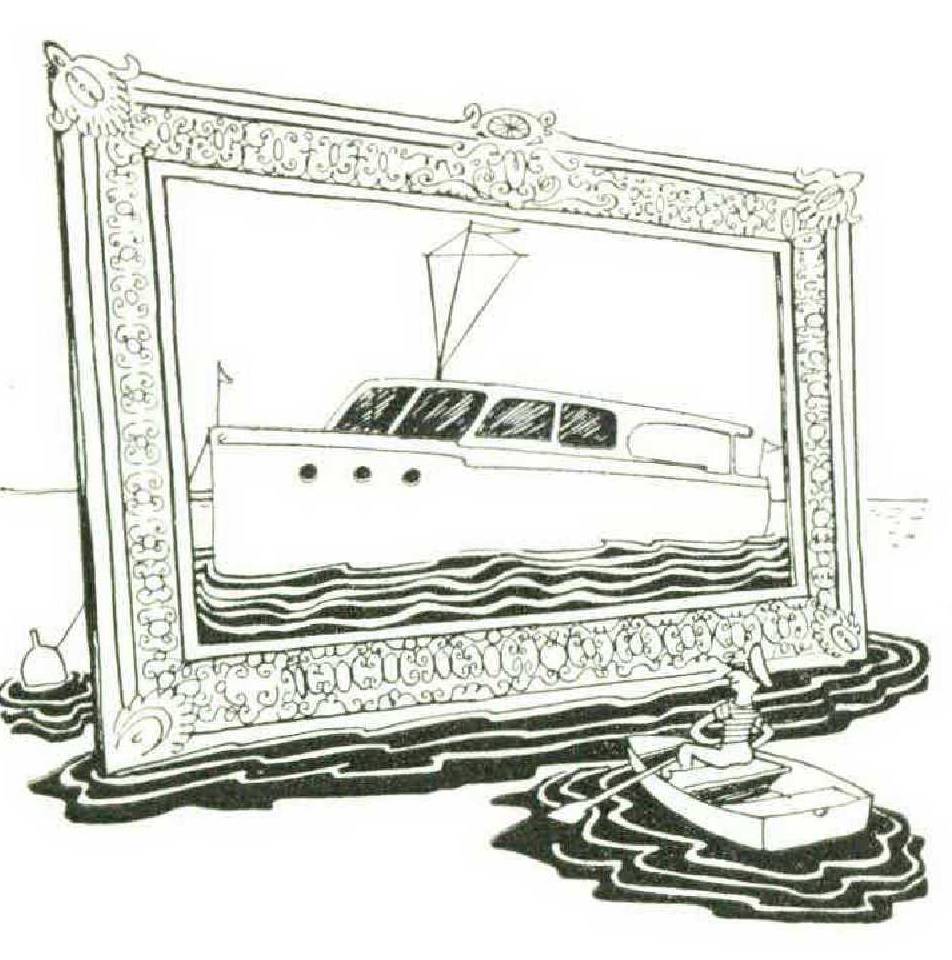
Our cruiser friend is the nervous sniffer type who well knows the danger of gasoline vapors in the bilge. And that is proper. But when by midsummer he had not detected the slightest whiff of gas, he pulled up the floor panels to see why. He had now reached the “can’t leave well enough alone” stage. As long as the floor boards are up, why not tighten the gas line connections?
His curiosity as to why his boat was not leaking finally got the better of him in August, and he had her hauled. Peace of mind can be cheap at almost any price, but the boatyard bill elevated him to the “What in heck do they think I am?” level of owning a boat.
Two or three times during the summer, the cruiser suddenly disappeared from her mooring. These absences, which sometimes lasted as long as a week, were directly related to early alerts on storms sulking in the South Atlantic some two thousand miles away. One log entry tells the story: “South Atlantic storm alert. Tied up at yard pending further reports.”
There was a good deal of talk about a slag cruise over Labor Day. but a weather front moving down from Hudson Bay suggested caution and delay. Then the owner detected “considerably more than minimum play” in the steering linkage. The boatyard figured at least a day to tighten things up. The cruise was off.
Three days later the boat was hauled out for the season.
“The early bird gets the best berth in the winter storage shed.”
I was with him when he made the season’s last entry in the log: “Engines in operation and under way thirteen hours, thirty minutes, May 15—September 4.”
As we left he gave her stern an affectionate slap. “Well done, old gal. See you at our mooring in the spring.”