Fertilizer
JEFF WYLIE teas the head of TIME’S Boston bureau before becoming director of public relations at the Massachusetts Institute of Technology.
By JEFF WYLIE
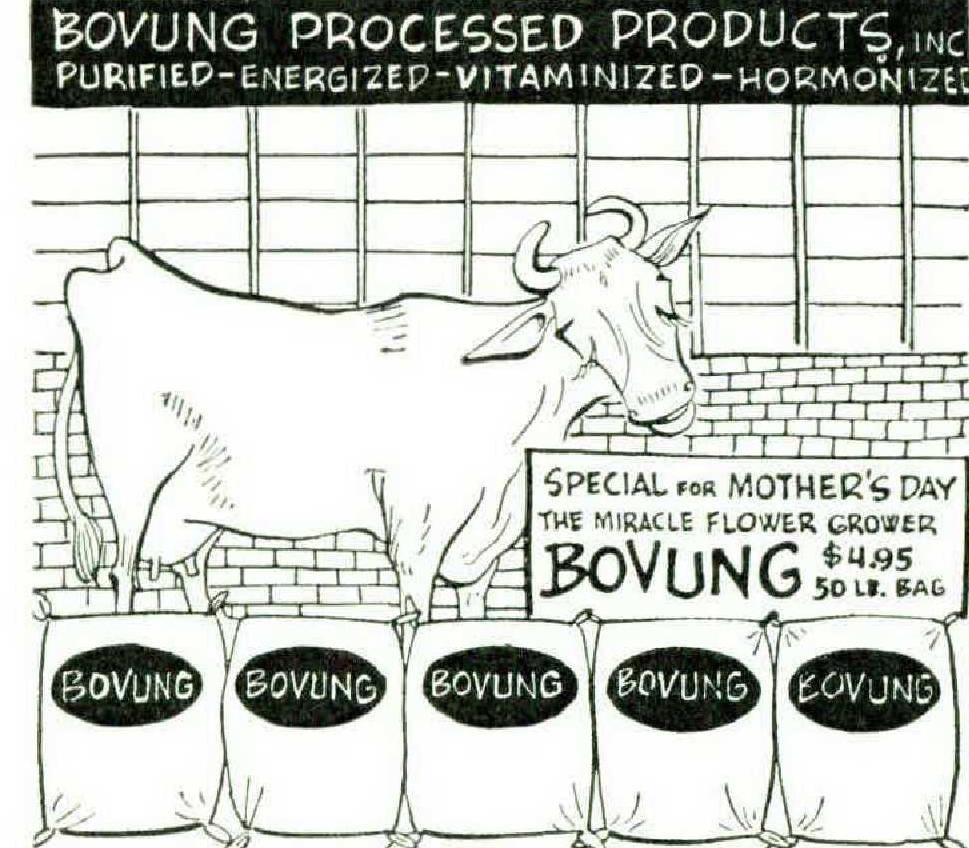
Recently an intense young suburbanite of my acquaintance asked for and received as a Mother’s Day gift a fifty-pound sack of Bovung. At the risk of appearing to give a commercial endorsement, I must report that her marigolds flourished beautifully as a result of the generous use of the fertilizer. But I keep reflecting on my Great-uncle Willie and his amazement and contempt when he learned that my third cousin Lester had contracted to buy an entire week’s accumulation in the state fair cattle barns. Not that Uncle Willie didn’t appreciate manure. He was a successful dirt farmer, and he knew that farmers don’t live by dirt alone. He also knew that although there were no coals in Newcastle, Indiana, there was plenty of what Lester bought, and there would be no profit in shipping it by the carload all the way from the fairgrounds at Indianapolis.
Cousin Lester was not committed to an institution, though any Hoosier jury would have quickly adjudged him a hopeless lunatic. After all, he was harmless, and the family merely made certain thereafter that he never had access to more than enough money to buy a bag of tobacco.
The fact was, of course, that Cousin Lester was born forty years before his time. He had the makings of a great tycoon, and would have been one if he had grown up in this age of packaging, trick trade names, and cowlessness. How could he or Greatuncle Willie have guessed that the time would come when suburban housewives would pay well for what everybody then had plenty of? How, for that matter, could they have dreamed that grocery stores would sell dainty plastic packages (fourteen ounces — no one sells a full pound of anything these days) of sterilized, sifted, odorless, enriched, moisturized, government-inspected, untouched-by-human-hands dirt?
This surely offers a hint of what is yet to conic when overpopulation of the earth puts elbowroom at a premium, when all food comes from chemical plants, and when only the rich can afford flower boxes with geraniums growing in genuine, oldfashioned soil. They may have, by that time, used up most of the fourletter words in the English language for names of soap, deodorants, and bug-killers, and may label the product “Dirt" (with soilium added) or use some of the words that Unlcle Willie used to use.
I figure that at present prices the topsoil on Uncle Willie’s acres today would be worth $875 million, and perhaps twice that much if vitamins and hormones were added. But Cousin Lester and I missed our chance to make a fortune, for Uncle Willie’s farm is covered with ranch houses beautified with flowers that thrive in the best soil and Bovung that the supermarkets sell.