Around-the-World Grouch
An English novelist who served as a lieutenant commander of escort vessels in World War II. NICHOLAS MONSARRAT is best known in this country for his stirring book, THE CRUEL SEA. Now a Canadian resident, Mr. Monsarrat has traveled widely in Europe, Africa, and North America — a fact which he here treats in a satiric vein.
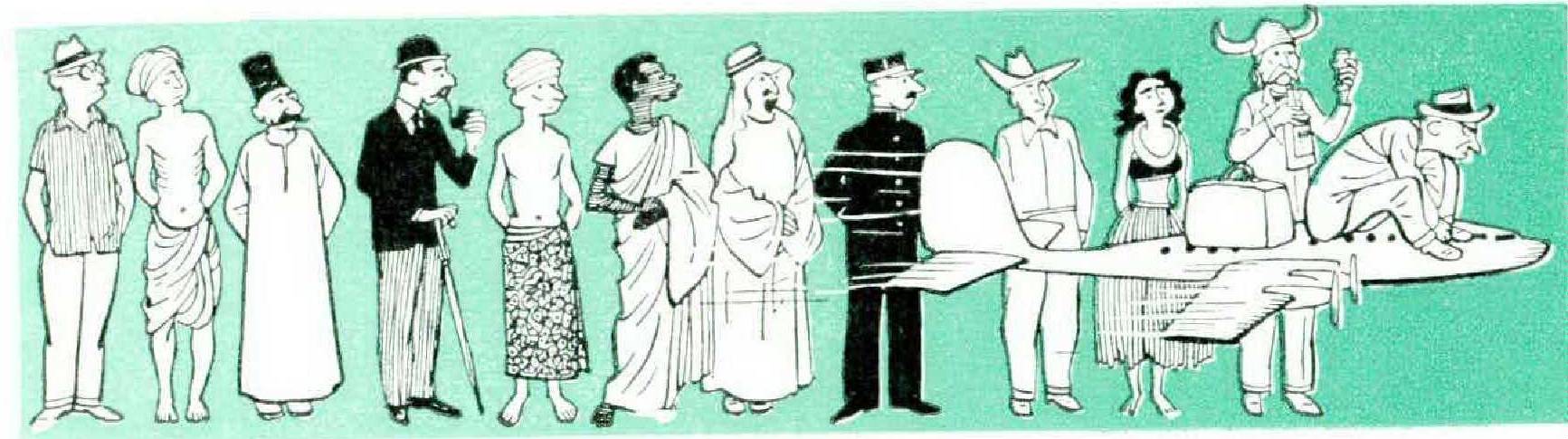
I’VE recently spent four months traveling 42,000 miles, zigzagging my way round the world from my home in Canada, visiting twenty-one different countries. You think it was fun? Gather round. The whole thing was a terrible mistake; I should have stood in bed, which is where I am now. Here is my list of world-wide complaints. Any omissions will be the subject of a later article.
To begin at the beginning: Don’t go to England. They’re in a real mess there. It rains all the time, especially upon the Rolls-Royces which stand listlessly, three deep in the traffic blocks. And people — even normally decent folk — are getting far too talkative; you can’t spend two hours in a railway carriage without some pushful fellow saying “Nice weather” and rattling his newspaper at you. Hereditary peers, long-time champions of the monarchy, now turn around and snap at its ankles, like curs or weasels. Mr. Khrushchev actually stayed at Claridge’s, on the very next lloor. The British seem to have lost their heads altogether.
Don’t go to Scandinavia. If you fulfill even half your social obligations, your liver will never recover. Someone says, “Skoal!” and you say, “Skoal!" and the man next to you says, “Did you say skoal?” and you say, “Yes — skoal!” In no time at all you have aquavit running out of your ears. If you fail to raise your glass toward every single woman in the party, you are asocial pariah; if you make the gross error of toasting your hostess, a kindly man will say: “In this country we do not toast our hostess. It is deeply forbidden. Skoal!” Your host, an enormous blond man, will knock you nearly senseless with a friendly blow between your shoulder blades and say, “You insult my wife, yes? Skoal!”
Skoal.
Do not fly to Paris by the Hotshot Lunchtime Special or whatever it is called. By the time you reach Le Bourget you will be permanently felled by indigestion. The airline is in honor bound to serve you a nine-course meal with three different kinds of wine, in the space of sixty-five minutes; and by gosh they do it! As soon as the “fasten your seat belts” sign is flicked off, the whole place is in a gastronomic uproar. Food and drink are thrown at you as if in a lunatic cafeteria; they seem to pour down the stewards’ arms. Above all, they are compulsory. If you don’t wolf everything in sight, and wash it down with tiny individual bottles of Martini, sherry, white wine, red wine, champagne, brandy, Drambuie, and Cointreau, you’re just wasting the company’s time and foully betraying their boasted atmosphere of an exclusive airborne London club.
Striving for a touch of individuality in my flight, I asked the steward (after snagging him firmly by the trousers) why he hadn’t opened my bottle of champagne. “Sir,” he said, tugging for his freedom, “the company don’t allow it! If we opened even half the bottles, we’d never get through on time. Would you care for coffee?” “Coffee?” I said, appalled. “I haven’t even finished my soup!” “One coffee,” he said, and disappeared like a flash through a door labeled KEEP OUT.
In fact, don’t go to Paris at all. You will be asked to appear on television. You will explain that your French is not good enough. The man will say: “Alors, we will do it in English,” but thirty seconds before zero, under the blinding lights and the equally blinding stares of the technicians, he will announce: “Alors, we will do it in French, after all.” You do it in French, after all. Ma foi!
Don’t go to Nigeria or Ghana. Hot rain falls all the time. There are far too many foreigners, actually running their own country. Under blinding skies, the temperature soars to 105 degrees. In Lagos, the causeway is sinking into the sea, cutting off the capital from the mainland, but only the taxi drivers are worried — the climate defeats everyone else. In Ghana a man will thrust a microphone under your nose and ask you what you think of this glorious epoch, which has at last brought freedom from the hated British. As a British immigrant to Canada, your personality is hopelessly split, which, in a temperature of 105 degrees (humidity 98), hurts.
Don’t go to Johannesburg. They have a crime wave there which has to be seen to be believed; they also have a government, somewhat ditto. In the game reserve, hired lions snarl at you, while elephants walk away in studied reproof. You will lose a fortune at poker. The bookmakers are positive robbers. A simple little dinner party for twenty people (just caviar, guinea fowl, and cerises au something-or-other, with a bare twenty-one bottles of champagne) will set you back four hundred and ten dollars.
Do not dream of going to Bombay. It is hot, it is dirty, it has three million Indians, most of them milling round the door of your hotel. To add further confusion, people gather under peepul trees, spitting betel juice onto wandering —yes, you’ve guessed it. A handmade silk tropical suit will cost all of twenty dollars, and the tailor takes a whole twenty-four hours to make it. A personal bearer, who squats permanently outside your door and does everything from pressing your clothes to painting your toenails, gouges you a full sixty cents a day. Above all, Bombay is dry. An ingenious government racket will compel you to pay a rupee to fill in a form to apply for a liquor permit (five rupees) in order to buy (one per week) a bottle of Scotch whisky costing sixty-five rupees. Total disbursements, fifteen dollars. There are no polite words to describe the taste of the whisky, when you finally get it.
Alternatively, you can buy on your permit twenty-seven quart bottles of fermented liquors ol a strength not exceeding 2 per cent of alcohol by volume. Brother, you’ll need them all.
Don’t Jly across India. Enormous crowds gather at the airport to bid farewell to every plane. The whole place is crammed with relatives, dogs, children, well-wishers, and professional mourners. You cannot get anywhere near the plane, and pretty soon you don’t want to. For all these people are in tears, all of them absolutely inconsolable; there is a crescendo of wailing sobs as your departure is announced, and a final rush toward the counter labeled “Flight Insurance.” It is not reassuring; and the journey itself completes a process of aerial demoralization. All Indian air crews sport large black curling mustaches, like the more reckless type of Battle of Britain pilot. Life in hand, curry in throat, you zoom and dip toward the eastern horizon.
Don’t go anywhere near Calcutta, if you want to hold on to your breakfast. This, the premier city of a country which has the effrontery to lecture the West on how to conduct its affairs, is a positive monument to disease, dirt, and mismanagement. The main streets must be the filthiest in the world. Outside the city, malodorous acres of shacks, indescribably squalid, deface the landscape, worse than any Johannesburg native location. Beggars, and hawkers selling every conceivable kind of trash, pester you from morning till night.
On a short nighttime walk of a mile or so, in the center of the city, I counted one hundred and seventy people asleep on steps and sidewalks, like bundles of rags left to be picked up in the morning. They have been left there by the Indian government, and they are without hope. Next time you read a vaunting headline, “Mr. Nehru on the Reorganization of the Entire Globe,” just bear all this in mind. Mr. N. would do better to run for mayor of Calcutta, and begin his global charity at home.
Don’t go to Rangoon; it might accidentally spoil the rest of the trip. You will start a wonderful forty-eight hours with a party, which develops into a screwball singing festival: Americans singing Rule Britannia, English singing Way Down upon the Wabash, Burmese singing Gilbert and Sullivan. It ends, with regret, at 3:30 A.M. Bright and early next morning, you will be afloat in the British ambassador’s pride and joy, his newly acquired Chinese junk, designed, built, and canvased according to a plan at least one thousand years old. You will eat àa la Burmese, not faked-up European food. You will examine exquisite prints of the Burma of a hundred and fifty years ago. In the evening you will meet half the Burmese air force, and then an old school friend who, taking you home for dinner, confides that he has the hi-fi set to end all hi-fis. You will listen to Dvořák’s cello concerto, and most of La Forza del Destino. You will wake up next morning thoroughly disgruntled, with the conviction that in Burma, though only halfway round the world, you’ve enjoyed yourself in a way that won’t be duplicated in the future.
There are just a couple of things to offset all this, You will need a slide rule for the currency, which is in rupiahs, a kind of ruptured rupee. If you visit a Buddhist pagoda, you will wade barefoot through betel juice, while large sneering gongs are struck to signalize other people’s almsgiving.
Have nothing to do with Hong Kong. It is a free port; you will certainly invest in a mink coat (female, Siberian, very cheap) which later disintegrates and earns you a reputation for frugality which was not your original intention. Earlier, flying in, you will roar past hills and even buildings which are within touching distance of either hand; looking back, pale, shaking all over, you will think, “Heavens! Did we really do that?" The women wear the ugliest clothes in the world; washed-out tunics, shapeless trousers, all the mysterious glamour of the East wrapped up in one dreary shake of the head. The rickshaw boys, passing you, call out, “Rickshaw?” Then they sidle up and say, “Nice girl?" Then they take a closer look at you and say: “Young girl?" The streetwalkers make loud kissing noises as they pass you. It is about as intriguing as a muffled sneeze.
Avoid Singapore like the plague. It is hot. It is humid. Its guns still point the wrong way. In your hotel, the note paper has your full name printed on it. You can’t even write an anonymous letter.
Djakarta. Ah, Djakarta. Never make a stop there, however short, however inadvertent. You don’t have to be Dutch to feel like a leper. Here the Indonesians have contracted the prime disease of nationalist fervor: the filling in of forms, and then the cancellation of them, unseen, with enormous rubber stamps. They have a currency form for transients that is positively brutal in its particularity. When you have filled out all thirtytwo items, racking your brains to remember how many frozen yen you had in 1929, a man will seize the form, stamp it, and hand it back to you, his face a bored inscrutable mask. And that is all. No one reads it. no one wants it, either now or later. It is your own do-it-yourself souvenir of Indonesia.
The man ahead of me in the queue, a cynical fellow with three cameras, completed the item “Traveler’s Checks" with “$6,000,000.” Of course, it could have been true; after all, we were traveling first class. But no one blinked an eyelash. anyway.
Leave Australia completely out of your itinerary, for there you will receive the bitterest disappointment of your life. You will have heard terrible tales of Australia; how you can only get a drink between five and six in the evening, how there isn’t any service at all, how you’ll have to sleep four in a hotel room, how if you ask to be called at 7 A.M. with a cup of tea, they will hand you an alarm clock and a thermos flask.
None of this is true at all. and you will experience an undoubted sense of loss as you drink all day. relax in your air-conditioned hotel suite at night, ring the bell at three in the morning and order your friends their four final Scotch-andsodas. True, you can complain about finding such daunting dishes as rump steak and lamb chops on the breakfast menu, but it’s not really much to get worked up about. The trouble is, Australia is not what it was (if it ever was).
Never fly across the Pacific, from Sydney to San Francisco, at one gulp. It takes nearly two days suspended in mid-air, and visions of The High and the Mighty will plague you all the way. Point of No Return, They Died with Their Seat Belts Fastened — there is no end to the intimations of disaster. You will have a short stopover of five hours in Honolulu, but what can you do in Honolulu in five hours, if you are forty-seven years of age and married? The fact is, the Pacific is a very big ocean, and anyone may quote me on the point.
Please don’t go to San Francisco. Does the road wind uphill all the way? Yes. to the very end. San Francisco is the very end, a city insanely tacked onto an overhanging cliff. I suppose if you were tired, or afraid, you could lean against it.
Finally, never fly nonstop from San Francisco to New Fork. You will arrive nine hours late (engine trouble). having spent the morbid period of 2 A.M. to 7 A.M. at Denver airport, and a further educational two hours at Chicago. At Denver, a man in the full-dress uniform of Santa Claus, rather intoxicated, will board the plane and. inexplicably, complete the journey with you. Who is he? An eccentric? A vice president on the run? A nightclub reject? Who can tell?
My literary agent, a perceptive New Yorker, suggests that the company always installs a jolly Santa Claus on any plane that is over two hours late, to distract the customers. On that scale, we should have had four or five of them, all loaded to the gills.
All in all, don’t go round the world. Come and stay with me in Ottawa instead. East Wing, Ward G. Knock and enter. But softly.