The Great Smokies
A graduate of Harvard. class of 1931, PAUL BROOKS succeeded Ferris Greenslet as editor in chief of Houghton Mifflin Company. His interest in the out-of-doors is reflected in his holidays as well as in his publishing activities. He and his wife have camped, paddled, walked, fished, birded, and chased butterflies from Thoreau’s Concord River at their doorstep to the Olympic Peninsula and the Oxford Canal. Now we follow them to the Great Smokies.
PAUL BROOKS
SOME places are like some poems; return to them again and again, and each time they reveal new meanings and new delights. Such a place, for my wife and me, is the Great Smoky Mountains National Park, a unique remnant of primeval America, fifty-four miles long and twenty wide, lying along the spine of the Southern Appalachians that forms the border between North Carolina and Tennessee. The Smokies are not tall by Western standards, seldom rising much above six thousand feet, but they are among the most ancient mountains in the world and richest in natural life. From the air you see a sinuous, green-clad ridge, with smaller ridges going off in every direction, separated by deep valleys and tortuous streams. Their inaccessibility until recent times has been their salvation. Like a rock in midstream, they stood virtually untouched by the main current of westward migration. The course of empire took its way through easier channels, and thus a bit ot the original forest survived — the finest woods, I believe, east of the Mississippi and the best hardwood stands you will find anywhere.
A park like this is a living museum, whose exhibits change with the altitude and the seasons. In a day’s climb one can travel through successive biological zones equivalent to a journey from Southern Tennessee to the Canadian border, from the great tulip trees in the valleys to the virgin spruce-fir forests of the summits, where the climate is equivalent to that of the coast of Maine. Our first visit seventeen years ago had been in early November — “out of season” in terms of the tourists though not of the trees. The flaming autumn foliage reaches its peak here several weeks later than in New England. On the high divide it was already winter. Icy fog swirled about the summits, and when the sun at last came out a million ice-covered twigs were turned to diamonds.
In later years we came to know these mountains in other moods. In late April, when the dogwood was in flower on the lower slopes and the high, hardwood forest was only faintly washed with green, when bright-yellow trout lilies and pale-pink spring beauties bloomed along the Appalachian Trail and pine siskins flocked in the spruce tops and played about our camp site. In May, when we had pitched our tent between showers near a tulip tree whose upright orange blossoms shone like candles in the mist, when the silver-bell tree hung its white pendants in the ceiling of leaves, while the maroon of the wake-robin relieved the endless greens and browns of the forest floor. In September, for a lazy week at the lush end of summer, when the katydids were loud at dusk and I saw alight on a thistle my first gulf fritillary butterfly, burnt orange above and silvery below, a beautiful insect that seemed to embody all the hot glare of the tropics.
OUR most recent trip to the Smokies was in late June, the best time of year for the famous display of azaleas, rhododendrons, and mountain laurel. The main objective, however, was not simply to enjoy a spectacle but to immerse ourselves for a few days in the park’s finest “wilderness area” — the official term for a tract of primeval forest which is kept in its natural state, unlumbered, unspoiled by roads, and accessible only by trail. Leaving our car at a park campground, we set off with a tolerably light load in our packs, including a five-pound tent, sleeping bags, air mattresses, a Hudson’s Bay ax, a pair of binoculars, and food for three nights.
As every season has its own personality, so every trail has its own cadence. The one we followed began to mount in steady switchbacks straight up from the river valley, gaining two thousand feet in the first three miles. Through the dense stand of second growth “poplar” — as the local people call the tulip tree — we began to catch glimpses of distant mountains. An occasional mammoth red oak showed that we were approaching the wilderness area. Our backs and packs were dark with sweat when at length we reached the crest of the ridge and the trail leveled off to an easy walk. Through a grassy opening in the forest a less traveled path sloped gently downward to the spring where we would spend the night. The penciled X on our geological survey map became a flow of ice-cold water welling out of a sandy slope, set off by the delicate pink of mountain oxalis and the deep red of cardinal flowers. Great trees stood all about us: buckeyes and red maples, a yellow birch some four feet in diameter, red spruce rising spearlike through the gnarled hardwoods or stretched out on the ground at incredible length, moss-covered and moldering, seedbed of future generations.
Trees like this do not have lower branches. Before sleeping that night, we had to find a sturdy sapling from which to suspend our food bag out of reach of the bears. In bear country this should be a bedtime routine, like brushing your teeth or putting out the cat. One night at the campground we had suffered a lapse of memory which would have been less amusing if we had already been on the trail. Asleep in our tent, we were awakened by a metallic crash that could mean but one thing: a bear in the food box. We bellowed and waved flashlights; the only response was crunching and stentorian breathing as our visitor consumed one pound of steak, two pounds of bacon, four chocolate bars, two loaves of bread, one pound of cheese, one pound of butter, and — with a particularly offensive slurp — two dozen eggs. The raw eggs, my wife pointed out charitably, would be good for his coat. As he lumbered away he stumbled over a tent rope and shook our roof in farewell.
This time, after dark there was only the sweet descending spiral of the veery’s song and at dawn the busy yank! yank! of the red-breasted nuthatch. Morning was half over before we said good-by to our camp site by the spring and set out on what is known as a rough trail or manway, to distinguish it from a trail that a pack horse can negotiate. As we entered the wilderness area the switchbacks with their moderate slopes were left behind. Clambering up the hogback, with pauses to pant and rest from our packs, climbing down the crazy ladder of rhododendron roots, we began to sense why the Smokies are considered rugged mountains despite their moderate height, why the homesteader left this country to the hunter and the Indian. If we could not really get into our heads the complex geological history of the mountains, and its relation to the forest all about us, we could at least feel it in our legs.
The mountains as they stand today are the product of erosion rather than upheaval, an ancient plateau carved by the slow chisel of the streams. In spring, when there is as yet no concealing cover of leaves, one sees and hears the waters still at work, sparkling threads at the bottom of each V-shaped draw. In contrast to younger and higher ranges like the Rockies and the Sierra, there is little exposed rock even on the summits of the Smokies, for at this latitude six thousand feet is below timberline. The huge lichen-covered boulders in the stream beds, architects of deep pools and shimmering cascades, are said to have broken off from bare rock and rolled down the mountainside in the more violent climate of the last glacial age. But while other areas were actually covered by ice or submerged beneath the sea, this region remained a sanctuary for the hardier trees and flowers, with the result that it is today a botanist’s paradise, containing more than one hundred and thirty species of trees.
And here most of our Eastern trees achieve their maximum size, thanks to the moist air and an annual rainfall second only to that of the Pacific Northwest. Canada hemlock grows up to nineteen feet in circumference, red spruce fourteen, cucumber tree (a magnolia) eighteen, yellow buckeye fifteen, and so on — greatest of all being a noble tulip tree with a recorded girth of twentyfour feet. Here, as in the Olympics, we have watched the valleys steaming after a downpour or stood beneath the dripping foliage as the sun came out and tendrils of mist spiraled upward through a thousand shafts of light. This smokelike mist, and perhaps the purple haze which even on fair days may lie along the mountaintops, has given the Smokies their name and much of their subtle beauty, so different, for instance, from the massive jagged outline of the Rockies. Subtle but not mild. In summer violent thunderstorms march along the ridges; we have seen great banks of cloud that appeared to rise almost vertically up one side of the main divide, like smoke from a forest fire, blanketing North Carolina in darkness while Tennessee still basked in the sun.
One such storm, followed by a cloudburst, hit us on a September evening years ago when we were camped on flat land near a river. As water flooded under the ground sheet (I had failed to dig proper ditches), the ropes shrank and the tent pegs began working ioose in the mud. Barefoot, I stood in a couple of inches of water, hammering in the metal pegs with a camp ax. A flash nearby, and I saw a blue spark leap from my right to my left foot; I felt as if I had touched a Paul Bunyan electric fence. I decided by now to come in out of the rain. Happily the tent held, the storm subsided, we somehow managed to get a fire going to cook our steaks and by nightfall were giatelully settled for sleep. It was hot, and the tent flap was open. I was just dropping off when I felt something crawl up my arm and across my fact . A pack rat, distinctly damp. I told him to go away. Again to sleep, again the scampering up my arm. At this point my wife, who doesn’t like rats even wild and uncorrupted pack rats had had enough. Angrily she got out a heavy needle and thread and sewed our front door firmly shut. The rest was silence.
Now as we worked our way down off the ridge, the rumble of an approaching storm mingled with the distant murmur of a different stream far below us on whose bank we planned to camp. Two hours later, under an angry sky, we waded through the swift, icy current to pitch (and ditch!) our tent on a tiny bit of grassy level ground. The first drops fell as the last peg went in. With some old curved roots I fashioned a sort of dome to shelter our fire of driftwood gathered from the stream’s edge; it hissed and sputtered but miraculously lived, and its updraft carried off the clouds of midges that had swarmed from the grass.
Above the soporific sound of the creek rose the three liquid notes of the wood thrush, in place of the veery that had sung us to sleep at higher altitudes. A great horned owl hooted twice and was still.
Ducking in and out of the rain, I opened a tin of meat for supper and idly read the watersoaked label: “New beautiful party bag and billfold $2.50 value for $1.00. Get this fashionable new pearl white party clutch bag with matching billfold NOW !” Well, not just now.
THE toughest days in the wilderness are often those that mean most in retrospect. By our very modest standards, the next day qualified. In other summers we had paddled and portaged through a bit of the roadless area north of Minnesota; we had lived for a while with the gigantic rain forest of the Olympic Peninsula. But never had we come so close as we did that day to recapturing the experience that the early explorers described with such mingled delight and awe. From out camp site the rough trail led downstream through a mixed forest of virgin hardwoods and conifers, alternately following the stream bed or mounting steeply through the tangle of rhododendron. At one point the going got so rough that we had to take off our packs and pass them along by hand.
After a few hours of this, any place where you could put your foot down solidly twice in succession felt like a highway. But at least we had a map, and there was a trail of sorts. The mountain laurel was in full bloom, its shell-pink flowers massed along the banks of the creek and festooned over the house-high boulders in the torrent.
Someone is supposed to have asked Daniel Boone whether in all his wanderings he had ever been lost. No, he replied, but he had been bewildered (using the term in its root sense). We were bewildered now as we tried to pick out the trail marked on our map. A right-angle bend was clearly shown, and we found a few old blazes where it should have been, but they soon petered out in the trackless forest. Only slowly did we realize that a new trail had been blazed since the map was printed. We remembered a confusing day years ago in the Minnesota canoe country when we found ourselves paddling up a long narrow lake that obviously was not on the map; all came clear when we reached a beaver dam and realized that the beavers had created the lake since the last survey. More often it is the user, not the map, that is at fault. I have made boners that should put me at the back of the class. The trouble, I told myself as I tried to reconcile the trail with the map, generally begins with an idée fixe: you visualize a trail turning off at such-andsuch a point, a portage at a certain arm of the lake, and you miss it when it turns up unobtrusively somewhere else. A map, like a Ouija board, can be made to say what you subconsciously want it to say. Keep looking at it, even when you think you know it by heart. And don’t forget to note the date in the corner; things may have changed.
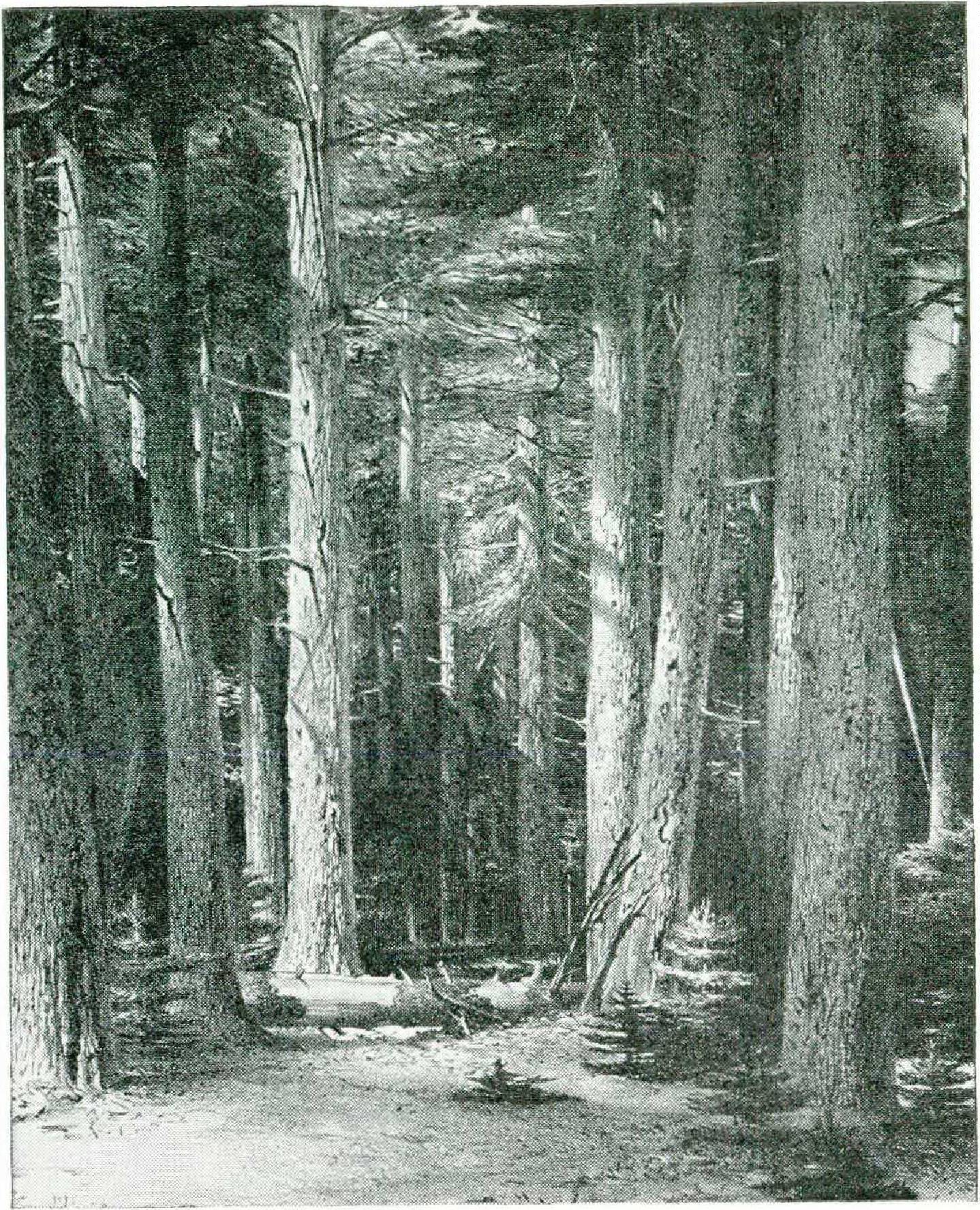
As the day wore on and we got deeper into the valley, the lorest became more and more impressive. The dense understory of rhododendron, virtually impenetrable till a trail has been hacked through it, gives these untouched woods a strangely parklike appearance. Few saplings grow above this deep green blanket; one’s eye travels far among the bare straight trunks of the hardwoods and towering hemlocks. The lowest leaves were often so far above our heads that we needed binoculars to identify them. Accustomed to the cosy woodlands of New England, we felt as if we were in an enchanted country where shrubs are trees and everything grows larger than life size. “ The spirit-haunted forest, fairy-enchanted, Stupendous and endless,” as Vachel Lindsay called it, where kittens turned to tigers, pigs to wild boars, colts to gold-horned unicorns, where “The smallest, blindest puppies toddled west . . . And turned to ravening wolves Of the forest.”
We saw no wolves, and my Field Guide to Animal Tracks omits the unicorn; the cloven triangle in the sand on the riverbank was more likely the print of a deer. There were other signs of hidden life. The deep claw marks on a spruce tree were obviously made by a bear. The “scats” here and there along the trail were harder to identify — either fox or wildcat; even the experts sometimes fail to tell which, Bits of evidence fitted together; those big oval holes we noticed in a dead snag, the loud tattooing that had echoed through the forest, and now the black-and-white feather at our feet. This was the pileated woodpecker, the red-crowned cock of the woods, king of his tribe now that the ivory bill is near extinction. Smaller birds were less elusive; a pair of blue-winged warblers scolded us for coming so close to their nest, as the juncos had along the higher trail; a winter wren, reminiscent of the Long Trail in Vermont, lit up the woods with song; a kingfisher shot downstream with his loud rattle. Yet compared to open and brushy country, with its variety of bird song, we found that a climax forest is a quiet place where life goes on unheard and unseen.
Was our trail also going quietly on forever? Packs were getting heavier, our morning freshness was wilting, and our spirits were sinking with the sun. Would we ever get out of here to send for that party clutch bag? We reminded ourselves that we were not lost, only bewildered, and that we were bound to intersect the main trail if we kept on going downstream. This was, we reassured each other, the only possible answer. The map may have been out of date but the river valley was not. When at long last we emerged from our tortuous tunnel onto a clear-cut path running in the right direction, we were vastly relieved to find that our answer checked with the one at the back of the book. Near the meeting of the trails was a dark laurel-bordered pool with sheer rock walls but a pebbly beach large enough for a tent and open to the setting sun. Enough for today.
Two days later, having returned to civilization and replenished our packs, we set out on a final trip to see one of the park’s rarest exhibits. The flame azalea, member of the rhododendron family, reaches its peak of flowering the third week in June on those grassy summits of mysterious origin locally known as “balds.’ Again the long climb —three thousand feet of it; again the feeling of a world apart, but this time an open, sun-drenched world, a high island surrounded by blue-green swells extending to the horizon.
Abruptly from the dark woods we had stepped into a meadow dotted with clumps of blueberry, dwarf willows, and low thickets of hawthorn; we heard brush-country birds; towhee, brown thrasher, chestnut-sided warbler. All about — though densest at the edge of this inverted green bowl glowed the azalea, head high, ranging in color from deep red-orange through pink to almost white. “The clusters of blossoms,” wrote its discoverer, William Bartram, “cover the shrub in such incredible profusion on the hillsides that suddenly opening to view from the dark shades we are alarmed with apprehension of the woods being set on fire. This is certainly the most gay and brilliant flowering shrub yet known.”
When we had wandered about and looked our fill, we stripped and lay in the deep grass. We were a bit weary after the morning’s climb, but from a distance we must have appeared a lot deader than we felt. A turkey vulture, soaring on the rising air along the ridge, circled us deliberately, tilted his scrawny red head, and fixed us with a hungry eye. He seemed to ponder for a while, turning this way and that to get a better look, then reluctantly sailed on. Not quite, not quite yet.