The Aftertaste
Playwright, actor, and producer, PETER USTINOVis now in Hollywood, where with Sir Laurence Olivier he is starring in the new film being made from How ard Fast’s novel, SPARTACUS. Meanwhile, he continues to write for the ATLANTIChis original and unorthodox stories, each one of them probing into a new aspect of contemporary life.
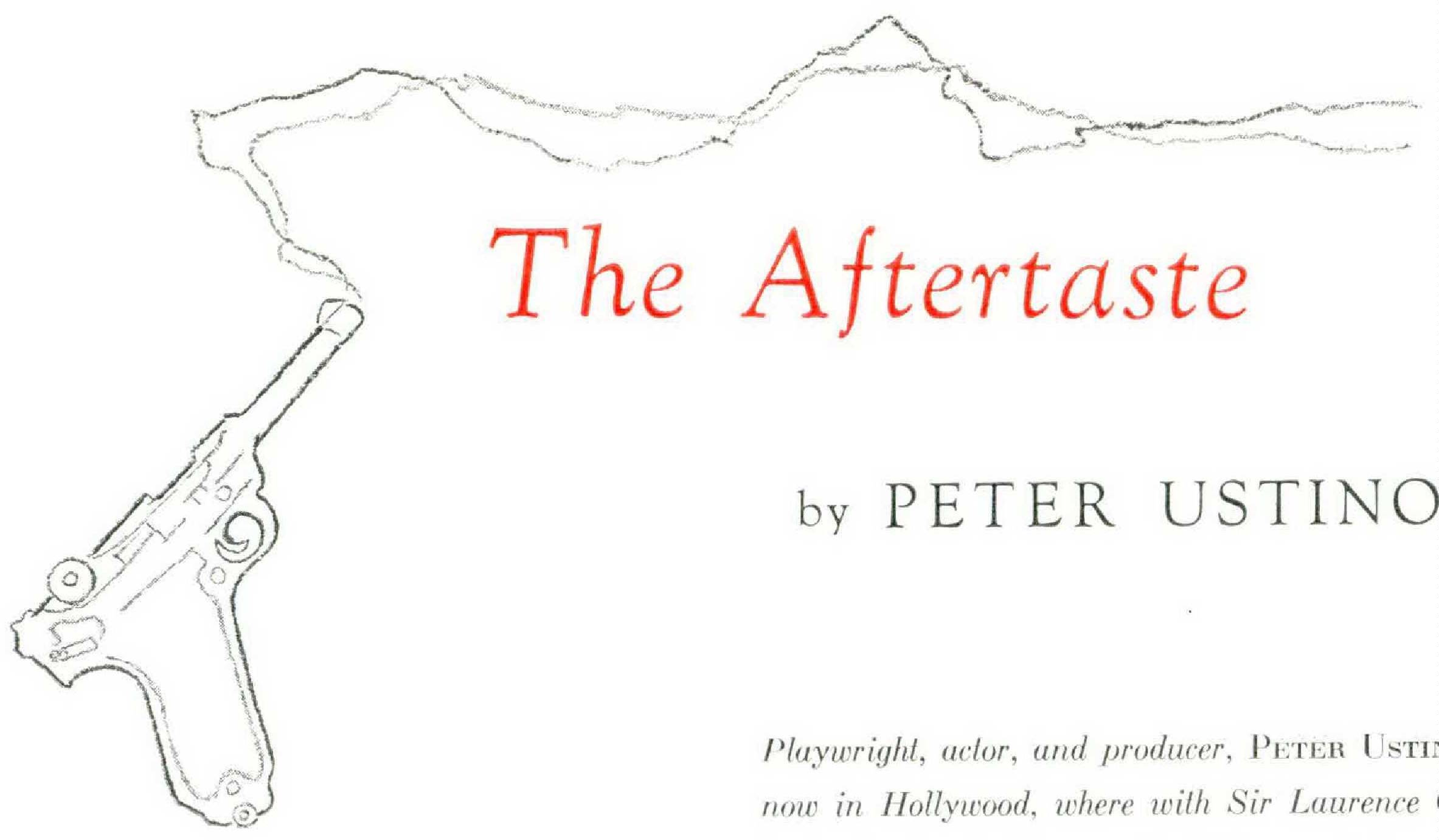
IN NORMAL times, there was snow as far as the eye could see, snow, smooth as a marshmallow. This winter, however, there were blemishes on the clear face of the landscape. It was as though a knife had cut through a gigantic apple, only to find a family of peaceful maggots hibernating there in yellowed trenches, untidily. They were horses, men, all dead. The wind howled, whistled, died, howled again. Snowflakes drifted by, leapfrogging, scurrying, rising mysteriously as well as falling. There was a hovel in the middle of nothing, a shabby hut which seemed to have fallen onto one knee in the snowdrifts, more like a moving thing which had become bogged down than a static edifice. No discernible road led to it. It was alone.
Inside, in the semidarkness, half hidden under blankets, were the 603rd Mountain Division, the 346th Nibelungen SS Regiment, the 425th Special Engineer Brigade, and the 78th Italian Brigade, each represented by its last surviving member, General Leopold Reims, General Egon Freiherr Von Augenstrahl, General Rudolf Kowalka, and General Baldcssare Capognoni.
They had not eaten for two days, they had not slept for three, they had not fought for a week. If the battle was still going on, they had no evidence of it. There was no gunfire, only the wind.
“I give it another ten minutes,” growled General Reims in a weak voice.
“And then what?” asked General Kowalka.
“And then I will take my life.”
“Why wait ten minutes?”
Reims looked at Kowalka with disdain and tapped his breast pocket. He took out an empty packet of Overstolz cigarettes, searched it for the fiftieth time, and threw it on the floor.
General Capognoni had three cigarettes left, flat Italian ones. He had kept them for emergencies. Now he offered one to Reims from a golden etui.
“I don’t smoke,” said Reims, not looking at Capognoni.
“I will, with pleasure,” said Kowalka.
Kowalka and Capognoni lit up. The Italian general studied the face of Reims, who was the senior of the four officers. The calculated refusal of the cigarette had stung him, but he had neither the inclination nor the energy to lose his temper. His hatred was too deep for that.
Reims had eyes like a bird of prey, set close together, and he seemed to have to turn his head in order to change the direction of their constant gaze, which was endlessly, dangerously forward. He blinked only rarely, but when he did his lids fell and rose again mechanically, like a time exposure on a camera. There was a deep fold on the bridge of his nose, as though heavy glasses had once become embedded there and it had entailed surgery to remove them. His lips were a perfect, high-precision fit, with little incisions running across them, a fading wound from which the stitches had not yet been removed. The nostrils were large and flared, and quivered with irritation as some small nerve under one eye beat an endless tattoo somewhere near his cheekbone.
The way his hair grew seemed essentially foreign to the Italian. It stood up sharply and whirled around a double crown, where a tuft of longer hair sprouted aimlessly, forever unkempt and strangely defenseless. The color was gray of the kind that must have been fair once, and the skin of the face, brown and leathery, changing to an obscene white on the lower neck, which looked not so much shaved as plucked, a dead chicken.
Deliberately, General Capognoni blew the scented smoke from his cigarette in the direction of Reims, saw it spiral around the aggravating head of the desiccated war lord, and noted with small pleasure the increase in the twitching as the odor of the Turkish tobacco was drawn into those huge, flared nostrils.
“Suicide is the ultimate form of cowardice,” General Egon Freiherr Von Augenstrahl suddenly declared.
“It is the height, the acme of honor,” General Reims shouted feebly.
“By killing yourself, you are doing the work of the enemy. You are wasting a bullet which should be used in battle.”
“Our orders specifically forbid us to fall into enemy hands,” Reims snapped.
“Our orders were given us by a crackpot Austrian corporal in Berlin. As a German officer, I no longer consider myself bound by orders which have allowed our tragic situation to develop.”
Kowalka laughed. “Not a word against the Austrians,” he said lightly. “Our friend in Berlin was a corporal in the German army. Had he stayed at home, he would have remained a private.”
There was no argument.
Capognoni studied Von Augenstrahl. A good face, young but with an undercurrent of unpleasant and disconcerting hysteria. He was tall and thin, dark for a German. There was a chain around his neck. It may have been an identity disc, but he was probably a Catholic. His mouth was disfigured by a permanent scowl, which was too dramatic not to be the expression of a weak man in search of strength. His sudden outbursts, his categorical decisions, were those of one who is reckless in attack and stubborn in defense but who is unsure of any qualities which lie beneath the surface; a man whom generals believe has it in him to be a born leader because he learns the obvious lessons too well.
“D’you know the one about Count Bobby and the Jewish stockbroker?” said Kowalka.
“Spare us your jokes,” Reims answered.
“I beg your pardon. I forgot that jokes were rationed too.”
Capognoni glanced at Kowalka, who lifted what was left of his cigarette into the air as both a salute and a toast to the generous donor. Capognoni smiled slightly, because he was polite by nature. Kowalka was a professional Austrian, and as such annoyed the Italian. He took strength, and indeed joy, in all the most flagrant vices of his race, which was insupportable for an Italian who was working hard to do just the opposite. And yet, it was only a manner of speaking, this dogged facetiousness. In action, Kowalka had proved himself not only courageous but, what is even rarer, imaginative.
His small dark eyes darted hither and thither, thinking of something to say, something amusing, at least ironic. His mouth was full of gold teeth, gold and a little white, Austrian baroque. On his upper lip lay a small mustache, not the postage stamp cultivated by Hitler, but a delicate pagoda roof. His nose was amusingly long and pointed, but split at the end like a baby’s bottom. A good husband, Capognoni thought, for a wife who likes laughter and is not too vigilant.
CAPOGNONI started thinking about women, the women of men such as these. He threw down his cigarette and stared at Reims. The Frau Gemahlin was probably one of those gaunt Teutonic creatures with a plummy, apologetic voice, too tall to be really feminine, too thin also. He imagined her pink skin, punctuated by long fair hair, like rushes, and he shuddered. When Reims had gone, she would fit admirably into black trappings, receive her condolences with the bleak affectations of suppressed heroism, and bend, a folding ruler, to place the sad flowers on the tomb. Von Augenstrahl, he guessed, had no wife. Nor, if he survived, would he ever have one. There was some obvious agony of the spirit behind the aristocratic façade, some great passion which had found no direction. He was of the stuff of martyrs, of monks, of proud, rigorous solitudes, but also of surrender to vice, to dissipation, to corruption and perversion. Temptation could never be far away with an eye so febrile and a scowl so desperate. His family was perhaps too old, the marriages had been too good for too long, the code of behavior too elevated to be practical in an age which had no patience with chivalry.
Capognoni glanced at his watch, which had a gold case. Instead of flicking it aside to tell the time, he looked at himself. Time had no meaning any more, but he had. He saw one hazel eye, distorted by the scratches on the gold; one eye, an eyebrow, a little of an aquiline nose.
“How different,” he thought, “am I from these uncertain northern savages.” He was convinced that neuroses emanated from the north. His life had held no problems of the kind which would induce twitches or stammering. Mediterranean existence was as clear and as limpid as the southern sky. There were emotion, of course, and easy tears, but they were definite medicinal advantages. Sorrow did not linger inexpressibly, to fester into complexes. If there was grief, it was immediate and very loud. Others would help by weeping just because they saw tears flowing. It needed no precise, logical reason. It cleared the mind and was good for the appetite.
He was further from home than any of them, further from the cypresses and the olives, the smell of the herbs drenched by the sun, the languid sea: further from home and the children, the yelling streets, the screeching tires, the arguments conducted from pavement to pavement, the lizards on the sand that must have been old when the Romans were alive. He thought of his children more than of his wife. Aldo and Teresa, in their identical costumes, rear admirals in the Italian navy. He thought of Poppea, the white sheep dog, a blind rug hobbling about the patio in search of shade. Yes, he thought of his wife, Donna Marcella, with her resigned, patient face, her ample bosom, her smile of dull but touching understanding. He wanted to cry, but he couldn’t because of the presence of those damned Germans. They would misunderstand, as they had always misunderstood. This was a time for militant thoughts.
He remembered his pleasures, the recklessness with which he drove his red Alfa-Romeo to impress his mistresses. Ninety miles an hour in a built-up area was nothing strange, and in any case, he had an amiable relationship with the police. Amalia Portanello had been his favorite, a tall, cool blonde who might have sat for Signorelli, even for Botticelli. The smell of her perfume had lingered around the car even when she was absent. They liked to bathe at night, naked, at Fregenae.
Giovanna Petricoli had been more passionate, perhaps, but consequently more of a nuisance, since she had been impractical enough to yearn for a permanent liaison, a kind of second marriage on the side. Chiara Dossi was an actress. Most sophisticated, but she had made him jealous by her unwillingness to commit herself, by her sidelong glances at door and window, by her mysterious telephone conversations with other people in his presence. Anna Maria Lisone was the wife of his best friend, which gave a subtle spice and melodrama to their acts of love. Ah, life had been full and voluptuous. What was he doing here, in the midst of a Russian winter, freezing to death? His connections could have kept him at home, at some desk job in the Ministry of War. Why was he scarcely able to move his feet, he, who loved nothing better than a bed of pine needles to walk on, and hot sand leading to the sea?
He was convinced that Italy was a warlike nation and that the temptations of her landscape and her climate must be resisted at all costs. The Romans loved life, he used to argue, and they denied themselves none of the pleasures of the body, but when the time came they marched in disciplined ranks into the frozen north, to conquer and to rule.
He suddenly imagined Reims in a bearskin, staring not at his unpromising destiny but at a foul-smelling pot of gruel, the fruit of a day’s primitive hunting. Himself he saw as a Roman, all gilt and glory, ministering to the shivering savage, explaining that there is no power on earth to stop the inexorable advance of the legions.
JUST then Kowalka broke the mood. “Hey, Generate,” he said, “we fought the only civilized wars, didn’t we? The Austrians and the Italians. At Caporetto you ran away, at Vittorio Veneto it was our turn. It was all done as gentlemen should do it. At the first sign of an advance, the other side retreated. There was none of this nonsense of both sides trying to advance at the same time.”
Gapognoni flushed under this insult. “I don’t agree,” he said stiffly. “Wars are to be won, and every effort should be made to win them.”
Reims grunted.
“You may have complaints to register about our soldiers,” Capognoni went on with quiet fury, “but they pale beside our complaints of German generalship.”
Reims turned on him. “How do you allow yourself such impertinence!” he cried, the white of his eyes isolating his light blue irises from the eyelids. “It is well known that Italian strategy leads in only one direction, backwards!”
Before Capognoni could reply, Von Augenstrahl intervened. “What you say is unfair, Herr General, and beneath the dignity of a German officer.”
“How dare you tell me about the dignity of a German officer. I am the senior general present!” His outburst finished hoarsely as his energy ran out.
“ This is our war. We cannot expect Italians, Romanians, and Hungarians to fight our war as they would fight their own.”
“Our war is their war. We are accomplishing our historic mission of saving Europe from the Mongolians, the Asiatics. It is Germany’s destiny to accomplish this solemn duly of leadership. Look at the Russian prisoners, small, inferior men with slanting eyes and yellow skin, and you will understand that this war is Europe’s war.”
“Were you referring to the Japanese, Herr General?” asked Kowalka.
“I was referring to the Russians, the Russian prisoners!”
“It’s so Jong since I’ve seen a Russian prisoner,” said Kowalka with a humorous sigh.
“Time is up.” General Reims slowly drew his revolver and placed it on a packing case which was serving as a table. He looked at the two other German officers and said, “In my estimation, as senior officer present, the moment for a vital and tragic decision has arrived.”
Even in despair the Germans find the most complicated, overblown phrases, thought Capognoni.
“I made up my mind that if no relief had arrived by twelve o’clock, midday, then it would be our duty to resign ourselves to the inevitable and to obey the directive given to all officers, which is not on any account to fall into enemy hands alive. To ensure this, I order you all, with the exception of General Capognoni, over whose fate I do not presume or wish to have any jurisdiction, to take your own lives in an honorable way. Are there any questions?”
There was a moment of silence. Von Augenstrahl blinked rapidly once or twice and then said, “Herr General, my point of view is already well known to you. I will not waste my breath reiterating. Quite apart from certain religious scruples, which I will not discuss with those who are unqualified in such matters, I regard suicide as cowardly, unsoldierly, and ungentlemanly.”
“Am I to understand that you, a German officer, refuse to obey orders?” croaked Reims.
“I cannot obey orders which are against the dictates of my conscience and of common sense,” Von Augenstrahl snapped, the perspiration running down his forehead in spite of the cold.
“You are under arrest!”
Capognoni wanted to laugh. Kowalka did. Was there no end to absurdity?
“I am leaving,” said Kowalka suddenly.
“Where to?” asked Reims. There was almost a trace of hope in his voice, as though he believed Kowalka might have some secret information which he had been withholding.
“That is a good question,” replied Kowalka. “I wish the answer were as good. I don’t know. I am going to find the Russians if I can.”
“What for?” Reims demanded.
“In order to surrender,” said Kowalka simply.
Reims’s face became purple as the blood rushed wildly beneath the skin. “Can’t you leave the dirty work to our allies?” he cried.
Capognoni bit his lip. “Yes,” he said with a composure which was surprising even to himself, “leave the dirty work to your allies. It is in the great tradition of the German army. It worked well in Africa; why shouldn’t it work well here?”
Reims brought his fist down on the packing case but could find no words, since the violence of his emotions was evidently causing him some physical distress.
“Are you coming with me?” Kowalka asked Von Augcnstrahl.
“No. I have two bullets left. Neither of them will be for me. They will both be for Russians.”
“One is madder than the other,” observed Kowalka. “General Capognoni?”
“I am staying here,” said Capognoni. “As a Roman, it amuses me to see how the barbarians prepare for the end.”
“I had no idea that a Roman would wish to emulate the barbarians in these sordid matters. Rome’s greatness was that she always knew when she was beaten. She knew how to compromise. Even today she is referred to as Eternal.”
“It was always Rome’s duty to set an example.”
THE twitching on Reims’s face increased perilously, like the end of a film beginning to run off a spool. Death was a solemn occasion, and these impertinences were desecrating it. A man only dies once. It should be done in style, with due regard for heroic self-pity and with silence for massive and lugubrious thoughts.
Kowalka dug into his tattered pocket and produced a small compass.
“East is in that direction,” he said, pointing to the unpromising horizon. “I am going due east, toward Stalingrad. Perhaps, with the help of the Russians, I will succeed where the entire Sixth Army failed.”
“Coward,” said Reims, whose trembling hand was attempting to slip a bullet into the chamber of his revolver.
“Coward?” answered Kowalka pleasantly. “Perhaps.”
He tore the decorations off his uniform and lobbed them over toward Reims. “There, does that make you feel better, Herr General?” he asked and added, “It makes me feel better. There goes half my guilt.” He smiled disarmingly at Von Augenstrahl. “I trust you will go in the other direction. I have no wish to become a victim of your devotion to duty.”
“I am going west,” snapped Von Augenstrahl.
“I am delighted to hear it. General Capognoni, I hope to see you after this idiocy is over. The Hotel Imperiale at Cortina d’Ampezzo is one of my favorites. Do you ever go there?”
Capognoni did not answer.
Kowaika clicked his heels in the Prussian manner, brought his hand up in the Nazi salute, shouted, “Heil Mozart!" and staggered out into the snow.
Von Augenstrahl gazed at Reims. “Is there anything you wish me to . . . to tell anyone . . . if I should be lucky?”
Reims looked up gratefully, pathetically. “My wife can look after herself,”he said gravely, “and my sons were brought up to be officers and gentlemen. I have no fear that they will disgrace our name. Tell them I died as they would have wished and that it had to be.”
“Heil Wagner,”murmured Capognoni, but neither of the Germans heard him.
“Tell them to destroy my dog.”
Capognoni looked at Von Augenstrahl in sudden horror, but Von Augenstrahl just nodded stiffly, his eyes shut.
This was too much to tolerate. Such was Reims’s taste for suicidal heroics that he even wished a poor, healthy dog to accompany him to the kennels of Valhalla.
“Why kill an innocent dog?" he cried in spite of himself.
Reims ignored him but gazed at Von Augenstrahl with baleful eyes. “Freiherr Von Augenstrahl, we have disagreed on many points,”he said, “but we are both German officers. I should like to shake you by the hand before I do my duty.”
Impulsively Von Augenstrahl extended his gloved hand, which Reims took in both of his, practically petrified in their tattered mittens. They looked deep into each other’s eyes, like lovers, and Capognoni knew that he had never seen anything so ugly in his life. Tears suddenly spurted uncontrollably from Von Augenstrahl’s dark eyes, and the whole of Reims’s jaw was shuddering violently.
Almost fiercely Von Augenstrahl withdrew his hand from the moribund grasp of the older man. saluted in the traditional pre-Nazi manner, turned, and walked out of the hut.
Capognoni felt an expression on his face which he had never experienced before, an expression which was probably one of revulsion, the anguish of a man with humanism in his blood faced by inhumanity. He glanced at Reims.
Reims, with much groaning and grunting, began to struggle out of his greatcoat. Instinctively Capognoni wished to help him, but restrained himself. He did not want to be party to this odious rite about which he understood nothing, nor did he feel qualified to interfere with the exquisite pleasures of a man who tasted every whiff of absurdity as though it were a rare vintage of human experience.
The revolver was in readiness. Reims searched his satchel with fingers that could hardly obey him any more, fingers as puzzled as those of a child when they find an unknown texture, as lost as those of a young monkey at grips with an unpeeled banana. At last he drew out a couple of medals and began to pin them to his tunic. He was in no condition to do this, and one after the other, they fell to the ground, but he did not notice. Then he shut his eyes and passed his hand over his breast with an almost feminine gesture. His eyes opened again when he realized that the medals were not there. He looked down and began to whimper. Like a baby whose toy has fallen out of its pen, he reached for the floor with no conviction of being able to reach them. Appealingly, he looked at Capognoni. The whimpering too was that of a baby, or of a dog locked out.
Capognoni returned the look steadily. “Bastard,”he thought, “to condemn your dog to death.”
Still the whimpering went on.
Capognoni felt like drawing his own pistol, putting a couple of bullets into Reims, and spoiling the whole elaborate ritual, but he did not move. It was cruder to wait.
Then Reims frowned, passed his hand over his heart again, let it loiter over the ribbons, and looked straight forward. He cleared his throat as though he were going to shout and then began signing the national anthem in the high, unsteady voice of an aged woman.
Suddenly Capognoni’s taste was mortally offended and, without pausing to think, he sang Vesti la giubba in a penetrating tenor, filling the air with sarcastic sobs as the third-rate artists do in Neapolitan restaurants.
In the middle of a phrase, Capognoni stopped. Reims could no longer hear him. The veins on his temple were standing out like flexed muscles, and the blood was racing around on the last lap of the race. Reims seemed transparent, a mere network of arteries exposed by the dissolving flesh. There was a report, and he fell to the floor motionless, the bitter draft from the ill-fitting door agitating the little tuft of defenseless hair on top of his head as the wind will play with a tuft of grass.
FOR a moment Capognoni was stunned as the noise of the explosion seemed to inhabit the room, dying more slowly than Reims, and then he began to retch, but as His stomach was empty it produced no more than an agonizing pain and wateringeyes. When he recovered his composure, he reflected how pleasant it was to be alone, to be unobserved. Surely a man could stand anything when there was no need to keep up appearances. He looked at the room as though he were seeing it for the first time. The rough beams had a sort of beauty. It was like being ill and alone, when the eye, for want of the indiscriminate everyday excitements, began to find an elusive symmetry in damp patches on the ceiling or could study the patterns of raindrops on a window and find a rarified satisfaction in watching their antics. The silence had the sound of music. The air was cold, but he consciously took a deep breath and noticed how clean it was, sterile as alcohol, white and simple. He thought of nothing and took pleasure in the thought.
Such pleasures do not last forever. They come only as reactions to some desperate involvement, and soon he began to remember how cruel the cold really was. As he huddled in his corner, he tried to keep his eyes from straying toward Reims, but the very fact of this conscious avoidance seemed to swell the presence of that stupid corpse, so grotesquely sprawled in the slush.
He tried to think of pleasant things, as he had done before, when the others were still in the hut. It should be easier to think of Italy now. After all, he was alone. He thought of Capri, but all he saw in his mind’s eye was a post card. The sea was too blue to be true, the houses too pink. In a silent, intimate panic, he realized that too much had happened for him to think pleasantly. It was like dropping off to sleep with the determination to have sweet dreams. No sooner does sleep come than they turn to nightmares. Better to have no thoughts. It was too cold not to think, and there was that mess on the floor. He listened for the sound of the explosion and could not be sure that it had died away yet.
Grimly he opened the door to the thoughts which were crowding in on him and from which there was evidently no escape, no relief. A wretched dog sentenced to death for no other reason than that the lachrymose vanity of a man demanded a funeral pyre large enough to emphasize his station. Perhaps Reims would never have indulged in all the nauseous pomposity if there had been no witnesses. If he had been alone, he probably would never even have killed himself. No actor can give of His best in an empty theater. No use dying if you don’t haunt some memory or other, if you don’t leave an aftertaste.
Capognoni thought of himself. His troops had not fought well, nor had he. His temperament was too volatile for battles of attrition, especially when reason declared them to be lost from the outset. How could he have demanded of his men to attack with the bayonet simply for the privilege of delaying an inevitable retreat, simply in order to drag out a preordained disaster? It was surely no proof of courage voluntarily to disobey your own intelligence. Driving a racing car at 150 miles an hour, that is courage linked to intelligence. But there again, there is a public gallery to play to. An error of judgment at that speed, and you go to your death observed, applauded, regretted, heroic. Not as in all this snow, neglected, unidentified.
He had seen the Germans seize the ascendancy in motor racing, backed by huge government subsidies which had financed machinery of unparalleled brutality. The drivers sat at the wheels of those monstrous weapons and forced them around the tracks ferociously, insensitively. The Italians kept up by sheer artistry, by coaxing and cajoling their slower cars into prodigious performances, by talking to the engines, by whispering to the blistered tires, by humanizing the inanimate.
That was courage ! Italian history was peppered with redoubtable condottieri, exquisite murderers, incredible heroes, and, more recently, daredevils by the dozen in the riskiest of sports. Any fool can be courageous in pitched battle if he is stupid enough and if his indoctrination has divorced him from all contact with the human race, but it takes real courage to be burned like Savonarola, with the clear realization of your sacrifice, and with your intelligence untrammeled to the end. But then, Savonarola too was burned in public. He died before witnesses. The aftertaste was there to take over from the flames.
How dismal to starve to death. What if the Russians never came? Capognoni began looking for something to write on, some message he could leave. Then he remembered that he had lost his pen and that his pen, even before he lost it, had had no ink in it. There was a complicated finality to this conspiracy to wipe him off the face of the globe anonymously. He began to be convinced that he would starve. He listened and heard nothing. He shouted and was surprised to hear his own voice.
If the Russians did come, what would he do? Surrender, of course. It was logical. There would be no witnesses except a few Russians, and it was all they would expect. Then he glanced at Reims and felt some of the old resentment welling up within him. He remembered the taunts from that paltry Lohengrin and the beady looks of complicity from Kowalka with his cynical nonsense about Caporetto and Vittorio Veneto, of war fought as a tinseled minuet between civilized nations. He had abrupt visions of Africa, of Italy’s place in the sun, and of the cruel complex which had endlessly turned the most glorious dreams into embarrassing realities. He thought of the roads which had been built in Ethiopia, only, as it happened, to facilitate the British advance. What was wrong?
He was wrong. He had thought of surrender. Not only had he thought of surrender, but he had thought of surrender as logical. He was wrong, and he was Italy. Long enough had he absorbed insults by pretending not to have heard them, long enough had he been polite, compliant, diplomatic. To win, it was not sufficient to wait for the enemy to move and then to react. To win, it was imperative to dare, to grasp the initiative. He should have seized Kowalka by the throat at the time of that affront instead of sitting back and relying on sarcasm. He should have shouted Reims down, shot him, anything. His natural politeness would always be taken for weakness by these caricatures of men. Now he wanted them all back, alive; he wished to play the scene over again. He was furious.
Two shots rang out. Von Augenstrahl? A decision, quickly. He used to hate going to the dentist, because he invariably reacted to the pain of the drill before the instrument had begun its work. One day he had relaxed completely and forced himself to believe that his visit to the dentist was a daily occurrence, of no particular note. Although the drill hurt abominably, the operation was over before he allowed himself to be impressed by it and he had emerged into the street a man of resolution. Danger was a thing to be drifted into, not a thing to make elaborate preparations for. Allow your thoughts to wander.
A voice called out in the distance. Two voices. Capognoni glanced at the beams and reflected on the complexity of wood. What a fuss to make. Singing the national anthem and pinning on those bits of tin, sent out by the thousands in order to boost morale. Quickly he studied the wood again and then lit a cigarette. His hand was shaking, but only slightly. He presumed it was the cold.
Slowly the door opened and a submachine gun edged shyly into the hut. It was followed by a young Russian soldier, padded against the cold so that he looked almost like a diver. Only his face showed, a pug-nosed, spotty, adolescent face with big blue terrified eyes. His mouth was open, and the breath flowed from it like a caption balloon in a cartoon.
“Raus” said the Russian nervously.
Capognoni smiled and answered in Italian that he was more comfortable where he was.
“Raus?” said the Russian once again, inflecting the word as though it were a question.
Capognoni answered again in Italian, and the Russian, after a moment’s hesitation, stumbled out and called for someone with more authority.
Capognoni inhaled his cigarette with relish and read the word Nazionale printed on it over and over again.
A lieutenant entered and said, “Sprechen Sie Dentsch?”
“Lei parla Italiano?” asked Capognoni.
“Raus,” shouted the lieutenant, who seemed to be in a hurry.
“Parlez-vous français?” said Capognoni.
The lieutenant advanced toward him, stumbling over Reims. Capognoni held up a restraining hand.
Annoyed, the lieutenant snapped, “Sie sind Kriegsgefangener. Raus.”
There seemed to be nothing for it. The only means of communication was that damned language which had plagued him ever since he had come to Russia. “I refuse to surrender,” said Capognoni in German, quite quietly. The lieutenant did not appear to understand.
“We are still at war,” Capognoni added.
The lieutenant smiled quite pleasantly. “What do you want to do about it?” he asked.
Capognoni smiled in return. He was acting a scene which was worthy of him, and he knew the value of each nuance. Slowly he opened his holster and as slowly drew his pistol.
The lieutenant’s amiable, cheeky smile faded from his face as he suddenly became conscious of an unbelievable peril. He reached for his own gun and fumbled with it. Capognoni aimed his pistol slowly and deliberately at the lieutenant, but did not fire. It was the lieutenant who eventually fired, and Capognoni sat quite still.
“You tell them . . .” he said with difficulty, “that the Italian army . . . was the last to cease resistance on this front.’
The lieutenant was angry. “Who the hell cares,” he cried, “so long as we’re winning?”
Capognoni looked at his audience and knew from the troubled expression on the lieutenant’s face that his gesture would live on ineradicably in at least one mind. The aftertaste.
In a fury, the lieutenant brought his fist crashing onto the packing case and howled, “What did you do that for?”
Capognoni opened his mouth to reply, but died instead.
“Crackpot,” said the lieutenant, who was a conscript and engaged to be married.
This concludes the first series of seven stories written at the editor’s invitation by Mr. Ustinov. A new series, to appear consecutively in the ATLANTIC,will begin in the early autumn.