The Emerging Africa
BARBARA WARD and her husband, Sir Robert Jackson, have been in residence in Ghana fairly steadily since 1953. There she has watched the emergence of the new nation, and there at the University of Ghana to a group of students and officials she delivered the five stirring talks which compose her new book, FIVE IDEAS THAT CHANGE THE WORLD.
THE ATLANTIC

BY BARBARA WARD
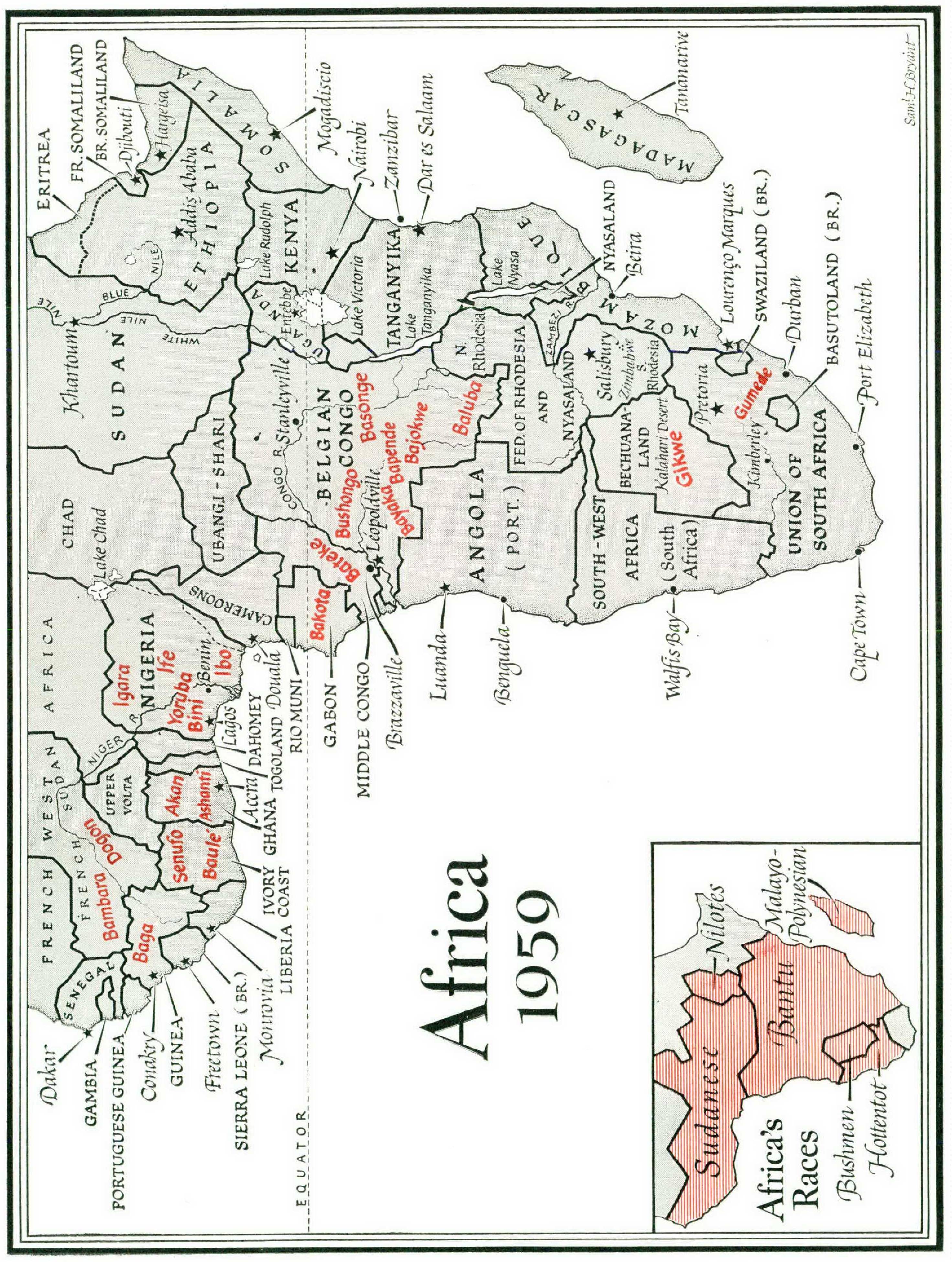
IN SPITE of President Nasser’s attempts to extend his influence down the Nile and across the desert, the distinction between North Africa and Africa south of the Sahara still has validity. North Africa had centuries of contact with other civilizations, a rich culture, a common tongue, and a unified religion. But when we leave the clear brilliant air of the Mediterranean to move southward into the heart of tropical Africa, all is changed. We enter an area which only a century ago was without any link with other civilizations, still living, over most of its extent, in the tribal conditions from which the Mediterranean world emerged five or six millenniums ago. The lateness of the discovery of Africa divides it not only from the Mediterranean north. It makes its experience unique in human history.
Apart from the small Dutch settlement in the Cape, virtually the only steady outside contact with Africa until the middle of the nineteenth century was the slave trade, conducted by Atlantic slavers along the West coast and by Arab slavers along the East. In the West, African coastal chiefs were the middlemen and used their wealth to build up more organized tribal kingdoms. But in the East the Arabs themselves ran the slave raids inland toward the lakes and cut a great swath of misery and destitution and hopelessness right through Central and East Africa. Even the most primitive forms of tribal society were shattered by the regular raiding for slaves. This was the world discovered by David Livingstone, and to put an end to it was the most valid reason Europeans had at that time for entering Africa in strength.
But it was not the only reason. In the 1870s diamonds were discovered at Kimberley in South Africa. A few years later the vast gold deposits of the Rand were uncovered. The old picture of Africa as an inexhaustible source of mineral wealth — the legend of King Solomon’s mines, of the wealth of Prester John, of “Africa and golden joys” — seemed to be confirmed just when Europe was passing through the brief imperialist fever of the late nineteenth century. All the European powers attempted to secure control of various areas of the continent in the last two decades of the century, in part to develop them, in part to keep others out. Germany and Britain maneuvered in East Africa, Britain and France in West Africa, Britain and Holland in South Africa. The two smaller colonizers, Belgium and Portugal, kept their cut between the rivalries of the giants. Out of this welter of economic interests, strategic pressures, force, and diplomacy, Africa emerged divided between the powers and open to any patterns of political development or economic growth they might determine to introduce.
Throughout most of Africa, a local reaction was unthinkable. The gap between the representatives of modern European society — restless, energetic, questioning, brash, making money in a hurry, building vast enterprises of evolved scientific and technological design — and the tribesmen of the forests and villages still dreaming among the myths of tribalism and animism was a gap too great to allow for any cultural continuity. African society, in all areas of intensive European development, was simply pulled up by the roots. To this day, the really significant divisions in Africa south of the Sahara lie not so much between tribes or colonies as between areas of varying intensity in European investment and settlement.
At one end of the spectrum is the region of heaviest white engagement. In the Union of South Africa nearly 90 per cent of the land and in Southern Rhodesia about SO per cent have been confined to European use. All mining and industry are under white control and, explicitly in the Union and to a very considerable degree in Southern Rhodesia, society is organized on the basis of white dominance. Yet the white population is outnumbered by about 9 to 2 in the Union and by about 14 to 1 in the Central African Federation, of which Southern Rhodesia is a member state.
From the start, these two most southerly states of Africa have faced a dilemma which is certainly not confined to Africa but is met there in its most acute form today. What should be the policy of dominant minorities when the territory they take over is inhabited by men differing from them totally in race, tradition, and, above all, in evolution along the ladder of human progress?
One answer was given thousands of years ago in India, when the caste system consigned men of darker skin and more primitive habits to the menial tasks. Another answer was given in the Caribbean, in North America, and Australia, where the local tribes virtually disappeared under the incoming pressure of the white man. Yet another answer is being given in Soviet Asia, where Uzbek and Kazakh nomads, not much less primitive than Africa’s Bantu tribes, have been absorbed into the new Russian-directed industrial system brutally and ruthlessly but without any racial barrier to their advancement.
None of these possibilities applies in South Africa today. Caste is breaking down even in India, and in Africa there are no religious sanctions to enforce it on the majority. Decimation was tried in the Belgian Congo at the turn of the century, but the outcry raised in the world was such that no white government could have adopted it in the wake of King Leopold. Moreover, by 1910 the African majority were already the essential force in South African mining. Today, they are the indispensable condition of South Africa’s rapid industrialization.
The Soviet solution — of incorporating the tribesmen and the nomads into the industrial economy on a basis of equality or rather of equal servitude — is ruled out in part by the theory of white domination, in part by the failure, over the last five decades, to educate Africans to bridge the gap of millenniums. Soviet policy, however dictatorial, has at least been logical. The drive to industrialize has been accompanied by as fierce a drive to educate. In South Africa, the Bantu Education Act even marks a reverse direction, since its precise aim is to unfit the African for participation in advanced European technological society. Thus that society is being based on the labor of those who are not to share in its advantages. In the Rhodesias, even though the theory of dominance is not acknowledged, there is little trace of the educational drive to develop African capacity, which would alone make the proclaimed policy of ultimate racial partnership a reality. The most likely outcome, therefore, seems one of increasingly rigorous racial repression to counter the stirrings of African nationalism, which will be inevitably intensified by African advance in other parts of the continent. The chances facing such a policy in a world as race and color conscious as our own are dubious at best.
That European settlement is harder to assimilate than European economic development is suggested by the experience of the Belgian Congo. After the disgrace of the royal regime, the Belgian government kept policy firmly in its own hands. There was little encouragement in Belgian settlement even in areas where the climate was attractive. No settlers were allowed special political privileges. The great mining interests which opened up the copper belt were in part government owned, and their policies were related to the broad social objectives of the colonial regime. The aim has been to build up a settled, skilled, urbanized African labor force and to create a prosperous productive native agriculture. In the Congo, the basis of a settled African urban society is at least being laid, and when the first elections were held at the municipal level in 1957 Africans and Europeans voted together. In spite of recent disturbances — in spite, too, of vast Europeancontrolled wealth — the Congo’s future lies in self-government and autonomous development.
We COME now to the African territories where there has been little or no European settlement. With two exceptions, all have followed much the same pattern of development and present many of the same problems. The exceptions are Portuguese East and West Africa, where both economic and political development has been on too small a scale to launch the two territories into the main flood of African change, and Kenya, where sixty thousand Europeans, ten thousand of them farmers in the White Highlands, have a permanent home in a land of over 6 million Africans. Here, however, there is now no question of white domination. The problem is becoming rather one of protecting a white minority interest from being wholly engulfed by intolerant African nationalism.
In the rest of East Africa, in Equatorial Africa, and in West Africa, both British and French, the political direction is firmly set toward African autonomy and varying degrees of independence. The reason for this is not so much great indigenous development and sophistication, although it is certainly true that West Africa with its widespread commerce, its towns, markets, and local currencies was readier for the modern age than the herdsmen and the subsistence farmers who were dominant in most of the rest of Africa.
The chief reason is that the European did not settle. For one thing, the climate was too unattractive, the fevers too mortal. For another, mineral development was small and was long confined to some gold mines in the Gold Coast (now Ghana) and a little tin mining in Nigeria. In fact, West Africa might have continued uncolonized for another half century, had not the industrial revolution created new needs in urban Europe. The grime and filth of the new industries changed soap from a luxury to a necessity and made the vegetable oils of West Africa — milled from ground nuts and from palm kernels — commercially attractive enough to draw the European merchants, just as spice and pepper had once lured them to the Indies. Colonization in these areas did in fact resemble European colonization in Asia of a century before — a colonization of trade and outposts, of administrative control, and of law and order — and not one that planted down white communities, tore up local society by alienating the land, set in motion vast mineral developments, and introduced sudden dynamic changes into the local economy.
Yet even if the tempo was slower, the modern world came flooding in. Growing wealth in the Atlantic world increased the market for every sort of African product — oil and cotton, coffee and cocoa, bananas and tropical fruits. Although the middlemen of this expansion were European, the producers of many of the exports were African peasant farmers growing cocoa in the Gold Coast, ground nuts in Nigeria, or cotton in Uganda. This new wealth began to break up the old communal agriculture and encouraged Western spending and Western tastes, especially in education. The mission schools opened up the new ways, and wealthier families sent their sons to Britain or France, where they learned the rights of man and the claims of nationalism, studied law, and returned to form a new group of leaders and politicians.
Whether another fifty years of this type of evolution would have created African communities fully equipped — by education, habit of mind, and working institutions — to deal with the social requirements of modern, urban, technical, and popular society, we shall never know. What is certain is that World War II compressed half a century of political evolution and economic change into not much more than a decade.
Up to 1939, the doctrine of all colonial powers was in the main that colonies should pay their way at whatever level their resources permitted. The per capita African incomes in French territory were among the lowest in the world, and every African dependency was stricken by the collapse of primary prices in the thirties. Since World War II all this has been reversed. The French have rarely spent less than 250 million dollars a year in Africa; virtually every British colony evolved its ten-year development plan with the help of subsidies from Britain amounting to at least 70 million dollars a year. In addition, between 1947 and 1957 primary prices were often seven and eight times higher than the pre-war level. As a result every prime mover of economic change — export income, agricultural productivity, public works, industrial development — has been at work in black Africa since the war.
Politics has shown the same acceleration. The equality of all French citizens, white and black, proclaimed at Brazzaville in 1944, has worked like a ferment in French territory. Within the British Commonwealth, the granting of independence to the dominions in Asia only intensified the pressure of self-government in Africa. At first, there was a divergence between French and British methods, the French promising equal citizenship in a centralized French Union, the British partnership in a Commonwealth of independent states. But French policy, under African pressure, has moved from centralization to the idea of autonomous states within a federal framework or even, conceivably, within a looser bond of the Commonwealth type. What is clear is that no political links or common institutions with Europe will prevent the African colonies, French and British alike, from managing their own affairs.
Yet their clear determination to achieve autonomy does not rid these African states of all trace of their old dependence upon European resources or of their recent emergence from the European colonial system. In spite of the great expansion in their educational programs in the last decade, not one of them has a literacy rate higher than about 25 per cent. In spite of an important increase in the number of graduate students, they must still be numbered in thousands for populations verging on 100 million. Not one ex-colony can fully staff its own administrative services. In French Africa 75 per cent of the federal services are still manned by Frenchmen. Technical services are even less Africanized, simply because there are not yet the African scientists, agronomists, engineers, and technicians available. For another two decades at least the emergent African states must rely upon expert non-African assistance.
Equally they cannot produce all the capital needed to sustain the rate of advance their people expect. Ghana, with some 500 million dollars set aside from cocoa earnings, is uniquely well provided, but even this sum is not enough to launch the Volta power and aluminum project needed to end the economy’s dangerous dependence upon a single export crop of cocoa. Certainly one reason for the almost unanimous decision of the French African colonies to remain within the French Union lies in their leaders’ knowledge that from no other source will there come lavish assistance in manpower or capital grants of the order of 100 million dollars a year.
Politics, too, continues to be stamped with the inheritance of colonialism. The new ideas of parliamentary and party government brought in from Europe are still at odds with the African tradition of chieftaincy and tribal rule. Although there can be little doubt that party government, in more or less absolute forms, will prevail, the friction is enough to throw obstacles in the way of self-government in Uganda and to exacerbate political and regional rivalries in countries such as Nigeria or Ghana.
But the colonial inheritance can be seen most clearly in the uncertainty of the future relationships between the new African states. Virtually all their frontiers were determined fifty and sixty years ago, by negotiations conducted in London or Paris or Berlin. One may question how many of these boundaries will survive the ending of the colonial epoch. Will East Africa, for instance, remain a region of three separate states, or will Kenya, Uganda, and Tanganyika draw together? Could a broader federal system covering all West Africa emerge? In which case, who would dominate it? British-trained politicians, or French?
In short, Africa today, North and South, East and West, autonomous or dependent, is still largely a projection of European policies and of African reactions to them. The epoch that is opening is new and unpredictable, because for the first time Africans will become independent actors on their own stage.
Yet there are certain factors which may be discerned as possible keys to future African policy. As Dr. Nkrumah, Prime Minister of independent Ghana, pointed out in a recent article in Foreign Affairs, there is a vast reservoir of good will for the West in Africa. Language, education, personal friendships, familiarity, commercial ties, business experience — all these intimate links inherited from the colonial phase still bind Europe and Africa together, and wherever progress toward African autonomy is accepted as the goal of European policy, good will envelops the process of change and survives to underpin the Africans’ new status. Not all Africa’s leaders are as passionately pro-Western as Chief Awolowo in Nigeria or M. Houphouet Boigny in the Ivory Coast, but even M. Sekou Touré, who led Guinea to independence in General de Gaulle’s referendum, hopes for a continuing link with France. Probably a majority of leaders follow Dr. Nkrumah’s line of “positive neutrality” pursued in close cooperation with the Western powers.
But two shadows fall across an otherwise promising prospect. If the plight of the African in the Union and the Rhodesias should grow steadily more unendurable, the whole Western link with Africa might be strained to breaking point by the policies pursued in Africa by white governments claiming to represent and conform to Western standards and Christian ethics.
The second difficulty is the doubt whether the Western powers have taken the full measure of Africa’s need for continuing outside help. British colonial grants are not maintained after independence. France has threatened to cut off completely countries choosing independence. Meanwhile, there are no alternatives in sight. American programs are negligible. International aid has gone overwhelmingly to South Africa. Even primary prices have given little encouragement in the last two years. To these dubious prospects one must add the fact that there is still no real Western drive behind programs for training more Africans either in Africa or abroad, while the seconding of officials for service with African governments is very uncertain, although some progress has been made in Ghana and Nigeria.
Naturally, this indifference and uncertainty — coupled with the racial policies of the South — offer the Communists their best hope of securing a foothold in Africa. Hitherto, they have made only desultory attempts to influence African events. There are signs now of rising interest. M. Sekou Touré was offered recognition and credits on the morrow of the Guinea vote. Diplomatic missions are to be opened in all independent states. Africans are being trained in Moscow, and a Communistdominated Asian-African Committee has permanent quarters in Cairo. None of this is very serious provided the new Africa can count on Western backing and support.