The African Revolution
The new constitution for Kenya provided for the direct elections of Africans by Africans to the colony’s legislative council, and among the eight candidates who were successful in 1957 was a Luo tribesman.TOM MBOYA. Now in his thirtieth year and the general secretary of the Kenya Federation of Labor, Mr. Mboya is a spokesman for the worker in Africa and a leader who is being watched with respect by the AFL-CIO.
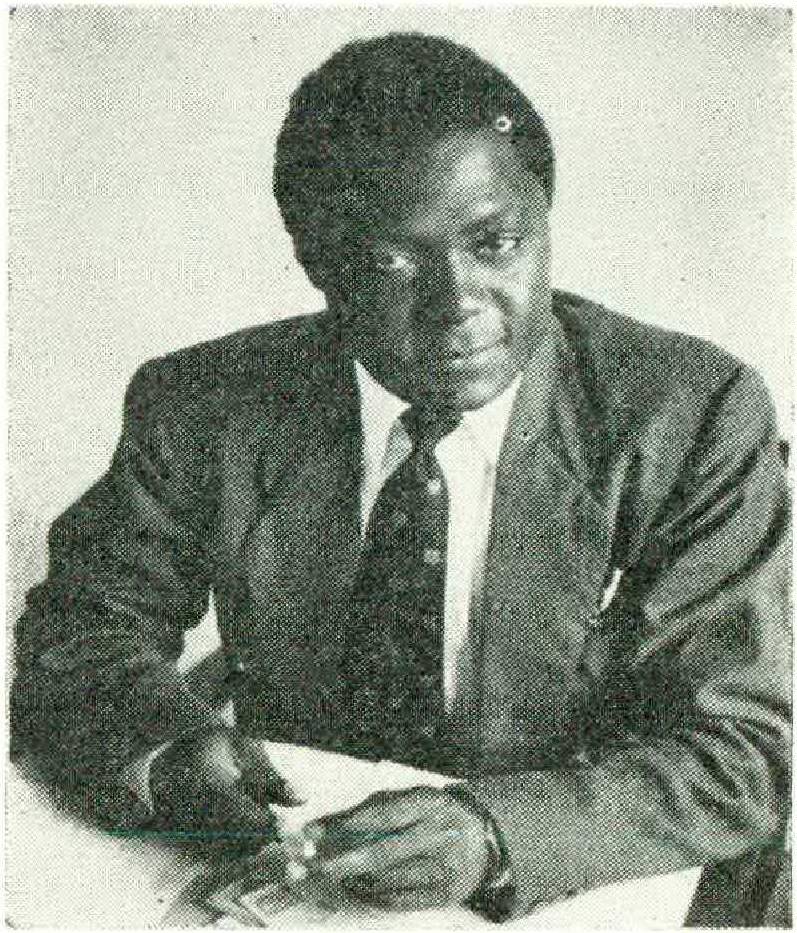
BY TOM MBOYA
IN Africa today a revolution is taking place. In some areas this revolution is political and is manifested by militant nationalist movements. But primarily it is an economic revolution, and it is occurring throughout Africa. The revolution differs in pace, content, and pattern in different countries, but no one can mistake the fact that Africa is fast changing from a primitive, non-industrial, subsistence economy to an exchange, money, and market economy.
Africa’s economic development has taken place through stimulus from outside, mainly from Western Europe. The first Europeans to come to Africa were quick to see its great potential, especially after the discovery of valuable minerals in various territories. Not content with trade only, the Europeans sought to achieve permanent control over Africa. This goal led to the partition of Africa and the creation of a system that was founded on exploitative motives, with all economic activities aimed at serving and feeding the economy of the mother countries, completely ignoring the necessity of development from the viewpoint of the African people. Whatever benefit the African got was incidental to the primary purpose of the colonial powers.
To further their policies and to ensure their political control, the colonial powers encouraged emigration to the colonies, especially where suitable land and climate were available or where large deposits of minerals had been discovered.
Despite its force as a stimulus to Africa’s economic development, colonialism has been the biggest hindrance to the development of the indigenous people. Under colonial rule little attention has been paid to the necessity to invest in education, health, technical training, and general community development for Africans. The Africans’ potential as a local market for consumer goods is ignored. Partition of Africa and the use of each territory as a source of raw materials for different colonial powers have made it impossible for Africa’s development to be planned on a continental or even regional basis. Where the economies of two territories were complementary, they could have been developed more quickly as a unit and thus made possible effective competition on the world market through a more diversified economy. Instead, colonial divisions have treated each territory in isolation from the others.
In the post-war period, the world has seen new nations emerge from colonial rule to independence. After India’s independence, there was a sudden awakening in Asia and Africa, and many formerly docile peoples began to demand freedom from colonial rule. As the pressure increased and more colonies won their freedom, colonial policies changed. The influence of the United Nations and the general concern of the rest of the world for the people in underdeveloped areas helped to bring about this change. As a result, various territories today are drawing plans for development, and efforts are being made in the mother countries to set aside sums of money for the development of the colonies.
The Colonial Development and Welfare Fund and the Colonial Corporation in Britain, TIDES (Fonds Investissement pour le Développement Economique et Social) in France, and Belgium’s ten-year plan for the Congo all have been established to further economic development in Africa. This change in policy has also led to an increasing direct participation of the African people and the establishment of projects for the education and technical training of Africans. Agencies such as the Commission for Technical Cooperation in Africa South of the Sahara have been created, although there is still opposition to the establishment of a regional office of the International Labor Organization and to the United Nations Economic Commission.
Africa’s economic development is dependent on capital and skill from outside. It is also dependent on markets in the mother countries and elsewhere, and its products must compete with similar commodities from better-developed countries. Economically Africa is divided between mineral territories and agricultural territories. The Union of South Africa has by far the greatest mineral wealth, with its export income derived from diamonds, gold, and uranium. The Rhodesias have copper and chrome, and the Congo has copper, diamonds, and uranium. The mineral territories attract large capital investment; the three territories just mentioned, with a population of 33 million people, have in fact absorbed half the capital invested in the entire continent of more than 200 million people. Since 1947, total investment there has amounted to 10 billion dollars.
Development in the agricultural areas is sometimes dependent on one cash crop — coffee, tea, cocoa, cotton, or sisal — rendering such countries very sensitive to changes in the world market prices. Ghana’s cocoa is responsible for 70 per cent of its exports, while nearly 90 per cent of the exports of Kenya and Uganda are agricultural (cotton in Uganda; tea, coffee, and sisal in Kenya), and about 70 per cent of the exports of Nigeria and French West Africa are derived from ground nuts, palm oil, and cocoa.
THERE is no mistaking the fact that the whole of Africa is awake to the need for a diversified economy and speedier industrialization. Lack of coordination can be seen in the attempts by a number of countries in the same region to establish aluminum production plants at the same time, instead of pooling their resources. Another example is the proposal to build separate dams for the production of electric power in neighboring territories where one would have been sufficient for the needs of both countries.
Emphasis on industrialization has resulted in a greater effort to increase power development.
Work is already going on at the Kariba project in the Rhodesias, and the first part of the Owen Falls hydroelectric power plant in Uganda, to serve Kenya also, has been completed. In Ethiopia work is proceeding on the Koka Dam, and plans are already being studied for the Volta project in Ghana, the Aswan Dam in Egypt, and the Inga project in the Congo. Note must also be taken of the increasing interest of various United Nations agencies and the World Bank and the contributions of the American Point Four Program. The establishment of the UN Economic Commission for Africa can be regarded as the evident recognition by all that Africa must be treated as a whole and not in isolated parts. This will not only lead to greater coordinated planning, but, even more important, it will open the doors to additional technical assistance and sources of capital for investment.
Economic development in Africa has been stimulated by the introduction of cash crops, capital, technical skills, discovery of minerals, and the creation of new demands. The whole process has gradually led to changes in land tenure in some areas and in the African’s social and cultural outlook. These changes have been more pronounced among African workers in the urban areas, where the chief purveyors of capital and skills have in all cases been the expatriate companies: Unilever, ICI, De Beers, and others.
African involvement, participation, and benefits have varied according to the nature of the colonial system and particularly according to the presence or absence of white settlement in the territory. Where no white settlers exist, the African has been the sole producer of cash crops and has in a small way engaged in retail trade, although mining has in most cases been carried out by expatriate companies which have the capital, the technical skill, and the equipment required. In areas without white settlement there has been a quick infusion of better farming methods and a broad-based transition from subsistence to exchange economy. There have also been a gradual but increasing social stability and a better distribution of national income, and labor’s share in the economic benefits has grown. Saving has been possible because the African incomes are keeping pace with changes in national income and with changes in demand. Cultural domination is slight, and the doors to skilled jobs and to administrative positions in the government are open to the Africans. There is less political tension, and the right of the African to political freedom is publicly acknowledged.
Examples of this social pattern are found in Ghana, Nigeria, and Sierra Leone. The entry of Africans into large-scale ownership of enterprise is, however, limited. In Ghana, for example, most of the large enterprises are in the hands of European or American companies, while Syrians are prominent in retail trade. But Accra’s business and market life would be dull without the Ghanaian market women, whose activities account for a large share of African trade. Most of the expatriate companies are being speedily Africanized, and Africans can be found even on boards of directors. The government is striving to stimulate local ownership of enterprise through the Industrial Development Corporation. At Kumasi College of Technology, Africans are being trained in technical and professional skills.
IN CONTRAST, the East and Central African territories show a development in which economic balance has been deliberately tipped in favor of the white settlers. Land alienation has taken place, and in Kenya, Nyasaland, the Rhodesias, and to some extent Tanganyika, the growing of cash crops is mainly in the hands of the white settlers. The African has an inferior and insignificant position in the economic life of the country and merely provides cheap labor for Europeanowned mines, businesses, enterprises, farms, and plantations. The African in these areas works mainly as a peasant in subsistence agriculture.
In the Union of South Africa and the Central African Federation, political and economic domination by white settlers is unrestrained, and policies are conceived to ensure the complete stifling of any attempts by Africans to compete in any field. Skilled jobs are exclusively reserved for white workers. Migrant labor is common. Retail trade is mainly in the hands of the Indians. African incomes are low and hardly go above subsistence level. Saving is almost nonexistent.
Kenya, Uganda, and Tanganyika have a milder form of racialism than has the Union of South Africa, and political changes are taking place giving the African a greater say in the affairs of the territories. These are agricultural areas. In the post-war period, Africans have entered the field of cash-crop production mainly through producer cooperative societies. In Tanganyika, the African cooperatives are responsible for about 50 per cent of coffee exports, the most important cooperative society being the Kilimanjaro Native Cooperative Union. In Kenya, the Meru Coffee Cooperative Unions have been responsible for the best grade of coffee in the country, although African production is still insignificant. Regulations exist here which control the extent of African participation, such as limitation on credit facilities and restrictions on cash crops which prohibit Africans from growing more than one hundred trees of coffee. Entry of Africans into skilled jobs and into the government administration is gradually becoming easier. Technical and trade schools are being established, and emphasis is being put on higher education. But despite these encouraging signs, the African has hardly any real say in the economic life of the country.
In Kenya, Uganda, and Tanganyika, political and racial conflict constantly threatens the flow of capital from outside, without which economic development is impossible, for unlike the Congo there is little if any local capital. Cultural domination is very pronounced and is resented by Africans.
Thus it is that in some parts of Africa the growth of national income is not an index of economic growth in the sense of improvement in technology, skills, per capita income, and general bettering of living standards. The nature of governmental income distribution and therefore the economic lot of the African people and labor are dependent on political forces. The underlying economic development of Africa’s settled areas is a conflict of objectives. The questions uppermost in the minds of the different racial groups are: What type of society shall we set up? Which section of the society shall wield both economic and political power?
Wages are low and in many cases are dependent on arbitrary decisions by employers or by the government. Trade unions are young, but already employment and collective bargaining agreements are to be found in a number of territories. Trade union structures vary according to the pattern to be found in the different mother countries. The main problems of trade union development are: the presence of a large body of migrant labor, lack of social security programs, lack of proper housing and educational facilities, and lack of sufficiently experienced leadership. Despite these difficulties, the trade union movement is growing and increasing in influence. The African Mineworkers Union of Northern Rhodesia has proved to be the most effective voice against the racialism of Central Africa, and today some start has been made in opening up skilled jobs for African miners in the copper belt.
The African revolution is gathering momentum; 1958 will go down in history as Africa’s year. In April the first Conference of Independent States was held at Accra. In December the first AllAfrican Peoples’ Conference was held at Accra, and in the same month the UN Economic Commission for Africa was established. The Africans’ part in this development will increase as more and more territories become independent and become responsible for their own economic growth.