African Sculpture
An internationally respected photographer for LIFE magazine. ELIOT LLISOFON has made hen extensive expeditions in Africasouth of the Sahara, m the course of which he uncovered many examples of African art, some of them now part of his own magnificent collection. He is a research fellow of primitive art at Harvard University and the creator of the authoritative, handsome volume, THE SCULPTURE OF AFRICA, a collection of his photographs, published by Praeger, with text by William Fagg and design by Bernard Quint.
THE sculpture which has been produced by the natives of Western and Central Africa has existed for ages, but its proper appreciation by us can be dated from the turn of this century. Although the’ Portuguese visited Benin, the capital of the well-organized and powerful kingdom of the Bini, in what is now Nigeria, in 1472, and brought back an ambassador from there to Europe, our first record of African carvings in a European museum is at Ulm, Germany, in the late sixteenth century. Nevertheless, we did not appreciate the artistic quality of African sculpture until the painters of the Paris School discovered it, among them Picasso, Braque, Derain, Vlaminck, and Matisse. The reasons for the ready acceptance of African art by the modern artist are perhaps a clue to our own appreciation. James Johnson Sweeney writes in African Folk Tales and Sculpture: “European painters, sculptors, and critics in the first two decades of this century were constantly on the lookout for examples of primitive art that did not conform to the naturalistic convention which had dominated the art of their continent for most of two thousand years. . . . And since their time European artists in each generation have been able to find in one or another aspect of Negro art something that seemed to justify their own theories: the expressionists found an emotional use of colour and distortion of shape, the cubists found ‘structure,’the surrealists found fantasy, mystery — even a pathological inspiration.”
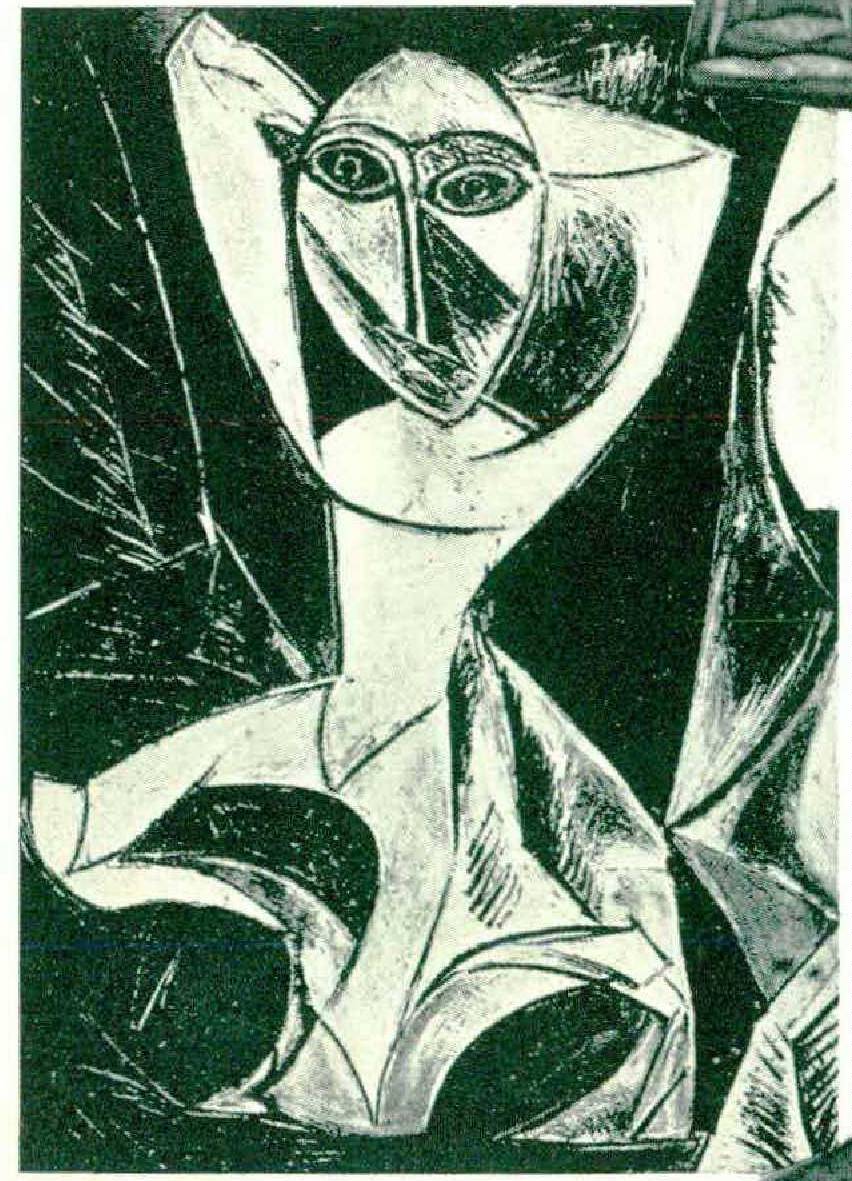
These artists not only discovered African art, but their art in turn was influenced by it. In 1907, Picasso altered the drawing of two of the faces in a large canvas, Les Demoiselles d’Avignon, to resemble African masks. The resemblance of Picasso’s Dancer (Figure 1) to a metal-covered figure employed by the Bakota in the French Congo to guard the family barrel of ancestral skulls is so striking that this sculpture (Figure 2) is shown alongside the Picasso. These canvases were the beginning of cubism in painting, one of the important milestones in modern art.
Without the indoctrination of having seen paintings by these modern artists, we would probably have considered the objects in the selection of photographs accompanying this article to be hideous native carvings best left in the jungle. Art is the great conditioner, and the artist leads the populace, perhaps unwittingly and perhaps unbidden, into new ways of seeing. It might be useful here to note that the plastic difference between premodern and African art is mainly one of distortion. This distortion involves changes of the normal proportion of different parts of the body; for example, a head may be carved as large as all the rest of the figure. Other types of distortion appear in the abstracting of bodies, both human and animal, to geometric or, as Malraux calls it, “diagrammatic” form and in the free interplay between human and animal forms combined into one composite sculpture. (There is a good example in the illustration on page 40.) In addition, African sculpture is rarely storytelling, a major characteristic of premodern European art.
Simplicity and strength are perhaps the distinguishing qualities of African sculpture. In contrast to the highly involved, baroque-like carvings of Oceania, African sculpture is a Gothic statement without frills. The sculptures are architectonic, evolving from the original material, the cylindrical tree trunk. One rarely finds the African carver adding pieces of wood to this simple shape. Instead, the figure is compressed out of the cylinder by what appears to be a minimum of carving. The feet are flat and form the base, the legs are often bent in what seems to be a desire to achieve tension in stance, the body trunk is straight up and down, and the head is firmly mounted and rarely tilted or turned (see Figure 5). The raw wood is usually stained or painted. In some cases the object was periodically anointed with magical substances.
It is extraordinary that, although African sculpture made an anticlassical appeal to modern artists, it too stems from a classical and traditional canon far more rigid than the one European art seemed to be suffering from. For African sculpture is not a free-flighl fantasy of individual sculptors but a tradition so classical that an expert may readily identify almost all African sculpture as to its exact provenance. I his seeming regimentation of style in African sculpture did not interfere with the creativity and individual ability of the artist. Indeed, twelve carvings have been identified as the work of the sculptor who produced the Baluba masterpiece shown in Figure 11. Religious art before the Renaissance was rigidly proscribed as to subject, but this did not prevent a Cimabue from producing great works of art.
The gradual metamorphosis in African tribal styles produced many distinct types, each one as unnaturalistic as the other and yet each one unique. It would appear that the process took place over many centuries, with innovations by individual artists capturing the approval of the people and becoming incorporated into a larger style common to all the artists of the tribe. We shall never know, perhaps, why one tribe’s mask is cubistic and another’s animal-like. The African carver has a style which has been handed down to him by other older carvers and in many cases from father to son.
Sculpture is only one aspect of a larger body of African culture. Folk tales numbering into the thousands, oral history, traditional music and dancing, well-organized governments, and a powerful religion arc some of the Africans’ attainments. Lack of a written language and thus of recorded history, ignorance of mathematics and other sciences, and a tendency to accept slavery and to practice human sacrifice and cannibalism are some of their uncivilized characteristics. Many have used the word “savage” not only for the African but also for the South Sea Islander and the American Indian, who shared some of these negative attributes. The fact that the people of Benin committed human sacrifices does not lessen the artistic quality of their bronzes, nor does the architectural wonder of Chichén Itzá become less extraordinary because the Maya threw sacrificial humans into a deep well. We have not changed our opinion of Kant, Beethoven, or Mann because of the horrors of Buchenwald.
INVESTIGATION of the philosophy of the African and the relationship of his art to his beliefs or religion has been pitifully meager. But enough material has been discovered to enable us to come to some understanding of the raison d’étre of African sculpture. William Fagg, the deputy keeper of the department of ethnography at the British Museum and probably the leading authority on African art today, has done some research on this question among the Yoruba in Nigeria. The late Marcel Griaule, of the Muséc de P Homme in Paris, spent many years investigating the Dogon in the French Sudan. Father Tempels has done fundamental research among the Baluba in the Belgian Congo, who have been some of the finest sculptors of Africa. His findings are summed up by Fagg: “African thought is conditioned by their ontology, that is, their theory of the nature of being; for them being is a process and not a mere state, and the nature of things is thought of in terms of force or energy rather than matter; the forces of the spirit, human, animal, vegetable and mineral worlds are all constantly influencing each other, and by a proper knowledge and use of them a man may influence his own life and that of others.”
Fagg continues with his own observations: “Of course ... foolish and naïve superstitions, developed ad hoc to plug gaps in the primitives’ understanding of natural phenomena, are in fact part of a coherent and logically ordered system which, though alien to that of the industrial civilizations, has some affinity, for example, with the world of Democritus and even of modern sub-atomic physics. This interpretation of African belief about the nature of things accords well with what we have long known of tribal peoples in other continents, especially the concept of ‘soul stuff’ in South-East Asia and mana in Polynesia. All these peoples seem to share a belief in the desirability of increase in the broadest sense as a principal end of life, together with a corresponding fear of loss of force.”
Knowing, therefore, the African’s preoccupation with fertility and his conviction that the supernatural exists all around him, we can understand better the variety of carvings used by him for the propitiation of these powerful forces. In this respect the most important figure for unseen influences is perhaps that of the ancestor. Throughout almost all of the sculptor-producing tribes, carved wooden figures of ancestors achieved primary importance. They vary in size and execution, and it is believed that few are actual portraits, for it is the spirit of the ancestor which is to be respected, appealed to, or appeased. Respect for ancestors is shown among the Bakota in the French Congo by the careful preservation of family skulls in a barrel protected by a metalcovered figure (Figure 2). A similar but more involved skull preservation is practiced in the Pacific, notably in Melanesia, where the skull cavities are first filled in and then decorated.
Wooden figures were also made for magical purposes. Ashanti women carried small figures in their clothing to ensure that their children would be well formed. Yoruba families had statuettes carved in wood in the event of the death of a twin, so that the spirit of the dead one would not further harm the family. The image was carefully kept and even fed. The so-called fetish figures were also magical. They were made to act for the owner, to protect him and his family, to propitiate spirits, or to harm enemies. Magical substances were inserted into some statues. Among the Basonge, human teeth were sometimes inserted into the sculpture, and the object was often decorated with bits of metal, tusks, cloth, feathers, beads, and small antelope horns. I collected among the Basonge small fetishes less than six inches high, each of which had a specific function against evils such as thieves, lightning, and sickness. There were also larger fetishes which protected an entire village.
THE great majority of figures which I have been describing are fairly representational in that the human element is apparent although sometimes distorted. The opposite may often be said of the masks. Here the fantasy of the African knows no bounds. From almost simple, realistic portraiture (Figure 9) to the wildest flight of imagination, in which the face is part human, part animal, or almost entirely cubistic (Figure 8), the mask has achieved great variety in its freedom from naturalism. A mask may have one nose or three or none at all; it may represent a human face sprouting wart hog tusks at six different places; it may be carved as a faceplate or a full helmet or completely flat, painted white as a ghost or flesh-colored as a living human, covered with antelope skin or cloth or beads and shells or strips of metal, made barely large enough to cover the face or so huge that it would seem impossible for one man to wear it. The masks of Africa are an extraordinary manifestation of the unlimited possibilities of plastic variation on any theme.
These masks are worn mainly for two types of function: puberty rites and secret societies. The coming of age of a boy is the most important thing in his life. Even to this day some tribes maintain this ritual. I was fortunate enough once to see part of such a ceremony in the Belgian Congo, when I came across a clearing in the jungle where the young boys of the village had been taken away from their parents for several months to undergo the coming of manhood with their teachers. Here the boys had been circumcised and then taught the folklore of their tribe. I was able to see twenty boys dancing in a snakelike line under the rigid tutelage of a weirdly masked teacher carrying a small whip, before I was invited to leave.
The secret society is one of the most important elements in African tribal organization. There are still some in existence today, although European authorities have done their best to outlaw them. These societies existed almost everywhere in West and Central Africa. They were diverse in nature and purpose, varying from mutual assistance groups to those formed for religious, political, or sinister reasons. Society masks were worn during funerals of members, festivals, and on other occasions. Women belonged to their own secret societies, although this was rare.
The people wearing the masks are generallycovered from head to foot with a costume made from woven fiber like raffia. This is sometimes stained or colored brown or left in its original tan color, or there are interesting patterns made by using both the natural and brown colors together. There are usually fringes of fiber at the wrists and ankles and a fringe from the bottom of the mask forming a union with the rest of the costume. When the mask is a small piece of rounded wood, like a faceplate, it is generally attached to a piece of cloth or woven fiber so that it can be slipped over the head.
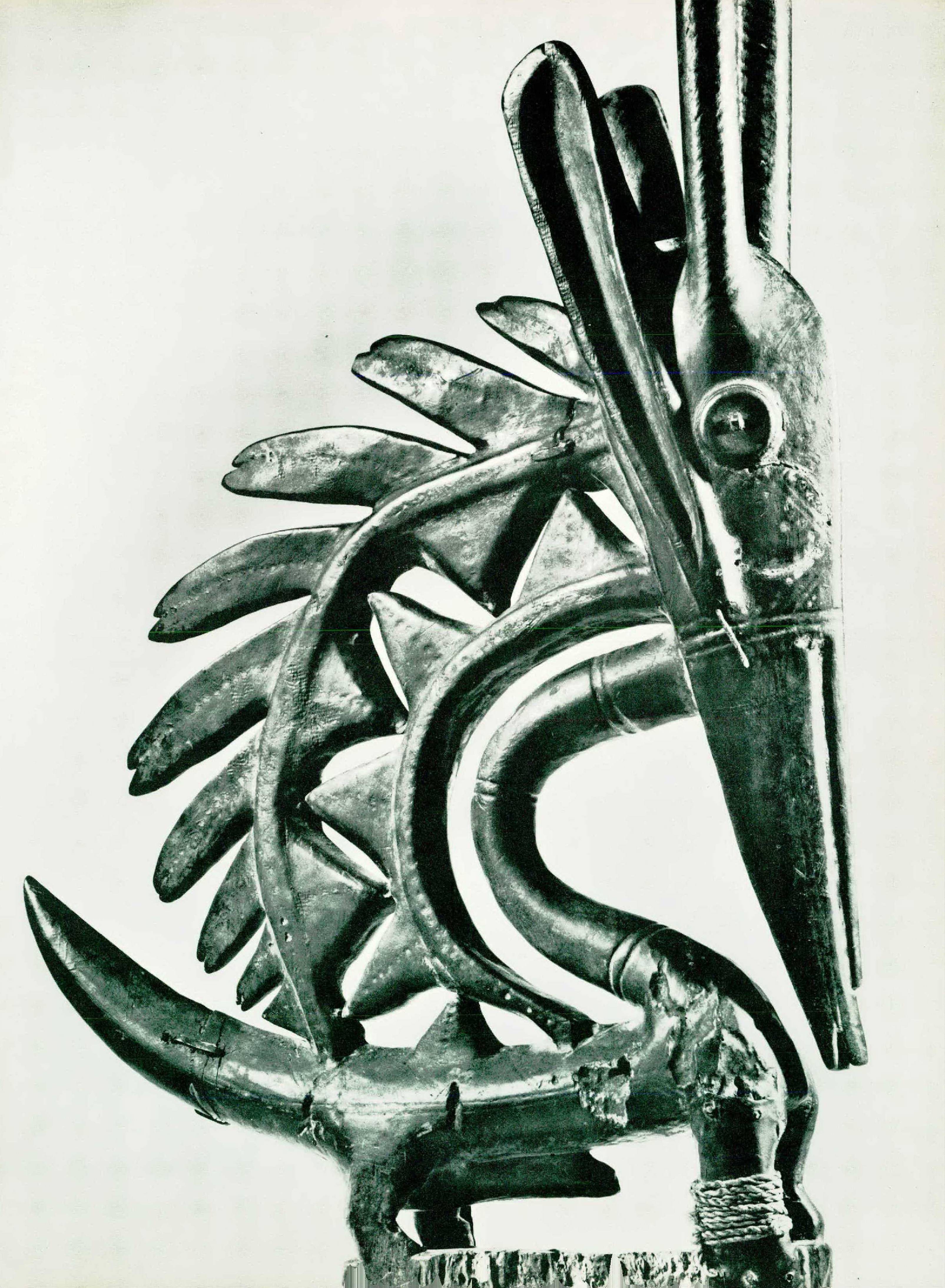
In addition to masks which are worn over the face, there are others which are worn on top of the head, and there are some which are not masks at all but ornate headdresses. One of the most interesting of this type, the antelope headdress of the Bambara people in the French Sudan (Figure 12), is worn on top of the head by fastening it to a basketwork cap, which is then fastened under the chin. These antelopes are a symbol of fertility and are worn during the dances celebrating the planting of grain. The antelope represents a half-human being, Chi wara, who taught the tribe to plant grain, according to a Bambara myth. There are many variations on this theme, and the antelope appears in many sculptural forms in which it is difficult to discover the original animal that inspired the carvers.
Divination objects of different types were also made. The Baulé in the Ivory Coast foretold the future by allowing a mouse to pass through a wooden vessel and then studying the pattern of the group of sticks inside, which the mouse had disturbed. The Bushongo in the Belgian Congo rubbed a small button of wood on the polished back of a smoothly carved animal: if the person taking the test was telling the truth, the button stuck.
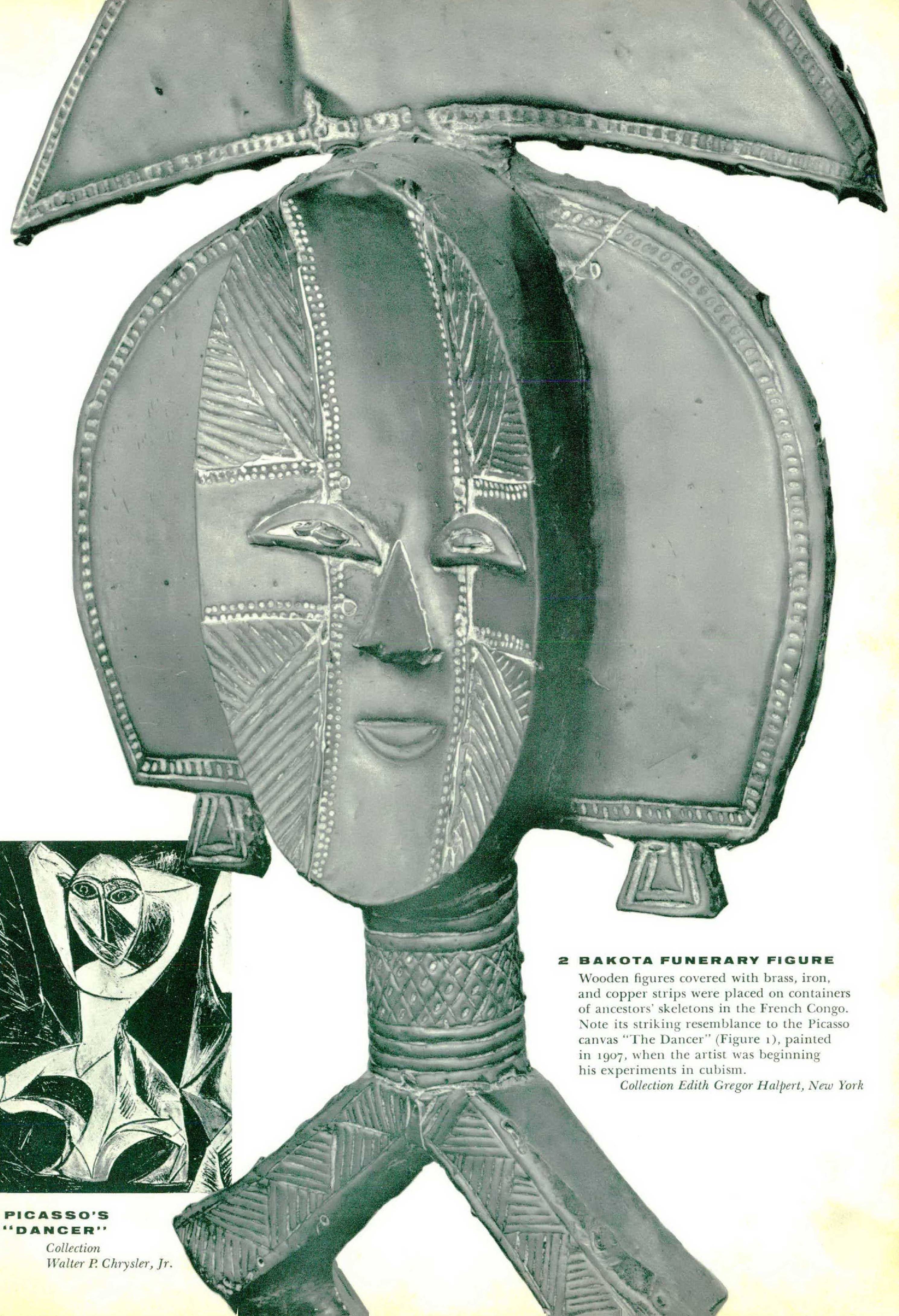
Wooden figures covered with brass, iron, and copper strips were placed on containers of ancestors’ skeletons in the French Congo. Note its striking resemblance to the Picasso canvas “The Dancer” (Figure 1), painted in 1907, when the artist was beginning his experiments in cubism.
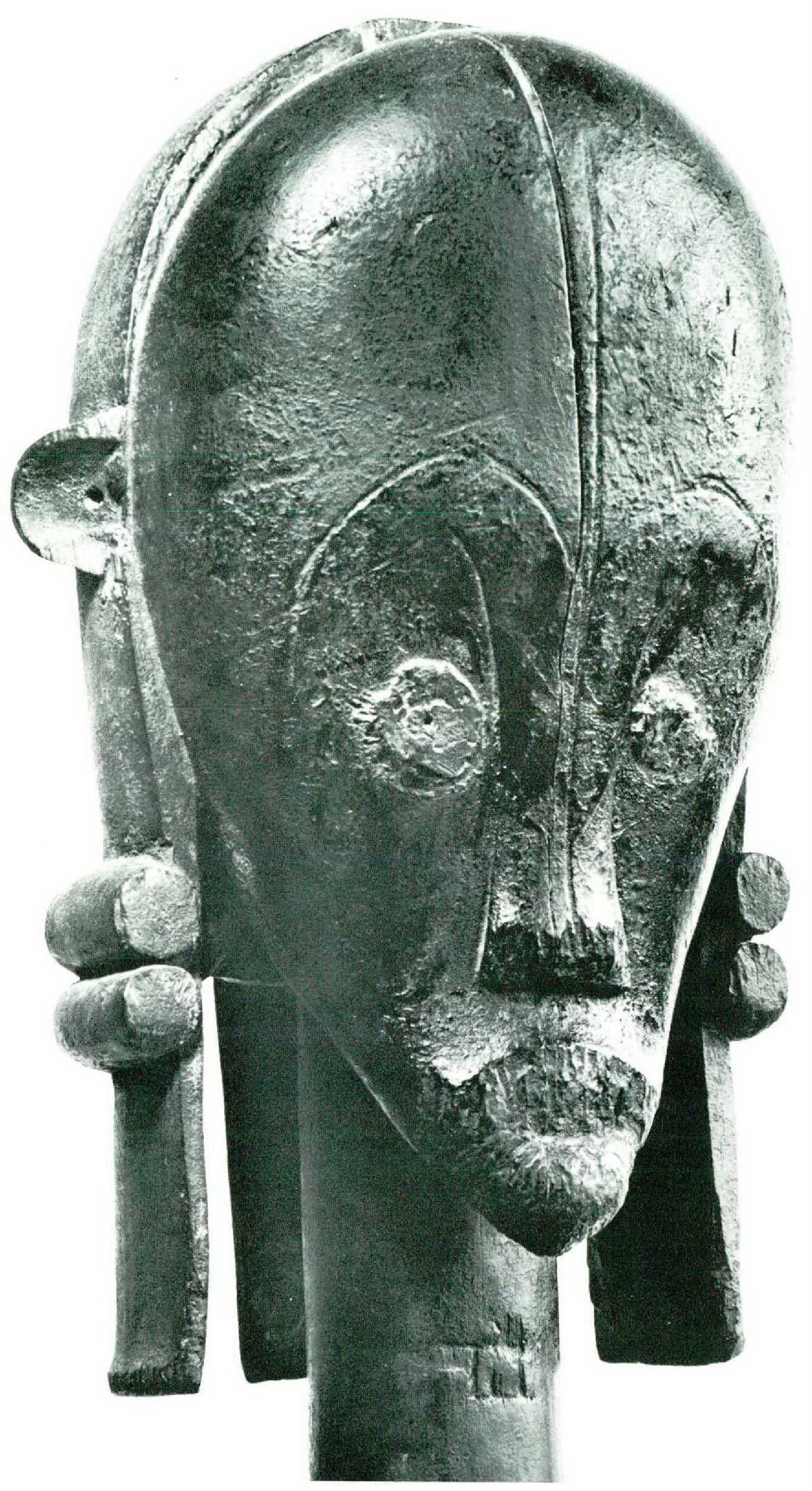
Wooden heads, half figures, and full figures were placed on containers of bones and skulls of ancestors by the Fang, neighbors of the Bakota in the French Congo, to keep away evil spirits. This sculpture once belonged to Paul Guillaume, one of the first important Paris dealers in primitive art.

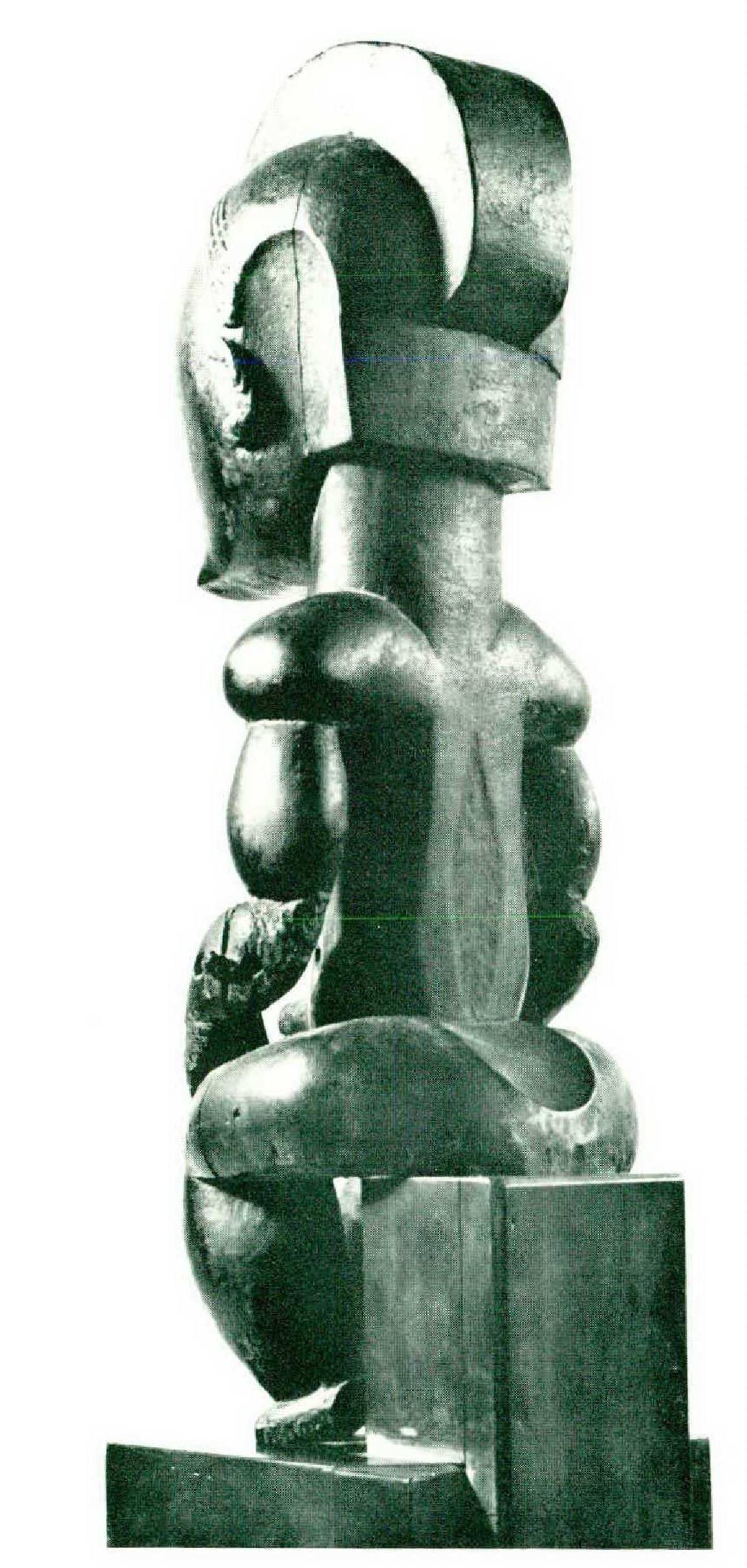
A full-figure example which, when shown in 1935 at the Museum of Modern Art exhibition of Negro African sculpture, was voted the most popular piece by the public and nicknamed the “Venus de Milo.”Alfred Steiglitz held the first art exhibit of African sculpture at Gallery 291 in 1914.
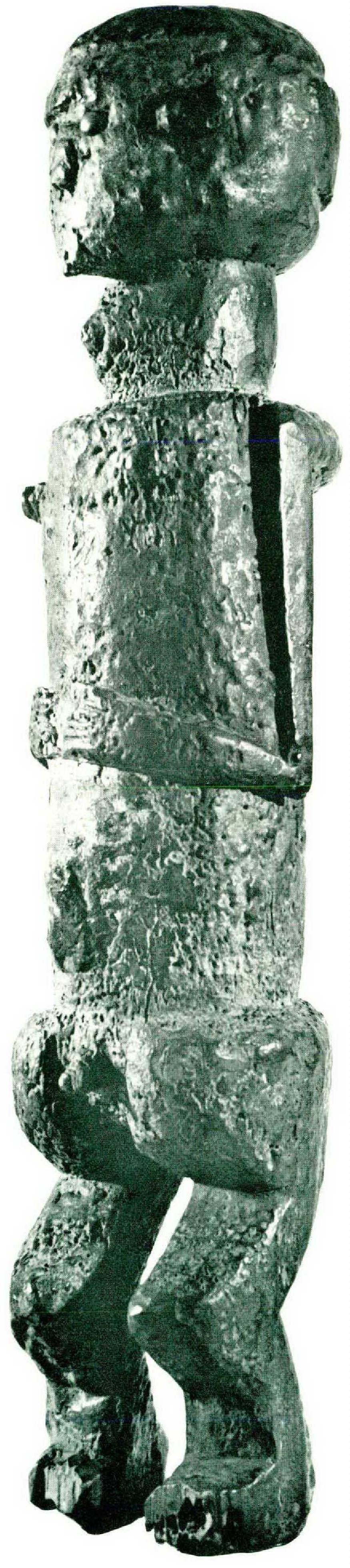
The Bateke made figures with the same cylindrical mass, the sculpture evolving from the original log. The arms are always tight against the body at right angles and the legs bent in a zigzag rhythm. Magical substances were usually inserted into the body.
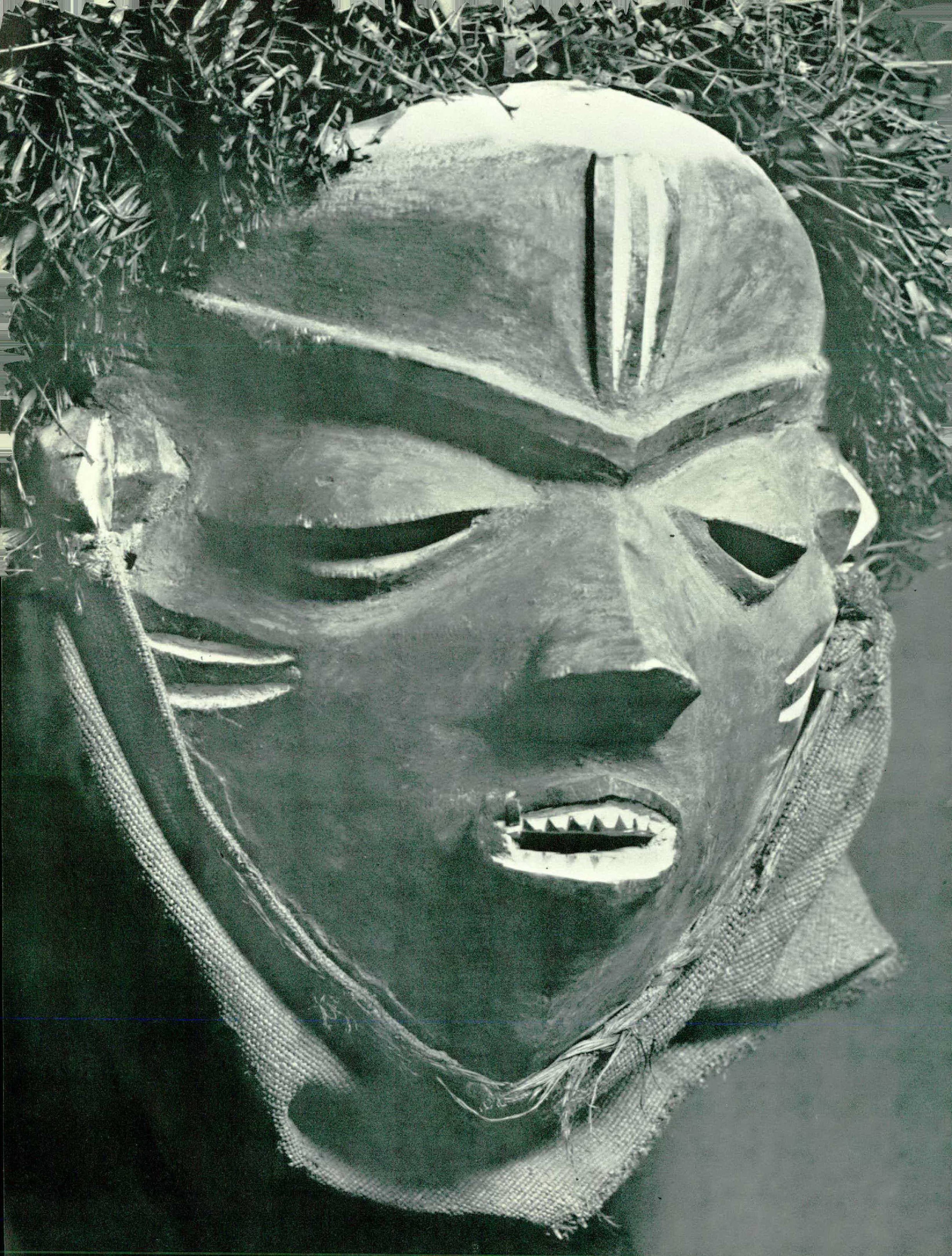
This mask, with about twenty variations like it, was worn by the boys during dances celebrating coming of manhood. The Bapende is one of the few tribes retaining traditional ceremonies and their related arts.
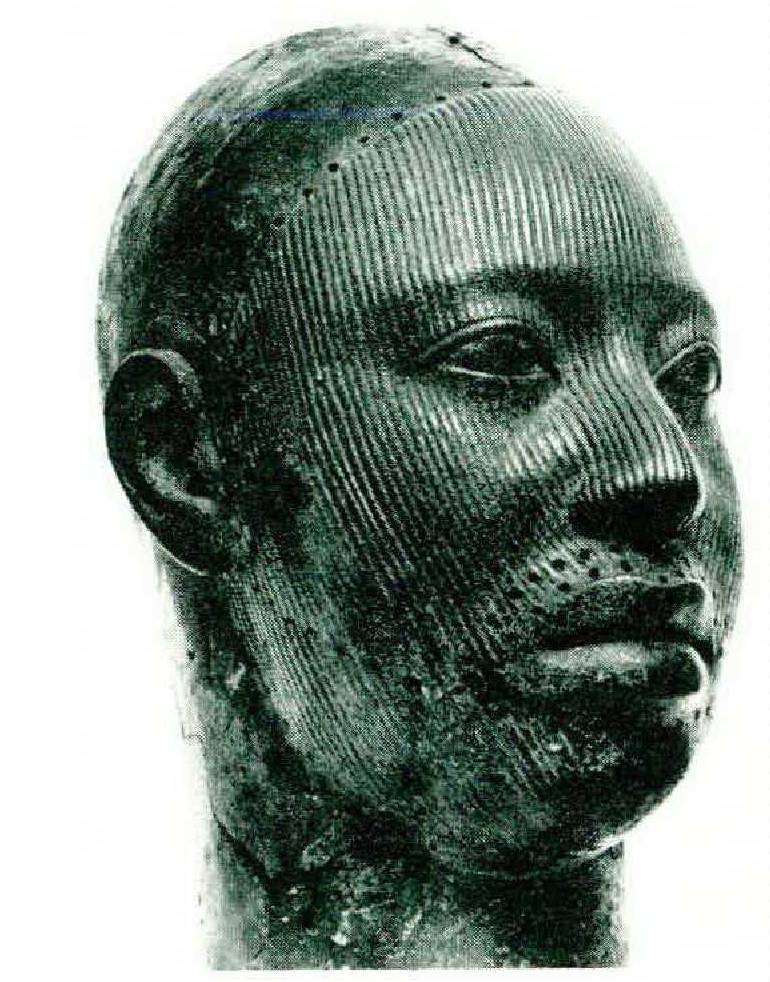
Bronze head believed to be a portrait of an Oni (ruler) of Ife from about the twelfth century. Atypical of other African art, because of its realism. The superb technique and naturalistic modeling have suggested possible Mediterranean influences.
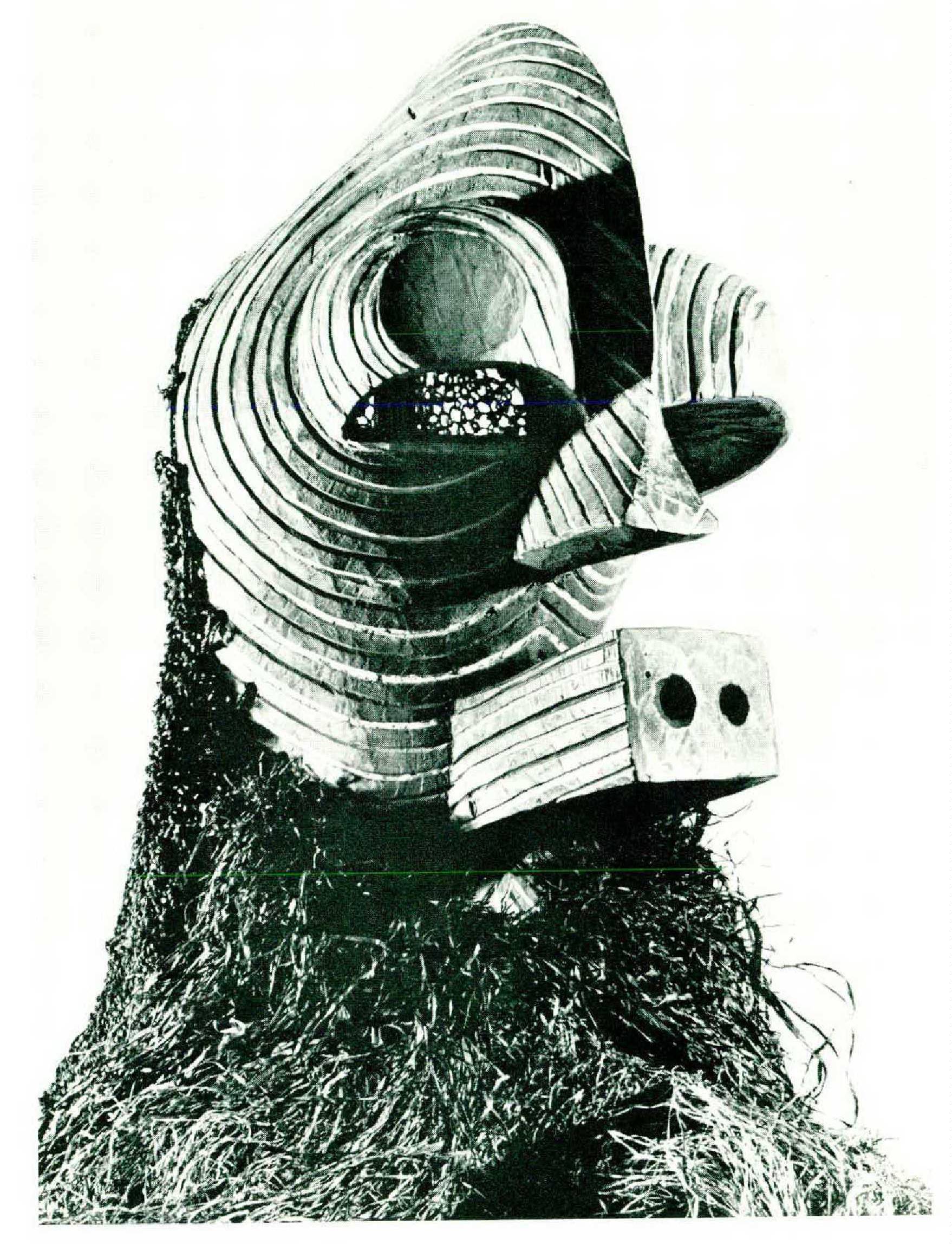
These extremely cubistic masks have been worn by witch doctors along the Lomani River, and are also known as “kifwebe” masks. The nose and forehead ridge are as streamlined as the keel of a yacht.
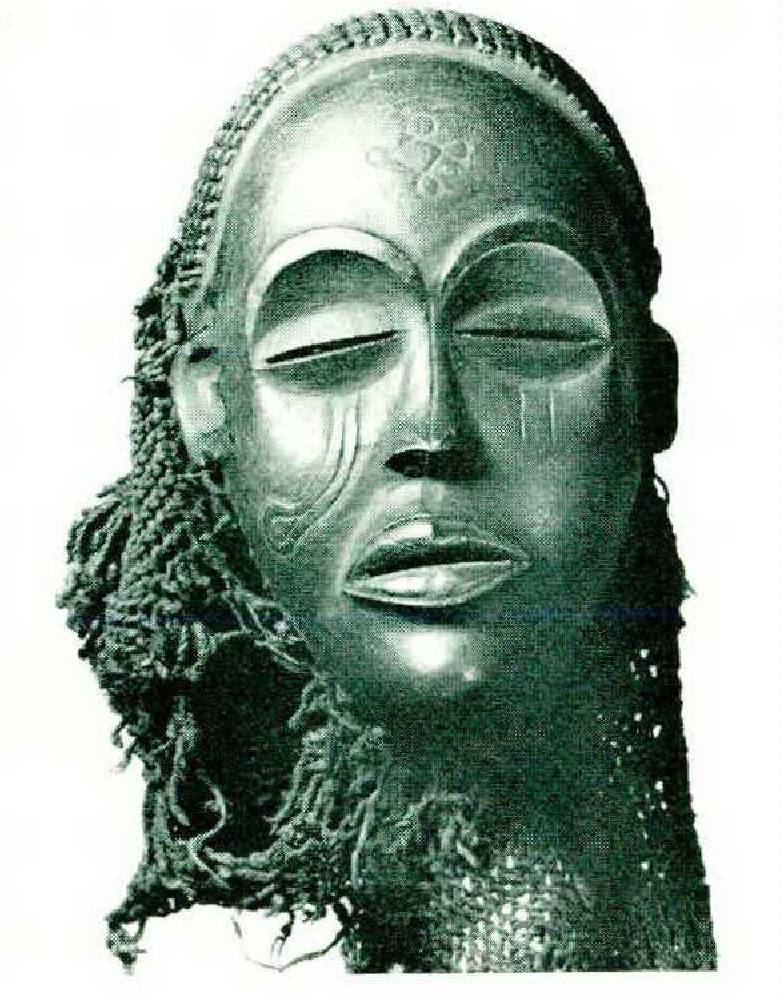
The naturalistic treatment of the human face is in great contrast to that of the Basonge mask (Figure 8). Called “the maiden,”it was worn by dancers covered with woven costumes including false breasts.
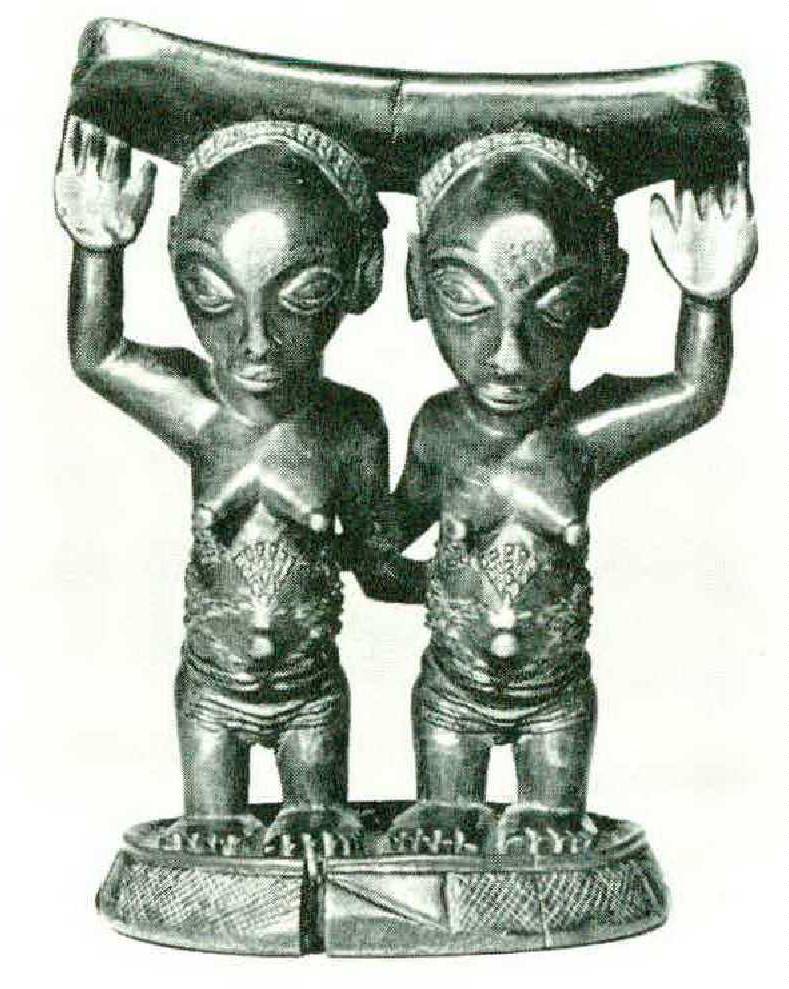
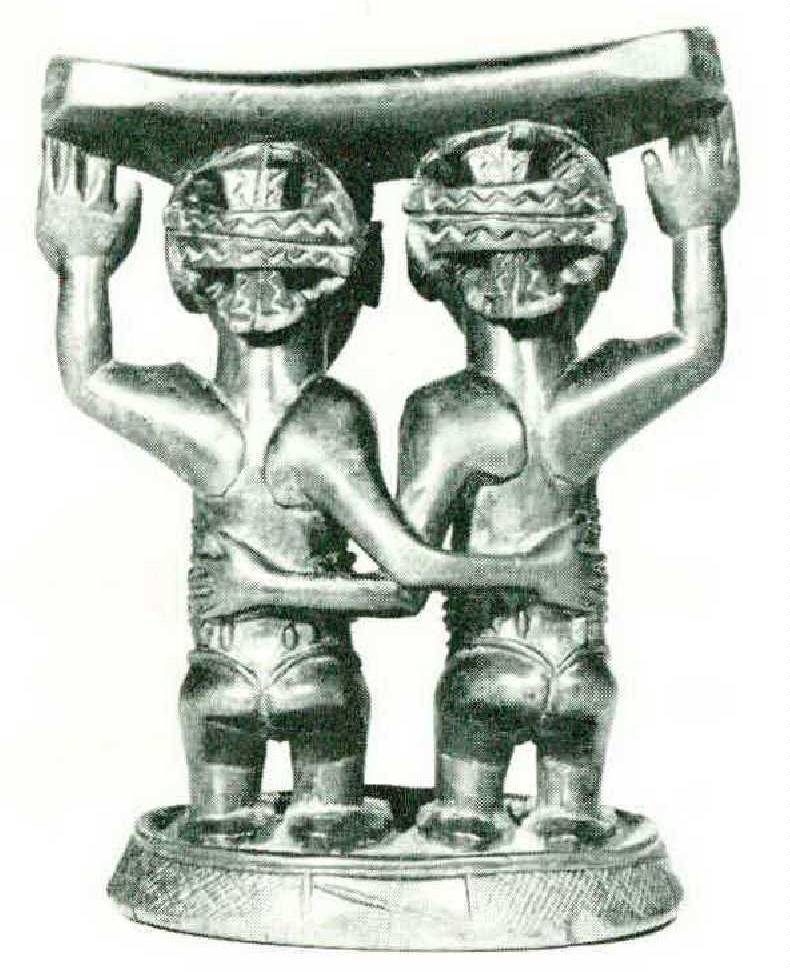
The two figures show the elaborate coiffure which necessitated these headrests during sleep. This object is an example of beautiful carving and detail lavished on a secular subject.
This forty two-inch-high antelope (the upper horns are not shown) was worn on top of the head in a dance celebrating the planting of grain. Note the deliberate lack of proportion in minimizing the size of the body in order to gain emphasis for the dramatic head.
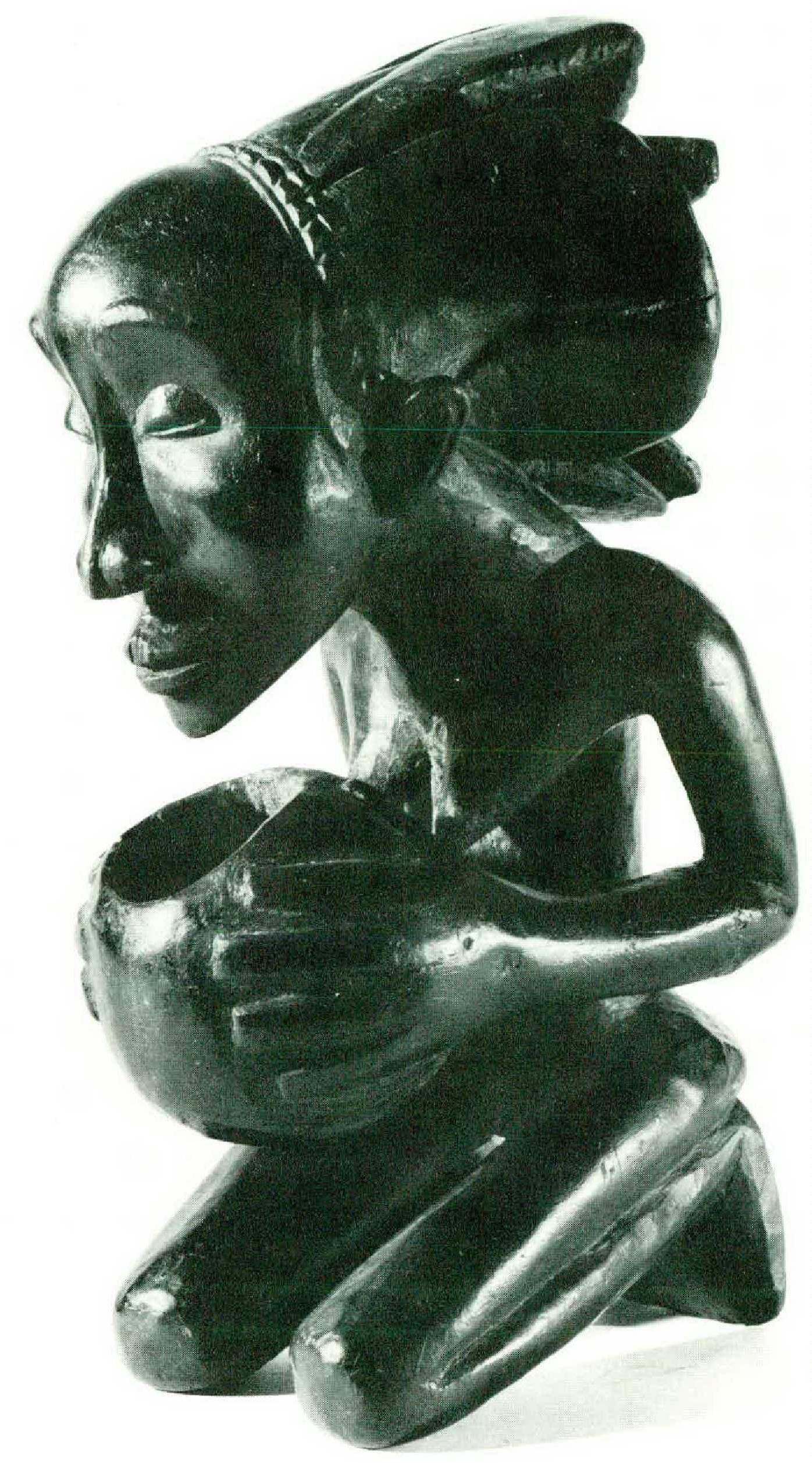
Used to collect offerings, this is one of the twelve known sculptures of the master of Buli, a village where several of his works were collected. The long sensitive face is his hallmark.
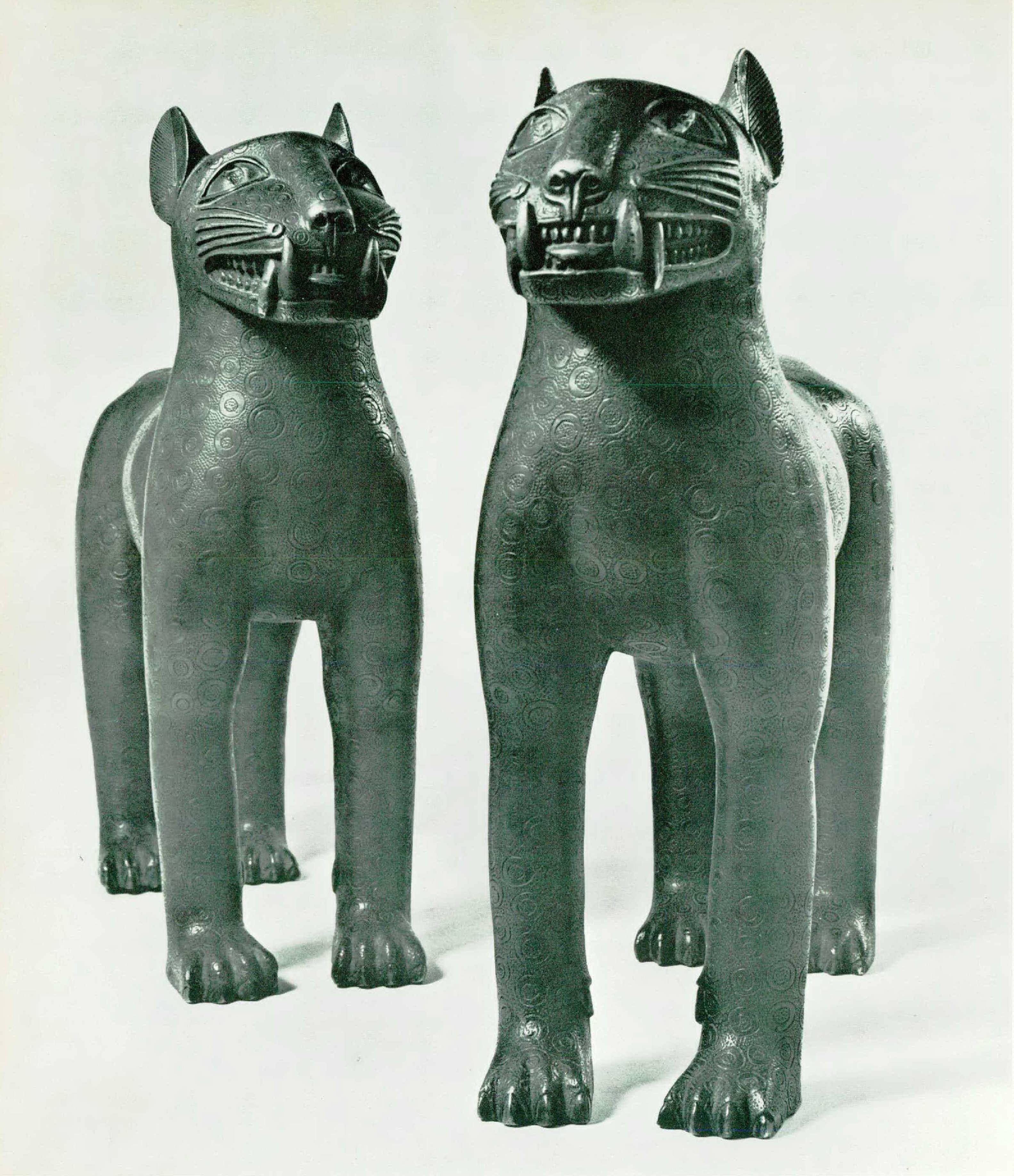
These two bronze leopards were part of the several thousand sculptures seized by an expedition in 1897 sent to punish the murder of an English consul who had protested human sacrifices. They are over two feet high and probably date from the late sixteenth century.
There are not many examples of African sculpture which were made simply as works of art, the Baulé being one of the few tribes indulging in this practice. But there are numerous useful objects which are decorated and carved in a manner so beautiful that they have achieved an artistic status. Boxes, stools, cups, headrests (Figure 10), heddle pulleys, architectural elements like posts and lintels have been appreciated as an integral part of African sculpture.
The question arises now whether or not the African regarded all this paraphernalia as artistic or simply as efficient. Are the distortions and inventions of the carver part of the magic of the piece or are they man’s universal quest for beauty? Meaning as well as beauty is in the eye of the beholder. What may be a cubistic mask of tremendous architectonic quality to us could have been simply a symbol of a secret society.
Does the African appreciate the expressionism so obvious to us, or does he know from tradition that a sculpture of an ancestor figure must conform to a certain appearance? Would the rejection of a Picasso cubistic portrait in the Ingere-David epoch be analogous to the African’s refusing an unconventional representation of his ancestors? Hans Himmelheber attempted to ascertain something about this in the Ivory Coast, where he conducted an interview with three native artists. Himmelheber asked them what would happen if they tried to be original and made some small inventions. One artist replied, “It could be done but no one would buy it"; the second answered. “One doesn’t do such things"; and the third said, “It wouldn’t be beautiful.”
How extraordinary it is that one culture could have produced the serene naturalism of the maiden mask of the Bajokwe (Figure 9) and the cubistic kifwebe mask of the Basonge (Figure 8).
THE process of artistic transformation is still going on in Africa. Leon Underwood, a well-known English sculptor, made an extensive trip through Nigeria and spent some time collecting Yoruba sculptures, several of which are outstanding. One of these pieces, a great mask now in the collection of Vincent Price, was carved by Bamboye in his youth. When a school was started by the English in his village, the director, concerned about the preservation of Yoruba tradition, asked the sculptor to teach the boys his art twice a week. Underwood tells the story in his book, Masks of West Africa: “The boys cut wood in the forest, replaced it by planting and proceeded to work on traditional lines at Bamboye’s direction. But there was something lacking. The work done subsequently by both boys and their master suffered. It acquired an art-consciousness, parting from the ordinary position of art in African life, and soon became typical of the meritorious, though lifeless, work in European art-craftsmanship exhibitions. Bamboye is incapable now of producing work like that which he did under the old tribal conditions. His pupils did not pick up the expression of his old work.”
Underwood goes on to note that the divination tables Bamboye carved for the Europeans to use as occasional tables did not have the same liveliness as tribal objects. This is not surprising. Bamboye’s art changed because his surroundings changed. ‘Teaching in a white man’s school was not his usual atmosphere, and more important still a new set of values had arisen. Tribal paraphernalia was not as important under European supervision and religious influence.
Almost everywhere in Africa the native carvers have been busy producing curios and makeshift objects for the local whites and the ever-increasing tourist trade. Why should the African lavish the attention and ritual on objects which are not understood or properly appreciated by casual purchasers? At best the sculptor copies masterpieces to be sold as real by the few who have had contact with old carvers. An interesting question would be posed if the African today were to be confronted by the connoisseur of African sculpture who not only would appreciate the object but would pay a handsome price for it.
There are a few remote corners in Africa where tribal art is still being practiced on a high level In 1951, I was able to collect in Kasongo Lunda, several days’ truck ride south of Léopoldville, a small but line collection of Bayaka masks. These had been worn by the boys that year on their triumphant return to the village after circumcision. A nearby tribe, the Bapende, are still performing similar puberty ceremonies and carving excellent masks (Figure 7). The filed teeth shown in the mask and ornately tatooed bodies are still common among these people.
I have also collected interesting material from the Bushongo in the Kasai River district of the Belgian Congo. These people are among the best of all African carvers. I found that an interesting phenomenon in art had taken place. In addition to the carving of cheap statues to sell to the occasional tourist, the artists of the tribe were still producing beautifully carved objects for their own use. These were small carved boxes which are used to contain razors of native manufacture and also the powdered red camwood, takula, which is an important African cosmetic.
Of course, the effects of Belgian administration were seen in the elimination of tribal artifacts formerly used for ritual purposes. One cannot help wishing that the Bushongo were still producing great African art, although one would not wish them still to be ruled despotically by their Chief, the Nyimi, who sat only on humans instead of chairs, possessed (even as late as 1951) over three hundred wives, and, when he died, was buried with a large entourage of older wives who were still alive. It is doubtful that the art can exist without the ritual that required it.
The same problem may be posed in reference to the Bini. A well-organized tribe (like the Bushongo, although they cannot claim a history of 1500 years as the Bushongo can), the Bini were notorious for their bloody sacrifices and rituals. The huge carved elephant tusks, which were held in place on the altar by inserting their bases into an opening in the top of bronze portrait heads, were covered with encrusted human blood. The large bronze leopards (Figure 13), which rank with the finest sculptures of animals extant, were cast by the “lost wax” process and formed part of the altar display of the palace.
A movement of a new art, secular in nature, has recently been started in various parts of Africa in which the African has been exposed to European techniques and standards. Paintings in oil like those made in Europe are a steady product of a group in the Congo. In West Africa several native sculptors are making large European-type carvings, several of which have been exhibited in England. But very little of this work stems from the original art of the African continent. It is at best a copy or imitation of European traditions with little of the vigor, directness, simplicity, and imagination which are the priceless ingredients of traditional African sculpture.
No one knows how much old African sculpture is left in that continent. Termites and rot quickly destroy wood, the most common material of the African sculptor. The last few years have seen an extraordinary appearance of good pieces from the French Sudan and the Ivory Coast. Tribes like the Senufo and Baga have been proselytized to Islam in large numbers, and one result of this acceptance of a new faith has been the sales of pagan idols to anthropologists, collectors, government officials, and dealers. Many of these pieces found their way to Paris, and for a while the market was flooded. This may have been the last major exodus of sculpture, but we do not know what else may be hidden away and where. We are certain only of the material in museums and collections throughout the world, and not all of these are of top quality. In the United States, several museums have noteworthy collections of African material, among them the University Museum of Philadelphia and the Museum of Primitive Art in New York.
ARE modern Africans interested in their own traditional art? William Fagg has found a surprising attitude about this. “The majority of them, when they hear Europeans praising African art and urging that it be encouraged to survive, show resentment on the assumption that an attempt is being made to ‘hold them back,’ the better to perpetuate European domination; to them tribal art is of the bush and therefore to be discarded in favour of a westernized mess of pottage. There are indeed some among them whose attitude is extremely enlightened, and who have supported the efforts of dedicated Europeans to provide museums and other means of conserving the artistic heritage. It may be that under their influence, the naïvely defensive attitude towards art will fall away gradually as the African territories come to independence and full responsibility. Political progress is not enough and Africans themselves must develop a cultural balance between their ancient and honourable traditions and the needs of the modern world.”
The existence of several museums for traditional art in Africa and the increase in interest in this material by our art museums and collectors have produced a situation in which the African has to buy his art in order to show it to his children. The museum at Jos in Nigeria is a case in point. The government of Nigeria has been buying Benin material which was taken away by the British Punitive Expedition of 1897. Of course, this is almost an impossible task, since most of the bronzes are in either museums or important private collections. The price is also going higher for fine objects; for example, the Benin ivory mask shown on the cover was sold for $56,000 last year to the Museum of Primitive Art in New York. The government of Nigeria is still not spending that kind of money to recover its treasures, although it did buy the two great bronze leopards (Figure 13) for almost half that amount. It might not be a bad idea to return some African sculpture to the Africans.