Insipidology
SCOTT CORBETT is a frequent contributor to these pages, and our readers will recall “Where the Centaurs Graze" in the ATLANTIC’s 100th Anniversary issue.
Insipidology (the science of modern terminology) interests me more and more. I was thrilled on a recent trip to flush a real collector’s item. Not far from the highway stood a tent, and outside it sat a gypsy. Beside the road a sign displayed the palm of a huge hand, with the words “Reader Adviser.”
Mow, it may be that an avoidance of the term “Fortune Teller” makes for better relations with the police department, but at the same time, “Reader Adviser” is right in step with modern trends in terminology. Let me point out what has been accomplished in a few other fields.
A quarter of a century ago, New York City’s last janitor died. Since then there have been only Building Superintendents. Now the homely garbageman has joined the janitor, leaving his work to be accomplished by Disposal Contractors or Sanitation Engineers.
You can still find the word “gravestone” in some of the older dictionaries, but not in the average metropolitan classified telephone directory. Monumental Works now produce Memorials. For that matter, caskets are practically a thing of the past; their place is being taken by a very similar product manufactured by Burial Case Companies.
Certainly these new terms are a great improvement on their outworn predecessors, but I feel that they drain the color out of life.
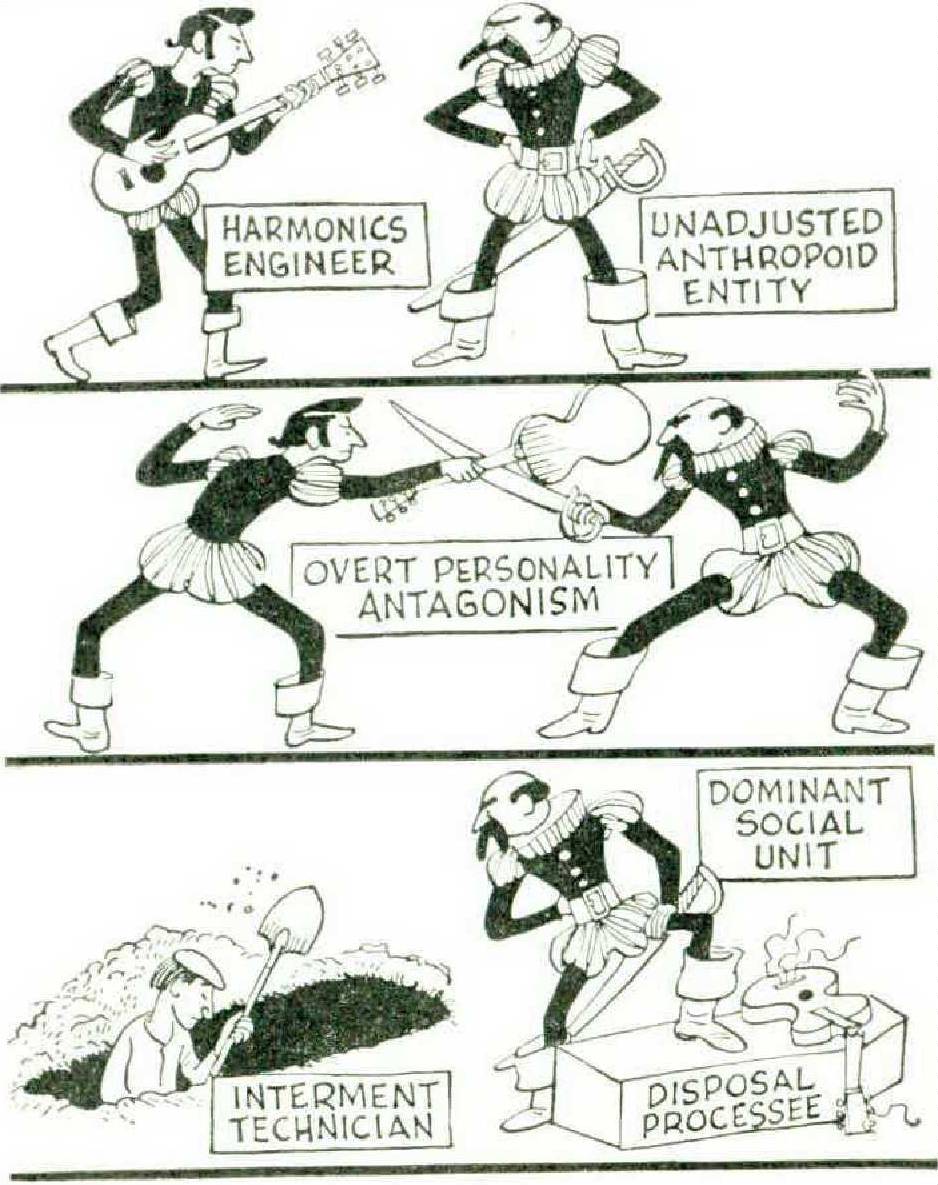
Are they not ultimately going to give the writer of swashbuckling novels and the opera librettist a hard row to hoe? Perhaps a quick comparison of possibilities will convince us that such fears are groundless.
First, let’s take the old-fashioned version of a swashbuckler plot. Our hero, Ethelred, disguised as a wandering minstrel, penetrates the grim castle of Monstro, the wicked duke. Monstro is a cruel villain who has our heroine Rowena’s father, Sir Humphrey, imprisoned in a foul dungeon, shackled with heavy chains.
Ethelred is recognized and dragged to the torture chamber, where the duke’s torturer puts him on the rack. In the meantime, disguised as a fortune teller, Rowena enters the castle. She frees Ethelred in the nick of time. He kills the torturer and then engages the wicked duke in a duel to the death — the duke’s death, that is — after which Ethelred and Rowena take over the castle and live happily ever after. Eventually somebody even remembers to run down and release poor old Sir Humphrey.
So there we have it: a good, exciting story full of passion and color, but hopelessly old-fashioned. The question is, can its terminology be revised to make it acceptable today without sacrificing too much of the color? Well, let’s see:
Our success symbol, Ethelred, disguised as an Aberrant Harmonics Engineer, penetrates the grim Intrusion Prevention Structure of Monstro, an antisocial duke. Monstro is an unadjusted personality who has Rowena’s father, Sir Humphrey, under supervision in the Subterranean Detention Section. Sir Humphrey’s aged limbs are loaded down with Activity Deterrents.
Ethelred is recognized and channeled to the Cooperation Procurement Division, where the Personnel Processor prepares him for Applied Antitherapy. In the meantime, disguised as a Reader Adviser, Rowena enters the Intrusion Prevention Structure. She frees Ethelred with a minimum of expenditure of the timeloss factor, but then the duke’s henchmen grab them and Monstro watches gloatingly while his Personnel Processor broils both of them to a crisp over a nice lire and . . .
I’m sorry, but there is something about this new language that simply makes me side with Monstro.