Barbershops
FRANCIS W. DAHL is widely known for his books and cartoons and his daily drawing on the editorial page of the Boston HERALD.
The contests in which you have to judge strangers on the basis of their appearance are always hard on the judge. Next to not judging beauty contests I prefer not to judge barber contests. Alas, a man can refuse the beauties, but he cannot give up getting his hair cut. Eventually he will find himself in a strange barbershop with barbers jumping about, smiling, bobbing, snapping their towels, and making little gestures toward their chairs. And he will feel that all but one of them are going to hate him for the rest of his life.
If he does what I do, he will avoid all their eyes and nod briskly to the nearest one as though in a great hurry, have to catch a train, no time to pick and choose. This causes all the other contestants to slump as though they had been shot. I will say the other contestants are always decent about it and resume their conversations or turn back to their bottle arranging. Perhaps they never give me another thought, but I am always glad when more customers come in and give them something to do.
My barber, Joseph, buys a Veteran’s Poppy every year and twists its stem around the railing on his glass cabinet. During the next twelve months it wilts considerably but is replaced by a new one every year. On the mirror is a peeling decalcomania (by courtesy of Lucky Tiger) of three rigid feminine profiles depicting the bob, the shingle, and a tortured spit-curl effect. This is a reminder of that nervous period when the flappers threatened to take over the barbershops. Well, have they? There may be a former flapper sitting over there, but she has brought in her youngest for a whiffle. Nothing has changed but the prices.
This was brought home recently at a quick-shave place near my office which I patronize in emergencies. The porter had opened the door of a closet where the tonics are kept in bulk, and on the back of the closet door was a red pennant which said, “To Hell with the Kaiser.” The porter started to mix some tonic with water, then stopped to look to see what my reaction might be. Then he looked at the boss barber, who was stricken. I made no outcry, however, so the boss held first one finger down by his side (I was facing the mirror) then four fingers, and the porter mixed one part of tonic with four parts water.
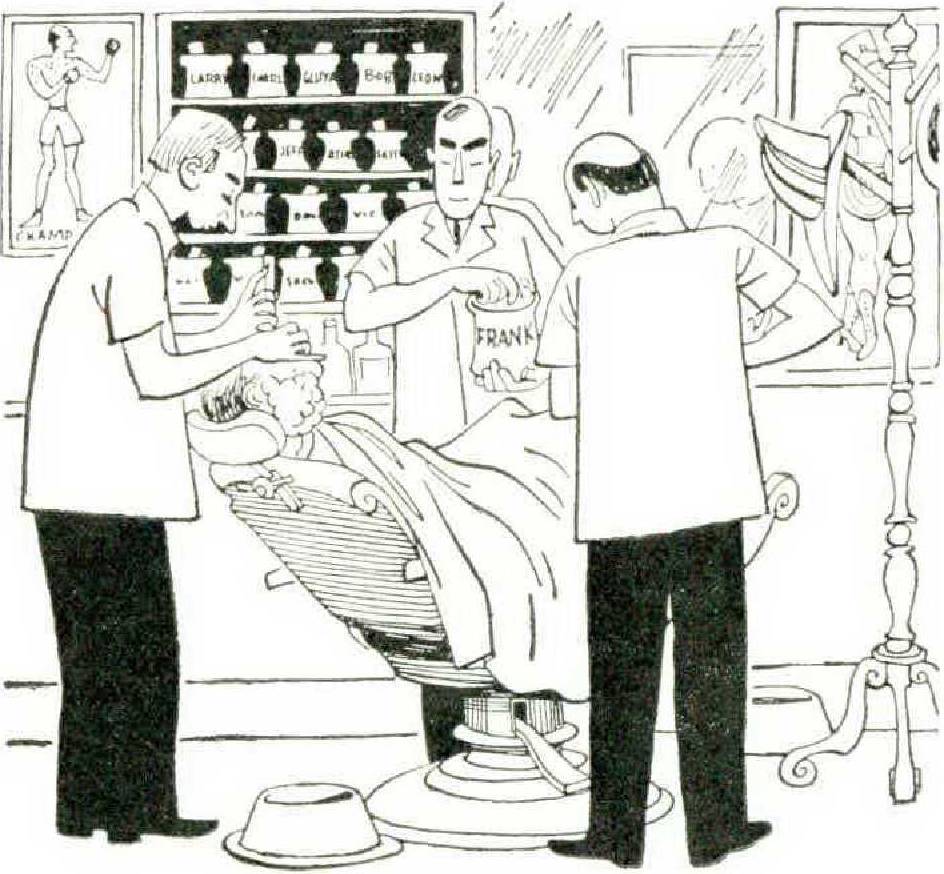
I made no outcry, because it would have meant having to choose another barber. As a matter of fact, I felt honored to be perhaps the only client ever actually allowed to witness this ancient rite. It was something I shall remember gratefully.
My Maine barbershop, which I patronize in the summer, is also suitably decorated. It displays that famous chromo of the little child looking up at the big dog with the title, “Can You Talk.” It has a massive gold frame and no question mark after the “Talk.” I often wonder how a picture that hung in thousands of Victorian parlors managed to get by without a question mark after the “Talk.” Perhaps it was not meant to be a question, I say rather sleepily to myself. Perhaps the artist meant it to have an exclamation mark: “Can You Talk!” This would indicate that the animal was a talking dog and a very good one, at least for those times.
My Cape Cod shop is furnished in similar fashion. A tin ceiling painted white (one coat), a row of kitchen chairs (two coats plus black rings on the turnings), flowered linoleum on the floor, and an oil heater. The atmosphere is not drowsy, however, because the barber, a member of the volunteer company, keeps his fireman’s hat on a table right close to the chair. I have always expected to hear the alarm sound, see the barber go dashing off in his fireman’s hat, and find myself in the doorway, peering up the street, with lather on my face like a character on a Saturday Evening Post cover. I believe I’ve seen something like this on a Saturday Evening Post cover.