Over the Bridge
A graduate of Harvard, ROBERT W. MORGAN, JR., worked for the Associated Press in Buffalo fur a year and a half and then joined the staff of the Boston GLOBE, where he has been a news editor and reporter. He became interested in the problem of Negro housing when he went to Roxbury to get a story for the GLOBE.
BOSTON and its suburbs encompass some of the most beautiful residential areas in the world, from Beacon Hill outward through Marblehead and Essex County on the North Shore, Cohasset on the South Shore, and inland through suburban towns like Wellesley and Concord. In these quiet, Northern communities racial tensions are virtually nonapparent. Boston’s Negro population still is relatively small. For these reasons, it is possible to get closer to some of the little-known aspects of housing segregation here than elsewhere in the North. And the ugly dilemmas posed by housing segregation are the same in Boston as they are in New York, Chicago, Detroit, Cleveland. Los Angeles, or Philadelphia.
In this city, where Americans first fought for freedom, where the slavery abolitionist movement flourished, and where William Lloyd Garrison published The Liberator, housing is segregated about 90 per cent. Most of Boston’s fifty-five thousand Negroes are living in substandard dwellings in a single overcrowded section of the city, no matter what rent they are able to pay. What integration there is has occurred largely in public housing projects.
It should be added that this situation is the result of the volition of Negroes as well as whites, of tenants as well as landlords, and that there are now operating in Boston partial solutions to the problems here raised.
An astonishing number of Bostonians are unaware of exactly what goes on in the Roxbury section of their city. They know that, the newspapers report a lot of fires and a lot of crime in that area. White people who go to Symphony Hall know that if they happen to drive two or three blocks south looking for parking space, they suddenly enter what they call the Negro district. Outside of this, the 77-block stretch from City Hospital southwest to Franklin Park is a mystery.
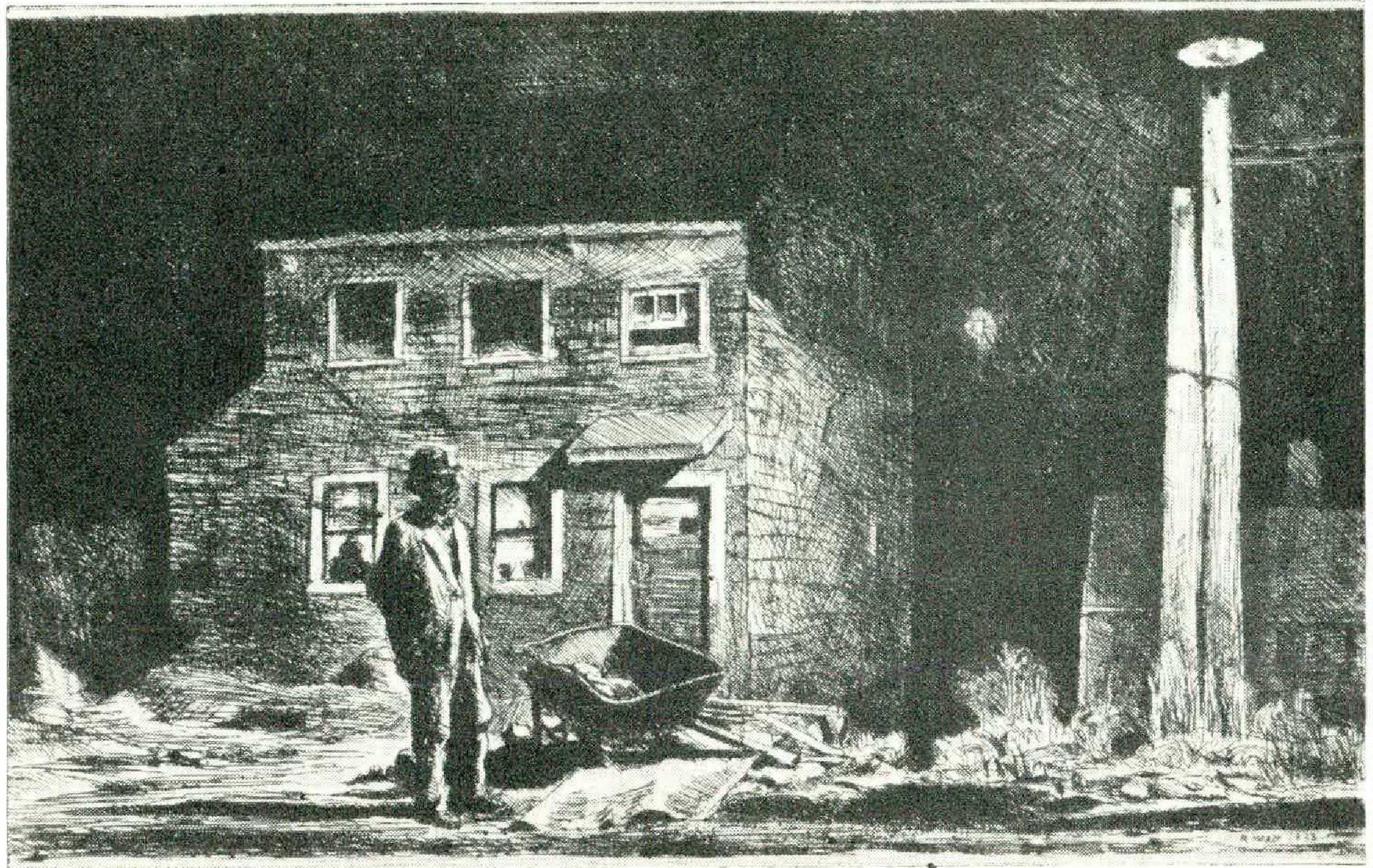
There is a place not far from the center of the city, for example, called Madison Park. It is a desolate spot, overgrown with witch grass and tall weeds. When I visited this neighborhood for the first time, I had a hard time believing I was still in Boston. The only noise came from a wrecker demolishing a row of condemned buildings along one side of the park, and on another occasion from the echoing shouts of a group of children playing tag around the rusted remains of an iron fence. There was no traffic at all, which was fortunate because the streets were covered with crushed brick and broken glass.
The largest building on the park was a fourstory brick tenement which used to be a hotel. One of the end walls, instead of being flat, had become slightly saddle shaped. It was as though a gigantic hand had taken the top of the building and given it a gentle twist. Holes showed throughout the façades of the structure. By following with the eve the horizontal line of the bricks, I could see that one corner of the building had dropped several inches.
Inside, the most noticeable thing was the almost overpowering stench of dank decay. One of the main stairways had been partially burned and had never been repaired. There was no front door, but only a gaping hole onto the street, so that during the winter the interior of the building was always cold. Why didn’t someone install a new front door? It wouldn’t do any good, the tenants insisted. There were so many other holes that the building would have been cold anyway.
The four floors were occupied by forty families. For the privilege of living in this dilapidated slum, the tenants were paying incredible amounts of money, in some cases as much as $90 a month. “Our rent is $30 a month,”one of them told me. “During the winter, fuel for the oil heater and coal for the kitchen stove come to as much as $15 a week. I keep the stove going all day long. It’s the only heat we get back there.”
At that rate, I suggested, they could afford to pay something like $60 a month rent the year round for a better place to live. “Sixty?" said one tenant. “Maybe more. Maybe $70. But we can’t find a better place.”
How many apartments had they looked at? The woman thought a moment. “Four,” she said. Was that all? Was she still looking? “I’m still going to look at some others. None of the ones I looked at were any better than this.”
Would they consider looking outside the Roxbury area?
“Oh, no,”she said. This woman’s husband was an employee in good standing at a large sugar refinery, the personnel department at the plant told me later, and his salary over the past three years had averaged $75 a week.
Before leaving, I made a brief inspection of the basement. Because there was no central heating, the basement consisted merely of a dark air space full of dirt and junk. I heard water running down one of the walls. I struck a match, but was unable to find out where the water was corning from.
You can interpret these facts any way you please, but one thing, I think, is inescapable: if these people were members of a white family prepared to pay $70 a month rent, they would not have been living in a place like this. They would not even have set foot in such a place.
FOR many slum Negroes the best hope is admission to one of the publicly financed housing projects. I accompanied State Representative Lincoln G. Pope, Jr., on a visit to a basement apartment on Tremont Street, from which the family was to move shortly into one of these projects. This building had a front door that wouldn’t open. It was necessary to go next door, ascend a flight of steps, go down a hall, and descend a flight of steps.
“How do you heat this place?” I asked the tenant.
“There’s no heat here,” she said.
“What do you do on a cold winter night?”
“I leave the kitchen stove on.”
The woman, who had four children, was expecting another child in a matter of weeks. Representative Pope assured them they would be out of that apartment within two weeks and into the project.
“Are you sure?” asked the woman. She sat down and seemed to look off into space. After a few moments, she started to say, “I’m so happy. I’m so happy.” She said it again and again. Presently one of the children went over to see why his mother was crying.
Slums exist, of course, for white people as well as for Negroes. It is apparent, however, that landlords are using the various aspects of segregation to exploit their tenants.
Colored families moving into apartments formerly occupied by whites along the fringes of the Negro district normally pay $20 a month more than the previous occupants. Where the white tenant paid $45 to $50, Negroes pay $65 to $70. There are instances in Upper Roxbury of Negroes paying $75 to $80 a month rent for unheated apartments.
“Rent is overall too high for these people,” I was told by the Reverend Samuel L. Laviscount of St. Mark’s Congregational Church in Roxbury. “Absentee ownership makes it very difficult. Sometimes you can’t find out who the real owner of a piece of property is. Some company or some intermediate is listed as the owner of record.”
In spite of obstacles like this, Boston has made a start on cleaning up its slums. Under a variety of programs, it is condemning slum properties and is tearing the buildings down. Land has been taken for new highways and public housing, and the city is empowered to seize any building it considers dangerous. In 1956, the city adopted a lengthy housing code in order to qualify for federal urban renewal funds.
The code precisely defines a substandard dwelling, or what it calls “minimum standards of fitness for human habitation in the City of Boston.” The section on heating, for example, provides that every dwelling shall have the facilities to heat “all habitable rooms ... to a temperature of at least 70 degrees Fahrenheit under ordinary minimum winter conditions.”
Using this code, the city health department has condemned and demolished more than two hundred Roxbury dwellings in the past two years. One city official predicts that within ten years the entire central section of the district will be leveled. He would not estimate how many people this would dislodge, but the number might run into many thousands. Under some renewal programs the city is required to help relocate these people; under others, it is not. Frequently, evicted slum dwellers, white or Negro, frustrate relocation efforts by moving in with friends and relatives nearby until those buildings are also condemned, at which time they will move again, but no further than is necessary.
Needless to say, there is not enough available housing in the city, public or private, to accommodate thousands of displaced Negroes. Demolition of the slums is a tremendous step forward, and one from which the city has no alternative. Nevertheless, it only aggravates the growing dilemma of segregation in housing, particularly as more and more Negroes move up from the South. If the Negroes are deprived of the places where they are living, then where are they to go?
A NEGRO veteran of the Korean War returned to Boston in 1954 and answered some fifty newspaper ads for apartments outside the RoxburySouth-End area. All turned him down. This man is now living in Roxbury.
“After the Korean War,” he told me. “ I enrolled at Northeastern University. I was also engaged to be married. I thought I could find a place to live in the Back Bay area, near the university, I answered about a dozen ads for apartments, going in person. Most of the landlords would see me and say something like, ‘I’m sorry. The place has just been rented.’ One man told me straight out he didn’t rent to Negroes. Then about a week later I would see the same apartment-for-rent ads appearing in the papers again. Same wording. Same addresses.”
To test the veteran’s story, I myself put in phone calls answering a number of newspaper ads for apartments in Brighton, Belmont, Arlington, and on Beacon Hill. I would allow the person answering the call to describe the apartment briefly. Then I would ask if there was any objection to renting to a Negro.
In most cases the person with whom I was talking would suddenly remember a third party who had to be consulted, and would I please call back? Sometimes this third party was out to lunch, or at work, or showing an apartment. When I called back, the place in question would be rented.
In one case, an agent said, “I’m sorry. But in that area the landlord wouldn’t stand for it, I’m very sorry.” This was a three-room apartment in Brighton renting for $85.
A Belmont woman described a three-room apartment to me at some length. Then I asked her if she had any objections to renting to a Negro.
“Well, the Negroes fought in the war the same as the white fellows,”she said. “I have no objection. But there’s somebody coming tonight to rent the apartment.”
One woman said she had no objection to renting to a Negro at all. This was a $100 apartment on Beacon Hill.
For the Negro living in Roxbury, buying a house in the suburbs presents the same sort of problems as does renting an apartment in the city. Scores of Negroes working in plants outside Greater Boston — and particularly the skilled workers and trained engineers at the many electronics plants that have sprung up at a distance of fifteen to twenty miles outside the city — find themselves obliged to commute from Roxbury.
A woman living in Roxbury and teaching at a private school outside Boston decided one day to answer an ad for a house in suburban Milton. She phoned the realtor, who suggested she meet him outside Milton High School to save time. When she drove up, the agent was waiting in his car. He came over and suggested she drive with him to see the house, so she got out of her car and they walked a few steps together, the realtor describing the property.
Suddenly he stopped dead in his tracks and said, “Oh. I didn’t know . . .”
“What didn’t you know?” the woman asked.
The agent was very embarrassed. Finally he said, “Well, this is an all-white neighborhood.”
The woman said, “I’m not interested in the neighborhood. I’m interested in the house.”
“I’m afraid the people would be rude to you,” the agent said.
“That would be my problem,” the woman answered. “Let’s go and see the house.”
He did not move. After a moment, he said, “I’ll be honest with you. I cannot sell a house in this neighborhood to a Negro.”
The woman said, “All right, show me a house in another neighborhood.”
The agent, one of the leading real estate men in town, turned red “to the roots of his hair,” as the woman put it later, and said, “I just can’t show you a thing.”
The house in question was selling for $18,000. The woman said that she and her husband could have bought one of several houses near the school where she teaches, through the influence of people at the school, but that these were all much too expensive for them.
This is pretty much the story throughout Boston’s suburbs. The realtors present a united front. Occasionally Negroes do succeed in buying a house through an agency, but only if it lies outside a price range of roughly $12,000 to $30,000. This means that Negroes can buy into some of the cheaper developments; sometimes they can buy an undesirable house that otherwise has proved unsalable; sometimes they can buy rather expensive homes in the very high-class suburbs, although Negroes rarely have that much money.
Occasionally a Negro succeeds in buying a home directly through the owner. A year ago basketball star Bill Russell of the Boston Celtics was driving along one of the express highways outside the city when he saw a “for sale" sign. He went in, found the owner eager to sell, and made a deal. By and large, relations with the neighbors have been excellent, the Russells report. Mrs. Russell is active in the Methodist Church and women’s group activities. “I am thinking of building a new house one of these days, and it will be here in Reading,” Bill Russell said. There are two other Negro families in the town.
An art dealer in Newton bought his $17,000 home from another Negro six years ago. “People here are very, very fine,” he told me. “The banks are wonderful. They will do anything for you. My kids are the only colored kids in the school.”
“If the sign says ‘deal with owner,’ the owner will sell,” his wife added. “If an agent is selling, you might as well save your dime.”
Some Negroes have been able to buy land in the suburbs and build. “We have had wonderful cooperation from our neighbors,” the owner of a new $15,000 home in Tewksbury told me. “And from the bank, too. It’s a bad situation in Roxbury. Too crowded. Things go on in crowded neighborhoods. I like it here.”
And a Negro who built a home in Lexington eight years ago told me, “We have had no trouble from the start. Since we moved out here, our luck has changed completely. The smartest thing I ever did was to get out of Roxbury.”
The public apparently has three notions about what happens when a Negro family moves into a suburban community:
1. There will be trouble in the neighborhood.
2. Property values will decline.
3. The entry of one Negro family will bring an influx of many more Negroes into the area, so that the whites will find themselves outnumbered.
In cases where Negroes have succeeded in moving into the Boston suburbs, the overwhelming evidence is that none of these things happen.
Since Governor Faubus began holding forth in Arkansas, residents of three Boston communities — Natick, Newton, and Wellesley — have taken a close look at discrimination in their own towns and have set up what they call Fair HousingPractices Committees. The aims of these committees are to persuade persons selling homes to list them with the committees on an open occupancy basis and also to educate neighborhoods about the myths that have sprung up relative to home ownership by Negroes and other minority groups.
A couple of months ago, I was sitting in an apartment in Roxbury talking to a gentleman in his sixties, who reminded me of the late actor Lewis Stone. Seemingly completely relaxed in a large armchair, he turned a lighted cigar slowly in his fingers and talked in a detached way about the run-down condition of the building in which he was living, the presence of rats, the high rent.
“I’m a Negro,” he said. There was no visible evidence that he was a Negro. “Last year, I made another attempt to go over the bridge.” He explained that the New Haven Railroad right of way cuts through Boston to the southwest and that there are only a few bridges across this canyon. The Massachusetts Avenue bridge, near Boston’s Symphony Hall, connects the Back Bay area with Roxbury. One side of the tracks is white, and the other is Negro.
“A lot of Negroes would like to go over the bridge,” he continued. “Get away from the tenements, the leaking roofs, the rats, the unheated apartments. I answered an ad, took the apartment, paid a month’s rent. Then I went back there with my wife. Well, the landlord took one look at her and raised the roof. So I took back my money and we left. What’s the use of making an issue?”
His wife was sitting next to him. He smiled at her and took one of her hands in his. Unlike his own, the skin of her hands was coal black.