The Teamsters Defy the Government
A journalist who took his degree in law at Drake University, CLARK MOLLENHOFF has been assigned to cover city politics ever since he joined the staff of the Des Moines REGISTER AND TRIBUNE in 1941. In Washington his work in helping to uncover corruption in the Internal Revenue Service, in the FCC, and in the labor unions earned him the Pulitzer Prize, the Sigma Delta Chi Award, and the ever-increasing respect of American readers.
AT FIRST glance they seemed an unlikely pair to pull off the most explosive investigation in the history of the United States Congress. Robert F. Kennedy was a young lawyer with no courtroom experience and a scant knowledge of labor and labor law. Senator John L. McClellan was a cautious, conservative Arkansas Democrat with a pronounced distaste for becoming involved in unnecessary political brawls.
Yet, in a period of less than two years, the McClellan-Kennedy combination has become one of the most celebrated investigation teams in the nation’s history. They have upended some of the biggest powers in labor, including Teamster bosses Dave Beck and James R. Hoffa, Carpenter boss Maurice Hutcheson, Operating Engineers czar William E. Maloney, and Bakery Union President James Cross. Under their direction, more than eighty lawyers, accountants, and investigators have burrowed into corruption and mismanagement in a dozen unions. The repercussions have been felt from New York to Los Angeles, from Seattle to Miami. In a dozen states, the exposure of labor corruption has ricocheted into politics in a way that was unflattering to many Democrats and Republicans. The thievery of union funds, as disclosed, ran into the millions. The brutality of labor violence and the threats to committee witnesses shocked the nation and changed the public attitude on the question of labor corruption.
In the fall of 1956, McClellan and Kennedy went quietly to work against the seemingly unbeatable combine from which came big labor’s power: the financial power of labor’s huge political funds, the political punch of labor’s endorsements, the economic pressure with which labor was able to neutralize or split the business community, the cynical bribery and ruthless coercion of labor’s crooks.
Public sympathy was then on the side of labor. The scandals of labor were considered insignificant; the indications of thievery of union funds were ignored. The public still viewed labor leaders as a class dedicated to unselfish defense of the workingman against the oppression of management. Well-meaning liberals denied the fact that big labor was more powerful, and consequently could be more corrupt, than big business.
On this issue the members of the United States Senate and House of Representatives could be divided into five categories: those who were so beholden to labor that they would oppose any probe; the idealists who followed labor’s flag as a symbol; the fence riders who were afraid to incur labor’s displeasure; those who were so bitterly against labor that their efforts were suspect; and a small sprinkling who did not take sides.
In the fall of 1956, McClellan and Kennedy were ignored by Teamster leaders. Beck and Hoffa were confident and arrogant; in one way or another they had found it possible to flag down a long list of congressional committee chairmen. Teamster President Dave Beck staked his career on the belief that the political power of labor could stall any thorough congressional investigation of corruption in labor. His successor-to-be, tough little James R. Hoffa, was his usual direct self when he told me: “Everyone has his price. What’s yours?” And commenting on the early efforts to get a fullscale investigation of Teamster corruption, Hoffa added with a smile: “Why don’t you give up? Nothing will come of it. We’re the Teamsters.”
Hoffa had dipped into the million-dollar treasury of his Teamster local in Detroit to contribute to the campaigns of governors, judges, and prosecutors. He played both sides and he wanted one thing: officeholders, Democrats or Republicans, who were favorable to Hoffa and his organization.
There were a dozen leaders of other national and international unions who were equally arrogant, equally corrupt, and equally confident that they could crush or coerce any chief counsel or committee chairman who had the audacity to try to investigate labor. Wise money would have been on their side. But the wise money lost. Young Bob Kennedy was short on experience, but he was long on the most important ingredients needed. He was bright, energetic, imaginative, and charged with a fierce integrity and stubbornness. He was driven by a mixture of ambition and personal outrage at the dishonesty and brutality uncovered in many union operations. He was blunt with those who lied to him, and threw the facts into the faces of lawyers and witnesses with a total disregard for what they thought of him. He was irritable when senators broke into the continuity of his questions with matters he considered irrelevant or premature. In private, Kennedy could be blunt in his comments to staff members who were not producing or who showed a lack of judgment in trying to break a case. But in public he had nothing but praise for the staff, and he developed an esprit de corps that made it what some Republicans critically called “a Kennedy staff with Kennedy security.” A Republican bitterness against Bob Kennedy smoldered throughout the investigation and occasionally blazed into the open.
McClellan was the insulation and safety device. He kept the dynamic young counsel and his staff from setting off explosions they couldn’t handle. Kennedy would have tackled Republican or Democratic political entanglement in labor scandals with a vigorous disregard for political repercussions. McClellan saw how any move in the union-political area could backfire whether it involved Democrats or Republicans.
When Kennedy ruffled the feelings of the Republican senators with his independence, McClellan soothed the irritated. If he thought the complaint had any justification he talked privately with Kennedy to try to avoid repetition of the incident. When there were Republican attacks that McClellan felt were unjustified, he did not hesitate to stand side by side with the young counsel and dare committee members to assail him.
Senate colleagues both respected and feared McClellan. He was a practical professional in the world of politics, and he played the game according to the rules of the Senate. If the facts in a case reflected unfavorably on another senator, McClellan approached it cautiously. He would allow material unflattering to some of his colleagues to go into the record in the normal course of an investigation. But his colleagues knew that John McClellan would give them the benefit of the doubt, and would not stretch the jurisdiction of his committee simply to embarrass another politician. But equally important in McClellan’s control of the committee was the fact that he would not take a challenge lying down, whether it was a challenge on his person or on his operation of the committee.
After years of law practice, McClellan is slow to arrive at conclusions. But when he speaks, he is usually on firm ground. In addition to his private law practice and work as a county prosecutor, McClellan has had nearly twenty years in the House and Senate, and this has given him a broad practical experience in the fields of government, labor, and business. His years on congressional committees have sharpened his questioning. “I’ve just tried to keep the politics out, and keep the thing on the track,” Chairman McClellan says, oversimplifying his role. “Bob and the staff did the work.”
THE McClellan committee has had the services of the best and largest investigative staff ever assembled on Capitol Hill; the spectacular and continuing success of the probe shows the caliber of those who have done the work. From the outset, great care was taken to avoid the hiring of spies who might leak information to corrupt labor to the detriment of the investigation. A key figure is Carmine Bellino, a former chief accountant for the Federal Bureau of Investigation. Bellino’s success had been spectacular even before he became a part of the McClellan labor racket committee, but he rose to new heights in a masterful reconstruction of the intentionally tangled finances of Dave Beck and James R. Hoffa.
The spirit of the staff has been as important as its quality. This has been no 9 to 5 investigation. It has meant work from 7 A.M. until midnight or 1 A.M., and when occasion demanded the staff worked all night. Bellino demonstrated that cases are made by moving fast: tying up a witness with an affidavit or getting custody of a record before it can be destroyed. Witnesses were under constant coercion to refuse to talk or to perjure themselves. It was vital to move quickly from key witnesses to corroborative witnesses, even if they were a thousand miles apart.
The McClellan-Kennedy team avoided the blunders and rash actions that have meant selfdestruction to other committees. The heavy shadow of the McCarthy-Cohn tactics hung over them as a warning. McClellan had served side by side with McCarthy when the wild-swinging Republican was chairman of the Senate government operations subcommittee. The recollection of McCarthy was added to McClellan’s natural caution, and he leaned over backwards to be fair to witnesses. “If you’ve got the evidence, you don’t have to worry about hurting your case by being fair,” McClellan said.
The specter of McCarthy had also been a vivid part of Kennedy’s background. Bob Kennedy’s first experience on Capitol Hill was with the Senate government operations investigating subcommittee during the hectic days when McCarthy was chairman. When Roy Cohn was chief counsel directing McCarthy’s probes, Kennedy was minority counsel representing the Democrats. He had seen Cohn’s fierce, wild, and unchecked use of the power of congressional investigations. He did not like it, and he did not like Cohn.
The McClellan-Kennedy team had a limited jurisdiction in the labor racket field when McClellan authorized the preliminary work in the fall of 1956. The investigation was done under the authority of the Senate government operations subcommittee, and hearings were to be limited to allegations that unions were filing false financial reports with the Labor Department and the Internal Revenue Service. This gave some claim to an examination of union finances, but did not embrace the broad investigative power the labor committees of the Senate and House had but did not exercise.
WAS the labor racket field really in need of exploring? What were the best leads to follow? If it was a fertile field for investigations, why hadn’t other committees completed the job? Those were the questions faced by McClellan as the probe into misuse of labor union funds began.
Kennedy had a series of conferences with the lawyers who had directed the prior investigations: Downey Rice, Francis X. Plant, Lester P. Condon, Edward McCabe, William Lecce, and others. From them he heard how labor’s political power had frustrated earlier investigations.
Kennedy was a novice beside these lawyers, and yet they had failed to do the full job. In some cases it had been because of weak chairmen, in others because of political pressure, in others it had been insufficient funds or an inadequate staff. Downey Rice had had fifteen years of legal work, including service with the FBI and other congressional committees, before he took on his first labor racket investigation. Early in 1953, he was serving as chief counsel to a subcommittee to the Senate Interstate and Foreign Commerce Committee, headed by Senator Charles Tobey, New Hampshire Republican. Its first objective was the waterfront rackets in New York, New Jersey, and New Orleans.
Senator Tobey was no great legal light, but he had a flaming indignation at crooked operations in labor or business. His experience on the Kefauver crime committee had stirred him with a desire to fight the underworld. He met Rice, who was an associate counsel for the Kefauver committee, and they teamed up to expose the waterfront and get rid of Joseph Ryan, then boss of the racket-ridden International Longshoremen Association.
Tobey was not a strong chairman, but with Rice as his chief counsel he did not have to be. To add to the strength of their small-budgeted committee, they had as chief investigator Francis X. Plant, a former administrative assistant to FBI chief J. Edgar Hoover recognized for his thoroughness in the preparation of a case. In the spring of 1953, Chairman Tobey authorized Rice and Plant to start an investigation of the Teamsters Union in Minneapolis on the basis of information furnished by the Minneapolis Star and Tribune.
Senator Tobey died in July of that year, and with his death the investigation ended. The Senate Interstate and Foreign Commerce Committee passed into the hands of Senator John Bricker of Ohio. He allowed Rice and Plant to work for several weeks on the Teamsters Union in Minneapolis, then in early October dealt the death blow to the investigation without so much as one public hearing. Bricker admitted that the information Rice and Plant found about the Minneapolis Teamsters was of a serious nature. He said he was turning the case over to “the proper committee.” It went to the Senate labor committee, cemetery of most labor investigations. Nothing came of it.
Kennedy was told of these barriers which were put in the way of hearings on corruption in the Minneapolis Teamsters Union. There were others.
in November, 1953, Representative Wint Smith (Republican, Kansas) took testimony in Detroit hearings from three Minneapolis witnesses in connection with Teamster corruption. He then dropped the hearings after stating that some kind of undefined pressure was being exerted on him. Smith talked about organizing another House labor committee for a special probe of the Minneapolis Teamsters. He went so far as to hire Plant and Rice to run the investigation, but they never got on the payroll.
Finally, the idea of a Smith subcommittee was dropped. Smith said it was because he could not make satisfactory arrangements with labor committee chairman Sam McConnell (Republican, Pennsylvania).
Kennedy didn’t learn the full story of the pressure the Teamsters applied to Smith until he had been investigating the affairs of Jimmy Hoffa for a year. Records and correspondence disclosed that in October, 1953, Hoffa had hired Payne Ratner, a former Republican governor of Kansas, for the purpose of getting Smith to postpone hearings on Hoffa at that time or to give Hoffa more favorable treatment. Smith denied he gave any favored treatment to Hoffa, but Hoffa wrote a letter to Ratner following the hearings commenting on how pleased he had been at the treatment he received and giving Ratner credit for it.
KENNEDY was told how the bipartisan pressure of labor could be used to block an aggressive staff even when the chairman was eager for an exhaustive investigation and hearings. He was told how Representative Clare Hoffman was stripped of his power to hold hearings in the labor racket field. Hoffman, an ultraconservative Michigan Republican, was chairman of the House government operations committee. In the summer of 1953, Democrats and Republicans in that committee rose up and relieved him of his power to hold hearings in the labor racket area as he was preparing for an attack on Hoffa.
When Les Condon, a former FBI agent, went to Detroit for the Hoffman subcommittee, the target was Hoffa, then chairman of the Central Conference of Teamsters. The chief investigator moved in on Hoffa’s domain with a broad smile and a hard-driving approach and had several good cases on the way before Hoffa had time to gasp.
Representative Hoffman staged a brief hearing in June, 1953, and enough material was unraveled to make Hoffa suspect that he had some stool pigeons in his own organization. In July of that year, Hoffa got in touch with New York labor racketeer John Dioguardi and arranged to have Bernard Spindel go to Detroit and do a complete wiring job on the Teamsters headquarters on Trumbull Avenue. The system was installed with a control box in Hoffa’s office. It was possible to sit in Hoffa’s chair, flip a switch, and get a recording or an amplified reproduction of any conversation on the union telephones or in any of the major rooms in the building.
Meanwhile a coalition of Democrats and Republican congressmen were intent on depriving Hoffman of power to conduct further hearings on Hoffa’s activities. Condon was no longer granted the power to use subpoenas. This meant that he could not set a date for records to be produced or witnesses to appear.
For a time Condon labored on without subpoenas, and while the Teamsters gave him no help, they said they did not hold it against him for trying to do his job. He was told that he was a nice young man, and that he impressed Hoffa. They said they would not be surprised when it was all over if Jimmy Hoffa wouldn’t be forgiving enough to hire him to work for the Teamster welfare fund as an investigator. Hoffa told him later that he figured Condon was just the kind of fellow he needed.
In January, 1954, Hoffman made still another effort to get authority for a Teamster investigation. This time he was thwarted by a countermove. The House government operations committee authorized a labor racket investigation, but put it in the hands of Representative George Bender, the genial backslapping Republican from Ohio. Most viewers figured that any labor investigation in the hands of this mild-mannered politician was as good as dead.
When Bender heard the rumor that he was being used to whitewash the Teamster fence, he did not like it. He announced that he was going to conduct a thorough investigation; he hired Rice and Plant; he was granted an appropriation of $51,000, a little more than half of what he asked for. And at the outset he seemed in earnest in his determination to follow up the clues in Minneapolis.
But the Democrats in Bender’s subcommittee, Robert Mollohan of West Virginia and Frank Karsten of Missouri, were not happy; they questioned the jurisdiction of their own committee, and they tried to call off the hearings in Minneapolis before the first witness was heard. They kept sniping at Rice and at times seemed more interested in consulting with the Teamster lawyers than with their own staff. Bender was incapable of maintaining order, and as the hearings drifted along it became questionable whether he was willing or able to give the investigation the forceful direction it needed.
In his staff work Rice had actually set the stage for the later indictment and eventual conviction of several top teamsters in Minneapolis, but at the time he himself was the only casualty in the Bender hearings. The pressure from within the committee not only crippled his usefulness, but forced him to resign.
In 1954 Representative Bender did little to alienate Teamster affections; in 1956 the Teamsters openly supported him in his campaign for re-election; and in 1958 he was proposed by Hoffa as chairman of a committee of three to look into the charges of corruption within the Teamsters.
KENNEDY also knew that Bill Leece and Plant had served as chief counsel and chief investigator for a Senate labor subcommittee headed by Chairman Ives of New York. Given a free rein by the chairman in the investigation, they had dug up the evidence proving embezzlement of $990,000 from the health and welfare funds of the Laundry Workers International Union. Then Ives lost the chairmanship when the Democrats won the Senate in 1955, and Chairman Paul Douglas (Democrat, Illinois) took over. Douglas conducted the hearings on the Laundry Workers and exposed some of the corruption in the United Automobile Workers-AFL and in a small tuck pointers’ union in Chicago.
The Ives and Douglas investigations were well executed as far as they went, but Douglas fought so hard against what he feared might be a smear on labor that he killed much of the impact of his hearings upon the public. He rejected the staff suggestions that criminal records of some labor leaders be put in the committee record. In early 1956, Douglas rejected suggestions that his committee be expanded to do a full probe of the Teamsters Union. He let the committee die in April of that year.
In the House, Sam McConnell took a few ineffective whacks at labor scandals in 1954. Bellino was accountant-investigator for the McConnell subcommittee for several months, but even his skill and enthusiasm could not overcome the deadening impact of McConnell. By September, 1954, Bellino had penetrated to the scandals involving the Western Conference of Teamsters, Dave Beck, and Frank Brewster. But McConnell did not have much heart as an investigator. Instead of castigating the Teamsters, he praised them.
IN THE fall of 1956, the Teamster bosses were flying high. Who was to stop them? On President Eisenhower’s busy pre-election schedule for October 15, 1956, there was room for a conference with Dave Beck. The former Seattle laundry truck driver had become one of the biggest men in America. Dave Beck was general president of the Teamsters Union, the biggest and most powerful labor organization in America, with 1.4 million members. He was chairman of the Independent Advisory Committee for the trucking industry. Beck and the President shook hands for a picture.
Respectfully standing aside were three men who had come to the White House with Beck: Roy Fruehauf, president of the nation’s biggest trucktrailer manufacturing company; B. M. Seymour, president of the nation’s biggest trucking company; and Arthur C. Condon, law partner of Beck’s good friend Senator James Duff, Pennsylvania Republican.
When Beck left the White House a few moments later and gave his political endorsement to President Eisenhower, it was a big news story. Most of the leaders of labor were supporting Adlai Stevenson. The incident dramatized the prestige and power the Teamsters Union still possessed in the months when the investigation was being launched by the McClellan-Kennedy team. It explained the cockiness of the Teamsters and the attitude that they were quite as big as the United States government.
In those first weeks Kennedy did not suspect Beck of taking union funds. The information he had pointed to Jimmy Hoffa, boss of the Central Conference of Teamsters; Brewster, boss of the Western Conference; and Sidney L. Brennan, International Teamster vice president in Minneapolis, who had already been convicted on one charge of accepting money from employers.
Kennedy was even a little naïve as the investigations started. He called Teamsters Union headquarters in Washington, D.C., to try to get cooperation from Beck in his investigation of Hoffa, Brewster, and Brennan. He got a brush-off from Einar Mohn, then executive assistant to Beck. The Teamsters took one look at “Bobby” Kennedy and concluded that this was a boy trying to do a man’s job. They did not resent it; they were just amused.
On December 15, 1956, Kennedy and Bellino interviewed Brewster in Seattle. On general questions about the Teamsters, the suave West Coast Teamster boss talked freely. He was willing to instruct this kid. Then Kennedy’s questioning moved to whether Brewster had used Teamster money for financing his race horses and for personal expenses. The tough veteran of union battles flew into a rage. How could Kennedy ask such questions?
“I might be impressed if we didn’t already have proof you’ve lied to us about several things,” Kennedy snapped back.
Kennedy was not as harmless as he looked. Brewster talked little after that, but he was unintentionally helpful on several matters dealing with Beck’s relationship with Nathan Shefferman, the operator of a labor relations firm in Chicago. Kennedy’s request for union books was turned down by Brewster and Attorney Sam Bassett.
By December 17, Kennedy and Bellino had made a stop in Minneapolis and were in Chicago interviewing Shefferman. By December 20 they had admissions from Shefferman that he was paying thousands of dollars in bills for Beck, Beck’s family, and Beck’s friends. There were $650 for Beck’s TV set, $14 each for Beck’s ties, $43 apiece for Beck’s Sulka shirts. The total was at least $94,000.
At the National Boulevard Bank and the Harris Trust and Savings Bank in Chicago they picked up Shefferman’s financial records, and Bellino started piecing them together. By December 27 the records had been reviewed, and Kennedy put before Senator McClellan evidence indicating that Beck, boss of the biggest union in America, was involved in large-scale corruption. Kennedy also told McClellan of Teamster unwillingness to cooperate and to produce records. McClellan listened, stony-faced, tight-lipped, and angry. Beck’s Teamsters were openly defying the authority of Congress. On Kennedy’s recommendation the chairman made out a subpoena for Beck’s appearance. He declared he would use all of the force of his position to get the records of the Western Conference of Teamsters and Seattle Teamster Local 174, which was Beck’s seat of local power.
Kennedy called Teamster headquarters in an effort to find Beck. He was informed, “Mr. Beck would rather not be subpoenaed.” Beck would be willing to sit down and talk on a voluntary basis, but he did not want a committee subpoena to interfere with his trip to Europe.
KENNEDY and Bellino had been moving fast, and now Beck and Teamster lawyers tried to use their political connections to head off the impending investigation, but it did not work. McClellan was giving young Kennedy full backing.
On January 3, 1957, while Beck was indicating that he would cooperate, a committee of Teamster attorneys met at the Palmer House in Chicago to discuss a coordinated plan to block McClellan and Kennedy. Among those present at the meeting was J. Albert Woll, who was general counsel for the Teamsters and also for the AFL-CIO. The lawyers decided to attack the jurisdiction of the McClellan committee in labor matters, also to advise Teamsters that if they took the Fifth Amendment before congressional committees it would not be used as a reason for disciplining them in the union. If no one would talk about union finances, the lawyers reasoned, the McClellan-Kennedy team would be stymied.
Difficulty in locating Beck and knowledge of the meeting of Teamster attorneys made Kennedy suspicious of the assurances that Beck would cooperate if not subpoenaed. He got in touch with Woll and told him that if Beck did not want a subpoena he should make himself available. Woll promised that Beck would meet with Kennedy the next night in New York. Shortly after 9 P.M. on January 5, Kennedy had his first meeting with Beck. Attorney Woll took Kennedy and Bellino to Beck’s suite at the Waldorf-Astoria Hotel in New York. Present with Beck was Simon Wampold, a Seattle attorney who was on the Teamster payroll as a legal adviser and was also involved in business ventures with Beck.
Kennedy carried a letter from Chairman McClellan. It was always conceivable that Beck had some proper explanation for his dealings with Shefferman, McClellan cautioned. If Beck could give a satisfactory explanation of his dealings with Shefferman and some construction costs on his house, Kennedy was authorized to leave without delivering the letter.
For most of the ninety minutes they were there, Kennedy and Bellino were treated to one of Beck’s explosive tirades against congressional investigations. He shouted out his pet theories on the U.S. Constitution. He declared that young lawyers like Kennedy just did not know how tough it was for him to clean out “the Communists and racketeers.” He declared he would “crucify any SOB caught muscling or racketeering.” But on the crucial questions by Kennedy on his dealings with Shefferman, Beck clammed up. He said he could not discuss them unless his personal attorney were present. Two Teamster lawyers were in the room at the time.
“It was one lie after another,” Kennedy recalls the general babbling by Beck. “We had enough documentary information to know he was not telling the truth.”
Kennedy handed Beck the letter from McClellan. Beck put on his reading glasses. He read the note informing him that McClellan planned hearings in mid-January at which time evidence would be introduced that indicated Beck had “misused” thousands of dollars in Teamster funds. It was requested that he be present to hear the charges and to answer them if he saw fit.
The bald head and pink cheeks of the Teamster boss turned a deep red with rage. It had been a long time since anyone had the nerve to slap him with a charge of personal corruption. “You’ll hear about this,” he warned. Beck still had power, and friends in high places in government. They had always helped him in the past.
VARIOUS obstacles came up to plague the McClellan-Kennedy team. The Seattle First National Bank, depository for the multimillion-dollar International Teamster treasury, refused to produce records for McClellan’s investigators. In Portland a mysterious burglary took place at the office of the Western Conference of Teamsters, and the financial records sought by the committee were reportedly ransacked.
In Washington a jurisdictional dispute arose which made it seem likely that the team would be quashed before it held its first hearing. Chairman McClellan had decided that he needed special authorization from the Senate it his government operations subcommittee was going to do the full job required; he drew a resolution asking for additional authority and a special appropriation of $350,000. But Senator Ives had also introduced a resolution asking for a special subcommittee of the Senate labor committee to tackle the same job. Ives had first broached his resolution in 1956.
These rival resolutions created the very conflict the Teamsters and certain other unions wanted. They tried to use it to force cancellations of the McClellan probe. Even honest labor viewed McClellan with some suspicion because of his conservative political philosophy. The AFL-CIO lobbyists worked constantly with the members and staff of the Senate labor committee, and they regarded that committee as the one they preferred to deal with. But McClellan was impervious to political pressure and went ahead with his first witnesses.
Boldly, Frank Brewster followed the strategy of Teamster lawyers. He refused to answer any questions on the grounds that the government operations committee had no jurisdiction. His lawyers argued that the labor committee should handle such an investigation and that the Ives resolution proved it.
In the next few days, the same pattern of defiance was followed by Einar Mohn, executive assistant to Beck; Nugent La Poma, secretarytreasurer of Seattle Local 174; and Harry Reiss, an official of one of the Teamster “paper locals” in New York City.
Beck went further: he simply failed to show up at the hearings. But by now Kennedy had inserted just enough material into the public record to give strong indications that Brewster and Beck were misusing funds. McClellan initiated contempt action against Brewster, Mohn, La Poma, and Reiss. He told his fellow senators of a Teamster telegram outlining their conspiracy of silence, and declared flatly that the authority of the government was being challenged. That did it.
The problem of jurisdiction was settled quickly on agreement between Senator Ives and Senator McClellan. Together they worked out a special eight-member, bipartisan Select Senate Committee on Improper Activities in the Labor or Management Field. Ives was to be the ranking Republican as vice chairman under McClellan. This fact effectively destroyed one Teamster gambit: the Teamsters had raised the cry in influential circles that if the Senate control would shift to Republicans, the government operations committee being set up by McClellan would fall into the hands of Senator McCarthy. It had been an effective argument, and Teamsters had had the help of representatives of the AFL-CIO in peddling it around the Senate.
Late in the afternoon of January 30, 1957, the Senate approved the special committee and the $350,000 appropriation without a single dissentingvote. For the first time, a specially authorized committee with plenty of money, a skilled investigative staff (initially twenty investigators and twenty-five accountants), and a tough chairman were on the trail of Dave Beck, Jimmy Hoffa, and the other labor racket figures.
“Getting started was the biggest hurdle we had,” Kennedy says. “There were several weeks during that jurisdictional fuss when I just wondered whether we could make it. We had to start with Beck,” he added, “and he helped by hiding from us and fighting back. We had the facts to prove conclusively that Beck had misused some $400,000 in Teamster funds.”
The experience of other labor racket investigators made Kennedy wary of spies, but the problem was brought home to him dramatically in the first month of operation of the special committee.
On February 14, 1957, John Cye Cheasty, a New York lawyer, reported to Kennedy that he had been offered $ 18.000 by Hoffa to get a job on the McClellan committee staff and spy on the activities of the investigators. Cheasty said that Hoffa gave him $1000 in cash. He dumped $700 of the money on Kennedy’s desk. Kennedy hurried Chcasty down to McClellan’s office. McClellan called the FBI so that a trap might be set for Hoffa if Cheasty were willing to go through with it.
A week later, McClellan and Kennedy launched the first public hearing. It called in a gaudy array of pimps, prostitutes, politicians, and pinball operators. Indeed, there were critics who said that McClellan and Kennedy were staging a sex show and that it had nothing to do with the authorized probe.
In the initial hearings big Jim Elkins, former Portland gambling king, was the key witness. McClellan was cautious about using him: he impressed on Kennedy that it was never safe to stake the reputation of the congressional committee on the veracity of one witness. Elkins was examined and cross-examined before he was used. His story was checked in every possible way. Corroboration was produced by the bushel, and with it some recordings of conversations involving the Teamsters and gangsters who were taking over control of Portland vice. Even then, McClellan and Kennedy used Elkins’ testimony cautiously and kept him within the bounds of firm corroboration. It was a pattern they were to follow all the way through.
Initial criticism of the committee evaporated as it became clear that the Western Conference — Beck’s own beloved domain —was rotten to the core. Teamster political power was used in attempts to take over organized vice. Frank Brewster had signed checks paying the expenses of Seattle racketeers who controlled Portland gambling, prostitution, and liquor operations. Teamster power and pickets were used to enforce mobster deals.
At 11 P.M. on March 13, 1957, the FBI arrested Hoffa in Washington for an “attempted bribe” of Cye Cheasty, committee employee and double agent. At the hearing the next morning, McClellan commented: “This action of Mr. Hoffa is clearly indicative of the steps the gangster elements are undertaking and will continue to undertake to hinder, hamper, obstruct, and destroy this committee. . . . We will try to meet them and accept their challenge and deal with them accordingly.”
When Kennedy was asked by reporters about the New York indictment of Hoffa, the young attorney said he considered it an airtight case. “If Hoffa is acquitted, I’ll jump off the dome of the Capitol,” Kennedy quipped. He thought it was an off-the-record comment, but a Detroit reporter picked it up. It was an indiscreet comment from a committee counsel, and Teamster attorney Edward Bennett Williams was to throw it in Kennedy’s face for weeks.
In April, there were anonymous threats on the life of investigator LaVern Duffy, who was investigating Teamster violence in the Scranton, Pennsylvania, area. But the hearing went on. Dave Beck was sent sprawling by the avalanche of evidence piled up against him in May, and he retreated to the cover of the Fifth Amendment after documents proved that he had engaged in “a theft” of from $300,000 to $400,000 in union funds.
In June, the McClellan-Kennedy team rolled over two top officials of the Bakery and Confectionery Workers International Union, President James G. Cross and Vice President George Stuart. Both took the Fifth Amendment as accountantinvestigators George Kopecky and James F. Mundie spelled out the story of more misused union funds and power. Cross had spent thousands of dollars in union money to put a former prostitute on the payroll, to pay her expenses at conventions he attended, and to call her long distance.
There was color and significance in the July hearings that involved two top officers of the United Textile Workers of America, President Anthony F. Valente and Secretary-Treasurer Lloyd Klenert. Investigators A1 Calabrese, Morton E. Henig, and Ralph W. Mills produced the documents showing how Valente and Klenert had dipped into union funds to finance the purchase of expensive homes in Washington and of a wide variety of personal items: $566.50 for a color TV set; $222 for a woman’s black suit; $20 for a handknit sweater; $49.50 for a golfer’s lamp; $11,411 for theater tickets ($2564 of it for tickets to My Fair Lady).
THE racket-ridden unions did not take all this sitting down, and a whispering campaign was organized in the late spring to undermine the committee. Teamster propagandists, playing on the Republican dislike of Walter Reuther and his United Auto Workers-CIO, portrayed McClellan and Kennedy as engaged in a political conspiracy with Reuther. According to the Teamster story, McClellan and Kennedy were going to knock off Beck and Hoffa so that Reuther could take control of the 1.4-million-member Teamsters Union. In return, Reuther was to throw his political support behind John Kennedy for the Democratic presidential nomination in 1960, Teamsters whispered. The fact was that neither McClellan nor Bob Kennedy had met Reuther, and both were conservative in their thinking and far from his ultraliberal viewpoint.
Some Republicans on the committee accepted the Teamster rumor at face value. Privately, they started complaining that McClellan and Kennedy were out to get Beck and Hoffa and let Reuther take over. The rumor was “leaked” to reporters and was printed in a national news magazine. Senator Kennedy and his brother Bob were enraged. Chairman McClellan called a meeting at 2 P.M. on July 18, 1957, for a showdown with Republicans on complaints about Bob Kennedy. Senator Ives, who stood with McClellan and Kennedy all the way, made it clear he had not accused the Kennedys of using the committee for partisan politics.
Senator Kennedy read a statement from a Newsweek story that stated: “The counsel, Robert Kennedy, has ignored continual demands for an investigation oi Reuther, GOP members say privately.”In polite terms, he then challenged the other Republicans to put up or shut up on their reported complaint.
“I have insisted on an investigation of the Kohler strike and the Perfect Circle strike, and I have been assured by Bob that that will be done, and I am perfectly happy with that,” commented Senator Gold water.
Senator Mundt denied any part in causing political troubles in the committee and assured Chairman McClellan: “ I am as happy as a South Dakota pheasant in a South Dakota cornfield.”
Senator Carl Curtis (Republican, Nebraska) chimed in: “I want the record to show that I have complete confidence in our chairman and our staff, and I believe that this committee will continue to cooperate and do a good job.”
Chairman McClellan relieved Kennedy of the complaint that Republican members were not being told what was going on by taking the responsibility himself for failure of the committee to be fully advised. And he concluded the meeting with this defense of Kennedy and the staff: “They are not perfect and neither is this committee. With our imperfections, but with the purpose of achieving a goal that is worthy of the dignity and stature of the United States Senate, and of results that will serve the welfare of this country, we shall now adjourn this love feast and proceed with the business at hand.”
The Walter Reuther matter was temporarily disposed of, but the committee got a shock the next day. In the middle of the afternoon hearing on the Textile Workers of America a note was passed to Kennedy that “Hoffa was acquitted.” Kennedy gasped as if he had been kicked in the stomach.
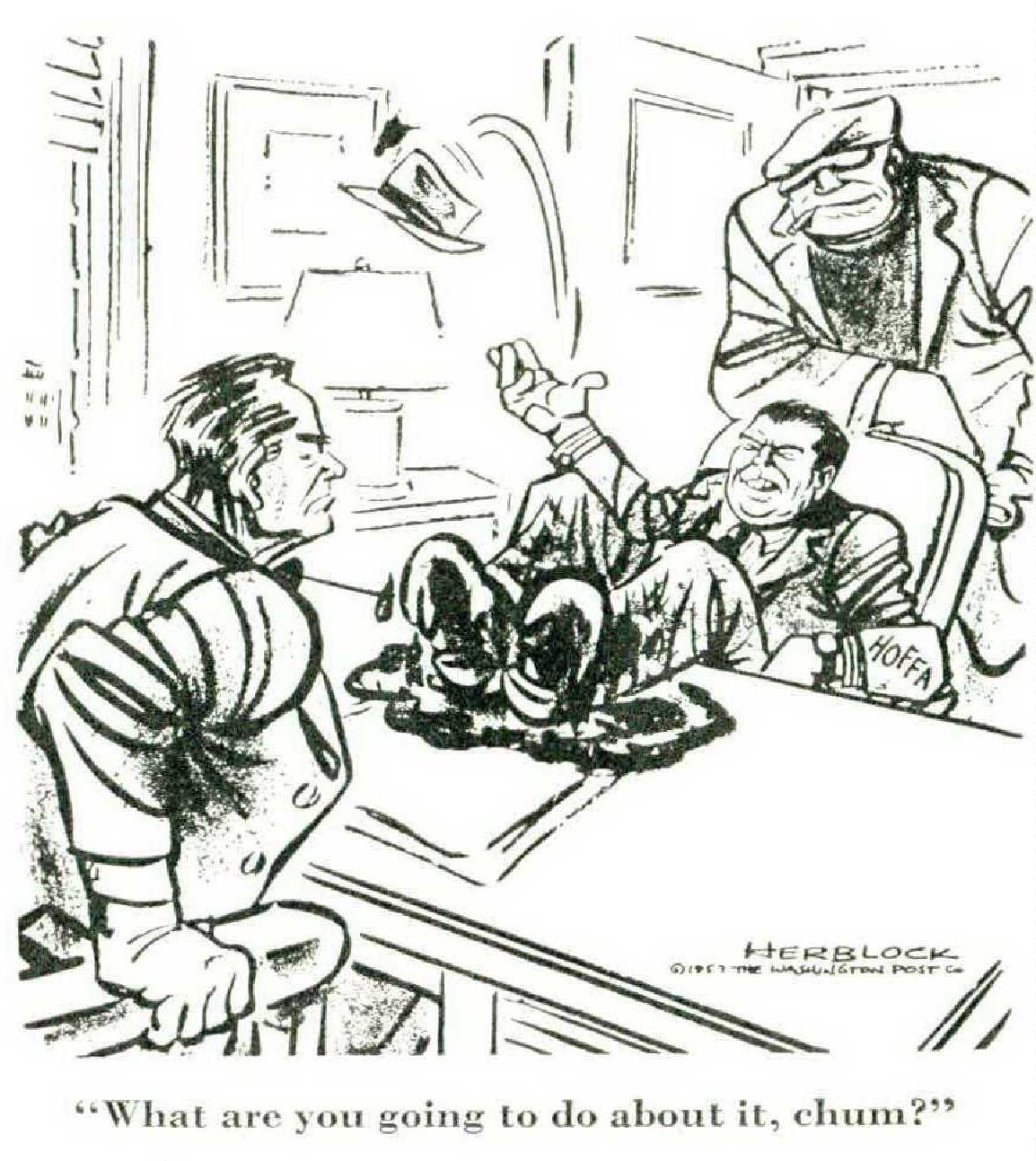
Hoffa had surprised the prosecution by testifying in his own defense. The glib little Detroit Teamster boss admitted he had paid money to Cheasty and received folders containing files of the McClellan committee. But Hoffa told the jury he merely hired Cheasty as a lawyer and not as a spy on the McClellan committee. There was no reason in the world why he would want to spy on the McClellan committee, Hoffa told the jury. He said he never misused union funds, and he denied that there were any rackets in his racketeer-infested Central States Teamsters. The jury believed Hoffa, or at least had reasonable doubt that he hired Cheasty as a spy.
Hoffa’s racketeers — the thugs, narcotics peddlers, dynamiters, and arsonists-burst into cheers. Tough little Jimmy Hoffa had licked that rich kid, Bob Kennedy. Hoffa had outwitted the FBI and the Justice Department. St. Louis Teamster boss Harold Gibbons arranged victory meetings and set up an apparatus to make Hoffa the general president of the International Teamsters.
Meanwhile, Kennedy shifted some of his top investigators to a study of Hoffa’s tangled personal finances. A McClellan committee office was established in the federal building in Detroit. When committee accountant Bellino pressed Hoffa for union books and financial records, the Detroit Teamster said menacingly to the accountant: “I’ve looked into you, Bellino. You’ve got seven kids, and you’re going to have to earn a living for a long time.”
In early August, McClellan and Kennedy ripped into the story of scandals in the Allied Industrial Workers Union (formerly the UAWAFL). The scandals involved the financial dealings of the union’s Secretary-Treasurer Anthony Doria, pal of Hoffa and of labor racketeer Johnny Dioguardi.
From there McClellan and Kennedy swung into the so-called paper locals set up by Hoffa and his friends in New York to grab control of the New York Joint Council of Teamsters. Again Hoffa’s men were in the spotlight: Dioguardi; Anthony (Tony “Ducks”) Corallo, convicted on a narcotics rap; John McNamara, a convicted extortionist; and John O’Rourke, now an International Teamster vice president who took the Fifth Amendment on questions involving union finances.
In one week before the television cameras, Kennedy had Hoffa reeling. He forced Hoffa into corners with evidence, including some telephone taps which were legally obtained by New York District Attorney Frank Hogan.
“To the best of my recollection, I cannot recall, and this does not refresh my memory as to this conversation,” Hoffa repeated relative to the telephone taps of conversations with Johnny Dioguardi.
Chairman McClellan and other committee members concluded that Hoffa was finished. McClellan adjourned the hearings, and the staff was turned loose to tie down the details of Hoffa’s farflung financial deals and the machinations of his hoodlum empire. But Hoffa came back. He did not give up his fight for the presidency of the Teamsters, and he vowed to fight the AFL-CIO if that organization should Carry out its threat to oust the Teamsters.
IN October, 1957, the McClellan-Kennedy team conducted hearings aimed largely at management corruption as practiced by Nathan W. Shefferman. Shefferman was a pal of Dave Beck. He sold his union-busting tactics and his influence with the Teamsters Union to employers from three major offices in Chicago, Detroit, and New York. in the Flint, Michigan, area the trail led to two of Hoffa’s men, Frank Kierdorf and Jack Thompson, two ex-convicts who had become Teamster officials under Hoffa. Kierdorf, a convicted armed robber, was later to become “the human torch” when his attempt at arson at a laundry backfired and left him in flames.
In November, McClellan and Kennedy opened hearings on the racketeer-Teamster group that had grabbed a near monopoly on the garbagecollecting industry in New York and Los Angeles. Again a central figure was one of Hoffa’s pals — Bernie Adelstein, a Long Island Teamster boss.
McClellan and Kennedy next exposed the fact that the Teamsters Union and the Barbers Union were involved in the Tennessee labor violence and misuse of union funds. The hearings that shook Tennessee politics included disclosure of a $20,000 pay-off in Teamster funds to a state judge for fixing a criminal case involving Glenn Smith, top Teamster leader in Tennessee. Investigators LaVern Duffy and James McShane broke a case that local officials had not been able to touch. The culprit, Glenn Smith, a twice-convicted burglar, was a Hoffa man. Again Republicans complained that too much time was being spent on the Teamsters Union and on violence and pay-offs. Explanations that the Teamsters had corrupted or controlled many other unions did not satisfy Senator Goldwater and Senator Mundt, who wanted hearings on the UAW and Reuther.
By the time McClellan and Kennedy had knocked over the multimillion-dollar scandals in the Operating Engineers, the Republicans were roaring for hearings on the UAW. With backing from McClellan, Kennedy paid no attention to the complaints and tied up the Operating Engineers. Operating Engineers President William E. Maloney and his top aides were linked to gangsters in Chicago, New York, New Jersey, and Philadelphia. It was proved that Maloney had stifled democracy by keeping one Chicago local union in trusteeship for twenty-nine years.
The magnitude of these scandals did not get Senator Goldwater to take his eye off what he considered the most important investigation — Reuther and the UAW.
When at last McClellan scheduled the UAW hearings on the Kohler and Perfect Circle strikes, Republicans opposed his plan on the order in which witnesses would be called. Reluctantly McClellan bowed to the demands in order to avoid criticism for having engaged in a “cover up” for Reuther. He let the Republicans call the shots, but when the hearings opened on February 26, 1958, he put the responsibility on their shoulders: “The proceedings that will be followed here are not the proceedings in keeping with the Chair’s views as to how this matter should be presented. I have yielded to this procedure out of what I conceive to be deference to a higher duty and responsibility. I believe the work of this committee . . . transcends all other consideration of any person, any individual, any party, anybody’s policy, or the political fortunes of any member of this committee.”
For more than a month after that, the McClellan committee was embroiled in bitterness. Partisan politics dominated the questioning. Kennedy questioned the witnesses only to bring out the basic facts, then faded into the background as the various senators quarreled with witnesses and put speeches into the record on their philosophy on unionism and government.
Chairman McClellan was quietly smoldering throughout those hearings. It pained him to see his hearings degenerating into a political brawl. When he injected himself into the hearings, he scolded both sides with equal vigor. There was Senate criticism of the conduct of the hearings, while editorials and cartoons stated that the McClellan committee was destroying itself.
“This is the only way,” McClellan commented privately. “We had no choice. We have got to have this hearing now, and I think that if we are careful we can keep it on the track.”
Senator Pat McNamara (Democrat, Michigan) declared that the McClellan committee had outlived its usefulness. He resigned from the committee, and there was no rush to fill the vacancy. It was finally necessary for the Democratic leadership to assign Senator Frank Church (Democrat, Idaho) to the vacancy.
The UAW hearings turned into such a sea of bitterness that all members and the staff were glad when they were concluded. The Teamsters were not. Hoffa’s boys had seen a chance that McClellan and Kennedy would be wrecked and that the searching reconstruction of Hoffa’s finances and his empire would never be exposed.
EVEN before the UAW hearings ended, on April 1, 1958, the McClellan-Kennedy team had plans to repair the damage and regain lost stature. They did so quickly. First they moved into hearings on the Hotel and Restaurant Workers Union and the Teamsters Union in Philadelphia. It was a case of black and white, and all members of the committee had to expose the clear corruption.
Likewise, in the hearings on Max Block and Louis Block and the scandals in the Butchers Union, McClellan could rally a unified committee against the forces of crime and corruption.
It was a smoothly operating committee again by the time hearings were staged on Maurice Hutcheson, president of the Carpenters Union and a power in national Republican politics. Hutcheson did not take the Fifth Amendment, but he simply refused to answer questions on alleged misuse of more than $500,000 in union funds.
The Bartenders and the Hotel and Restaurant Workers unions in Chicago presented no political problem. The committee was down to the job of fighting for testimony on the operations of a group of the old Capone mobsters, including Tony Accardo, who was shaking down hotels and restaurants through a union gimmick. But some witnesses were frightened and refused to talk. Others were threatened but talked anyway. Gunmen calmly walked into the restaurant owned by one key witness, held customers at gun point while they poured an inflammable liquid around, and then set the place afire.
A personal tragedy hit McClellan in late July, when James, the last of his three sons, was killed in an airplane crash. Crushed by the tragedy, McClellan appeared a broken man for several days. Then he set his jaw and told Kennedy that the best thing to do was to get back to work. Two weeks after his son’s death, McClellan was again at work on the biggest undertaking in his career. McClellan and Kennedy had no sure idea of how Hoffa and his racketeering friends would be eradicated from the labor movement. They were sorely disappointed when partisan politics killed the Kennedy-Ives labor reform bill.
They believe they have proof that Hoffa is the most corrupt labor official in America. “Five times as bad as Dave Beck,” Kennedy said. “He hires corrupt people, and he corrupts those who are not corrupt.”
Chairman McClellan summed up his committee’s aspirations when he said: “I don’t want to indict the teamsters who work and who are honest and decent Americans. We are trying to find out and point out where the rascality is, in hope that the Congress will have courage enough to enact some legislation to protect the working people of this country against such exploitation. I think the rank-and-file members ought to assert themselves to the very limit of their power and give the full strength of their support to any movement to clean this scum off of the labor movement.”
Many union lawyers were responsible for the continued success of the racketeer in union alliances in the Teamsters and other unions. These lawyers did more than merely defend union leaders who were in trouble. They drew huge retainers from union funds, while they helped corrupt union officials to prey upon the members. They modified union constitutions and manipulated union operations to crush democracy. They arranged huge fees for themselves from union welfare and pension funds. They dipped into union treasuries to finance personal business deals. They set up private businesses that dealt with the unions they advised. They pulled political strings in both parties to block local and federal investigations, and some even had knowledge of planned perjury, according to the evidence of the McClellan-Kennedy team.
City, county, state, and federal law enforcement authorities all share the blame for the past pattern of bipartisan political prostitution which allowed sordid labor rackets to develop. The Internal Revenue Service and the Labor Department are equally responsible. These departments were warned as early as 1953 that Hoffa authorized destruction of all union financial records every year, and there were volumes of other evidence on laxity in union finances that they could have consulted if they were interested.
Control of the labor rackets takes the enactment of new laws, but it also takes more aggressiveness in enforcing existing state and federal laws. The McClellan-Kennedy team has pointed the way. Now it is up to the press and the public.
To beat the gangsters’ defiance of our government, this is what is needed:
1. The McClellan committee must be continued for another year to complete pending investigations and dramatically focus attention on the need for legislation.
2. Local newspapers and other news media must follow through and insist that law-enforcement officials on municipal, county, and state levels pursue the leaders of union corruption and jail law violators.
3. Bar associations should initiate action to disbar those lawyers who operate as conspirators with corrupt union officials in covering up theft of union money, fixing of union elections, and general obstruction of justice.
4. Voters should oppose mayors, judges, prosecutors, governors, or federal officials who have received large sums of money or campaign contributions from corrupt union sources.
5. Voters should write their senators and congressmen periodically during the investigations, making clear that they approve exposure of racketeers and will condemn officeholders who fail to take aggressive action for antiracket legislation.
Why has the labor movement developed into an autocracy instead of in the pattern of democracy in which it was founded, and what prospect is there that management will regain the full cooperation of the leaders and of the rank and file? These questions, vital to our economy, will be discussed by Sumner H. Slichter in the December ATLANTIC.