The Evolution of Ethics
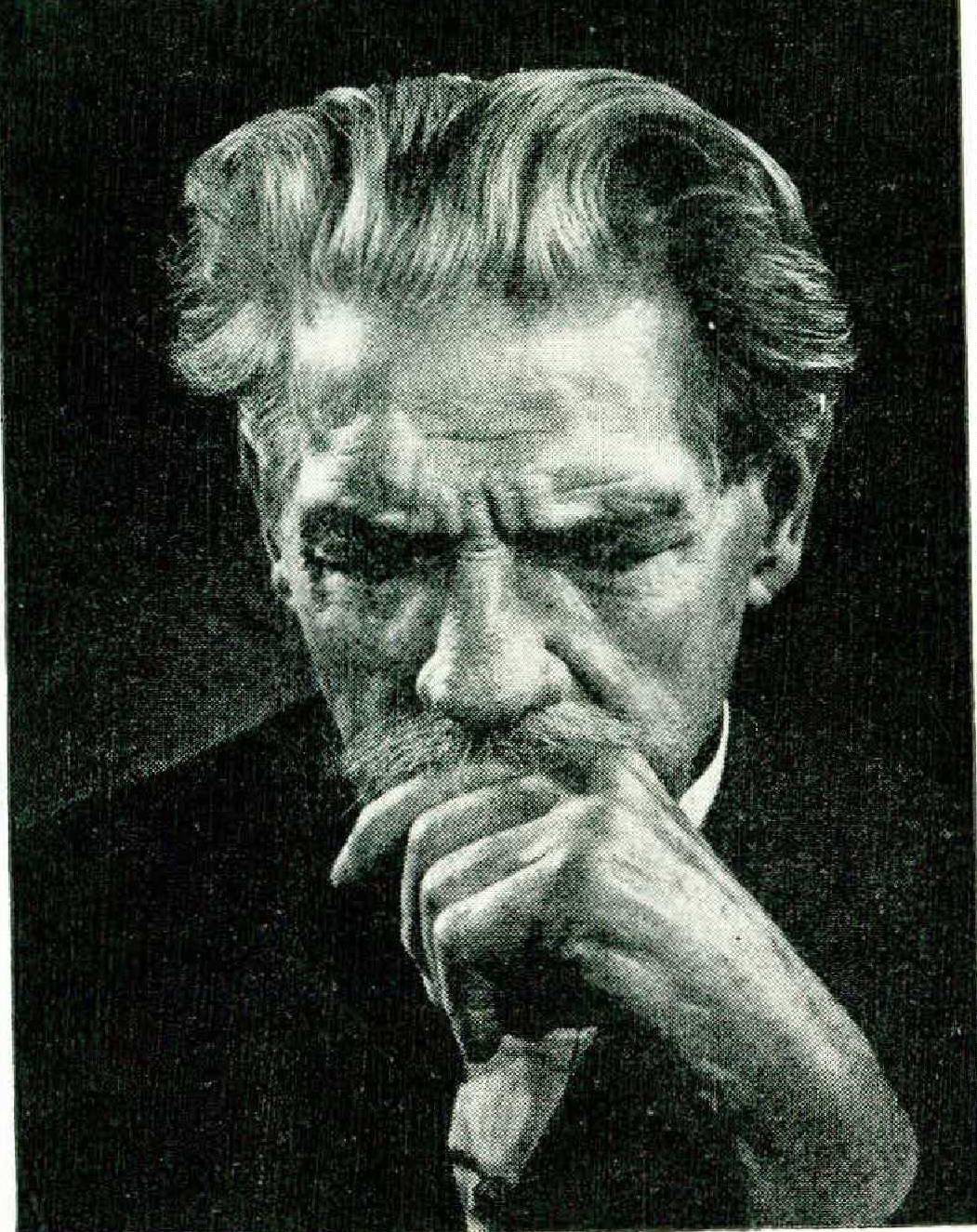
ALBERT SCHWEITZER read the essay which follows before the French Academy of Moral and Political Science, and subsequently presented the manuscript to Mrs. Carleton Smith, who did the translation. He wrote her: “This is very important to me, as it expresses the dominating idea in my thinking.”Doctor Schweitzer, who continues to devote himself to the hospital at Lambaréné, has many personal lies with America, including his service as adviser of the National Arts Foundation.
ALBERT SCHWEITZER
IN A very general sense, ethics is the name give to our concern for good behavior. We feel an obligation to consider not only our own personal well-being but also that of others and of human society as a whole, and it is in the extension of this notion of solidarity with others that the first evolution of ethics is to be seen.
For the primitive man the circle of solidarity is limited to those whom he can look upon as his blood relatives — that is to say, the members of his tribe, who are to him his family. I am speaking from experience. In my hospital I have primitives. When I happen to ask a hospitalized tribesman, who is not himself bedridden, to render little services to a bedridden patient, he will consent only if the latter belongs to his tribe. If not, he will answer me candidly: “This, no brother for me,”and neither attempts to persuade him nor threats will make him do this favor for a stranger.
However, as man starts reflecting upon himself and his behavior toward others, he gradually realizes that all men are his brothers and neighbors. Slowly he reaches a point where he sees the circle of his responsibilities enlarged to comprise all human beings with whom he is in contact.
In the history of man, this idea of responsibility toward others has been wholly or partially formulated in various cultures at various times. It was reached by the Chinese thinkers: Lao-tse, born in 604 B.C.; Kung Fu-tse (Confucius), 551479 b.c.; Meng-tse, 372-289 B.C.; Tchouangtse, fourth century B.C. It was also proclaimed by the Israelite prophets of the eighth century B.C.: Amos, Hosea, and Isaiah. As proclaimed by Jesus and Saint Paul, the idea that man obligates himself to all human beings became an integral part of the Christian system of ethics.
For the great thinkers of India, too, whether they belonged to Brahmanism, Buddhism, or Hinduism, the idea of the brotherhood of man was included in their metaphysical notion of existence, but they had difficulty giving it the proper importance in their ethics because they could not abolish the barriers erected between men in India by the different castes sanctioned by tradition.
Zarathustra, who lived in about the seventh century B.C:., was also prevented from reaching the notion of the full brotherhood of man because he had to differentiate between those who believed in Ormuzd, the god of Light and Good, and the nonbelievers who remained in the power of devils. This forced the believers to fight for the coming of the reign of Ormuzd and to consider the nonbelievers as enemies and treat them as such. To understand this, one must remember that the believers were Bactrian tribes who had become sedentary and aspired to live as honest and peaceful families, while the nonbelievers were nomadic tribes who dwelt in the desert and lived from pillage.
Plato and Aristotle and the other thinkers of the classic period of Greek philosophy limited their consideration to the Greek freeman, who did not have to earn his subsistence. All those who did not belong to this aristocracy were dismissed as men of inferior quality in whom there was no need to be concerned.
It was not until the second epoch of Greek thought, when the simultaneous blossoming of Stoicism and Epicureanism occurred, that the idea of the equality of men and of the sympathy which attaches us to all human beings was recognized by these two schools. The most remarkable protagonist of this new conception was the Stoic Panaetius, who lived in the second century B.C. He was the prophet of humanism, and even though the idea of the brotherhood of man never became popular in antiquity, the very fact that philosophy had proclaimed it as a concept dictated by reason was of great importance for its future.
However, this concept has never enjoyed the full authority which it deserves. Down to our time, it has ceaselessly been compromised by the stressing of differences—differences of race, of religious beliefs, and of nationalities —which turn our fellow man into a stranger to whom we owe nothing but indifference, if not contempt.
AS WE trace the evolution of ethics, we are aware of the influence exerted by the various concepts of the material world. There are the affirmative concepts which insist that interest must be taken in material matters and in the existence we lead on this earth. Others, on the contrary, advocate a negative attitude, urging that we detach ourselves from whatever has to do with the world, including our own existence on earth. Affirmation conforms with our natural feeling. Negation contradicts it. Affirmation invites us to be at home in this world and to throw ourselves voluntarily into action; negation requires that we live in the world as strangers and that we choose a passive role. By its very nature, ethics is affiliated with affirmation. One must be active if one is to serve the ideal of Good. An affirmative concept of the world produces a favorable climate for the development of ethics, while negation, on the contrary, hampers it. Negation of the world was professed by the thinkers of India and by the Christians of antiquity and of the Middle Ages; affirmation by the Chinese thinkers, the Israelite prophets, Zarathustra, and the European thinkers of the Renaissance and of the modern day.
In the thinkers of India, this negative concept of the world was the result of their conviction that true existence is immaterial, immutable, and external and that the worldly existence is fictitious, deceitful, and transient. The world that we consider as real was for them but a mirage of the immaterial world in time and space. By taking interest in this phantasmagoria and in the part he plays in it, they argued, man made a mistake. The only behavior compatible with the true knowledge of the nature of existence is nonactivity.
To a degree, nonactivity does have ethical characteristics. By detaching himself from worldly matters, man renounces the egotism that material interests and mere covetousness arouse in him. Furthermore, an essential aspect of nonactivity is nonviolence.
The thinkers of Brahmanism, of Samkhya, of Jainism, as well as of Buddhism, exalt nonviolence, which they call ahimsa; indeed, they consider it as the sublime principle. However, it is imperfect and incomplete because it concedes to man the egotism to be preoccupied entirely with his salvation. It does not command him in the name of compassion but in the name of metaphysical theories. It demands merely abstention from evil, rather than the positive activity inspired by the notion of Good.
Only a system of ethics affiliated with the affirmation of the world can be natural and complete. Buddha, who rises against the cold Brahmanic doctrine by preaching pity, cannot completely resist the temptation to forgo the principle of nonactivity. He gives in, more than once, unable to keep himself from accomplishing acts of charity or from recommending them to his disciples. Under the cover of ethics the affirmation of the World carries on, in India, a persistent struggle against the principle of nonactivity. In Hinduism, which is a religious movement against the exigencies of Brahmanism, affirmation is recognized as the equal of nonactivity. The reconciliation of the two is set forth in the Bhagavad Gita.
Man can believe that he is authorized to take part in the material world only as a spectator. But likewise he has the right to believe that he is called to play an active part. Activity, then, is justified by the spirit which guides it. The man who practices it with the intention of accomplishing the will of God is as right as he who raises the question of nonactivity. Nowadays, the thinkers of India make great concessions to the principle of activity, claiming that it is found in the Upanishads. This is true. The explanation is that the Aryans of India in ancient times, as we learn it from the Veda, had an existence penetrated with naïve joie de vivre. The Brahmanic doctrine of negation of the world appears side by side with the concept of affirmation only in the Upanishads, the sacred texts of the first thousand years B.C.
Christianity in early times and in the Middle Ages professed negation of the world without, however, reaching the extremes of nonactivity. Its denial of the world was of a different nature from that of the thinkers of India: to the early Christians the world was not a phantasmagoria, it was an imperfect world destined to be transformed into the perfect world of the kingdom of God. The idea of the kingdom of God was created by the Israelite prophets of the eighth century B.C.
In announcing the imminence of the transformation of the material world into the kingdom of God, Jesus exhorted men to seek the perfection required for participation in the new world. He asked man to detach himself from this world, the better to be preoccupied by the practice of Good. He allowed man to detach himself from material things, but not from his duties toward other men. In Jesus’ ethics, activity kept all its rights and all its obligations. This is where Christianity differs from Buddha’s religion, with which it shares the idea of compassion. Because it is animated by the spirit of activity, Christian ethics has a certain affinity with the affirmation of the world.
The transformation of the world into the kingdom of God was what the early Christians were looking for immediately, but it never occurred. During antiquity and the Middle Ages, Christianity remained in a situation of having to lose hope in this world, without the compensating hope, which had sustained the early Christians, of seeing the new world at hand. In the Middle Ages there was no enthusiastic affirmation of the world; actually this did not take place until the Renaissance. Christianity identified itself with this new enthusiastic affirmation of the world during the sixteenth and seventeenth centuries. Renaissance ethics — apart from the ideal of perfecting oneself, which came from Jesus — attempted subsequently to create new and better material and spiritual conditions for the existence of human society. From then on, Christian ethics found a goal for its activity and so reached its full bloom. From the union of the Christian and the Renaissance enthusiasm for the world is born the civilization in which we live and which we have to maintain and improve.
In the first century of the Christian era, thinkers of Stoicism — Seneca, Epictetus, and the emperor Marcus Aurelius — following the steps of Panaetius, the creator of the idea of humanism, came to consider Love as the virtue of virtues. Their system of ethics is about the same as that of the great Chinese thinkers. They have in common not only the principle of Love, but also the conviction that it proceeds from reason and is thoroughly reasonable.
During the first and second centuries of the Christian era, the Greco-Roman philosophy seemed to profess the same ethical ideal as that of Christianity. The possibility of agreement between the ancient and Christian worlds existed, but it did not happen. Ethical Stoicism did not become popular. Moreover, it accused Christianity of being a superstition because Christianity claimed that a divine revelation had taken place in Jesus Christ, and was awaiting the miraculous coming of a new world. Christianity, on the other hand, scorned philosophy as a guiding wisdom for this world. What separated Christianity and Stoicism was the fact that the Greco-Roman philosophy adhered to the idea of the affirmation of the world, whereas Christianity adhered to the idea of its negation. No agreement was possible.
Agreement did occur, but only after centuries. When Christianity became more familiar with the enthusiastic affirmation of the world, which the Renaissance had bequeathed to European thought, it at the same time became acquainted with ethical Stoicism and noted with surprise that Jesus’ principle of Love had also been stated as a rational truth. Thus it was deduced that the fundamental ideas of religion were revealed truths, confirmed afterwards by reason. Among the thinkers who felt that they belonged to both Christianity and Stoicism were Erasmus and Hugo Grotius.
Under the influence of Christianity, philosophy’s ethics acquired an enthusiasm that it had not possessed earlier. Under the influence of philosophy, Christian ethics, on the other hand, started reflecting upon what it owed itself and upon what it should accomplish in this world. Thus was born a spirit which did not allow the ethics of Love any longer to tolerate injustice, cruelties, and superstitions. Torture was abolished, the scourge of the witchcraft trials ceased. Inhuman laws gave way to others more human. A reform without precedent in the previous history of humanity had begun and was accomplished in the first enthusiasm of the discovery that the principle of Love is also taught by reason.
To DEMONSTRATE the rationality of altruism, philosophers of the eighteenth century, among whom are Hartley, Baron Holbach, Helvetius, and Bentham, thought that it was enough to show that love of others had a utility value. The Chinese thinkers and the representatives of ethical Stoicism admitted the utility value, but also insisted on other values. According to the eighteenth-century thinkers, altruism would be a well-understood egotism, taking into account the fact that the wellbeing of the individual and of society can be guaranteed only by the self-sacrifice which men make for their fellow men.
Kant and David Hume refuted this superficial thesis. Kant, in order to defend the dignity of ethics, went so far as to pretend that its utility ought not to be taken into consideration. Obvious as it is, it must not be admitted as a motive of ethics. Ethics, according to the doctrine of the categorical imperative, rules absolutely. It is our conscience which reveals to us what is Good and what is evil. We have but to obey the moral law that we carry within ourselves to gain the certitude that we not only belong to the world as it appears to us in time and space, but that we are at the same time citizens of the spiritual world.
Hume, in order to refute the utilitarian thesis, proceeded in an empirical way. He analyzed the motives of ethics and came to the conclusion that ethics is primarily a matter of feeling. Nature, he argued, endowed us with the faculty of sympathy, which permits and obliges us to feel the joy, apprehensions, and sufferings of others as if they were our own. We are, after an image employed by Hume, like strings vibrating in unison with others.
It is this sympathy which leads us to devotion toward others and to the desire to contribute to their well-being and to the well-being of society.
After Hume, philosophy — if we set aside the enterprise of Nietzsche-did not dare seriously to doubt the fact that ethics is primarily a matter of compassion.
But, if this is the case, is ethics capable of defining and setting a limit to the obligations of selfsacrifice, and thereby placing egoism and altruism in accord, as was attempted by the utilitarian theories?
Hume is not much preoccupied by this question. The philosophers who followed him likewise did not think it necessary to take into consideration the consequences of the principle of self-sacrifice through compassion. It is as if they had the presentiment that these consequences might prove to be a little disturbing.
They arc indeed. The ethic of self-sacrifice by compassion no longer has the characteristic of a law. It no longer comprises any dearly established and clearly formulated commandments. It is thoroughly subjective, because it leaves to each one the responsibility of deciding how much he will sacrifice himself.
And not only does it cease to give precise commandments: it is no longer satisfied, as the law must be, by the limitations of the possible. It constantly forces us to attempt the impossible, to carry devotion to others so far as to endanger our own existence. In the horrible times we have lived through, there were many of these perilous situations and many persons who sacrificed themselves for others. Even in daily life, the ethic of selfsacrifice asks from each of us that we abdicate selfish interests and renounce advantages for the sake of others. Alas, we too often succeed in silencing our conscience, the guardian of our feeling of responsibility.
How many are the struggles in which the ethic of self-sacrifice abandons us to ourselves! It is seldom that the heads of firms give a job, through compassion, to the man who needs it most, rather than to the man who is most qualified. But evil unto them who think themselves authorized, by such experiences, never to take into account the principle of compassion.
A FINAL consequence is to be drawn from the principle of self-sacrifice: it does not allow us to be preoccupied only by human beings, but obliges us to have the same behavior toward all living beings whose fate may be influenced by us. They also are our fellows, for they, too, aspire to happiness. They know fear and suffering, and they dread annihilation.
The man who has kept intact his sensibility finds it quite natural to have pity on all living beings. Why does not philosophy at long last recognize that our behavior toward all life should be an integral part of the ethics which it teaches?
The reason is very simple. Philosophy fears, and rightly so, that this huge enlargement of the circle of our responsibilities will take away from ethics the small hope which it still has to formulate reasonable and satisfactory commandments.
In fact, if we are preoccupied by the fate of all living beings with whom we come in contact, we face conflicts more numerous and more disturbing than those of devotion toward human beings. We are constantly in situations which compel us to harm other creatures or affect their lives. The farmer cannot let all his animals survive. He can keep only those he can feed and the breeding of which assures him necessary income. In many instances, there is the obligation of sacrificing some lives to save others. Whoever shelters a crippled bird finds it necessary to kill insects to feed him. In so doing, he makes an arbitrary decision. By what right does he sacrifice a multitude of lives in order to save a single life? He must also make an arbitrary choice when he exterminates animals which he thinks are harmful, in order to protect others.
It is then incumbent upon each of us to judge whether we must harm or kill, and thus become, by necessity, guilty. We should seek forgiveness by never missing an occasion to rescue living creatures.
What an advance it would be if men started to reflect upon the kindness due all creatures and refrained from harming them by carelessness! We must intensify the struggle against inhuman traditions and feelings remaining in our time if our civilization is to keep any respect for itself. Among inhuman customs which our civilization should no longer tolerate, I must name two: bullfights with their inevitable death, and hunting for sport.
It is finally the exigency of compassion with all beings which makes ethics as complete as it should be.
There is another great change in the evolution of ethics: today it cannot expect help from a concept of the world which justifies what it teaches.
In the past, ethics seemed convinced that it was only requiring a behavior in harmony with the knowledge of the true nature of the world. On this conviction are based not only the religions, but also the rationalist philosophy of the seventeenth and eighteenth centuries.
But it happens that the concept of the world that ethics called upon was the result of the optimistic interpretation of this very world which ethics gave and is still giving. It loaned to the universal will qualities and intentions which gave satisfaction to its own way of feeling and judging.
But in the course of the nineteenth century, research which seeks only objective truth was obliged to face the evidence that ethics had nothing to expect from an ever-closer knowledge of the world. The progress of science consisted in a more precise ascertainment of the processes of nature. It allowed us to use the energies of the universe. But, at the same time, it obliged us to renounce an understanding of the intentions of the universe. The world offers us the disconcerting spectacle of the will to live in conflict with itself. One life maintains itself at the cost of another. The world is horror within magnificence, absurdity within intelligibility, suffering within joy.
How can the ethic of Self-sacrifice maintain itself without being justified by an adequate concept of the world? It seems doomed to sink into skepticism. This, however, will not be its fate.
In the beginning, ethics needed to call upon a concept of the world which gave it satisfaction. Having reached the knowledge that the fundamental principle is devotion to others, it becomes fully aware of itself, and thereby self-sufficient.
We are now able to understand its origins and its foundation by meditating upon the world and upon ourselves. We lack a complete and satisfactory knowledge of the world. We are reduced to merely ascertaining that everything in it is living, as we ourselves are, and that all life is a mystery. Our true knowledge of the world consists in being penetrated by the mystery of existence and of life. This mystery becomes ever more mysterious by the progress of scientific research. To be penetrated by the mystery of life corresponds to what is called in the language of the mystic “learned ignorance.”
The fundamental idea in our conscience, to which we come back each time we want to reach comprehension of ourselves and of our situation in the world, is: I am life wanting to live, surrounded by life wanting to live. Meditating upon life, I feel the obligation to respect any will-to-live around me as equal to mine and as having a mysterious value.
A fundamental idea of Good then consists in preserving life, in favoring it, in wanting to raise it to its highest value, and evil consists in annihilating life, injuring it, and impeding its growth.
The principle of this veneration of life corresponds to the one of Love, which has been discovered by religion and philosophy seeking an understanding of the fundamental notion of Good.
The term Reverence for Life is larger and at the same time dimmer than the term Love. But it bears within itself the same potentialities. The essentially philosophical notion of Good has the advantage of being more complete than the notion of Love. Love comprises only our obligations toward other beings, but not toward ourselves. It is, for instance, impossible to deduce from it the notion of veracity, the primary quality of the ethical personality in addition to the one of Love. The respect which man owes to his own life obliges him to be faithful to himself by renouncing any self-deceit and by becoming himself in the noblest and deepest way.
By having reverence for life, we enter into a spiritual relation with the world. The absolute is so abstract that we can have no communion with it. It is not given to us to serve the creative will, infinite and unfathomable, by comprehending its nature and its intentions. But we come into spiritual contact with it by the feeling of the mystery of life and by devoting ourselves to all the living beings whom we are able to serve.
The ethics which obliges us to be concerned only with men and with society cannot have this same significance. Only a universal ethics which obliges us to be occupied with all beings puts us in a complete relation with the universe and the will manifested in it.
In the world, the will to live is in conflict with itself. In us it wants, by a mystery that we do not understand, to be at peace with itself. In the world it manifests itself; in us it reveals itself. To be other than the world is our spiritual destiny. By conforming to it we live our existence instead of submitting to it. By practicing reverence for life we become good, deep, and alive.