The Age of Rutherford
Ernest Rutherford, the famous nuclear physicist, was one of the brightest luminaries at Cambridge University when C. P. SNOWwas doing his graduate work there. He came within the radiance of the great man, and there were sparks on both sides from their early encounters. In mid-career Snow, now Sir Charles, turned away from science to embark on the novels which hare since made him famous.
IN 1923, at the meeting of the British Association for the Advancement of Science in Liverpool, Lord Rutherford announced, at the top of his enormous voice: “We are living in the heroic age of physics.” He went on saying the same thing, loudly and exuberantly, until he died, fourteen years later.
The curious thing was, all he said was absolutely true. There had never been such a time. The year 1932 was the most spectacular year in the history of science. Living in Cambridge, one could not help picking up the human, as well as the intellectual, excitement in the air. Sir James Chadwick, gray-faced after a fortnight of work with three hours’ sleep a night, telling the Kapitza Club how he had discovered the neutron; P. M. S. Blackett, the most handsome of men, not quite so authoritative as usual, because it seemed too good to be true, showing plates which demonstrated the existence of the positive electron; Sir John Cockcroft, normally about as given to emotional display as the Duke of Wellington, skimming down King’s Parade and saying to anyone whose face he recognized: “We’ve split the atom! We’ve split the atom!”
It meant an intellectual climate different in kind from anything else in England at the time. The tone of science was the tone of Rutherford: magniloquently boastful — boastful because the major discoveries were being made — creatively confident, generous, argumentative, lavish, and full of hope. The tone differed from the tone of literary England as much as Rutherford’s personality differed from that of T. S. Eliot or F. R. Leavis. During the twenties and thirties, Cambridge was the metropolis of physics for the entire world. Even in the late nineteenth century, during the professorships of Clerk Maxwell and J. J. Thomson, it had never quite been that. “You’re always at the crest of the wave,” someone said to Rutherford. “Well, after all, I made the wave, didn’t I?” Rutherford replied.
I remember seeing him a good many times before I first spoke to him. I was working on the periphery of physics at the time, and so didn’t come directly under him. I already knew that I wanted to write novels, and that that was how I should finish, and this gave me a kind of ambivalent attitude to the scientific world; but, even so, I could not avoid feeling some sort of excitement, or enhancement of interest, whenever I saw Rutherford walking down Free School Lane.
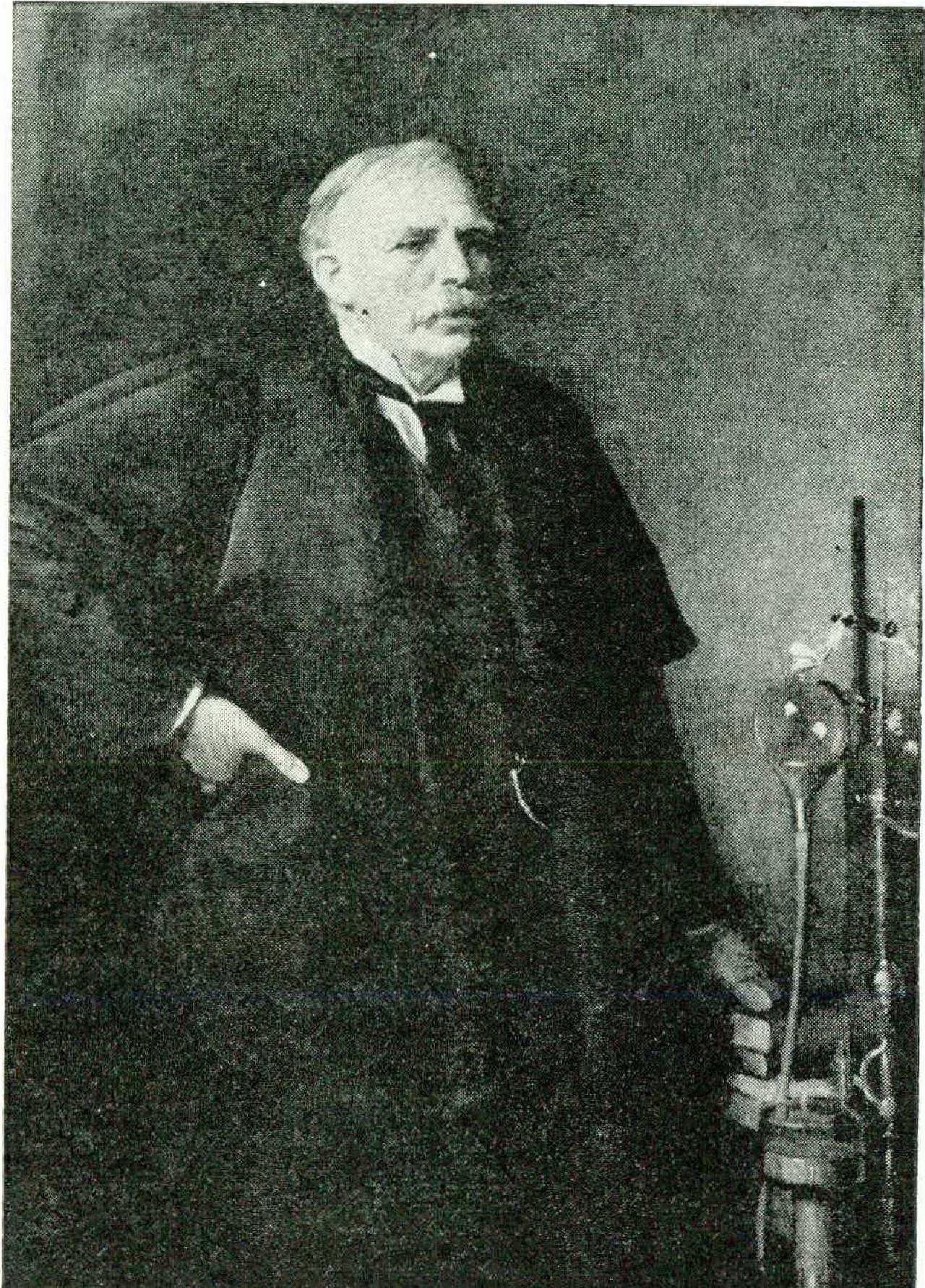
He was a big, rather clumsy man, with a substantial bay window that started in the middle of the chest. I should guess that he was less muscular than at first sight he looked. He had large staring blue eyes and a damp and pendulous lower lip. He didn’t look in the least like an intellectual. Creative people of his abundant kind never do, of course, but all the talk of Rutherford looking like a farmer was unperceptive nonsense. His was really the kind of face and physique that often goes with great weight of character and gifts. It could easily have been the soma of a great writer. As he talked to his companions in the street, his voice was three times as loud as any of theirs, and his accent was bizarre. In fact, he came from the very poor: his father was an odd-job man in New Zealand and the son of a Scottish emigrant. But there was nothing Antipodean or Scottish about Rutherford’s accent; it sounded more like a mixture of West Country and Cockney.
In my first actual meeting with him, perhaps I could be excused for not observing with precision. It was early in 1930; I had not yet been elected a Fellow of my own college, and so had put in for the Stokes studentship at Pembroke. One Saturday afternoon I was summoned to an interview. When I arrived at Pembroke, I found that the short list was only two, Philip Dec and I. Dee was called in first; as he was being interviewed, I was reflecting without pleasure that he was one of the brightest of Rutherford’s young men.
Then came my turn. As I went in, the first person I saw, sitting on the right hand of the Master, was Rutherford himself. While the Master was taking me through my career, Rutherford drew at his pipe, not displaying any excessive interest in the proceedings. The Master came to the end of his questions, and said: “Professor Rutherford?”
Rutherford took out his pipe and turned onto me an eye which was blue, cold, and bored. He was the most spontaneous of men; when he felt bored, he showed it. That afternoon he felt distinctly bored. Wasn’t his man, and a very good man, in for this job? What was this other fellow doing there? Why were we all wasting our time?
He asked me one or two indifferent questions, in an irritated, impatient voice. What was my present piece of work? What could spectroscopy tell us anyway? Wasn’t it just “putting things into boxes”?
I thought that was a bit rough. Perhaps I realized that I had nothing to lose. Anyway, as cheerfully as I could manage, I asked if he couldn’t put up with a few of us not doing nuclear physics. I went on, putting a case for my kind of subject.
A note was brought round to my lodgings that evening. Dee had got the job. The electors wished to say that either candidate could properly have been elected. That sounded like a bit of politeness, and I felt depressed. I cheered up a day or two later when I heard that Rutherford was trumpeting that I was a young man of spirit. Within a few months he backed me for another studentship. Incidentally, Dee was a far better scientist than I was or could have been, and neither Rutherford nor anyone else had been unjust.
FROM that time until he died, I had some opportunities of watching Rutherford at close quarters. Several of my friends knew him intimately, which I never did. It is a great pity that Tizard has not written about him at length. But I belonged to a dining club which he attended, and I think I had serious conversations with him three times, the two of us alone together.
The difficulty is to separate the inner man from the Rutherfordiana, much of which is quite genuine. From behind a screen in a Cambridge tailor’s, a friend and I heard a reverberating voice: “That shirt’s too tight round the neck. Every day I grow in girth. And in mentality.”Yet his physical make-up was more nervous than it seemed. In the same way, his temperament, which seemed exuberantly, powerfully, massively simple, rejoicing with childish satisfaction in creation and fame, was not quite so simple as all that. His was a personality of Johnsonian scale. As with Johnson, the façade was overbearing and unbroken. But there were fissures within.
No one could have enjoyed himself more, either in creative work or the honors it brought him. He worked hard, but with immense gusto; he got pleasure not only from the high moments, but also from the hours of what to others would be drudgery, sitting in the dark counting the alpha particle scintillations on the screen. His insight was direct, his intuition, with one curious exception, infallible. No scientist has made less mistakes. In the corpus of his published work, one of the largest in scientific history, there was nothing he had to correct afterwards. By thirty, he had already set going the science of nuclear physics singlehanded, as a professor on five hundred pounds a year, in the isolation of late-Victorian Montreal. By forty, now in Manchester, he had found the structure of the atom on which all modern nuclear physics depends.
It was not done without noise; it was done with anger and storms — but also with an overflow of creative energy, with abundance and generosity, as though research were the easiest and most natural avocation in the world. He had deep sympathy with the creative arts, particularly literature; he read more novels than most literary people manage to do. He had no use for critics of any kind. he felt both suspicion and dislike of the people who invested scientific research or any other branch of creation with an aura of difficulty, who used long, methodological words to explain things which he did perfectly by instinct. “Those fellows,” he used to call them. “Those fellows” were the logicians, the critics, the metaphysicians. They were clever; they were usually more lucid than he was; in argument against them he often felt at a disadvantage. Yet somehow they never produced a serious piece of work, whereas he was the greatest experimental scientist of the age.
I have heard greater claims made for him. I remember one discussion in particular, a few years after his death, by half a dozen men, all of whom had international reputations in science. Was Rutherford the greatest experimental scientist since Michael Faraday? Without any doubt. Greater than Faraday? Almost certainly so. And then — it is interesting, as it shows the anonymous Tolstoyan nature of organized science — how many years difference would it have made if he had never lived? How much longer before the nucleus would have been understood as we now understand it? Perhaps ten years. More likely only five.
Rutherford’s intellect was so strong that he would, in the long run, have accepted that judgment. But he would not have liked it. His estimate of his own powers was realistic, but if it erred at all, it did not err on the modest side. “There is no room for this particle in the atom as designed by me,” I once heard him assure a large audience. It was part of his nature that, stupendous as his work was, he should consider it 10 per cent more so. It was also part of his nature that, quite without acting, he should behave constantly as though he were 10 per cent larger than life. Worldly success? He loved every minute of it: flattery, titles, the company of the high official world. He said in a speech: “As I was standing in the drawing room at Trinity, a clergyman came in. And I said to him: I’m Lord Rutherford.’ And he said to me: I’m the Archbishop of York.’ And I don’t suppose either of us believed the other.”
He was a great man, a very great man, by any standards which we can apply. He was clever as well as creatively gifted, magnanimous (within the human limits) as well as hearty. He was also superbly and magnificently vain as well as wise — the combination is commoner than we think when we are young. He enjoyed a life of miraculous success. On the whole he enjoyed his own personality. But I am sure that, even quite late in his life, he felt stabs of a sickening insecurity.
Somewhere at the roots of that abundant and creative nature there was a painful, shrinking nerve. One has only to read his letters as a young man to discern it. There are passages of selfdoubt which are not to be explained completely by a humble colonial childhood and youth. He was uncertain in secret, abnormally so for a young man of his gifts. He kept the secret as his personality flowered and hid it. But there was a mysterious diffidence behind it all. He hated the faintest suspicion of being patronized, even when he was a world figure. Archbishop Lang was once tactless enough to suggest that he supposed a famous scientist had no time for reading. Rutherford immediately felt that he was being regarded as an ignorant roughneck. He produced a formidable list of his last month’s reading. Then, half innocently, half malevolently: “And what do you manage to read, your Grice?” “I am afraid,” said the Archbishop, somewhat out of his depth, “that a man in my position really doesn’t have the leisure . . .” “Ah, yes, your Grice,” said Rutherford in triumph, “it must be a dog’s life! It must be a dog’s life!”
Once I had an opportunity of seeing that diffidence face to face. In the autumn of 1934 I published my first novel, which was called The Search and the background of which was the scientific world. Not long after it came out, Rutherford met me in King’s Parade. “What have you been doing to us, young man?” he asked vociferously. I began to describe the novel, but it was not necessary; he announced that he had read it with care. He went on to invite, or rather command, me to take a stroll with him round the Backs. Like most of my scientific friends, he was goodnatured about the book, which has some descriptions of the scientific experience which are probably somewhere near the truth. He praised it. I was gratified. It was a sunny October afternoon. Suddenly he said: “I didn’t like the erotic bits. I suppose it’s because we belong to different generations.”
The book, I thought, was reticent enough. I did not know how to reply.
In complete seriousness and simplicity, he made another suggestion. He hoped that I was not going to write all my novels about scientists. I assured him that I was not — certainly not another for a long time.
He nodded.He wa looking gentler than usual, and thoughtful. “It’s a small world, you know,”he said. He meant the world of science. “Keep off us as much as you can. People are bound to think that you are getting at some of us. And I suppose we’ve all got things that we don’t want anyone to see.”
I MENTIONED that his intuitive foresight went wrong just once. As a rule, he was dead right about the practical applications of science just as much as about the nucleus. But his single boss shot sounds ironic now. In 1933 he said, in another address to the British Association, “These transformations of the atom are of extraordinary interest to scientists, but we cannot control atomic energy to an extent which would be of any value commercially, and I believe we are not likely ever to be able to do so. A lot of nonsense has been talked about transmutations. Our interest in the matter is purely scientific.”
That statement, which was made only nine years before the first pile worked, was not intended to be either optimistic or pessimistic. It was just a forecast, and it was wrong.
That judgment apart, people outside the scientific world often felt that Rutherford and his kind were optimistic — optimistic right against the current of the twentieth-century literary-intellectual mood, offensively and brazenly optimistic. This feeling was not quite unjustified, but the difference between the scientists and the nonscientists was subtler than that. When the scientists talked of the individual human condition, they did not find it any more hopeful than the rest of us. Does anyone really imagine that Bertrand Russell, G. H. Hardy, Rutherford, Blackett, and the rest were bemused by cheerfulness as they faced their own individual state? Very few of them had any of the consolations of religion: they believed, with the same certainty that they believed in Rutherford’s atom, that they were going, after the loneliness of this mortal life, into annihilation. Intellectually they had an unqualified comprehension, without any cushions at all, of the tragic condition of individual man.
Nevertheless it is true that, of the kinds of people I have lived among, the scientists were much the happiest. Somehow scientists were buoyant at a time when other intellectuals could not keep away despair. The reasons for this are complex. Partly, the nature of scientific activity, its complete success on its own terms, is itself a source of happiness; partly, people who are drawn to scientific activity tend to be happier in temperament than other clever men. By the nature of their vocation and also by the nature of their own temperament, the scientists did not think constantly of the individual human predicament. Since they could not alter it, they let it alone. When they thought about people, they thought most of what could be altered, not what couldn’t. So they gave their minds not to the individual condition but to the social one.
There, science itself was the greatest single force for change. The scientists were themselves part of the deepest revolution in human affairs since the discovery of agriculture. They could accept what was happening, while other intellectuals shrank away. They not only accepted it, they rejoiced in it. It was difficult to find a scientist who did not believe that the scientific-technical-industrial revolution, accelerating under his eyes, was not doing incomparably more good than harm.
This was the characteristic optimism of scientists in the twenties and thirties. It still is. In some ways it was too easy an optimism, but the counteraltitude of the nonscientific intellectuals was too easy a pessimism. Between Rutherford and Blackett on the one hand, and, say, Wyndham Lewis and Ezra Pound on the other, who are on the side of their fellow human beings? The only people who would have any doubt about the answer are those who dislike the human race.
So, in Rutherford’s scientific world, the liberal decencies were taken for granted. It was a society singularly free from class or national or racial prejudice. Rutherford called himself alternatively conservative or nonpolitical, but the men he wanted to have jobs were those who could do physics. Niels Bohr, Otto Hahn, Georg von Hevesy, Hans Geiger were men and brothers, whether they were Jews, Germans, Hungarians — men and brothers whom he would much rather have near him than the Archbishop of Canterbury or one of “those fellows” or any damned English philosopher. It was Rutherford who, after 1933, took the lead in opening English academic life to Jewish refugees. In fact, scientific society was wide open, as it may not be again for many years. There was coming and going among laboratories all over the world, including Russia. Peter Kapitza, Rutherford’s favorite pupil, contrived to be in good grace with the Soviet authorities and at the same time a star of the Cavendish. With a touch of genius and of the inspired Russian clown, he backed both horses for fifteen years until, on one of his holiday trips to Russia, the Soviet bosses blandly told him that they now wanted his services full time.
Kapitza flattered Rutherford outrageously, and Rutherford loved it. Kapitza was as impudent as Peter Lebedev; he had great daring and scientific insight. He once asked a friend of mine whether a foreigner could become an English peer; we strongly suspected that his ideal career would see him established simultaneously in the Soviet Academy of Sciences and as Rutherford’s successor in the House of Lords.
Between Leningrad and Cambridge, Kapitza oscillated. Between Copenhagen and Cambridge, there was a stream of travelers, all the nuclear physicists of the world. Copenhagen had become the second scientific metropolis on account of the personal influence of one man, Niels Bohr, who was complementary to Rutherford as a person — patient, reflective, any thought hedged with Proustian qualifications—just as the theoretical quantum physics of which he was the master was complementary to Rutherford’s experimental physics. He had been a pupil of Rutherford’s, and they loved and esteemed each other like father and son. (Rutherford was a paterfamilias born, and the death of his only daughter seems to have been the greatest sorrow of his personal life. In his relations with Bohr and Kapitza and others, there was a strong vein of paternal emotion diverted from the son he never had.) But, strong as Rutherford’s liking for Bohr was, it was not strong enough to put up with Bohr’s idea of a suitable length for a lecture. In the Cavendish lecture room, Bohr went past the hour; Rutherford began to stir. Bohr went past the hour and a half; Rutherford began plucking at his sleeve and muttering in a stage whisper about “another five minutes.” Blandly, patiently, determined not to leave a qualification unsaid, Bohr went past the two hours; Rutherford was beginning to trumpet about “bringing the lecture to a close.” Soon they were both on their feet at once.
THROUGHOUT the twenties and thirties, the quantum physics seemed as exciting as the experiments of the Rutherford school. At times it seemed more so. Looking at young Paul Dirac, in his middle twenties, pale and black-mustachcd like the bridegroom in an Italian wedding photograph, walking with his arms behind him along the Backs, people wondered if he had not written down the fundamental laws of physics and chemistry forever. Thirty years later, the revolution in theory still seems wonderful, but not quite so final as it did then. At the time, it was part, and in some ways the most dramatic part, of the general air of intellectual triumph which spread, of course, much further than physics —it touched almost all natural science. In physics the triumph was clearest and most dramatic, that was all.
Thus the climate in which English scientists went about their work was crammed full of confidence, socially well-intentioned and, in a serious working sense, international. But coming upon them was the distress of the thirties, the emergence of National Socialism, and the prospect of a war.
People outside the scientific world got the impression that, as soon as the trouble broke, the scientists moved to the Left as one man. That is not true, and yet the impression is not wholly false. More unanimously than any other intellectual group, the scientists were anti-Nazi. There were none of the ambiguous relations with Fascism into which Yeats and T. S. Eliot found themselves entering, none of those uncapitalized references to “the jew.” Rutherford and his contemporaries mostly voted Conservative, but they regarded that kind of utterance as intellectually and morally contemptible. In fact, the literary neoclassics, the “men of 1914,” made scientists think all the worse of the aesthetic world; in some ways, unfairly so. The social attitudes of Pound, Lewis, and T. E. Hulme are not, of course, representative of all artists. Their importance is symbolic, not statistical. This was a moral debasement the scientists did not know; many of them have not forgotten, and it has widened the gap between the cultures.
In his political attitudes, Rutherford was typical of a large fraction of scientists. He welcomed the Jewish refugees and put himself out for them; he presumably went on voting Conservative but was getting restive and sympathetic to the Churchill wing. He did not dislike Russia nearly as much as a nonscientific Conservative would have done. Like all scientists, conservative or radical, he had, almost without thinking what it meant, the future in his bones. In all those ways the respectable older scientists felt and acted with him. Some of them were already active in preparing for war, such as Tizard, perhaps the ablest scientist who ever devoted himself to military affairs; more than any other man he was responsible for the scientific thinking which lay behind the Battle of Britain.
But an overwhelming majority of the younger scientists had committed themselves to the Left. This was partly due to the social crisis; it was partly that science itself, in its new triumphant phase, was working inside young men’s minds. Like their seniors, the young scientists also had the future in their bones. Unlike their seniors, they found it natural to look for a political correlative. By the mid-thirties, it was very rare to find a physicist under forty whose sympathies were not on the Left.
This process of political crystallization had begun years before, when the leaders of the young radical scientists had already emerged: J. D. Bernal, Blackett, J. B. S. Haldane. All three were men of tough character and immense intellectual ability. The two Communists, Bernal and Haldane, suffered from the vagaries of the party line and were as late as 1935 leading a pacifist movement among scientists which they shortly after put into reverse. Nevertheless, Bernal, through charm, courage, and more learning than anyone else in England, became the most powerful intellectual force on the extreme Left; more than anyone else, he made Communism intellectually respectable. It was, however, rare for scientists, even the most radical, to enter the party. For most of them, Blackett — firmly planted on the Left but not a Communist, and a scientist of much greater achievement than Bernal or Haldane — was the chosen symbol. In fact, he spoke for the younger generation of scientists in the thirties very much as Rutherford spoke for the older.
My guess is that if one had taken a poll of the two hundred brightest physicists under the age of forty in 1936, about five would have been Communists, ten fellow travelers, fifty somewhere near the Blackett position, a hundred passively sympathetic to the Left. The rest would have been politically null, with perhaps five (or possibly six) oddities on the Right.
Of those two hundred, a number have since occupied positions of eminence. It is interesting that none of them has drastically altered his political judgment. There has just been a slight stagger, a place and a half to the Right, no more. The scientists who got under the shadow of the Communist Party have come out but have stayed (like Haldane) on the extreme Left. A few who were vaguely Left in the thirties would now be vaguely sympathetic to R. A. Butler. The changes have not been any more dramatic than that. There have not been any renunciations or swings to religious faith, such as a number of writers of the same age, once Left Wing, have gone in for. The scientists’ radicalism had deeper roots.
Before Rutherford’s death, a number of the younger scientists were already preparing for the war. Blackett, as usual giving them the lead, had been getting himself used to military problems for some years before. He had been put on the Air Defence Council by Tizard, who wanted talent regardless of politics and who was a specially good judge of talent when it came his way. It was for such reasons — and because England had just gone through its greatest age of physics — that the English scientists were by and large more effective than those of any other country throughout the war with Hitler.
That was one of the legacies of the age of Rutherford. The other legacy was that, after the war, some of the same scientists took Britain into the atomic age and got her a standing there which will retain her as a major power, if anything can.