Release From the Bull Pen--Andersonville, 1864
JOHN E. WARREN,son of a Wisconsin farmer, was in his freshman year at Madison when the Confederacy rebelled. He enlisted in 1861, served for four years in cavalry and artillery, and was eventually taken prisoner and shipped to Andersonville. Here he survived for 162 days under conditions which he describes with grim humor. This account was written for, but never published in, THE BATTLES AND LEADERS OF THE CIVIL WAR.Mr. Warren lived to a ripe old age in Maine, where he served as mill manager of the S. D. Warren Paper Company.
IT WAS on the first of June, 1864, that a division of troops left Memphis, Tennessee, under command of General Sturgis. Why he was chosen for the command, not having previously been connected with the service in our region, I do not know, unless it was to give him a chance to distinguish himself. Perhaps he went out solely to find that rebel, General Forrest, in which case he was highly successful — or at least Forrest found him.
The battery to which I belonged had been lying idle at Memphis ever since returning from veteran furlough, some two or three months previous, and the dullness of camp life had settled down upon us. Only a section of our battery was to accompany the Sturgis Expedition and, as I had been appointed orderly sergeant a short time before this, I had to beg for a chance to go with the old gun detachment with which I had served so long. Evidently, I did not know what I was asking for. We went out with flying colors, infantry, cavalry, and artillery, and even a brass band. On June seventh, we first fell in with the rebels under the irrepressible Forrest, and there were frequent skirmishes for two or three days, but still we continued on our way. On the tenth, the rebels made a stand at a place about ten miles from the station of Guntown on the Mobile and Ohio Railroad, in northern Mississippi. The fighting was begun early in the forenoon by our cavalry, under command of Colonel Waring.
Our guns arrived at the scene of action about noon, at which time a considerable force of cavalry and artillery had gathered to oppose the rebels, who showed signs of taking the offensive, the fear of which caused us great uneasiness as the infantry had not yet arrived. And, right here, let me, as one who has been familiar with all branches of the service, say a word for the men whom we, as cavalry or artillery, dubbed “flat feet" and “dust beaters” and often ridiculed on the march.
The cavalry could get around and find the enemy more quickly than the infantry, and, finding them, could and ordinarily did get away more quickly still. The artillery could make a big show and a tremendous noise, and at least let the enemy know where they were; but when it came to honest, close, and deadly work, both were willing to stand by in silence and take off their hats to the men who went on foot and carried the long guns. The difference was not in the original material, but in the experience and training each had received. And so on this occasion, when the infantry, who had been hurried forward under the burning sun of an intensely hot day, arrived at the scene of action — as played-out, bedraggled, and unwarlike a set of men as you can imagine — we felt a sense of relief. The cavalry fell back and mounted their horses, while the rebels, knowing from experience the difference between the infantry rifles and the cavalry carbines, or rather in the mettle of the men behind them, prudently withdrew for a time.
Our troops continued to arrive, and so did the rebel reinforcements, I presume, for about four o’clock of the summer afternoon they renewed the attack. The battle was short and sharp. Our line was soon broken, and the rebels, following up their advantage, threw our forces into rout and confusion. General Sheridan, or many another officer of less distinction, would still have been able to rally the troops and form a new line farther back; but Sturgis seemed to have important business calling him back to Memphis, and so led the retreat in a masterly manner.
Our wagon train, beautifully parked, fell an easy prey to the enemy; much of the artillery was left on the field; and the flushed and excited rebels poured a merciless fire into the flanks and rear of our retreating troops.
ALL night long the retreat continued, and morning found us at the town of Ripley, where we halted for a brief rest. At this time my gun was the only one remaining in the whole division, and we looked forward to a hard day’s work; but as we moved out of the town the rebels soon drove us from the highway, and shortly after we came to a stream which we could not ford with the gun, so, after spiking it and throwing the ammunition into the river, the cannoneers mounted the team horses as far as they would serve, and we hastened on. Being now equipped only with side arms, we were essentially noncombatants anxious only to effect a safe retreat.
I was well mounted on a magnificent black horse which had been selected from a corral of captured horses before we left Memphis and which proved of rare mettle for strength and endurance; but when some of my comrades who were not mounted asked for a chance to ride behind, I preferred to keep my horse in good condition, and so let one take him for a time, while I went on foot. It was a bad move for me, as I went on foot much longer than I intended. I walked along with some of my comrades behind the troops, and, as the road was just wet enough to beat down smooth under the tramping feet of the infantry, I took off my boots and carried them in my hands — another unfortunate move, as events proved.
All this time, the rebel cavalry was hovering on our rear and flank, making a dash whenever an opportunity offered. Walking along with us was a motley mass of men composed of dismounted cavalry, unarmed and slightly wounded men, all pressing forward and each looking out for himself. Close in our rear was the guard of New Jersey cavalry. Soon the rebels made a dash, and the Jerseymen, true to their training and instincts, broke and ran right through our swarm of poor noncombatants, making up for their want of bravery by their vigorous and energetic warnings to us to get out of the way, or the rebels would get us. For a time I had kept pace with the cavalry, when a mule with an empty saddle shot past me. Now, I had never exactly fancied a mule, but I was taken with a hankering for that particular animal and, dropping my boots, I went for him for all I was worth. The mule, however, evidently thought he could carry out his part of the retreat better with his saddle unoccupied. I had almost captured him, when he managed to illustrate the general principle that mules are very onsartain critters and mighty apt to fly up behind.
By this time, the Hessians had nearly all passed me, and the rebel bullets were spattering around in a very careless way. I got behind a tree a moment to take breath and consider the situation. A mounted rebel galloped up and, halting close by my tree, began firing with his revolver at the Jerseymen, who were retreating up an open slope in front. I could have laid my hand upon him as he sat there in his saddle. So intent was he in his work that he did not see me at first, and I hoped he would empty his revolver before he made my acquaintance; but his eye caught sight of me and, with a startled exclamation, he promptly covered me with the aforesaid Navy and called on me to surrender.
“Any Navy?”
“No.”
“Any watch?”
“No.”
“Pocketbook?”
“No.”
But he couldn’t tell me to “get out of them boots,” and either forgot or thoughtfully omitted the next order in the manual: “Get out from under that hat.”
The Confederacy was getting bare at both ends at this period of the war, and boots and hats were in great demand. My captor tapped the breast of my jacket with his foot and asked. “What is that?”
I drew forth the roll book, which I have now and which contains all the notes I kept of my visit to the Confederacy; this he rapidly looked over and, at my request, handed back. “What you got in your trousers pockets?” was the next question. I brought forth all my valuables, consisting of a chunk of soap and a silk handkerchief, and these he promptly confiscated. In my chase for the mule, I had got a considerable distance away from the road, and no one else was close by us when this arrangement of terms was going on; but many other rebels had come up, and now that our private business was arranged, my captor called out to an officer, “Hello, Captain, got a Yank. Will trot him out.” And your humble servant was accordingly trotted out.
The officer, after looking me over, told a boy to take me to the rear. The boy to whom was assigned this duty ought to have been at home attending a primary school, so far as years and size were concerned, and yet the easy unconcern with which he conducted me around won both my ire and admiration: mounted on an old, white horse and armed only with a revolver and a cavalry saber without a scabbard, which he had picked up on the way, he chatted away in the most social manner but did not forget to keep me covered with his revolver. We were constantly meeting the rebels coming up in squads and detachments, and before long came to a sort of rendezvous, where were gathered a considerable number of prisoners.
Since I was now fairly a prisoner and free from any immediate danger or responsibility, there was a sort of novelty in looking over the men who had captured me. I had seen rebels before, but circumstances ordinarily rendered it necessary to look at them over the top of a gun, a proceeding not giving one all the advantages for critical examination I now possessed. Once before in the heat of action, I had fallen into their hands, and had occasionally been with groups of prisoners captured by us; so I was not surprised to find that they didn’t have horns, and were withal very fair specimens of humanity. I doubtless saw the rebels at this time under the most favorable circumstances (for them). They were elated with their victory, and only their effective working material was in sight; but the general quality, enthusiasm, and earnestness of those I did see, their worn-down and serviceable appearance, the ease with which they had overcome us with probably inferior numbers, and the persistence with which they followed up their advantage, all provoked my admiration, and for the first time since the beginning of the war I began to be doubtful of the ultimate result, fearing we could never conquer such men as these.
I soon learned, however, that this was more than a fair average of the rebel army. Forrest’s cavalry had always been popular with the rebels, and his mode of warfare — in which he would penetrate the Union lines as far as possible and, finding himself unable to retreat, disband his force, allowing each to make his escape as best he could, armed or disarmed, and reassemble at some point within the Confederate lines — made it easy for all who were not of true mettle to withdraw from the service. I do not think a more effective body of troops was ever gathered than Forrest’s raiders.
WE MARCHED back to Guntown over the ground we had lost. There was the wearisome ride in overfilled freight cars to Meridian, Mississippi, and from there to Selma, Alabama. Then we went up the Tombigbee River in a wheezy old steamboat (there were several hundred of us, all told) which we found was loaded with corn and which we partially unloaded. It was Sunday when I was captured, and Sunday came round again before we drew near the stockade of Andersonville, or Camp Sumter, which I believe was its official name. Rumors had reached us ere this of the sufferings of our men in rebel prisons, but Andersonville had not then become as it has since, a synonym of suffering; and, worn out as we were by our long march, fighting, exposure, and privation, we all longed for our journey to end. I had pictured a camp among woods and streams, where quiet and rest would bring us some amends for short rations and removal from friends. Through the drenching rain, we marched to the stockade. The renowned Wirz, mounted on his white horse, met us with his guards before we entered the gate and counted us off into detachments, putting one of our own sergeants in charge of each. All commissioned officers had been separated from us at Macon, as none were allowed at Andersonville, the more completely to break up our organization. As we passed through the gate, we emerged into a noisy, bustling crowd, the sight of which I shall never forget. I had thought that at least the old prisoners would be glad to see us and hear later news from the war and the North, but each man seemed intent on his own business, and paid little heed to the hungry follows who had come in to share their lot.
It was just ration time, and a brisk trade was going on in the way of exchange; some had a mouthful of bacon impaled on a stick which they were trying to sell or exchange for bread. The size of this ration would have appeared ridiculous had it not been for our pressing need. The thought that we were expected to live with such a contemptible bit of meat served to us once a day did not seem at all funny at the time. The crowd about the gate was so dense that one could hardly find standing room, let alone a chance to sit upon the ground. Except for the street, which was kept clear by the daily trips of the ration wagons, the space was all taken up by little tents or shelters, mostly made of blankets, under which men cowered. Wandering away a little in search of a place where I might sit down and take in the situation, I found that the whole space inside the stockade was a dense mass of humanity, excepting the swamp, which was absolutely uninhabitable, deep, slimy, and reeking with filth. Finding a little space not quite so densely packed, I sat down on the muddy ground, thoroughly sick and disheartened. Everyone was looking out for himself, and although we were companions in misery, there was not one to speak a kindly or encouraging word. How one could long exist in such a mass of filth and misery, aside from the question of scanty rations, I could not see. I returned to my comrades, and after our rations were served we lay down blanketless on the sodden, reeking earth and slept as best we could.
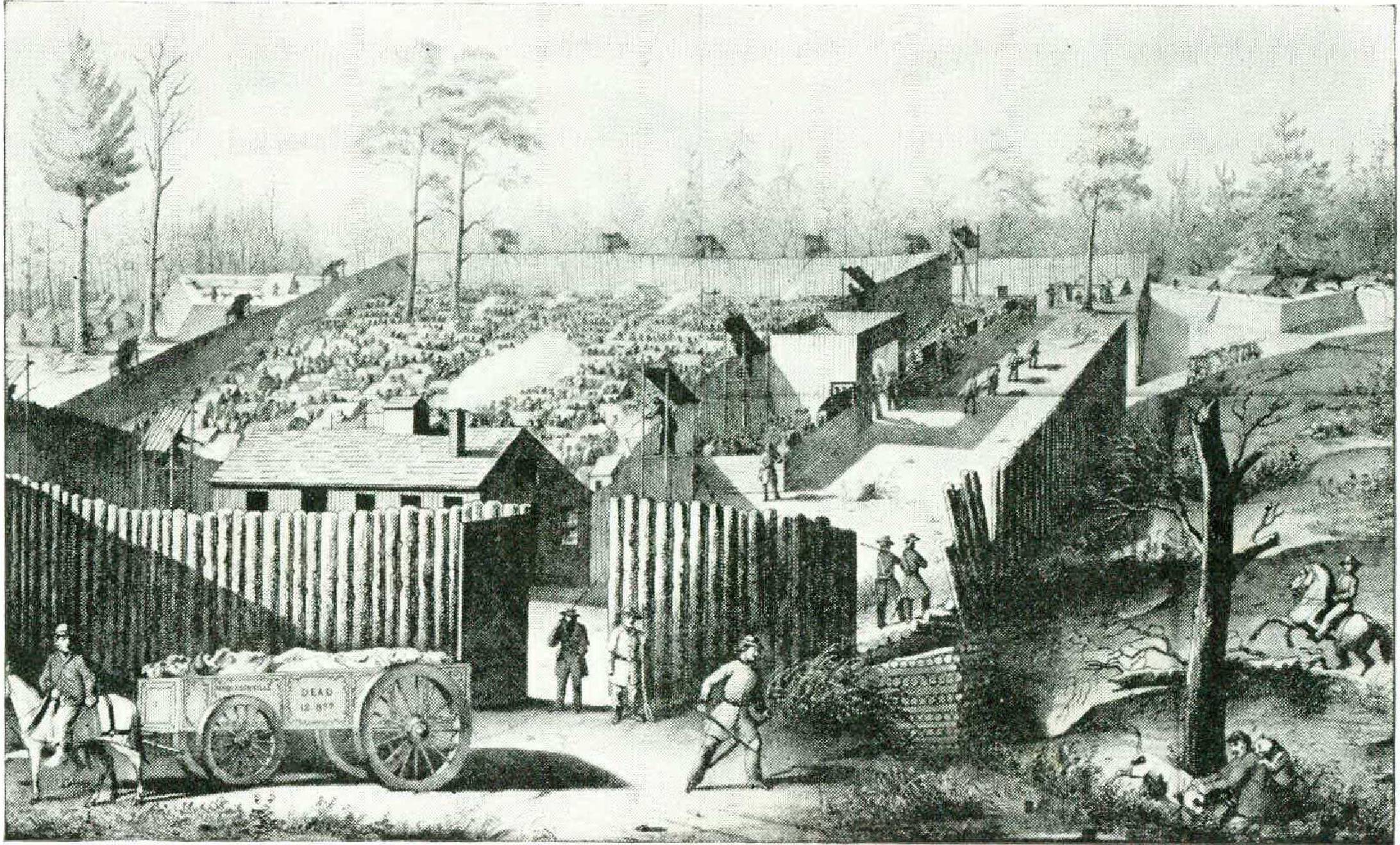
THE bull pen was enclosed by a stockade made of hewn, hard-pine timbers about fifteen feet high, which, although set closely, were not fastened to each other to prevent tunneling, almost the only possible means of escape from the stockade. On the outside of this stockade, at convenient intervals, were the sentry boxes, or platforms, on which stood the guards looking over the top of the stockade. Inside, and about fifteen feet distant, was the famous dead line. Between this and the stockade no one was allowed to step, thus insuring a clear space fifteen feet in width, all around the prison. This dead line was right enough in its way, being only a necessary precaution and as such in use in our own prisons. The thing to be condemned was the shooting of men who inadvertently got over the line without a challenge, which did not seem to be required.
The prison pen, or bull pen, as it was commonly called by its occupants, contained at this time about twenty-four acres, at least one third of which was swamp, almost impassable, much less habitable. Through this ran a brook, which afforded water for our use, but later many wells were dug and springs cropped out on the hillsides. The number who occupied the pen at this time could not have been less than 30,000, and this was constantly increasing. The rebels were busy enclosing an additional space of about eight acres on the north end, which was completed and opened a few days after our arrival, when we were assigned by detachments to definite lots which we were expected to occupy and on which we answered to roll call each morning. Previous to the opening of this addition, we had to shift for ourselves, and I am correct in saying that the prison pen did not contain room enough outside the swamp for all the men to lie down at the same time. After the opening of this addition, it never again became so crowded, for death almost kept even pace with the captures.
Our rations at this time, I think, must have consisted officially of one pound of corn meal and one-fourth pound of fresh meat or bacon; but this was so depleted by the swarm of extra-ration men fed from the common stock that, when it reached us, I doubt whether the ration of meat would have averaged two ounces. Of corn meal, there was usually enough, as many men who had the scurvy could hardly eat it at all. This ration was issued in various ways: one week we would receive mush, the next week, corn bread, and the next, raw meal, which we could cook to suit ourselves. Wood was very scarce and valuable and, when raw rations were issued, it gave us much trouble to secure enough, although to one who never tried it, the small amount necessary to cook a pot of mush would be surprising. Meat, we always ate raw, partly from necessity and partly from the idea that it would, at least in the case of fresh beef, go further in that way.
As we settled down to our prison life, the drawing of the rations was the one event of the day, and the hawking about of rations by those who wanted to trade made things lively and did much to keep up our spirits.
A considerable trade in the products of the Confederacy was carried on through the connivance of the rebel officers, and those who had money could buy many luxuries, but at fearful prices: good onions or Irish potatoes would sell for 50 cents to $1.00 each, and even at that price found eager purchasers on account of their value in preventing scurvy. The only useful trades in the prison, besides that of sutler, were the barbers, who would cut hair, or shave, at the standard price of one cent; the coopers, who made muchneeded small pails or tubs cut of the roots dug up from the swamp, often with no tools but the blade of an old case knife; and the brewers, who made a kind of sour swill, termed beer, from the spare corn meal. A drink of this, plain, from a tin cup sold for 5 cents; if drunk from a glass tumbler, as a reminder of better days, 10 cents was the price; colored with bloodroot, it was worth 15; sweetened with molasses, 20 cents; and, to all these refinements, the crowning glory of soda to make it foam made it worth 25. This drink was mild enough, so far as having any intoxicating character, and did, I suppose, some service in keeping off the scurvy.
THE two vices that most afflict mankind in ordinary stages of society are intemperance and licentiousness, and it is very natural to suppose that if these could be set aside, a great gain would be made in the happiness and well-being of mankind. But here was a community where prohibition had full sway, and from the lives of whose 30,000 members the temptation or opportunity for yielding to these vices was utterly cut out; but, as we read that in the days before the Flood the earth was filled with violence, even so it was here. The evil nature in men’s hearts, unrestrained by moral principle, will crop out, and here, finding no other vent, took delight in deeds of violence and murder. Gambling, too, was common, and all day long the dice would rattle, and all sorts of games to trap the money of the unwary would be paraded along the street.
The policy of recruiting the service by the payment of large bounties had borne fruit in the horde of bounty jumpers and deserters. In some states, the prison doors were opened to all who would enlist. Was it any wonder then that the prison contained many men who had sought capture rather than meet the consequences of their acts in our own lines, and here carried on their work of plunder, and even murder, from sheer wantonness? There was no law or tribunal to punish offenses, and for a time these men had sway. Almost every morning, someone would be found with his throat cut, and I have seen men knocked down and robbed in broad daylight, with hundreds looking on not daring to assert themselves against the banded violence of the raiders, as they were called. The rebel authorities had been appealed to in vain to stop this state of affairs, but paid no attention, and so things went on from bad to worse.
But one day, something fell under the eye of Wirz that brought about a change. The older residents of the prison had ere this banded together for self-protection, but could take no active steps to punish the raiders. Sometimes, though, a raider met his match. Among the Western regiments were many Indians, and, one day, one was brought in with some Wisconsin troops that had been captured. As he entered the stockade, worn out with his journey, the Indian laid down on the ground and went to sleep. A raider caught sight of a watch and chain, of which the rebels had forgotten to relieve the Indian (an oversight which the raider set about to correct), and, bending over the man, proceeded to loosen it; but the Indian’s sleep was not very sound, his savage instincts were quick, his knife handy, and that raider went raiding no more.
One morning, however, a company of the rebel soldiers marched into the prison, and the order was circulated that no more rations would be issued until the raiders had been delivered up. Under cover of the rebel guns, our men organized police squads, armed with whatever implements they could lay hands on, and arrested everyone against whom there was any suspicion and turned them over to the care of the rebel guards, who sent them outside for safekeeping. Hundreds were arrested, and a court was promptly organized among the prisoners for their trial, the rebels affording them facilities for the prosecution of the work and putting the minor sentences into execution, but not interfering otherwise with their action. Many of those arrested were set at liberty, and others sentenced to punishments according to the crimes of which they were found guilty; but six of the ringleaders found guilty of murder were sentenced to be hanged. At first, the rebels seemed loath to allow this order to be executed, no doubt fearing that their action might be misunderstood by our government, and a considerable time elapsed before we knew what the result would be.
In the meantime, a police government was organized among the prisoners, which, so long as I remained in the prison, proved effective. One morning a load of lumber was brought inside the stockade, with which a gallows was constructed, and about four o’clock in the afternoon the rebels brought in the condemned men, and after an officer had read an official statement of the situation, released them; but this was only a matter of form, as the police officers of the prison stood by to seize them. The rebel force at Andersonville was small compared with the number of men guarded, and they always seemed fearful of any concert of action among the prisoners; so on this occasion the whole rebel force was in line outside the stockade, and a light battery was drawn up to command the gallows and its surroundings, plainly visible on the other side of the slope, outside the stockade. A dense and deeply interested mass of men had crowded around the scene. Everything was in readiness, the six culprits were marched to the platform, and the nooses were slipped over their heads, amid the breathless interest of the 30,000 spectators. The raiders were, as I remember watching them from a near post of observation, all strong, well-fed men, and such as might well be feared for their physical power, among the starved, worn-out inhabitants of the stockade; but here they were, now, in our power. Suddenly one of them, the last in the row, broke from his attendants and sprang from the platform, right out onto the heads of the dense crowd, so dense that he seemed to bound along with strong, desperate strides, for rods, before he touched the ground. The sudden commotion caused by this in a crowd which had watched in breathless silence quickly attracted the attention of the rebels. The infantry were called to attention, and at the battery the cannoneers stepped in to load. A sudden fear seized the crowd, so quiet before, and it surged back, each one only anxious to get out of the range of that terrible battery, mindful of the havoc cannon shot would make in such a dense mass of humanity. For a few moments, all was rush and confusion; but the rebels bravely held their fire, and the men at the gallows stood by the remaining convicts. The escaped convict foolishly undertook to cross the swamp to the other side of the prison, only to be captured by a line of police stationed on the opposite bank, who led him back to the gallows. The noose was adjusted, the black caps pulled down, the word given, and five of the raiders dangled at their ropes’ ends.
The cords with which the men were hanged were not made, it seems, of the traditional hemp, but of good Confederate cotton which, to the sixth man, as to the Confederacy, proved unequal to its requirements. For the ringleader — known as Moseby, from the rebel guerrilla — heavier than the others with sin, it may be, broke his rope and fell to the ground. The man who officiated as hangman was known as '‘Limber Jim,” and the story is told that, when he first entered the prison, this same Moseby robbed him of $176. When Moseby reached the ground, Limber Jim grabbed him. “I have stood my chance,” said Moseby. “No,” responded Jim, “the rope around your neck cost me $176, and I will hang you as long as I can tie a knot in it.” He tied the knot, and it held.
THE great disease of the prison was the scurvy, which is not, as its name would indicate, a skin disease, nor necessarily one arising from uncleanliness. Another disorder, hardly less common, and more terrible in its effects, was a disease arising in the feet of the men from contact with the satu-
rated, poisonous earth of the swamp. Owing to the mulishness of the mule of which I have told you, I was barefooted when I entered the prison, and soon was attacked by an ulcer on the bottom of my right foot which grew worse. The usual result of ulcers of this sort I well knew from what I had seen and heard. Uncontrolled, the dreaded gangrene would soon set in and amputation would follow, only to make another wound for a fresh attack of gangrene. I have known men to suffer three amputations in rapid succession, all performed in the old way: the patient was strapped to a table without anesthetics, and, need I add, usually died in consequence.
It became evident that I must leave my comrades and go to the hospital, to which at this time it was almost impossible to gain admittance. It was not a question of need, but of room, no more being admitted than death made room for day by day; and although the deaths daily averaged more than 100, out of 2000 patients, so large was the source from which to draw new patients that but few of those needing treatment ever received it. Making a desperate effort, I at last succeeded in getting to the sick yard early one morning, was examined and admitted.
The sick yard was just outside the gate, and itself surrounded by a strong fence. Few were admitted to it through the gate at a time, and these only at the will of the surgeons. The yard was divided into wards corresponding, I think, to the wards in the hospital. One other man was admitted in the same ward with me. It was early morning when we entered the sick yard, and there we remained all day, or until late in the afternoon. It was a bright sunny day in the latter part of August, and we lay in the sand, in the shade of the stockade, until the sun crawled around and made our situation uncomfortable. Then I crawled across the yard, on my hands and knees, and lay down in the little patch of shade made by the awning where the surgeon stood when examining patients; my comrade for the day followed me, also on his hands and knees. I do not remember that any word was spoken between us, and who he was, I know not; we had been companions in suffering and now hoped for relief. The little shelter afforded us scanty shade, and as we crowded together to get the benefit of it, I remember the happy, peaceful expression on the man’s face as he folded up his coat for a pillow and lay down in the sand to sleep.
For myself, in spite of pain and hunger, memory recalls few pleasanter afternoons than the one in which I lay by my sleeping comrade, enjoying the pure air and gazing through the cracks of the fence into the quiet and beauty of the outer world. The long road had turned, and whatever might be ahead, the bull pen with its horrors was behind; and, although I knew nothing of the hospital, from which, it was said, none ever returned to the stockade, nor what might be in store for me there, hope again revived. When water was brought around, I took a cup from my companion’s haversack and, after taking a drink, filled it for him when he should awake; but all through the bright sunny afternoon, he slept peacefully on; he was nearer the end of his troubles than I, for when the wagon came around to take us to the hospital, I turned to waken him, but he was dead. Like one who gathers up the ammunition of his fallen comrade to help him in the fight, I hastily removed his haversack with the battered tin cup, and went my way.
The hospital was only a camp in the woods near the stockade, through which flowed a stream joining the one by the stockade a little below. It was surrounded by a strong fence, around which paced the sentinels, but escape from its bounds was not nearly so hopeless a task as it was from the stockade. It had been laid out in streets and wards, and simple tents, or rather flies of canvas, stretched among the grateful shade of the oaks which had been left standing.
On a rude bank or platform, raised some two feet above the sand under one of these, in the company of six or seven others, I spent the remainder of my prison life; for, although my foot began to mend at once, I was still on crutches when paroled, and never returned to the stockade. With more room, pure air, better water, and better, though not more abundant, food, I was thankful for the change. My berth was next to the outside one on the bank, and beside me, during the time I spent there, six others were brought from the stockade, one after another, to remain but a short time and then be carried out to add another foot to the long trench, which steadily grew day by day. Every morning along the street there would be a single rank of men, lying straight and stiff, with an old soldier’s cap placed reverently over each face to keep the light from the sightless eyes. Somebody’s hope, somebody’s dependence, waiting for detail to carry him out the gate on a stretcher. For one thing we must give the rebels credit: for as decent a burial and as complete a record as were possible under the circumstances.
Our food in the hospital was mainly rice and, although its insufficiency is proverbial among soldiers, it was better than corn meal. Later, toward the last of my stay, a ration of one spoonful of wheat flour was issued daily to each man, and the business of making bread, or rather rolls, suddenly became a regular trade among the convalescents. Our surgeons, in the main, did what they could for us, with their limited advantages and few medicines. The surgeon in chief was a faithful man and was afterward rewarded by our government.
I think the prison would have afforded an interesting field of study for a medical student, showing the different types of physical nature under adverse circumstances. Some men would dry up to meet the circumstances. All superfluous flesh would vanish, and the skin, dry and close, would become as dark as a Negro’s; the hair would become kinky by neglect and exposure to the smoke of the hard-pine knots, with which the cooking was done, and there were many white men who could hardly be told from mulattoes. Another feature made the resemblance of the men striking: the whiteness of the teeth of the prisoners, which has been often remarked; whether this arose from the absence of anything deleterious in our food, or from the scouring properties of the corn meal, or the sand, which pervaded everything, or was, as in the case of the Negro, only apparent by reason of the darkened skin, I know not. This class of mummy men looked as though they would last forever; but not so with all. I could not, if I would, depict to you the misery of this place, which has left its record in the 13,000 graves made in the short nine months of its existence.
THE beautiful autumn weather was rapidly passing, and already the colder nights made us fear the coming winter. About this time there occurred an event which has always had a deep interest to me, and which I have never seen recorded.
The Republican and Democratic conventions for nominating candidates for the presidency had both been held, and the result was known to us before our capture. The former had nominated Lincoln, the latter, McClellan. The issue was plain. A vote for Lincoln was a vote for the prosecution of the war to the bitter end; a vote for McClellan was a vote for compromise and peace. The rebels understood this, and no question was more frequently asked by them than our opinion of the result of the election. They saw the inevitable end, and hoped for better terms than could be made with the existing administration.
Lincoln had gained a strong hold upon the hearts of the soldiers, and his name was a tower of strength. There is no power so strong as that of personal loyalty. Any really successful military commander will rely as much upon the soldier’s loyalty to him as to the country or cause, and he is an unwise leader who neglects this power over his men. And so we, who now delight to honor the memory of our first martyred president, will never know how much we owed to that strong, quaint, rugged personality. What Christ is to the Christian, what Napoleon was to his soldiers, Lincoln was to the men who fought for the Union.
In almost any organization in the field, in spite of McClellan’s great popularity as a commander, Lincoln would have received an overwhelming majority. But here was an aggregation of soldiers who had long been removed from the knowledge of the progress of the political campaign and from active participation in the war, and all their circumstances called loudly for peace. A more representative body of men could not have been gathered, coming as they did from all parts of our land and from all conditions of society; and now that election was approaching, the rebels were deeply interested in ascertaining the political sentiments of the 1200 men still remaining in Andersonville hospital — no doubt thinking that a vote for Lincoln under these circumstances represented little but clean grit. Under their direction, huge campfires were sometimes built in the camp, around which the men would congregate in the cool autumn evenings and discuss the question; and from a rude platform, our stump speakers would hold forth in true Western style. The McClellan men were outspoken, noisy, and defiant; the Lincoln men were quiet and determined.
When election day came, orders were issued that all should be in their regular places at certain hours. Printed ballots were distributed by the rebels, bearing the names of Lincoln and McClellan, and the ballot box was passed around, and the vote counted under their close surveillance. It was a constituency that sent no representative; no returns were ever made, and there was no need that the vote should be counted to decide the result; but I think no more telling blow was ever given the tottering Confederacy, or a greater honor ever conferred upon President Lincoln, than the clear majority of 400 votes out of those cast by 1200 worn-out, starved, rotten men in Andersonville hospital.
Soon after this event, a rumor of exchange, more plausible than the former ones, was about, and one day a squad of rebel officers and surgeons, accompanied by a clerk, passed rapidly from tent to tent, selecting men. I promptly put myself in their way and put my best, or rather worst, foot foremost; it was acceptable, and my name and description were recorded. A day or two later, early in the morning, the call blew, and hastily snatching my old blanket and saying good-by (if so it might prove), I made for the gate. My name and description were all right, and with a heart full of thankfulness, I hobbled through the gate, out of which so many of my comrades had been carried feet foremost. We were marched to the station, loaded into cars, and with the notable Wirz to see us off and wish us good success in getting home, started on our way. At nightfall we were again marched through the stockade of Mill prison, where we remained a few days, and then proceeded on our way to Savannah.
At Savannah, on the early morning of another eventful Sunday, we were marched through the town to the wharf, where we signed the parole and were put on board transports and taken down the river to Fort Pulaski, under cover of which our fleet lay. Toward noon, we came in sight of our old flag floating from the masthead of one of our transports. We had had nothing to eat since leaving Mill the previous afternoon, and the night had been rainy, so we were all wet to the skin, and the cold wind from the salt water chilled us through. In this condition, we were kept waiting during the long afternoon while the preliminaries were being arranged, and the report crept around that there was some hitch in the proceedings and that the whole lot was to be returned to Savannah. More than one prisoner crept to the guards with the avowed purpose of throwing himself overboard should this be attempted. Just about dark, however, our transport steamed alongside the George Seavy, and we were counted over the rail. The long cabin, made bare for our reception, was fragrant with the aroma of boiling coffee, and after the usual delay, it was served to us with old-time hardtack.
Our long imprisonment was over; we were now under the protection of our own flag, and warmed and fed. The loyal North and home were before us. Joyfully we sang far into the night the longneglected, almost-forgotten songs of former days. Many an eye was bright with hope that night that never opened on the scenes of home, and many a voice was raised in song that never was heard by loved ones, for death pursued us still, and all along the ocean path and in the cemetery at Annapolis were laid many who had been paroled too late. A few days after, we were transferred to the steamer Baltic, in which we were conveyed to Annapolis. Here again, on another Sunday, the lighters met us in the blue waters of Chesapeake Bay and landed us at the wharf of the Old Naval School, used as a hospital during the war. Here, with care and comfort, I rapidly recuperated. My commutation money was paid me ($40.50), the price of 162 days’ starvation at 25 cents per day, in good, new, interest-bearing greenbacks, which I stowed away in the pockets of my new soldier pants with the mental exclamation, “There, old fellow, is a debt you owe your stomach, and you pay it, every cent.”