Carey Bloom
Irish essayist and critic, DONAT O’DONNELLis best known in this country for his book MARIA CROSS, a study of such modern Catholic authors as François Mauriac, Graham Greene, Sean O’Faolain, Evelyn Waugh, and Paul Claudel. He is fond of dogs, especially Kerry blues, as this narrative discloses.
BY DONAT O’DONNELL
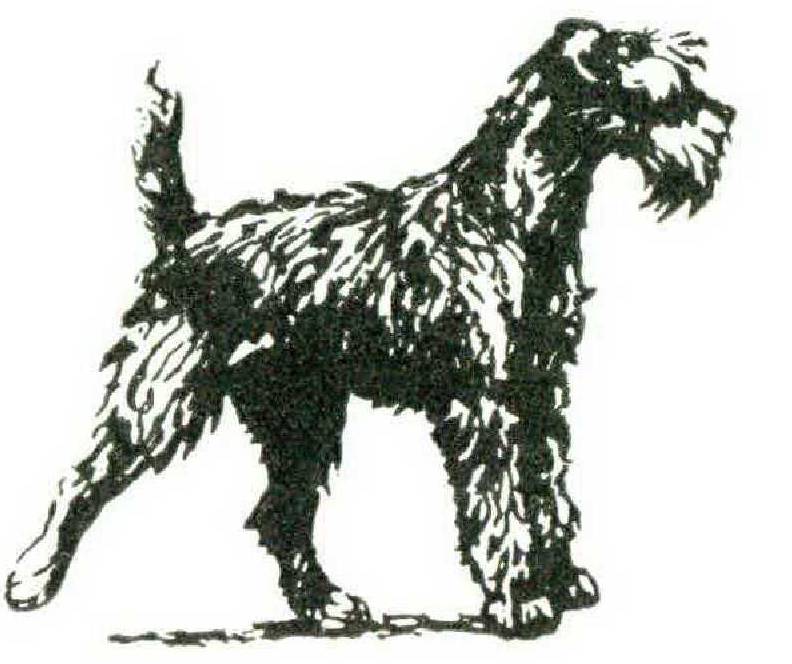
ON HIS native soil the Kerry blue is a shaggy blue-black animal, a little short on leg, purposeful and reticent, and a fierce fighter. So was our Kerry blue in Paris, above all shaggy, and we were very proud. The Parisians are exceptionally fond of dogs; they are also inexhaustibly curious about the diversity of the creations of God, or the Supreme Being. For both those reasons our Kerry blue attracted a good deal of attention. It was therefore nothing exceptional when the stout lady, proprietress of the restaurant in the Place Notre - Dame-des-Victoires, came over and asked what it was, as a dog. I told her it was an Irish dog, of a race unknown in France. To this she replied that she had an Irish dog herself, and went and got it. She produced with pride a rather impressive beast, trim and tufted, resembling an exceptionally tough poodle and having about it that suggestion of the sinister which the combination of physical strength and marked elegance always seems to evoke. As the two dogs were introduced I admired the stranger. He was, I confessed, superb as an Irish dog but, I was ashamed to say, I did not recognize the breed. The reply was crushing:
“Mais, mon pauvre monsieur, c’est une des races les mieux connues de chiens irlandais! C’est un Carey Bloom!”
There were, she revealed, only three “Carey Blooms” in all Paris: her dog, a bitch in the Avenue Henri Martin, and another dog in the Boulevard Raspail; but in the last case she thought the district cast doubt upon the pedigree. I could have added to the list, but found it too hard to explain that my own dog also was striving, in his woolly way, to be a Carey Bloom.
I got two things out of this encounter: a new name for my dog and a new place to take Irish visitors in Paris. Irish people in Paris, like other visitors, want to plumb the depths of French wickedness and perversity, but it is by no means sure that they all know a depth when they plumb one. The dog of the Place Notre-Dame-desVictoires was a good answer to this sort of thing. He constituted visible and tangible evidence of French perversity, in a form which any Irish person could understand. “When I look at that dog,” said one of the Irish visitors, “I understand the Fall of France.” His cup was full when I revealed that the dog had belonged to André Gide, when he lived in the Rue Vaneau. As the beast sneered at them across the café table, my friends found it easy to believe themselves in the presence of a disciple of Gide’s. Only that diabolical brain, surely, could have conceived the project of tonsuring a Kerry blue into the semblance of a poodle.
I always meant to survey the field completely, to visit the pedigree bitch of the Avenue Henri Martin and the attainted dog of the Boulevard Raspail, but my newspaper decided otherwise. My new editor felt that the Irish people were not interested in what was happening in Paris; they were interested in what was happening in Donnycarney: I was to come home, quickly.
This raised a difficulty: what about Carey Bloom? It is very easy to bring a dog from Ireland (or England) to France: you just bring it. But to bring a dog back from France to Ireland or England is quite a different matter. You must, to begin with, obtain a license to import a Canine. If you get this you must, on arrival in Ireland, hand over the Canine, in an approved Nose-andPaw-proof Receptacle, to an approved place of Quarantine, there to be confined for Six Calendar Months, at cost to owner of £2 a week. Then, if the dog is still alive, you can have him. All this is understood to be required to keep the scourge of rabies out of Ireland and, of course, England. The French, however, have a different story.
It became clear that there were three courses possible:
1. To leave Carey Bloom in France.
2. To bring him to Ireland complying with the Regulations.
3. To bring him to Ireland without complying with the Regulations.
The first course I should have favored myself, but it was ruled out by my two small daughters. The second course found no supporters: it would probably kill or at least disable the dog, and it would also cost us more than £50; the sentimentalists and the realists united in rejecting any such policy. It was therefore decided, by elimination, that Course 3 was to be adopted. Carey Bloom was to be smuggled, and I was to do the smuggling.
This was a more formidable and dangerous task than at first appears. In Ireland it is the Department of Agriculture that administers these laws. And it has been said that there are only two forces worth mentioning in Ireland: the Church and the Department of Agriculture. I risked not merely a heavy fine and a jail sentence, but also the loss of my job. Then hope dawned. I didn’t have to smuggle Carey Bloom into Ireland at all. England would do. England and Ireland, politically, are fractured, but to the veterinarian they are still one and indivisible. If Carey Bloom were once in England, he could be brought to Ireland without fuss or formality. And even if I were caught smuggling into England, it would be by Englishmen, having broken an English regulation, and possessing therefore a sacred claim on the sympathy of my own countrymen. Even my newspaper would have to back me up; my friends could see to that. If it failed me it would be accused of playing England’s game, and then let it look to its circulation!
In good spirits, then, I prepared for the attack. My family went ahead by air, leaving me with the car and Carey Bloom. My last dinner in Paris I took in the Place Notre-Dame-des-Victoires. The stout lady, pleased at what I had done for the reputation of her dog and house, gave me photographs of both. The picture of the dog had been taken at one of our evening gatherings. The dog was seated at a cafe table, with a hideous expression of intelligence, in the middle of a lively group; he had a glass of Pernod in front of him and four saucers — a surprising number, for he drank very little. On the wall behind, someone had taken care to hang a portrait of M. Gide. To a man facing, perhaps, an English prison on the morrow, it all seemed a little childish, and yet endearing. They put me to bed on the premises.
My START on the following morning was not as early as it should have been, nor my head as clear. It was eight o’clock when, with Carey Bloom upright in the seat beside me, I left Paris by the Porte de Ncuilly, on the road to Dieppe. I stopped at Pontoise to consult the local vet. My plans involved putting Carey Bloom in a case, and the case in the boot of the car; anyone who knew Carey Bloom realized that this could hardly be done without assistance, much noise, and perhaps even bloodshed, unless the patient were unconscious.
The vet of Pontoise was large, sportif, and ties gentleman —with crew cut. He was also in full sympathy with my project. The English quarantine laws were a piece of cynical hypocrisy. La rage canine was, without doubt, a very terrible disease, but did I know when the last case of it had been notified in France? No? Eh bien, man pauvre monsieur, the last case of la rage canine in France occurred in 1910! Dix . . . neuf . . . cent . . . dix! Under President Fallieres! Had I so much as met anyone who had even heard of President Fallieres? No? Well, then!
The vet of Pontoise was striding up and down the room, breathing heavily. I tried to bring him back to the immediate practical aspects of the problem: I had a boat to catch, needed instructions on dog-doping, and the dope itself. “None of that,” said the vet, “presents any difficulty. Do you know the real reason for the quarantine regulations? It is that the dog breeders of England fear the French competition — and Dutch competition perhaps a little too —”
“My boat goes,” I said, “at 12:30, and if you could give me some pills, something that would work quickly —”
The vet stopped walking and looked me sternly in the eye. “Of course I will give you the pills,” he said. “Ne vous affolez pas. Vous avez largement le temps.”
I looked at my watch, with gathering hopelessness.
“It is admirably simple,”said the vet of Pontoise. “Suppose there is a minister who is an honest man and who says, ‘You are breaking my feet with your silly regulations about quarantine for dogs: I will abolish them!’ Vlan! So what happens? One dog breeder rings up his brother, the governor of the BBC. Another calls his uncle, the editor of the Times. A third takes up the phone and says, ‘Give me Canterbury 1.’
“So all the hysterical old women of England that is 40 million out of a total population of 50 million — get together and make some brouhaha. They say: Keep out French Diseases! They say: A Vote for Labor Is a Vote for Rabies! Then one day the minister gets up in the House and says the question needs further study, and he sets up a commission of dog breeders’ brothers to study it! As for you, monsieur, here are four tablets of Gardenal. Give the animal one not more than half an hour before embarkation; give him the other three on the boat —just put them in his mouth, he’ll swallow them. You’ve nothing at all to worry about — he’ll sleep like a woodcutter, and the customs people in England are the same as our own, they never look at anything.”
Out in the yard the vet of Pontoise — who refused any payment — took a good look at Carey Bloom. “He could be a nice-looking dog,” he said, “if he were properly trimmed.”
Having no time for this controversy, I got into the car and prepared to turn into the street.
“Of course,” said the vet, “I know that in England they like dogs to be like that. They have the mania of the natural. It is perhaps,” he added thoughtfully, “a form of hypocrisy.”
AS I drove through the Vexin on the road to Dieppe I felt considerably fortified by the vet’s remarks. His exposure of the economic basis of the quarantine regulations was convincing enough -allowing for French hyperbole — and it conferred on my own enterprise an agreeable touch of righteousness. I was encouraged, furthermore, by what he had said about the laxity of the customs examination.
It was only in Dieppe itself, driving down to the port, at noon, that the brightness of this vision began to fade. I realized that I was a hall hour late, and that the doping of Carey Bloom was going to present certain difficulties. At the port I had two simultaneous problems to solve rapidly: to get the car on board, and to dope Carey Bloom. En principe, cars are not accepted at all, unless presented an hour before departure. And it was now — successive officials pointed out thirty minutes . . . twenty minutes . . . ten minutes before departure. French officials, once they have logically established the utter impossibility of some course of action, usually like to show that they, being élite personalities, can none the less do it, this impossible thing, and the formalities in this case were pushed through with surprising speed. This involved, however, running up many steps and gangways, and the frequent assumption of that air of harassed and apologetic helplessness that, for the French official, is the mark of a deserving member of the public.
In between these interviews I had repeatedly to get back to the car for an even more difficult argument, with Carey Bloom. Carey Bloom is a patient dog, and he did not at all object to my trying to feed him Gardenal. I could put the tablet in his mouth and hold his massive jaws together. He would look at me sadly but uncomplainingly, his eyes deep violet pools under the blue shadow of his shaggy brows. Then, when I let go my hold, Carey Bloom would deposit a white and glistening object on the seat of the car. The ultimate official, who came to the car with the cleared papers, seven minutes before departure time, found me still clutching Carey Bloom’s head, the two of us staring at each other fixedly. The official mistook this for a display of Anglo-Saxon sentimentality and disapproved. “You had better get your car on board immediately,” he said. “You need not fear seasickness, either for yourself or your dog. The sea is perfectly calm. But hurry in the name of God.”
There was clearly now no question of putting Carey Bloom into a suitcase and the suitcase into the boot of the car. That, and the doping, would have to be done on board, at leisure as I hoped. I pushed Carey Bloom onto the floor in front of the seat and covered him with a rug. The result looked depressingly like a dog covered with a rug. I drove to the ship’s side and sat in the car waiting to be hauled aboard. But a face, covered with soft coal, appeared at the window, and spoke:
“You are not, monsieur, by chance a member of the Union of French Stevedores and Port Workers, affiliated to the CGT? No? In that case, monsieur, perhaps you would be good enough to hand me the key of your car, and proceed, yourself, on foot, on board the boat. I will take your place at the wheel and will occupy myself with the loading of your car. You can be tranquil.”
I got out, as tranquilly as I could, but I did not proceed on board the boat. I waited. In a remarkably short time the stevedore was out again, jumping up and down and waving long bluebloused arms. He was not, it seemed, paid to be bitten by dogs.
It was not the Queen of England who ruled in France, and French workers had rights, for which, through their syndicates, they knew how to enforce respect. Other members of the Union of French Stevedores and Port Workers, gathered round, agreed with these views. I was not impressed, because I knew the man had not been bitten. Persons who had been bitten by Carey Bloom stayed bitten; they did not jump up and down in this frivolous manner, conversing about the Rights of Man and of the Citizen. I explained, and demonstrated, that the dog was sage and gentle. As for myself I owed no more allegiance to the Queen of England than they did, being a good Irish Republican. In fact, the dog was there in defiance of an English regulation — a regulation, moreover, which was unfairly aimed at French exports and was devised to protect the private interests of the English four hundred families, including Sir Eden himself. The stevedore, to whom I gave a thousand francs, saw my point of view. He would put car and dog aboard: “Once there you are in England. The sailors are all English and capable of anything. They are all little bourgeois, Calvinists, and police spies.”
How right he was I found in a very few minutes, aboard the S.S. Black Prince. It was a fine clear day with a dead calm sea, but no sooner had my car been hoisted onto the lower deck, and the French stevedore departed, than a company of Calvinists descended with a huge tarpaulin. Silently, with grim efficiency, they lashed this covering into position over the car, securing it tightly. A small gap remained between the lower edges of the tarpaulin and the deck; as a window of the car was open, air could still penetrate to Carey Bloom. But only air; no question now of the leisurely administration of drugs, no question of a doped dog sleeping quietly in the boot. No possibility of tampering with that tarpaulin without detection, even if I were a skilled tarpaulin-tamperer, which I was not. The seamen might not all be Tory police spies, as the French stevedore claimed, but they had a look about them of belonging to that class of men who are described as “law-abiding” because they like to see other people getting into trouble.
I made my way to the bar, for a Guinness. The barman, I found with pleasure, was an Irishman, even a Kerryman — Mahoney by name — and therefore by definition indifferent to the law, “our pets,” and the public health of England. He heard my story gravely. No, nothing to be done with those seamen. All non-Catholics, mostly Methodists, don’t smoke and don’t drink, would inform on their own mother. The only help he could give, the Kerryman said, was with the Newhaven dockers. These were a decent crowd, that is to say, mostly Irish, who could be trusted to keep quiet if it was made worth their while. With the help of the dockers I should be able to get the car and dog quietly off the boat and as far as the customs shed. After that I was on my own. He thought the chances were about five to one against my getting through. You would be better off in England poisoning old women, the barman thought, than to be caught smuggling a dog. However, he would do his best for me, and wished me luck.
AT Newhaven, the dockers did their part, as arranged through the barman. I drove slowly along the quayside, using one hand to pull the rug back over Carey Bloom. Carey Bloom, normally a very quiet dog, growled and shook the rug off. I pulled it back again, wishing I were in some quiet English watering place, respected by all, happily poisoning old women. Carey Bloom stayed under the rug this time, but shivering and sniffling. I reached the customs shed.
The customs shed (motor vehicles) at Newhaven is a building I now know rather well. It is open at both ends, full of wind and echoes. There are a few officials there, but it is difficult to make them out at first, so still are they in the uncertain light of the great windowless hall. You make them out, however, as you go along. One of them now came forward: the Automobile Association, a gingerhaired man with that touch of slightly furtive affability that marks the man who has one leg in the official world and another in that of private enterprise. He would clear the car papers while the other customs formalities went through; it would only take a few minutes. He took my triptyque and disappeared into the shadows.
Several minutes passed in a silence broken only by an occasional whimper. Then suddenly H. M. Customs was beside me: a friendly fresh-faced man with an outdoor look about him and a perfunctory sort of expression which I liked even better.
“Anything to declare?”
“No, I’m in transit to Ireland — going on to Holyhead tonight.”
“Nothing intended for the United Kingdom? No brandy, wine, cigarettes, or perfume?”
“Nothing at all.”
“All right, sir, you can carry on.”
My car began to move forward as on its own initiative toward the exit of the cavern, toward freedom and success. Its lights shone on a gingerhaired man: the Automobile Association. He waved; I stopped. They were a little slow clearing the papers — the usual man was away — would I mind waiting where I was for a few minutes? By this time H. M. Customs had strolled up, benevolently, a man with time on his hands. I wanted to say that I would like to wait anywhere except where I was, but I had some difficulty in finding suitable words for this thought. I said I would wait. H. M. Customs decided to keep me company. He was a fisherman, and it was his opinion that the best fishing in the world was to be found in Connemara. Or perhaps Donegal. Though Lough Derg, in Limerick, at dapping time was hard to beat.
Bored, Carey Bloom stretched himself under his rug. At least I hoped it was under his rug. I had a hideous feeling that the rug by now had slipped off. But it was impossible to look round. All I could do was to trust to the dim light and try to make intelligent answers about dry-fly fishing in the west of Ireland.
A figure appeared, moving briskly from the direction of the exit. The Automobile Association! The figure came closer. It was not the Automobile Association. It was more of H. M. Customs. More, and older, and nastier.
“Have you cleared this car?" he asked my fisherman friend.
There was a slight Scots edge on his voice, and a singularly unpleasant inflection to it. The remark had an unfortunate effect on Fisherman. He dropped the subject of the May fly on Lough Derg and took a quick look inside the car.
Then his manner changed. “I’m afraid, sir,”he said quietly, “I’ll have to ask you one further question.”
Something told me what that question was going to be.
“Are you carrying any animals in this car, sir?”
“No,” I replied firmly.
“Since you declare you are carrying no animals, sir, perhaps you would tell me what that is?”
I looked round, for the first time. Carey Bloom’s muzzle and two front paws were resting on the front seat. His shoulders were covered with a tartan rug. He was asleep.
“That,” I said, “is my dog.”
“Since you admit that is your dog, sir,” said the Scot, “how do you explain your previous declaration that you were carrying no animals?”
Clearly he felt that this was a telling piece of cross-examination. Privately I agreed with him, but I decided to go down fighting.
“This dog is being conveyed to Ireland,”I said. “In Ireland he will be put in quarantine immediately. I am taking him direct to Holyhead. He will not be let out of the car in England at all. All your previous questions were about what I had for the United Kingdom. I took it that this question was the same. As I had no animals intended for the United Kingdom I thought it was right to answer the question in the negative.”
Fisherman’s mouth hung open, like that of a Lough Derg trout in dapping time. He was obviously dazzled by this unexpected piece of dialectic. There was a silence.
I was weak enough to break the silence by a conciliatory remark. I should have known better than to make a conciliatory remark to a Scot, but my nerves had been under a strain for some time. “I should prefer to take him to Ireland for quarantine,” I said, “but of course, if that would be contrary to your regulations I’m perfectly prepared to put him into quarantine here.”
I thought this a fair offer, but it brought out the worst in the Scot.
“You don’t seem to r-realize your position,” he said grindingly. “It’s not a question of what you are prepared or not prepared to do. The animal, of course, will be impounded, and may be committed to quarantine if the authorities are satisfied as to your willingness and ability to pay for his upkeep. Otherwise he will be dest-r-royed. The fact is that you yourself have already committed two very serious offenses: first by importing a dog without a license and second by falsely declaring that you were not carrying animals. On either count you are liable on summary conviction both to a heavy fine and to a p-r-rison sentence of not more than Six Months. I shall now have to report the matter both to the police and to my own superiors. You, sir, will please remain where you are and ensure that that animal does not leave the car until he is officially impounded.”
THE program for the evening was faithfully observed. The police arrived and took a statement. And later came an overalled contingent with a handcart on which stood a large crate. They looked like something out of Defoe’s Journal of the Plague Year. To them, not without a twinge, I handed over Carey Bloom. He licked my hand in farewell, but otherwise made no sign. As they wheeled him away, toward imprisonment or death,
I saw on the back of his crate a huge sign in yellow characters:
DANGER! RABIES!
I thought bitterly of President Fallières. I became aware at the same time that a new character, and one having authority, had come on the scene. This was an elderly man, not in uniform but in sports coat and flannels. The old gentleman’s general appearance was kindly and paternal, but I could see from his expression that he had Very Little Sympathy for Certain Classes of Offender and that I belonged to one such class.
“I’m afraid,” he said, “that in view of what’s happened we’ll have to put some further questions to you formally. After that we’ll have to search your car thoroughly. You see you’ve already made one false declaration, so you can’t expect to receive normal tourist treatment.”
He left a moment for this insult to sink in. Then: “Are you carrying any Narcotic Drugs?”
“No.”
“Any Plants or Parrots?”
“No.”
“Any Arms or Ammunition?”
“No.”
“Any more animals?”
This was too much.
“Look,” I said, “I’m not a professional dog smuggler, or any other kind of smuggler. That dog belongs to my daughters, who are very fond of it. If it had to go into quarantine I wanted to bring it to Ireland. If it were quarantined there they could visit it every day. As it is they won’t be able to visit it at all. I’m sorry if I infringed your regulations, and you can go ahead and search my car. You won’t find anything.”
For the first time since coming to Newhaven I had managed to strike the right note. The old gentleman’s manner perceptibly softened. He made no reply, however, until the car had been searched and been found, as I had said, to be free from Narcotic Drugs, Arms, Ammunition, Plants, Parrots, and Other Animals. He addressed me now as a fellow human being, rather than as an individual engaged in a Vile Traffic.
“I can understand your feeling for your Pet,” he said. “I have three dogs of my own. But, believe me, it’s in the interests of Our Pets themselves to see that these regulations are observed.”
He lit a cigarette, for effect. Then quietly: “Have you ever seen a case of rabies?”
“No,” I said. “I’m afraid I haven’t. You see the last case of rabies in France was in 1910. The year of the Coronation of King George V. That was before I was born.”
Balked of his dramatic effect, the old gentleman looked at me thoughtfully. “We don’t want to be unnecessarily severe about this,” he said. “We should prefer not to have to prosecute, if we can avoid it. I’m quite prepared to accept your story, send the dog to an approved place of quarantine in England, and let you go on your way, without further formality. So if you’ll just show me the license from the Eire Department of Agriculture to import the dog into Ireland, we can regard the matter as closed.”
The Scot, who had looked depressed during the earlier part of this speech, cheered up at the end perceptibly and unpleasantly. He could obviously see, merely by looking at me, that I possessed no licenses of any kind. He was quite right.
“I didn’t have time to get a license,” I said. “I was ordered by my employers to come home at very short notice indeed. My first idea was to leave the dog with some French people, who would give it a home for a time, while I made the necessary arrangements in Dublin for its importation. Then at the very last moment, the night before I left, I found that the home was quite unsuitable.
I couldn’t just abandon the dog, so I decided to take him to Ireland and hand him over for quarantine there. I don’t think the Irish authorities, in the circumstances, would have made too many difficulties about there being no license.”
The Scot smiled. What he thought of my story was quite clear. But his superior, the owner of three dogs, looked puzzled. He would, at least, not condemn me out of hand.
“You say you found this home was unsuitable,” he said. “Now just what do you mean by that?”
“Well,” I replied, feeling better, “you see, the man who offered to take care of the dog was a Frenchman, a café proprietor. My dog is a Kerry blue — you know the breed, I expect — and this man said he owned a Kerry blue, too. That made me think he would know how to look after my dog, so I agreed to leave it with him. Then, to be on the safe side, I decided to go and have a look at his dog. This is what I found.”
I handed over the photograph of the dog of Place Notre-Dame-des-Victoires.
The three customs men studied it. The two Englishmen were visibly affected. They seemed like men peering into an abyss. It was the old gentleman who spoke.
“Do you mean that they give this unfortunate dog . . . drink?”
“Pernod,” said I quietly. “Then they make him do tricks for the customers.”
“Do you know,” said the old gentleman, “I wouldn’t have believed it, even of the French.”
One felt that moral condemnation had reached its ultimate. He examined the picture again for some time, then handed it back.
“I can’t condone breaking regulations,” he said, “but I must say that if I had to choose between breaking a regulation and leaving my dog with a man like that — well, I might do what you did. I’ll recommend no further action. I wish you good luck and you can be sure your dog will be well looked after.”
It was the Scot who showed me past the police, to the Automobile Association and freedom. The Automobile Association, in an undertone, wanted to know what had happened. The Scot told him:
“The gentleman made a false declaration to the customs and was caught in possession of contraband,” he said. “He gets off under English law because he once knew a poodle that took to the drink. Good night.”