Africa, on a Brief Holiday
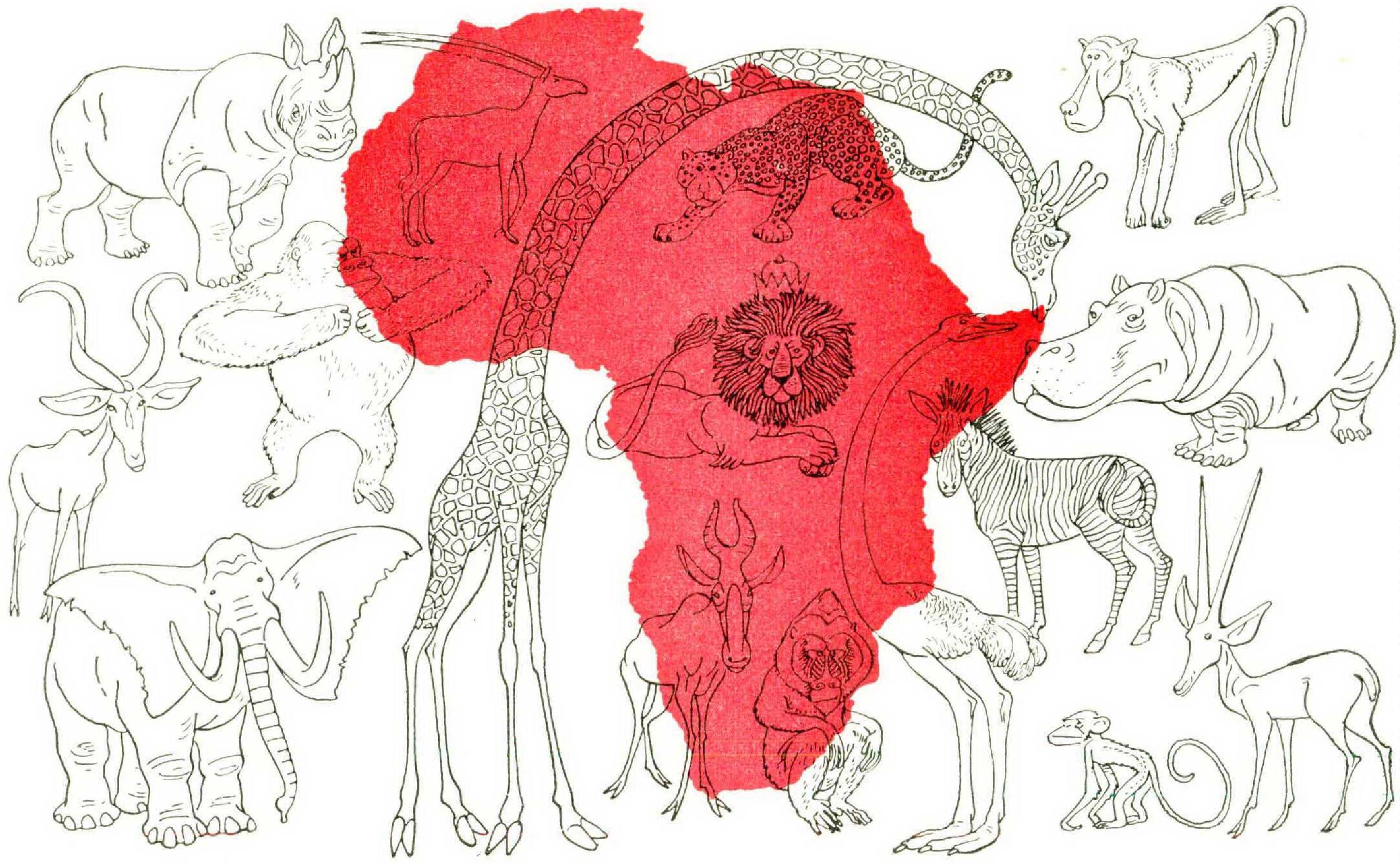
The Africa of thirty years ago, when I lived under canvas and walked my twenty miles a day through the bush, is gone. But the change is to the traveler’s advantage. Airlines crisscross the continent almost as thickly as the native footpaths which used to be the only trails away from the railroad lines. And if Central African Airlines, Hunting Clan, or Air Carriers do not schedule runs where one wants to go, it is not difficult to charter a plane nor very expensive for oneand two-hour flights. One can hop, skip, and jump around almost at whim and come down in once remote places, piloted by sporting young experts who handle their Beavers or Puss Moths like pets. So today one travels with speed and lives in comfort in modern hotels or well-run camps.
Probably that is why the accents of California, Illinois, New England, and the South are becoming familiar between the Cape and Nairobi. On a month’s holiday one can photograph lions, elephants, rhinoceroses, and other game (or even shoot them) and still have spare days to let the feeling of “the blue” sink into one’s bones.
Half in earnest, I always have suggested to African travelers that they take their ear muffs along. Most of southern and east Africa lies 3000 feet or more above sea level (Johannesburg is almost 6000 feet high), so when the sun goes down one needs a sweater and sleeps under a blanket or two. From October to April, summer clothes and a sweater or light coat will be adequate, but the rest of the year a topcoat and spring-weight suit are indispensable. Even in Northern Rhodesia I have seen a skim of ice on shallow pools as the sun rises on a warm July day. Africa is alive with surprises and .sharp contrasts.
People with seventeen days extra to spare go by ship to the Cape and let the African spell start working under Table Mountain. Less leisurely folk land in Johannesburg by air, a thirty-eight-hour flight from New York by Pan American (roundtrip fare, $1440). Each time I fly I think back to when I lived on a ship for a month to reach Cape Town.
To see the most in the shortest time, it pays to trust oneself to such old hands at arranging tours as Trans-African Safaris. Their most popular trip is that between Johannesburg and Durban, which telescopes much of Africa’s delight into six days, making it a time bargain as well. Last winter I took the trip in a coach seating eight, which costs $140 including all hotels, meals, and tips. By car with chauffeur the price is about $179; less if the trip is shared.
Once beyond Johannesburg, Americans think of Iowa or Nebraska or other states that undulate beneath vast skies. Then Africa asserts herself. Ndebele villages lie in the grass, their mud houses decorated with bold and vivid designs, and Ndebele women scuttle like shy rabbits along the roadside. They wear massive bead chokers, anklets to their knees, and bracelets to their elbows. The bolder of them squat by the road, ready to be photographed or to sell their beadwork, which makes attractive summer costume jewelry.
In a matter of hours one goes from industrial Johannesburg to Ndebele villages, then drops 3000 feet from the high to the low veld. This is country of red-hot pokers and rocky kopjes where transport riders and prospectors contended with lions, elephants, and malaria in the oxwagon days. By sundown one reaches Numbi Gate, the southern entrance to Kruger Park.
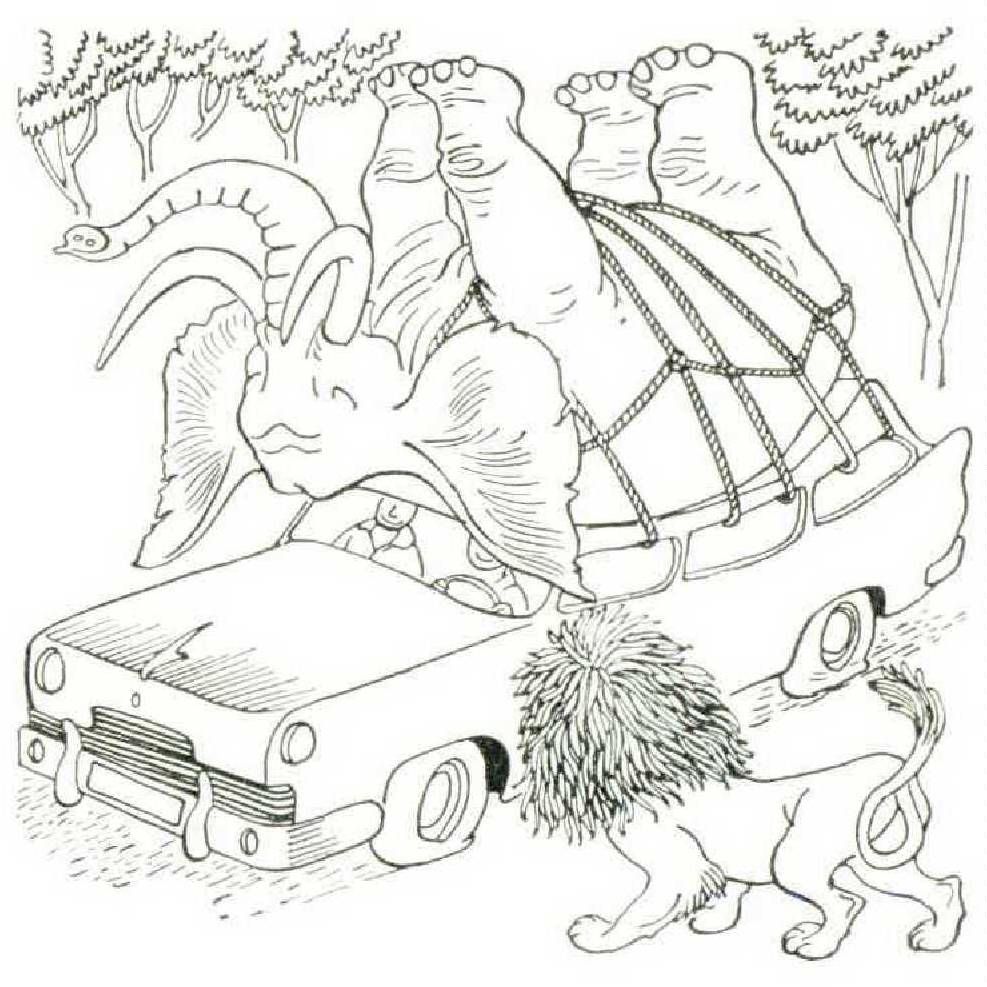
This is the famous 200-mile-long game sanctuary, where lions sometimes block traffic by sunning in the road. South Africans themselves come year after year to watch the animals. Almost every African species is here. Even in the rainy season, when the grass is long, we saw lions, giraffe, innumerable antelope, zebras, and hippopotamuses. We just missed elephants, but when man is caged in a car and the animals roam at will, game spotting is a matter of luck.
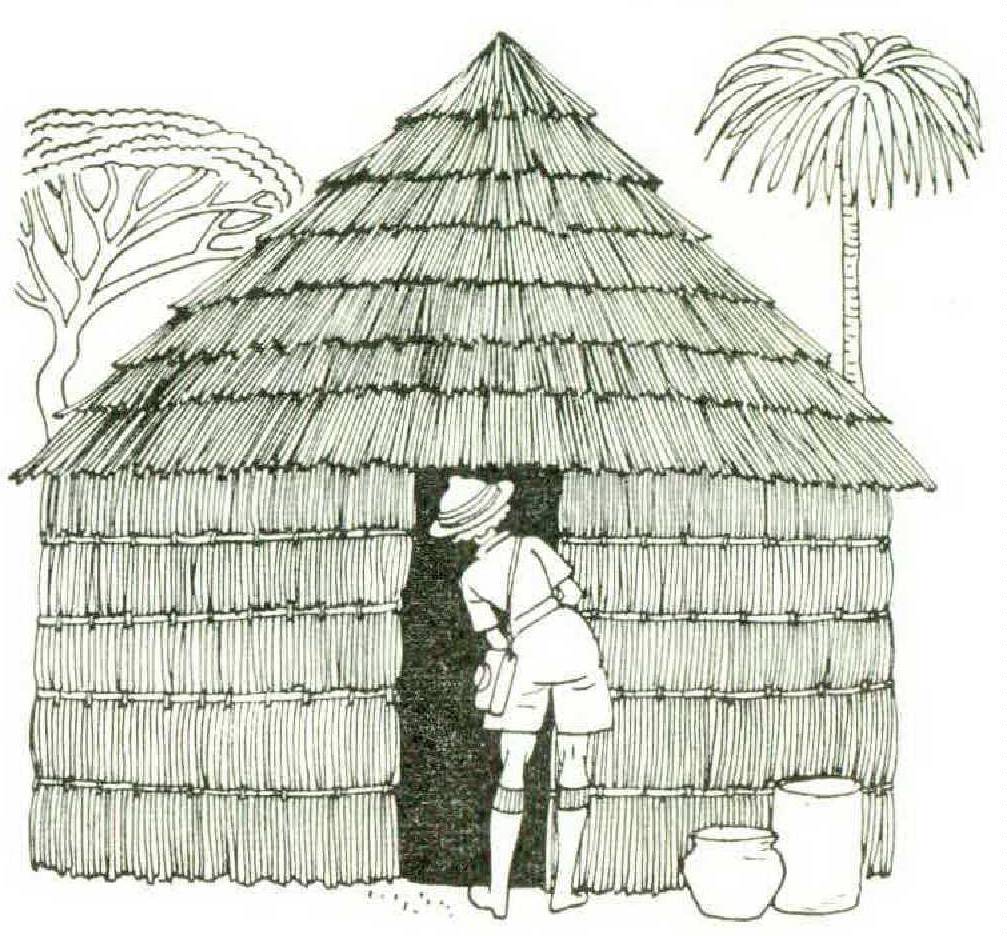
Most people sleep under a grass roof for the first time on this first night out of Johannesburg. The rondavel, a circular mud hut with a grass roof, is the African’s contribution to architecture, and it has been adapted to the wayfarer with great taste. The Kruger Park rondavels are built of brick, and the floors are concrete, not mud. They are lighted by electricity instead of by an open fire, and each hut has a bath and adequate, comfortable furnishings for two.
What is more, servants come at a call, the more cheerfully in return for a smile and a small tip. Service, in fact, is one of Africa’s delights for Americans adjusted to the do-ityourself way of life; it becomes easy to adopt the custom of the country and call “Boy!” The call even brings ice at the cocktail hour, when the hyenas start howling beyond the fence, but there is nothing synthetic about the setting. It is unspoiled African bush — ungroomed, unpruned, bathed in Africa’s sun and the blue of her distances.
Swaziland, further on, is the Africans’ Africa; administered by the Swazis and the British for the Swazis themselves, not for white settlers, it is a country of gorgeous views, where the road corkscrews up and down mountains and over a 6500-foot pass.
The Swazis, who stride along free as air between their villages, specialize in wondrous, photogenic hairdos, dyed red or white and topped with feather or quill. Their tiny huts on the mountain slopes look no more secure than birds’ nests. But travelers find rooms with baths in the hotels of the two towns: pretty Mbabane, the capital, or Barberton, the commercial center.
For good measure, a day and two bracing nights are spent high up in the Hluhluwe Reserve, the home of the black rhino, the rare white rhino, and innumerable wart hogs, among other game. On a mountaintop are rondavels and simple living, and buffalo or rhinos can be seen on the sky line. Visitors may leave their cars and stalk up to the game with a guide, even to the great black hulks that look like boulders except for a great horn riding the boulder’s nose and big ears wriggling to catch sounds. One steps quietly, not saying a word. Finally the guide hisses a warning; this is the spot to stop for a rhino picture.
To go from Hluhluwe to Durban is like going from the bush to Miami or Palm Beach. From the bare rolling hills and beehive huts of Zululand, the road threads through an ocean of sugar cane. A suburb or two suggests civilization, and soon towering hotels line the Marine Drive; to the left stretches one of the great beaches of the world, pounded by the Indian Ocean.
Durban is South Africa’s favorite resort town and its second port, and the many hotels reflect concern for tourists. The Edward probably is the best known and most distinguished, although there are dozens which compete with it successfully, all modern and well furnished. The Marine is the oldest and most selective and is about as up-to-date as a tea cozy. But hotels in Durban are places to eat and sleep, for life is lived on the beach. Hungry for the sight and feel of the sea, people come from all over the high, dry African plateau, from the Congo and beyond, to dive in the surf, bask in the sun on the sand, and ride in rickshas drawn by Zulus decked out in feathers, furs, and beads.
In no other big city does one see so many colorful non-Europeans, mostly Indians in saris and Zulus who specialize in fine beadwork. One may even buy a love letter to wear as a necklace. Curio shops pepper the city, but the best fun is to go to the native and Indian markets. they seethe with color, exuberant buyers and sellers, and crafts from many tribes.
Surf fishing — for sharks, if you wish — and horse racing also draw people to Durban, but do not try to be there for the July Handicap Week without a room booked a year in advance. This is South Africa’s great social and sporting event, run for a purse of about $15,000.
From Durban it is just a day’s drive to the Royal National Park, where snow lies on Mont-auxSources, over 10,000 feet above the sea, and the hotel even has a ballroom! Or one can wind through the Valley of a Thousand Hills, a Zulu reserve of breath-taking beauty.
This itinerary can be covered within ten days of arriving in Johannesburg, where Americans invariably feel at home. The bustle is familiar, and so are the big new office buildings and the movie houses. On arrival or between trips into exotic parts it is an agreeable place to shop for curios, have a shampoo and wave, and enjoy the fleshpots.
Of hotels, the Carlton and the Langham are the best known, though I found the Waldorf less commercial, and its food ranks with that in good European hotels. Instead of Indians, as before World War II, most maîtres d’hôtel and waiters are Italian; French menus are the rule rather than the exception. Of dishes peculiar to South Africa, the best known is delicious in spite of its unsavory name, monkey gland steak. It is a good tenderloin under a hot tomato sauce. By American standards and at the current rate of exchange, hotel prices are low. A single room with bath and breakfast costs about $8.00 a day.
Johannesburg still is a mining town ringed with mountains of mine tailings, and it would be a mistake to miss a tour through one of the gold mines. It is no common experience to be swaddled in miner’s gear, to step into an iron cage and then be dropped to between two and three thousand feet underground, where Africans drill the gold-bearing rock.
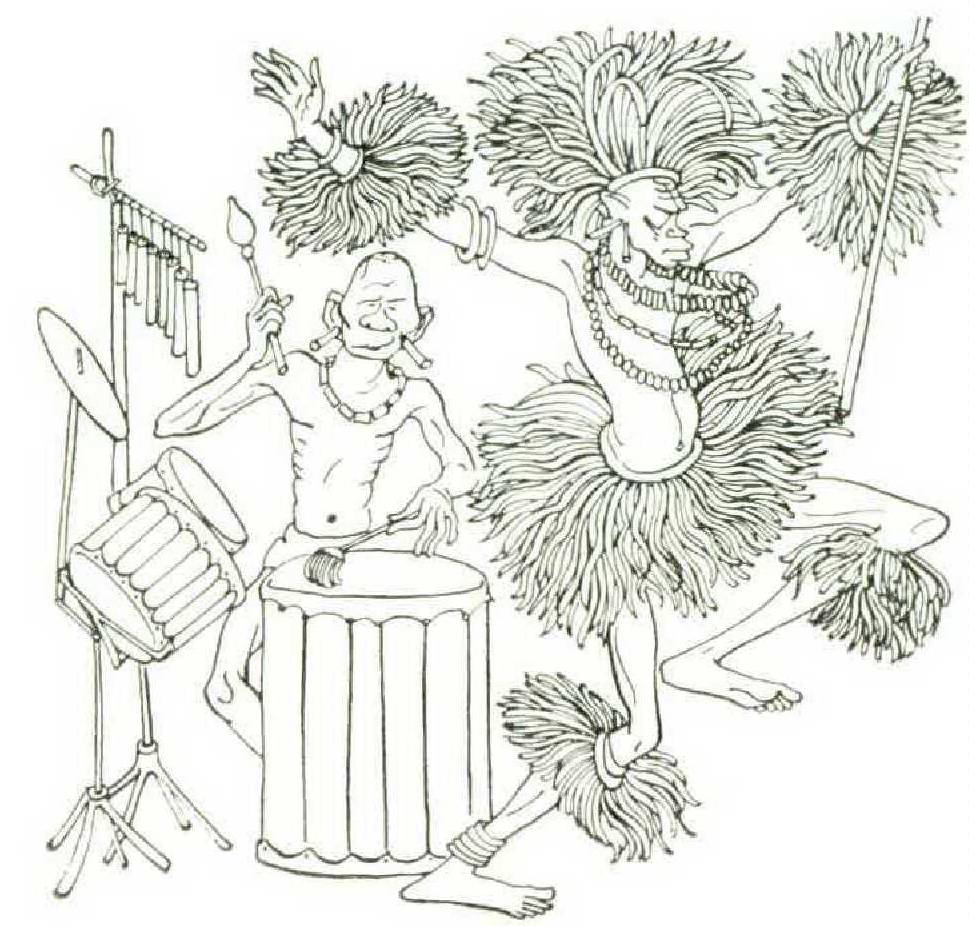
Tribal dances are another side to life in the mines. On Sundays, African mineworkers compete with one another in tribal teams. Dressed in feathers, furs, and vivid calicos, each team is bent on outdancing another to the rhythm of its own tom-toms, xylophones, rattles, and sticks beaten on sticks. Tom-toms and dancing are forbidden almost everywhere Europeans live, so this is perhaps the only spot, except Durban, where a visitor can see tribal dancing. Any hotel will arrange these excursions.
For carvings, skins, basketwork, and bead work, the most reliable shops are Ivy’s, the principal taxidermist; the Gainsborough Galleries; a new shop in Greaterman’s basement (this one is not very well known); and Moritz Davis and Son, opposite the public library on President Street, where treasures may be found beneath the dust. Over the past few years, recordings of African music have been made which are well worth bringing home.
But cities are not for African addicts. For hunters whose dream it is to slide into bush shirt and shorts, and head into the blue on the heels of a tracker looking for elephant spoor, there has been fulfillment since the Northern Rhodesia government had a brain storm eight years ago.
The Luangwa Valley is one of the great game areas left in Africa. It always has been sparsely populated, which means the natives had not shot all the game before the government stepped in. The river never dries up, so animals concentrate along its banks during the dry hunting season, between July and midOctober. In this unique spot the government began organizing safaris from which hunters return in a short time with elephants, buffalo, lions, and other big game.
The Luangwa was formerly weeks from New York, but nowadays all one needs to do is fly to Fort Jameson via London or Johannesburg. From “Fort Jimmie” the government takes over, transports the hunter to a camp on the Luangwa, houses him in a rondavel, puts him in the hands of a professional hunter, assigns a tracker and skinner to him, and all but guarantees his trophies.
To ensure the best hunting, groups are limited to two hunters and two observers. The canny government discovered that wives often want to go along to hunt with a camera, protected by their own guides, and wives are classed as observers. Perhaps their presence keeps the standard of living at a high level, although the British have a genius for creating comfort in the bush. In any case, a trained chef sees to the roast duck, Maryland chicken, antelope steaks, and the rest of the menu, and beer comes cold from a refrigerator.
Americans have reserved most of the few safaris which are offered each year, with the Swiss running a close second. Not having hunted in the Luangwa, I can only quote what they say: “an unbelievable three weeks’ safari,” “an elephant after seven days,”"the best hunting place in the world.”
I cannot imagine going all the way to Africa without visiting Victoria Falls, only four hours’ flight from Johannesburg. Men have been awed by their magnificence and power since prehistoric time, and Africans still toss offerings to Mosi oa Tunya, the Smoke that Thunders. Except for a few trails and rustic benches, the surroundings remain as Livingstone found them, not “improved” by so much as a guard rail. So do not go too near the edge or watch the swirling water too long. People have been overcome by vertigo and have disappeared, and since the challenge of light and spray and setting is unending, photographers are tempted to take hair-raising chances.
In its gentler dry-season mood of smooth water under a blue sky, the Zambezi turns residents and visitors alike into boatmen. They take to canoes when the river is safe or go picnicking by launch to one of the palm-tufted islands to watch hippos blowing. But it takes a fisherman to appreciate the river.
Africans always have fished the Zambezi, of course, and now sportsmen are discovering it. From many points near the Victoria Falls Hotel big catches are taken of tilapia (bream), barbel, and tiger fish, which live up to their savage name. The excitement of fighting these big leaping fish in Barotseland is a memory that still thrills me. And it is only forty miles from the falls to the rocks and rapids of Katambora, where one may spend the night in a simple fishing camp. Tackle can be rented in Livingstone, so there is no need to bring it.
I went one morning on the dawn game flight in the de Haviland Rapide, which flies about one hundred miles upriver, over the great Barotse plains. The plane dipped over herds of elephants, giraffe, and ostriches; a buffalo having his morning wallow; sable and big antelope. Returning, we flew low enough to spot crocodiles on the river banks; then high again over the falls. This bird’s-eye view is perhaps the grandest of all.
On any walk near the hotel one meets baboons and monkeys, untiring clowns who show off by climbing over parked cars and who carry on their uninhibited family life as if no one were around. In July lucky travelers may see wild elephants crossing the river on their annual migration, and all year round a variety of game roams the thousand-acre Victoria Falls Game Park.
Only a day’s drive to the south lies the great Wankie Game Reserve, where the bush rolls to Bechuanaland, inhabited by 3000 elephants living alongside Africa’s other animals. The two camps ($1.05 per night per person) are for rugged travelers who arc content to cook their own meals, or have a servant do it, on an outdoor grill.
Not all pleasures at the falls demand a fund of energy. Across the road from the eastern cataract, Stone Age man has been reconstructed in the field museum on the very spot where he once lived, with the tools he used 400,000 years ago. Another exhibit shows how the falls were formed; how they began sixty miles below the present site and were seven miles downstream 10,000 years ago.
At the Rhodes-Livingstone Museum in nearby Livingstone, native and foreign visitors gather in the patio at eleven and three o’clock to hear and watch Africans play the same style of drums and xylophones as those on display. The audience is as interesting as the concert, and the music comes straight from the villages. The museum houses rare letters, diaries, and various tangible relics of the two men who began Rhodesia’s modern history, as well as a wealth of other Africana. For future visitors there will be an African village, now being built, where they can watch skilled craftsmen making baskets and working in wood, skins, ivory, and iron. Their work will be on sale, too, after passing high museum standards; so one will find the best there.
Including three excellent meals, the prices at the sprawling, spacious Victoria Falls Hotel range from about §6.00 a day to twice as much, depending on the room. Service is deft and constant. Tea and drinks are served on wide terraces facing the garden and the gorge. A swimming pool, tennis courts, and a bowling green are at the guests’ disposal.
Only time, imagination, and exchequer limit what one may do in Africa, and there are trips off the tourist trail which can be fitted even into a tight schedule.