The German Wines
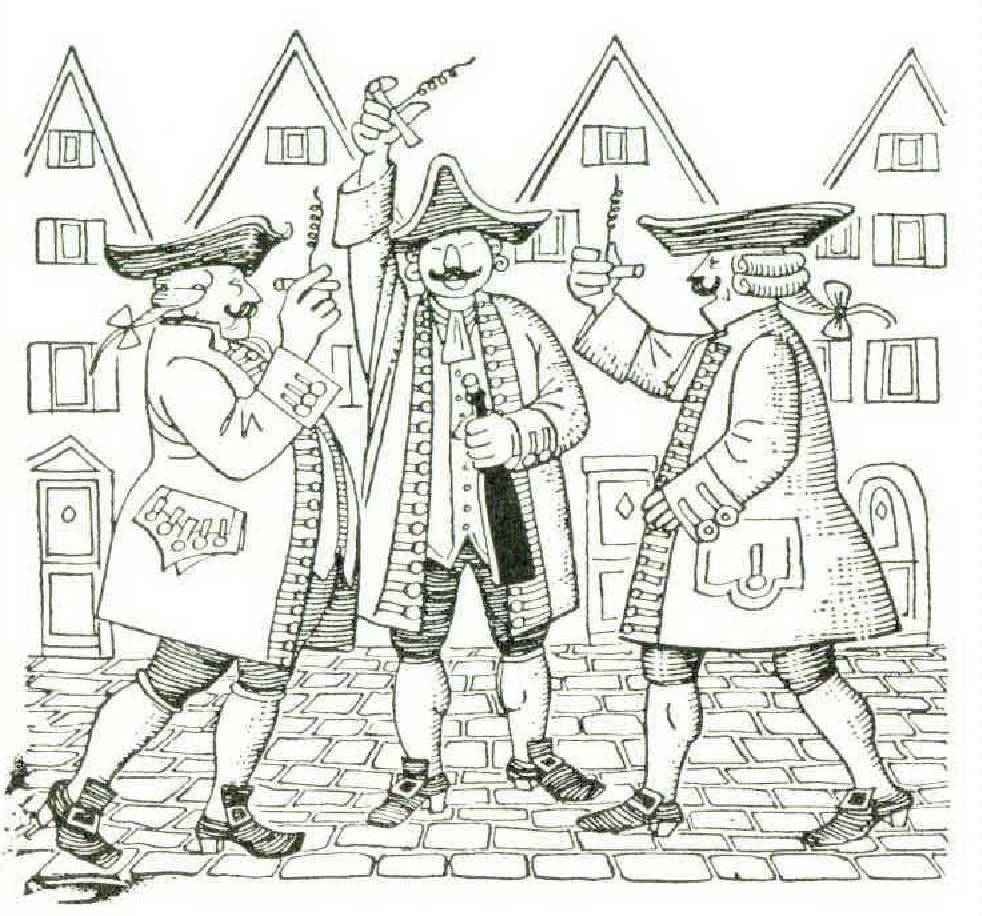
In 1752, so the story runs, the town councilors of Bingen (on Rhine) decided to taste the 1751 vintage — or that part picked, pressed, and cellared by the commune — immediately after a routine meeting. The council chamber was only two floors above the cellars, and the meeting was short. At the end of it, the clerk of the council, Ritter Boos von Waldeck, found he had no pen to sign the minutes. He decided that a pencil must do but he asked for one in vain: four and thirty councilors could not produce even a stub of a pencil from among them.
Boos von Waldeck decided that the signing of the minutes could wait, so he led the councilors down to the cellar. There stood three dozen bottles ready for tasting, but the clerk had forgotten something for the second time that morning. He had no corkscrew. This time his omission was quickly repaired: four and thirty corkscrews flashed from the pockets of the councilors.
The Germans love tales about wine like that of the “Bingen pencil” almost as much as the wines themselves. The telling of them is a part of the ritual of wine drinking which Germans not only expect, but demand. Here are a few points of that ritual.
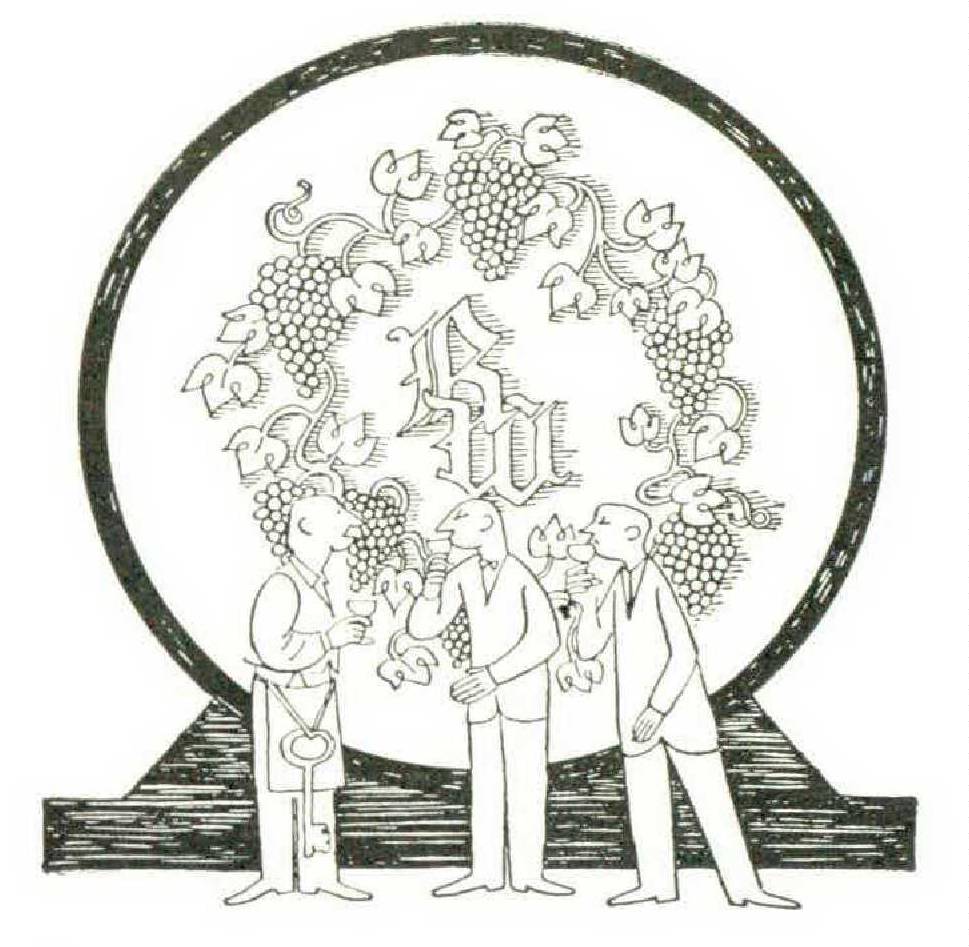
Drink wine whenever you feel like it, but drink good wine at your leisure. Wine glasses must be clear, so that you can appreciate the delicacies of tints, which range from the palest yellow of young and maidenly wines to the rich gold of pedigree veterans (85 per cent of all German wines, including all the best, are white). Long-stemmed glasses bring a wine’s fragrant bouquet nearer to your nostrils and give plenty of stem for your hand (cellar-cold is the best temperature for most German wines; twenty minutes in the icebox can improve and will do no harm; not so, warm fingers clasped too lovingly round the bowl of the glass).
The Germans are famous formalists, and ritual can become tedious. They lift their glasses, with appreciative sniff, to each and every member of the company, with spoken or silent toasts, sip reflectively, lower their glasses halfway, but lift them again to their neighbors before setting them down at last.
Although it has obvious virtues, this can take rather long. But there is time to savor color, bouquet, and taste and to roll the wine lovingly round the palate. Three senses have been satisfied. The German approach is at least preferable to that of the host of the Southward Inn, on the West Road out of London, who hung this sign in the sixteenth century, “Drunk for one penny. Dead Drunk for twopence. Clean Straw for Nothing.”
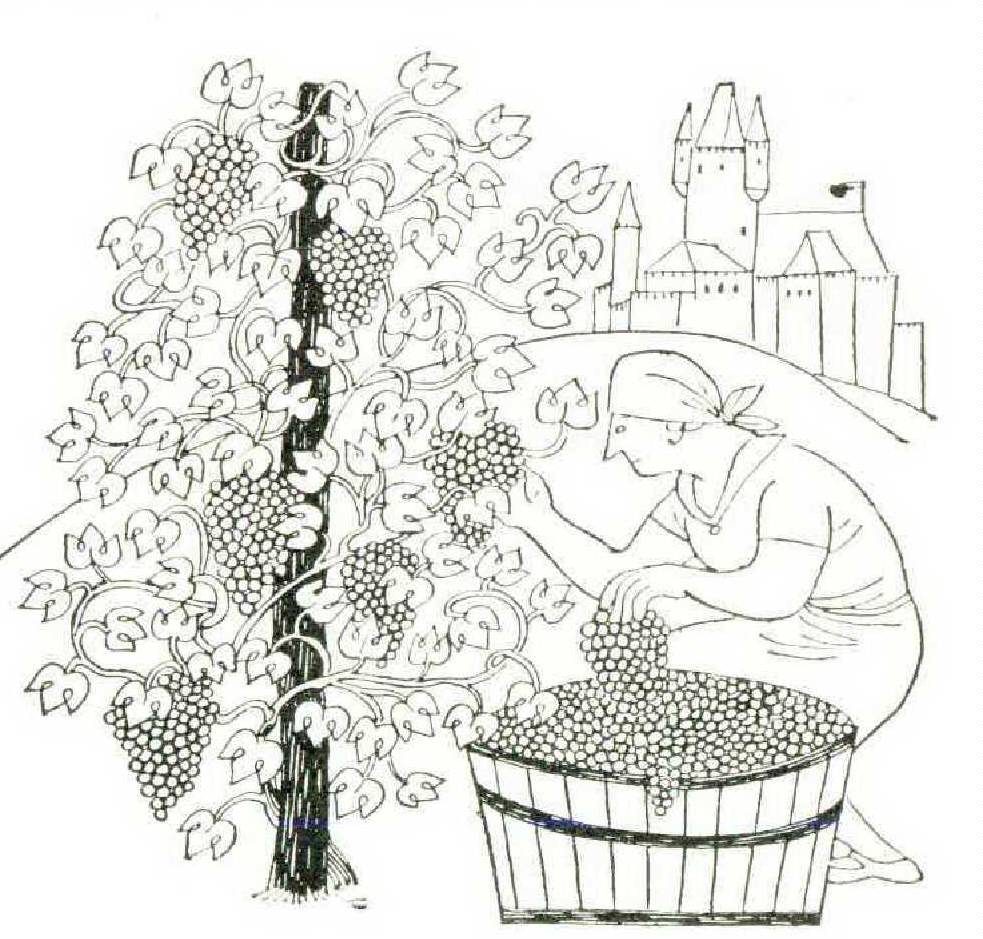
The making of German wine has nothing to distinguish it from the making of wine elsewhere. The vintage, or Weinlese, is late, and pickings may start at the very end of October. In a northern climate the grapes need every bit of sunshine they can get. Grapes for white wine are pressed at once, for red after ten days’ fermentation has let the color “run” from the skins. Vin rose, made when grapes are pressed a few days after picking, is rare in Germany and is called Schimmer or Schiller wine. The word connection with the poet is not genuine.
After pressing, the juice is run into casks and left there for upwards of six months (once it was much longer, but Germans are drinking their wines quicker and younger today, and they have to be bottled sooner). The cellar master will sample the wines from each cask so often that he will get to know all their characteristics. The cellar owner will conduct his private tasting before he bottles his wine or ships it to wine merchants in the cask. The latter, today, want to get their hands on as much wine as possible. They may buy, bottle, and sell sooner than is desirable. Such is the pressure caused by expanding demand — Germans are drinking nine liters per head per year, against only four before the war — and the effects of three lean wine years in a row.
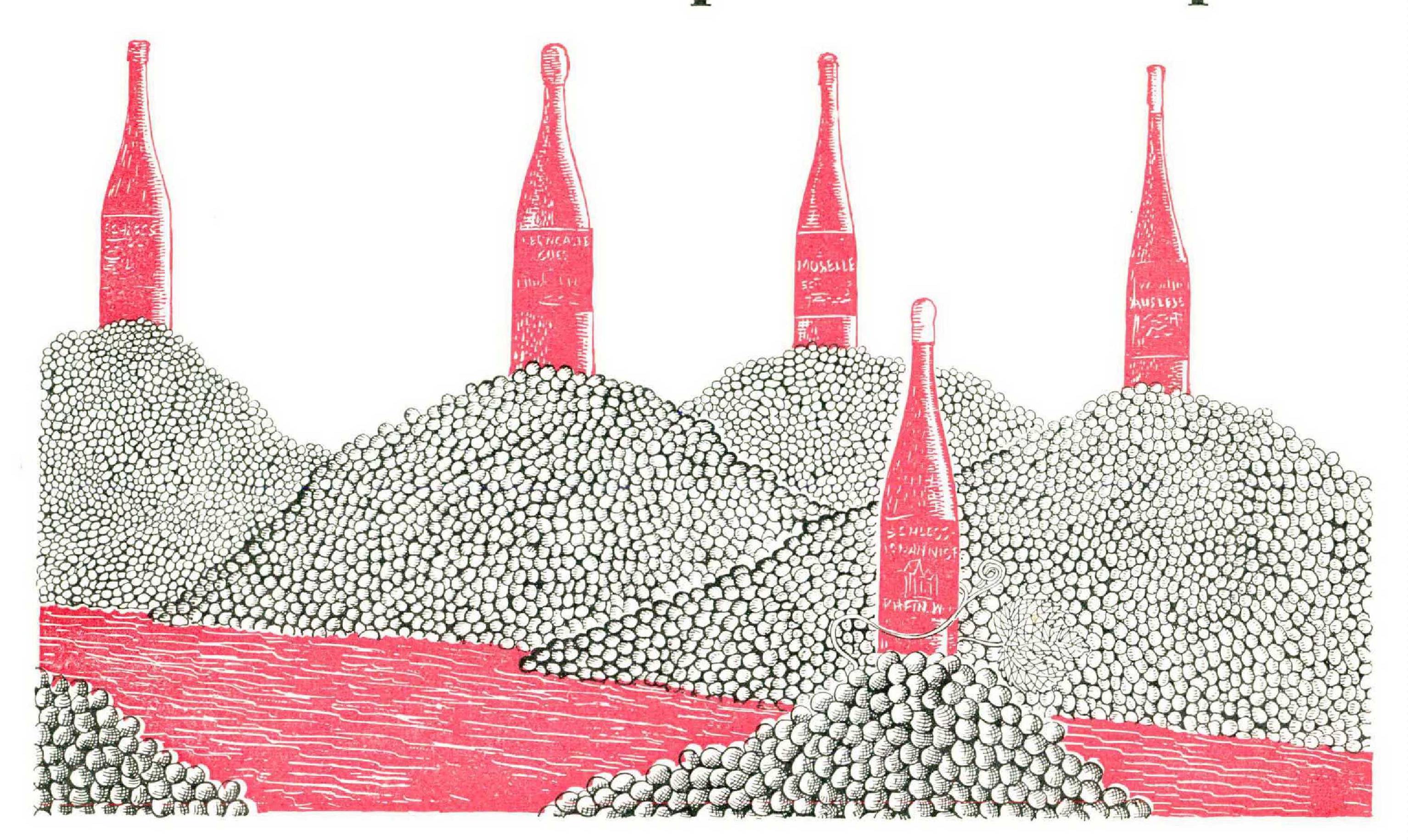
The long, reddish-brown Rhine wine or Ilock bottles, the slim green bottles of the Moselle, and die squat Bocksheatel flagons of Franconia have this in common: they bamboozle the beginner and often trap him into asking for a “brand” name which he mistakenly imagines must give him something good. This made Carl Zuckmayer, author of The Captain of Kopenick and The DeviVs General, remark that “There are no wane lists in the United States or Canada which do not head their German wanes — if they include any — with Liebfraumilch. Sometimes one has the impression that Germany is a single vineyard.”
In reality, Liebfraumilch — never great and often much less than good — is, as an English expert said, “Germany’s appellation non-contrôlée.” It can be produced from any Rhine wine of good quality and pleasant character. This was laid down by the Worms Chamber of Commerce in 1910. Little wine comes from the original vineyards of the Liebfrauenstift church in Worms, and Liebfraumilch may be collected from anywhere within forty miles of the place, blended by wine merchant or foreign importer, sweetened with injections of ground or liquidized sugar. A fancy label (Doctor Faust or Meistersinger) can be slapped on and a substantial price charged. Liebfraumilch takes a low place, if it appears at all, on German wine lists. On British, its latest and most dubious challenger is “Schön Frau Wein. Piesporter.”
Germany has wine laws, and they are strictly enforced. German-bottled wines — including Liebfraumilch robbed of its pretensions — do not deceive. A glance at the cork capsule will show whether the wine has been bottled by a grower or, at least, a reputable firm. If the bottle carries the word Originalabfüllung, this is a second check on its authenticity. If labeled Natur, it will contain a pure wine, with no sugar added. Then there is the name of the wine and its year of growth.
If the word Spatlese is added, the grapes were picked late and the wane is of superior quality. Higher up the scale is the Auslese, for whose making whole bunches of grapes have been set aside and allowed to ripen longer. Titles of nobility, like Feine and Feinste Auslese, sometimes occur on the rungs of the ladder leading to the kings and emperors, the Beerenauslese and Trockenbeerenauslese. These are nectar — rounded, smooth, sweet but not sickly — and can be made only in very small quantities in a very fine summer. They may fetch twenty or thirty dollars a bottle at the wine auctions of Trier and Eltville.
All in all German wine labels should cause no alarm or embarrassment. One reads: “1953. WehlenerSonnenuhr. Auslese. Originalabfüllung Josef Pruem.” This is easily interpreted: 1953 was a magnificent wine year; Wehlen has some of the finest vineyards on the Moselle and in all Germany; the Pruems have grown wine for several hundred years. This one will be full, fruity yet elegant, a delicious experience.
The science of German wine classification had a curious beginning. Three hundred years ago the Johannisberg hill in the Rheingau, facing south across the river and sitting snug in the shelter of the Taunus mountains, was the property of the Abbey of Fulda. One year, the Abbot — busy, perhaps, with rents and revenues — forgot to order the Weinlese. The sun continued to shine with unusual strength, drawing the moisture out of the grapes and shriveling them up. At the same time, a tiny fungus, Botrytis Cinerea, got to work on its own, coating the fat, full grapes until they began to look like desiccated raisins.
One day the Abbot saw them and flew into a rage. He believed that the vintage was ruined, but he ordered the picking — more as a penance than anything else. The grapes were picked in a great hurry, at just the right time, and they made a great wine. Out of this disordered incident has grown the science of picking, as complex as any military campaign.
Naturally, wine names are liable to have snob appeal. The Bernkastel Doktor, for instance, is apt to sell at substantially higher prices than the equally fine wines made a mile or two away at Wehlen, Zeltingen, and Graach. Berncastel Cues had a good story to tell which made it famous. Kurfürst Bohemond of Trier contracted a mysterious fever in 1356. His doctors were helpless, so a reward was offered for a cure. It was earned by a knowing old soldier, who carried a small cask of wine to Trier from the Berncastel Cues vineyard, which the Kurfürst gratefully dubbed his “doctor.”
Schloss Johannisberg has a double cachet, from castle and place name. One or two names have won fame from originality, like the Wachemheim Geruempel, or dustbin; the Forst Ungeheuer, or monster; or the Kroev Nacktarsch, or bare backside, which appeals so much to the natives of the Moselle. But these names need not be distrusted; their use is guarded by the few entitled growers.
Good and bad years are easily remembered. The London Wine and Food Society issues a little card each year which lists the quality of European wines under eight headings during the past twenty-five years. Rhine and Moselle are lumped together under one heading. The card is a faithful index, for the society’s president, M. André Simon, is a connoisseur and gourmet.
Thanks to high acid content, German wines keep a long time, and there are 1921s which have retained body and are still developing their beautiful bouquets. But these are exceptional. Even 1934s and 1937s, highly prized in their days, are beginning to fade. The fine 1945s and 1947s arc unprocurable, for little was made in each of those two wonderful summers, and 1949 also produced a small vintage—1.3 million hectoliters against an average year’s 2.5 million. The 1949 wines are still met sometimes and should be greeted with tender fervor. The year 1949 was the third of a run of seven “fat” years, and looked to be the best until 1953 came along.
The 1953 vintage is still laying its claims to be the wine of the century (contested by 1911, 1921, and 1949). In the first place, it was a big year in quantity, with no spring frosts and a 2.4 million hectoliter vintage. Secondly, it produced wines of superb quality that benefited from an autumn sunshine which looked as if it would never end. These wines are still maturing and gaining in character. Unfortunately they are already terribly expensive, with a fair Nutur wine costing around two and a half dollars.
This is only partly due to increasing consumption in Germany. Since 1953 there have been three lean years. Three million hectoliters were produced in 1954, but there was far too little sunshine. The wine has a high acid content and will keep but will not improve. There was some late summer sunshine in 1955, but pickings were put forward by an early hoarfrost which stripped the leaves from the vines and stopped organic growth. The 1955s may not keep.
In 1956 there were gripping black frosts in spring, and less than a million hectoliters of wine were made. The quality is wretched, and what reached the market is mostly sugared stuff lacking all individuality. Although 1957 will produce twice as much wine, it will be mainly mediocre. October’s fine days came too late and too singly, and 1957s will not prove as good as 1954s and 1955s.
Good wine can still be found inside Germany. The average wine waiter knows his job; the average Weinstube values its clientele. The following notes may be of some help.
RHINE WINES. The three great areas are Rheingau (powerful, sweet wines of individuality), Rhine-Hesse (fuller and sweeter, with rather less character), and Rhine-Palatinate (very strong, with striking differentiations and often a smack of the soil). As with all German wines, serve chilled. They are best drunk with the dessert course, but do well with fish and white meat, too. Classic Rhine wines are made from the Riesling grape, but a Traminer, with its muscat flavor, is especially good with dessert.
MOSELLES. Lighter, less sweet than Rhine wines, the best have exquisite fragrance and delicacy. A 1952 Natur (they can still be found, since they suffered from unfair comparison with the 1953s) is ideal with fish. Saar and Ruwer wines rank with Moselles, but have their own special characteristics.
FRANCONIAN WINES. Mostly from the Würzburg area, they have a greenish glitter and an earthy taste which takes a little acquiring. Excellent with oysters and other seafood. ideal for a proor post-theater sandwich, and interesting as an alternative to pre-meal sherry or cocktail. These are wines for clear thought and discussion.
OTHER WHITES. The best of those not mentioned are the wines of the Nahe valley, which are, in a sense, halfway between Rhines and Moselles, less fruity than the former but fuller than the latter. They are strong, and excellent general-purpose wines. South Baden produces a fierier wine on the slopes of the Kaiserstuhl, and there are plenty of drinkable wines in fair-to-good years all the way down the Rhine valley.
GERMAN REDS. Deliberately left to the last. A good lining to the throat is needed in order to drink one of the “famed” reds of the Ahr valley. Some of the reds of Würzburg, the middle Rhine, and the Heilbronn area of Württemberg are much better. But compared with the French, German reds are harsh and of poor value. It is no consolation to hear that they have medicinal properties.
Three final thoughts about German wines. Uncork the bottle a good half hour before drinking it. This gives it a chance to “breathe.” Do not replace the cork; it may flake into the wine.
Do not expect good wine or lovely wine queens at ) Weinfeste — most of Lite wine is young and “green,” and the wine queens are generally chosen on the basis of knowledge of viticulture. Their physical proportions are apt to be generous.
Remember that the German wine growers are among the most hospitable people in the world. I have attended private tastings which began at three in the afternoon and ended at three in the morning. Growers believe in their wines, because love as well as labor has gone into their making. They love an apt compliment, as the story of the Archduke of Hesse’s visit to the Mayor of Schwabsburg shows. The archduke was given a splendid meal and excellent wine. At the end of it he raised his glass to the mayor and said, “Sir, your wine is incomparable.” The latter, unabashed, answered, “Your Highness, now I’ve made a good friend, I must admit I had a better one put by. Which we shall drink now . . .”