Some Painters of the Russian Ballet
Derain, Matisse, Picasso, and Bakst — these were some of the painters who worked with the Russian Ballet on IGOR STRAVINSKY’Screations. How they collaborated with Diaghilev is the gist of this conversation between the composer and ROBERT CRAFET.This will be part of the book, CONVERSATIONS WITH STRAVINSKY,to be published by Doubleday next winter.
ROBERT CRAFT — Do you remember Balla’s set for your Fireworks?
IGOR STRAVINSKY — Vaguely, but I couldn’t have described it even at the time (Rome, 1917) as anything more than a few splashes of paint on an otherwise empty backboard. I do remember that, it baffled the audience, however, and that when Balla came out to bow there was no applause: the public didn’t know who he was, what he had done, why he should be bowing. Balla then reached in his pocket and squeezed a device that made his papillon necktie do tricks. This sent Diaghilev and me into uncontrollable laughter, but the audience remained dumb.
Balla was always amusing and always likable, and some of the drollest hours of my life were spent in his and his fellow Futurists’ company. The idea of doing a Futurist ballet was Diaghilev’s, but we decided together on my Fireworks music: it was “modern” enough and only four minutes long. Balla had impressed us as a gifted painter and we asked him to design a set. I made fast friends with him after that, visiting him often in his apartment in Rome. He lived near the zoo, so near, in fact, that his balcony overhung a large cage. One heard animal noises in his rooms as one hears street noises in a New York hotel room.
Futurism’s headquarters were in Milan, however, and it was there that my meetings with Balla, and also Boccioni, Russolo the noisemaker, Carra, and Marinetti took place. Milan was to Switzerland as Hollywood is to Beverly Hills, except that it was easier then to take the train and descend to Milan for an evening performance than it is now to drive to downtown Los Angeles. And in wartime Milan my few Swiss francs made me feel agreeably rich.
On one of my Milanese visits Marinetti, Russolo (a genial and quiet man but with wild red hair and beard), and Pratella, another noisemaker, put me through a demonstration of their “Futurist music.” Five phonographs standing on five tables in a large and otherwise empty room emitted digestive noises, static, and the like, remarkably like the musique concrète of seven or eight years ago (so perhaps they were Futurist after all, or perhaps Futurisms are not progressive enough). I pretended to be enthusiastic and told them that sets of five phonographs with such music, mass produced, would surely sell like Steinway grand pianos. Some years after this demonstration Marinetti invented what he called “discreet noises,” noises to be associated with objects. I remember one such sound (to be truthful, it was not at all discreet) and the object it accompanied, a substance that looked like velvet but had the roughest surface I have ever touched. Balla must have participated in the “noise” movement too, for he once gave me a papier-mâché Pascha cake that sighed very peculiarly when opened.
The most memorable event in all my years of friendship with the Futurists was a performance we saw together at the Milan puppet theater of the Pirati Cinese, a “drama in three acts.” It was in fact one of the most impressive theatrical experiences of my life. The theater itsell was puppetsized. An invisible orchestra — clarinet, piano, violin, bass — played an overture and bits of incidental music. There were tiny windows on either side of the tiny stage. In the last act we heard singing and were terrified to see that it came from giants standing behind these windows; they were normal-statured human singers, of course, but we were accustomed to the puppet scale.
The Futurists were absurd, but sympathetically so, and they were infinitely less pretentious than some of the later movements that borrowed from them — than Surrealism, for instance, which had more substance. Unlike the Surrealists, they were able to laugh at their own pose of artist-contraGentiles. Marinetti himself was a “Balalaika,”but he was also the kindest of men. I regret that he seemed to me the least gifted of the whole group when compared to Boccioni, Balla, and Carra, who were all able painters. The Futurists were not the airplanes they wanted to be, but they were at any rate a pack of very nice, noisy Vespas.
R.C. — Did you choose Nicolas Roerich to do the Sacre du Printemps décors?
I. S. — Yes, I had admired his sets for Prince Igor and imagined he might do something similar for the Sacre; above all, I knew he would not overload. Diaghilev agreed with me and, accordingly, in the summer of 1912, I met Roerich in Smolensk and worked with him there in the country house of the Princess Tenischev, a patroness and liberal who had helped Diaghilev.
I still have a good opinion of Roerich’s Le Sacre. He had designed a backdrop of steppes and sky, the hic sunt leones country of old map makers’ imaginations. The row of twelve blonde, squareshouldered girls against this landscape made a very striking tableau. And Roerich’s costumes were said to have been historically exact as well as scenically satisfying.
I met Roerich, a blond-bearded, Kalmuckeyed, pug-nosed man, in 1904. His wife was a relative of Mitoussov’s, my friend and co-librettist of The Nightingale, and I often saw the Roerichs at Mitoussov’s St. Petersburg house. Roerich claimed descent from Rurik, the Russo-Scandinavian Urprince. Whether or not this was true (he looked Scandinavian, but one cannot say such things any more), he was certainly a seigneur. I became quite fond of him in those early years, though not of his painting, which was a kind of advanced Puvis de Chavannes. I was not surprised during the last war to hear of his secret activities and of his curious connection with Vice President Wallace in Tibet; he looked as though he ought to have been either a mystic or a spy.
Roerich came to Paris for Le Sacre, but he received very little attention and after the première disappeared — slighted, I think — and went back to Russia. I never saw him again.
R.C. — Was Henri Matisse your choice of painter for the Chant du Rossignol sets?
I.S. — No, his collaboration was Diaghilev’s idea entirely. In fact, I opposed it, but too directly (Amiel says, “Every direct resistance ends in disaster”). The production and especially Matisse’s part in it were failures. Diaghilev hoped Matisse would do something very Chinese and charming. All he did do, however, was to copy the China of the shops in the Rue de la Boètie. Matisse designed the sets, the costumes, and curtain.
Matisse’s art has never attracted me, but at the time of the Chant du Rossignol I saw him often and liked him personally. I remember an afternoon with him in the Louvre. He was never a rousing conversationalist, but he stopped in front of a Rembrandt and started to talk excitedly about it. At one point he took a white handkerchief from his pocket: “Which is white, this handkerchief or the white in that picture? Even the absence of color does not exist, but only white, or each and every white.”
Our Matisse collaboration made Picasso very angry: “Matisse! What is a Matisse? A balcony with a big red flowerpot falling all over it.”
R.C. — Do you remember Golovine’s décors for the first Firebird?
I.S. — All I remember about them is that the costumes pleased me at the time. The curtain was the curtain of the opera. I do not remember how many sets Golovine did, but I am certain that if I were transported back to that Firebird of 1910 I would find them very opulent indeed.
Golovine was several years my senior, and he was not our first choice. Diaghilev wanted Vroubel, the most talented of all the Russian painters of that epoch, but Vroubel was dying or going mad. We also considered Benois, but Diaghilev preferred Golovine for his realization of the fantastic scenes in Russian, and Golovine’s orientalism conformed to the ideals of Diaghilev’s own Mir Isskoustva rather than to the academic orientalism then so popular. As an easel painter, Golovine was a kind of Russian pointillist.
I do not remember Golovine at the first Firebird performance. Diaghilev probably did not have money enough to pay his trip (I myself received one thousand rubles, five hundred dollars, for the commission and the expenses of all the travel and stay in Paris). The first Firebird! I stood in the dark of the Opera through eight orchestra rehearsals conducted by Pierné. The stage and the whole theater glittered at the première, and that is all I remember.
R.C. — How do you regard Léon Bakst?
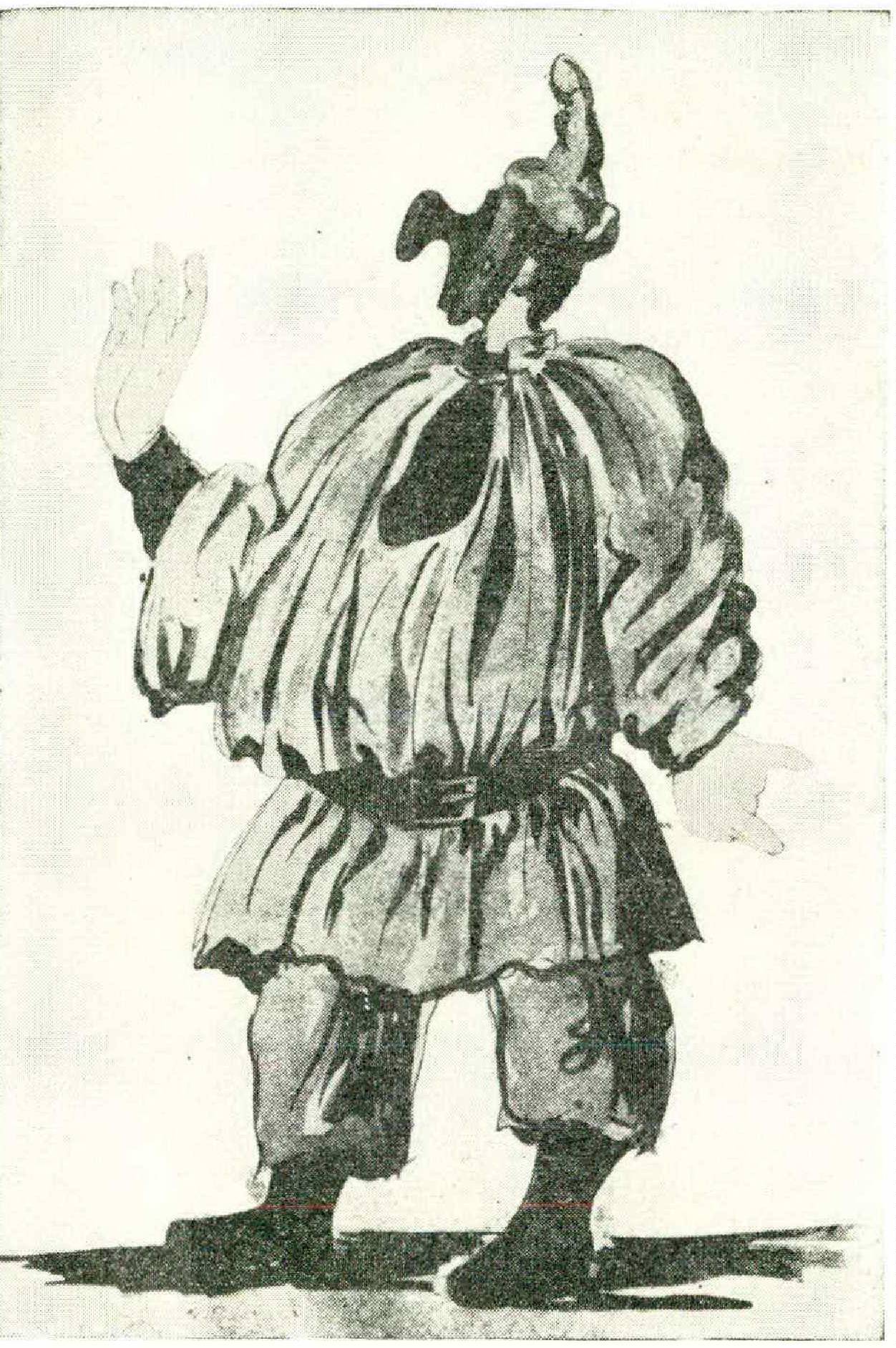
I.S.— No one could describe him as concisely as Cocteau has done in his caricature. We were friends from our first meeting, in St. Petersburg in 1909, though our conversation was largely Bakst’s accounts of his exploits in the conquest of women, and my incredulity: “Now Lev, you couldn’t have done all that.” Bakst wore elegant hats, canes, and spats, but I think these were meant to detract from his Venetian comedy-mask nose. Like other dandies Bakst was sensitive — and privately mysterious. Roerich told me that “bakst” was a Jewish word meaning “little umbrella.” Roerich said he discovered this one day in Minsk when he was caught in a thundershower and heard people sending their children home for “baksts,” which then turned out to be what he said they were.
There was a question of Bakst designing Mavra for me, but a money quarrel resulted with Diaghilev. None of us ever reconciled and I regretted it, especially when only three years later, aboard the Paris on my first trip to the United States, I saw the notice of his death in the ship’s newspaper.
Bakst loved Greece and all things Greek. He traveled there with Serov (Serov was the conscience of our whole circle and a very important friend to me in my youth; even Diaghilev feared him) and published a book of travel diaries called With Serov in Greece (1922) that ought to have been translated into English long ago.
I had seen Bakst’s easel painting before I knew any of his theatrical work, but I could not admire it. In fact, it represented everything in Russia against which Le Sacre du Printemps is the revolt. I consider Bakst’s Scheherazade to be a masterpiece, however, perhaps the perfect achievement of the Russian Ballet from the scenic point of view. Costumes, sets, the curtain were colorful in an indescribable way — we are so much poorer in these things now. I remember, too, that Picasso considered Scheherazade a masterpiece. In fact, it was the one production of the Ballet he really did admire: “Vous savez, c’est très spécialiste, mais admirablement fait.”
R.C. — And Benois?
I.S. — I knew him before I knew Bakst. He was at that time the most cultivated Italophile I had ever met, and except for Eugène Berman he would be still; and Benois and Berman are very much alike in the fact of their Russian background, their Romantic theater, their Italophilia. Benois knew more about music than any of the other painters, though of course the music he knew was nineteenth-century Italian opera. I think he liked my Petrouchka, however, or, at any rate, he was not calling it Petrouchka-ka as others of his generation were. But Benois was the conservative of the company, and Petrouchka was his exceptional work.
I collaborated with him in a small way before Petrouchka with two orchestrations contributed to Les Sylphides (I doubt I would like these arrangements today — I no longer care for that “clarinet solo” kind of music). But though I was delighted with his work in Les Sylphides I would not have chosen him to do Petrouchka on the strength of it. My real friendship with him began in Rome in 1911, when I was finishing Petrouchka. We stayed in the Albergo Italia near the Quattro Fontane and for two months were with each other every day. Benois was very quickly up on his amourpropre. The Ballet’s greatest success at that time was Le Spectre de la Rose with Nijinsky, and Benois was plainly jealous of Bakst’s role in that success. Jealousy accounts for an incident that occurred the following year. Benois was painting the backdrop of Petrouchka’s cell when Bakst happened on the set, picked up a brush, and started to help. Benois fairly flew at him.
R.C. — And was Michel Larionov your choice of painter for Renard?
I.S.— Diaghilev suggested him first, but he became my choice also.
As you know, I composed Renard for the Princess Edmonde de Polignac. In 1914 I was cut off from my Russian estate money and lived in Switzerland on a very small income. Diaghilev could pay me nothing in those war years, so I accepted a commission of 2500 Swiss francs from the Princess de Polignac. Diaghilev was furious with jealousy, but Diaghilev was always jealous; I think I am fair in saying that about him, and I certainly knew him well enough to be able to say it now. For two years he would not mention Renard to me (which did not prevent him from talking about it to others: “Our Igor, always money, money, money, and for what? This Renard is some old scraps he found in his dresser drawer”). Diaghilev visited me in Ouchy in January or February, 1917, and I played Les Noces for him. He wept (it was very surprising to see this huge man weep), saying it had touched him more than anything he had ever heard, but he would not inquire about Renard even though he knew I had completed it. And he knew also that the Princess de Polignac had no theater, that she had commissioned me only to help me, that she would give Renard to him to perform.
Larionov was a huge blond muzhik of a man, even bigger than Diaghilev (Larionov, who had an uncontrollable temper, once knocked Diaghilev down). He made a vocation of laziness, like Oblomov, and we always believed that his wife, Goncharova, did his work for him. He was a talented painter nevertheless, and I still like his Renard set and costumes.
Renard was performed together with Mavra, as you know, and both works were preceded by a big orchestral ballet which made my small-scale pieces seem even smaller. Renard was no huge success, but compared to it Mavra was even less of a hit. Mavra was very ably designed by Survage, an unknown artist who had been commissioned after Diaghilev had quarreled with Bakst. The Mavra failure annoyed Diaghilev. He was anxious to impress Otto Kahn, who attended the première in Diaghilev’s box and who was to have brought the company to America. Otto Kahn’s only comment was: “I liked it all, then ‘poop,’ it ends too quickly.” Diaghilev asked me to change the ending. I refused, of course, and he never forgave me.
Another ballet painter I saw a lot of at this time was Derain. I liked his “Parigot" talk, liked him more than his pictures, in fact, though there are charming small Derains. He was a man of large build and a copious drinker. During the latter activity, furniture was sometimes smashed, but I always found Derain very agreeable. I mediated for him in a quarrel with Diaghilev, who wanted to change something in La Boutique Fantasque. In his later years Derain was a solitary figure, and we no longer saw him at concerts or spectacles. My last meeting with him was an extraordinary coincidence. I was driving near Toulon and stopped to walk in a pine woods. I came upon someone standing before an easel, painting, and it turned out to be Derain.
R.C. — Have you any notion where Picasso’s backdrop for Pulcinella might be?
I.S. It was in the dome of the Paris Opera when I last heard, and completely faded save for the moon, whose yellow had been renewed, in part, by a cat. Diaghilev I suppose was in debt to the director of the Opera, and when our company withdrew alter the Pulcinella performances the Picasso was left there.
I have a vague recollection of meeting Picasso with Vollard at my friend Prince Argutinsky’s about 1910, but I did not know him until 1917, when we were together in Rome. I immediately liked his flat, unenthusiastic manner of speaking and his Spanish way of accenting each syllable: “He ne suis pas musicien, he comprend rien dans la musique,” all said as though he couldn’t care less. It was during the time of the Russian Revolution, and we could no longer precede our ballet programs with the imperial anthem. I instrumentated the Song of the Volga Boatmen to replace it, and on the title page of my manuscript Picasso painted a red circle as a symbol of the Revolution. Picasso drew my portrait at this same time (the first one; the armchair portrait was done in his Rue de la Boétie apartment, and the third one was conceived as a mutual gift from Picasso and myself to our friend Eugenia Errazuriz). It was in the Hotel de la Russie near the Piazza del Popolo, where many of the ballet dancers were staying, including Picasso’s future wife Olga (Olga who changed his social life; she had many new robes from Chanel to show, besides Picasso, and suddenly the great painter was to be seen at every cocktail party, theater, and dinner).
We journeyed to Naples together (Picasso’s portrait of Massine was drawn on the train) and spent some weeks in close company there. We were both much impressed with the Commedia dell’Arte, which we saw in a crowded little room reeking of garlic. The Pulcinella was a great drunken lout whose every gesture and probably every word, if I had understood, were obscene. The only other incident of our Neapolitan holiday I can remember is that we were both arrested one night for urinating against a wall; someone in the Maffia had heard of us, however, and we did not have to pay a fine.
Picasso’s original Pulcinella was very different from the pure Commedia dell’Arte Diaghilev wanted. His first designs were for Offenbach period costumes with side-whiskered faces instead of masks. When he showed them, Diaghilev was very brusque: “Oh, this isn’t it at all,” and proceeded to tell Picasso how to do it. The evening concluded with Diaghilev actually throwing the drawings on the floor, stomping on them, and slamming the door as he left. The next day all of Diaghilev’s charm was needed to reconcile the deeply insulted Picasso, but Diaghilev did succeed in getting him to do a Commedia dell’Arte Pulcinella. I might add that Diaghilev was equally against my Pulcinella music at first. He had expected a strict-mannered orchestration of something very sweet.