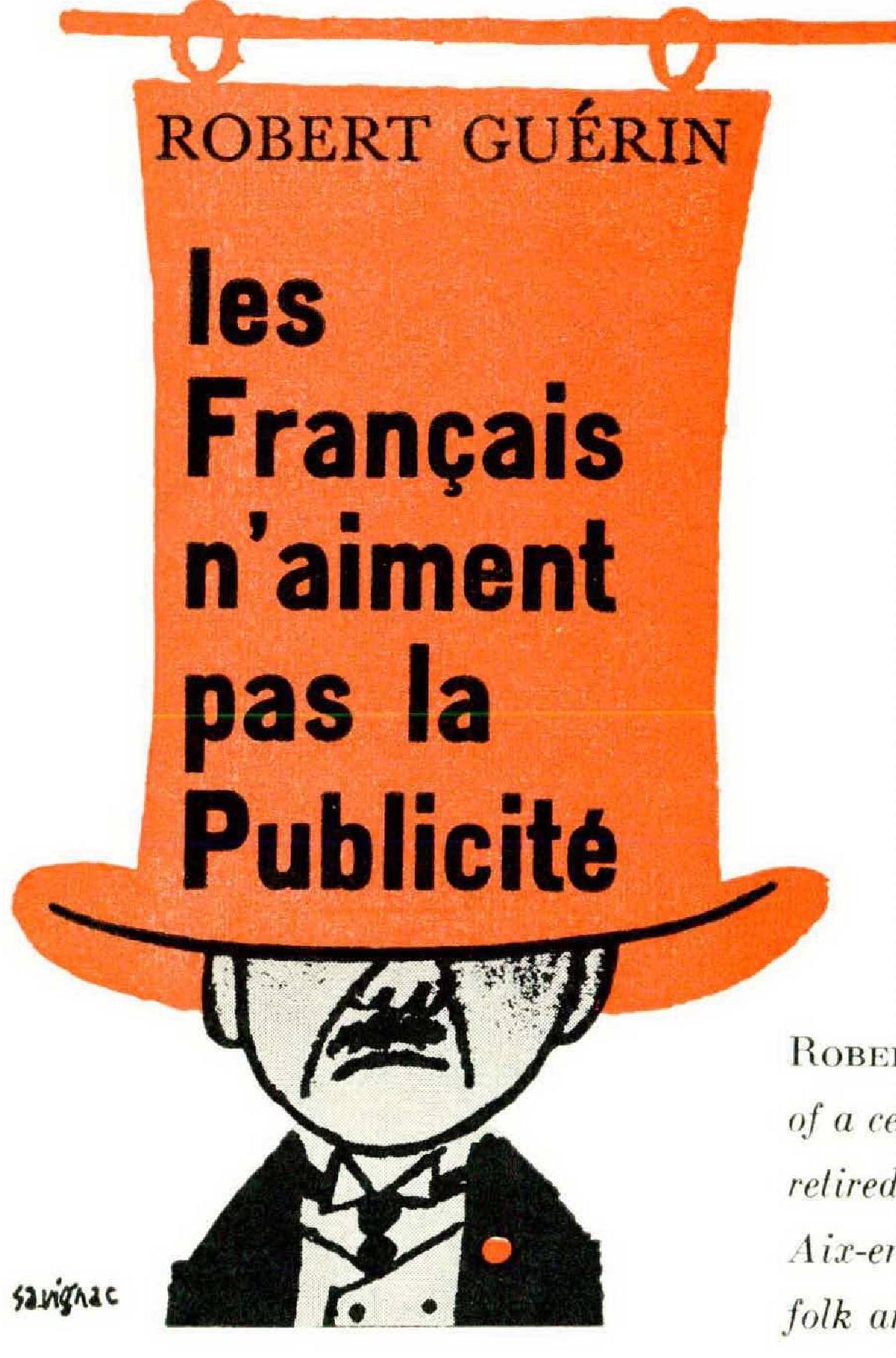
Les Français N'aiment Pas La Publicité
ROBERT GUÉRIN spent more than a quarter of a century in advertising. Now retired, he lives in his country house at Aix-en-Provence, writing, collecting folk art, and cultivating his garden.
ROBERT GUÉRIN
Nor long ago two broadcasters for the RadioTelevision Française were put out to graze for three months for mentioning the name of a commercial product during a program. In France radio and television are state controlled and no advertising is permitted. Thus the government and the parliament who have decreed this state of affairs arc the first to display their hostility to advertising, sacrificing billions of francs a year on the dusty altar of principle.
In France publicity is almost officially declared persona non grata, and this ostracism is the reflection of a general sentiment. The average Frenchman is hostile to publicity. He approaches it warily and reluctantly, pushed toward it by necessity, because in an industrialized country where production exceeds consumption, purchases must be stimulated and the public made to feel new cravings.
One of the peculiarities of the Frenchman’s nature is that he wants to appear less than he is. A deep well of peasant mistrust and bourgeois parsimony incites him to live in the shadows. The fear of the neighbors, the fear of the future, the fear of the taxman have taught him the art of camouflage.
In America a millionaire is a national hero, a model citizen, a star in the financial firmament. The papers show him founding hospitals and hooking swordfish from the deck of his yacht. His descendants bear numbers like the kings of France: W. W. Brown II, W. W. Brown III.
A French billionaire, on the other hand, is a fellow who lives off the income of his income. In a country where the Jacquerie and the Revolution of 1789 are still living memories, it is better to arouse pity than envy. In France public opinion stigmatizes and the treasury penalizes the man who has succeeded. Our great industrial firms are scared stiff of being talked about. The dream of every business manager is to stay safely in the red. If a French storekeeper has his shop front repainted and bathed in neon, the housewives say: “Look how that fool spends the money he has robbed us of,” and they change grocers
We thus find ourselves in a vicious circle. We don’t like publicity because we do it badly. We do it badly because we don’t like it.
If our publicity is so inferior to what it should be, it is above all for certain psychological reasons related to our character. J’he Frenchman is by nature a skeptic. He is distrustful and incredulous. He is fiercely independent, and he does not like someone dictating his conduct or trying to influence him. Fie is a reasoner, so that he distrusts all publicity that is not demonstrated a priori and presented to him in equations. Besides, he does not understand publicity’s essential role, and no one has explained it to him.
Schueller, the great manager of Monsavon and Dop, tells in his memoirs of having for neighbors two Nobel-Prize-winning scientists in physics and chemistry: Jean Baptiste Perrin and Joliot-Curie. Often he would argue with them, for they claimed that publicity was a huge hoax, a means of selling for a bogus price things that could be sold cheaply. “For example,” Joliot-Curie would say, “you take four sous’ worth of sulphate of soda, you put it in a lovely box which costs ten sous, you call it Sels Kruschen, and you sell it for twenty francs. That’s your publicity for you!”
If men of superior intelligence in their own fields don’t understand the first thing about publicity, is it surprising that the man in the street is even further in the dark?
The French are an old people who, like oldtimers, remain attached to their habits of thought. For centuries they lived with the simple idea that the good things of the world are rare and that they sell themselves. “A bon vin pas d’enseigne For a good wine no label,” says the proverb.
Schueller used to explain to his friends that the machine age has changed all this by permitting men to produce quality goods at low prices. But in France if you say, ”C’est de la publicité,”it is generally with a pejorative connotation. It means: it’s a bluff, a fast one they’re trying to put over on you. If a young actress pretends to commit suicide by throwing herself into the Seine, so that the papers can talk about her, everyone says, “C’est de la publicite.”
In France, however, publicity is usually honest, for the simple reason that it couldn’t be anything else. First of all, because it is under constant surveillance. There is a government agency for the repression of fraud which watches over the health of the public and the truthfulness of advertising. When Monsavon launched its milk soap, the Bureau dcs Fraudes visited the Monsavon factory to see if the new soap really contained milk. The French press also has its own agency, the Bureau de la Vérification de la Publicité and the Union des Annonceurs, which includes the largest firms and tries to maintain the moral level of publicity.
Because the public is more distrustful, more difficult to convince, publicity in France should in theory be better, more astute, more subtle than anywhere else; but the opposite is the case. We have inventive minds, original artists, but we don’t know how to use them. The leading poster makers of this century have been Frenchmen. Even today powerful personalities like Cassandre and Savignac are better known abroad than they are at home.
In Paris there is a new school for movie publicity which is unique. Belgians, Swiss, Englishmen, and even Americans now come here to have their film commercials made by movie men like Paul Grimault and Raik. Every year a publicity film festival is held at Cannes which shows that one can marry the art of salesmanship with the art of spectacle in a formula which will satisfy everyone. As for our publicity agencies, there are almost a dozen of them in Paris which, in organization and talent, can rank with the finest. They lack only one thing: clients.
In thirty-five years in the advertising business, I have known a good many business managers, but I have met only three or four who had any sense of publicity, who had that sort of directional flair you find in carrier pigeons. The rest lacked it completely. Their radars were stone dead. These men go in for publicity only because driven to it by force of circumstances, and they do so without conviction. They wouldn’t mind getting themselves known, but they don’t want to make themselves conspicuous, and their advertising reflects this contradiction.
The French industrialist thinks he knows more about his business than anyone else, and he is right. He also thinks that no one can talk about it better than he, and he is wrong. Several years ago a French industrialist embarked on an inspection tour of the United States. In Chicago, where he was received by the president of Swift & Company, the great meat-packing firm, he raised the inevitable question, “And how about your advertising?”
“Our advertising? I see it, like everyone else, when I open the morning paper.”
“What? Doesn’t your agent submit his projects to you?”
“Neither to me nor to any of my directors. Our agent knows his job and I let him do it, so long as he does it well.”
Now let us see how it works in France.
The board of directors convenes at five o’clock in the afternoon. A small attraction has been readied for the occasion.
“Gentlemen,” announces the Chairman, “although advertising is not one of the essential activities we are concerned with here, I thought you might like to see the make-up of a poster we are thinking of using next season. I should like your reactions to it.”
The publicity chief and the poster, one bearing the other, are ushered into the sanctum. It is a thoroughly nondescript poster, which is why it has been selected. A few hasty retouchings have obliterated any signs of vigor and originality that threatened to creep into it. As such it is ready — a masterpiece of mimicry. There is really nothing more to be said. However, you never appeal in vain to the critical sense of seven cultivated Frenchmen during the hour of digestion.
“It’s fine, of course,” says the Economist, “but there’s one thing I don’t care for, and that’s that white background. It doesn’t show up. And it will encourage lovers in the Metro to scribble messages on it and kids to cover it with lewd drawings. It seems to me that a blue background —”
“Blue is a color which doesn’t stand up,” says the Admiral. “In a week your poster will have faded. In my opinion a lovely red —
“Red!” interrupts the Diplomat. “You are not serious? You don’t think we’re going to fork out thousands to finance Stalin’s propaganda! Now wouldn’t we do better with green?”
“For many people,” the Treasurer cuts in, “green brings bad luck. Take my wife—she refuses to wear the emeralds her grandmother left her, though they are real beauties.”
Yellow, of course, is a magnificent color, but an unfortunate symbolism is associated with it which none of the directors, to spare His neighbor, feels like mentioning. Everyone is instinctively agreed that yellow is out of the question.
The publicity chief is in a stew. He has just made a rapid tally and discovered that there are as many directors as there arc colors in the rainbow. The problem thus appears insoluble. Bravely he plays his last card. “And why not black?”
But here the opposition is unanimous. Black? Send for the mortician.
“As for the figure,” the Governor adds, “it’s a ‘pin-up’ — isn’t that what they call it these days? She’s attractive, all right, but it seems to me that the slope of the breast —”
Whereupon all chime in at once, for if each of these gentlemen is an expert in his particular province, all of them are furiously competent when it comes to busts.
The Chairman glances at his wrist watch and in a discreet voice puts an end to the recreation.
“Time flies, gentlemen, and our agenda is pretty crowded. I therefore propose that we go on to more serious matters.”
If it is not that, then it is this:
The scene — March 9, 3 P.M. On his agenda pad the Big Chief has made a note of the appointment and its purpose: “Guerin. Find a slogan.”
“What we need,” declares the Big Chief, “is a real knockout of a slogan. You see what I mean, a slogan like — but no, when you set these ringing phrases down on paper, they sound as flat as pancakes. Their force comes from being repeated millions of times.
“We should be able to hit on something. We must imagine, invent, create. It’s difficult, I know, but what the devil, we have brains, haven’t we? Now there must be a method of going about this.
“What about the small Larousse — or even the big one? We ought to be able to find something in that. Five or six words of the French language — all we have to do is to pick them out and arrange them. Unless perhaps we hit on some foreign word, or some picturesque, compelling piece of slang, or even some new, specially coined expression? A slogan is nothing but a simple phrase, something ear-catching and easily rememberable which conjures up the product’s qualities, something popular and childishly simple, like —
“ No, Mademoiselle, tell him I’m not here. I don’t want to be disturbed. That goose has upset my train of thought. And just when I had something terrific on the tip of my tongue.
“What’s the matter, my dear Guerin? Are you, the specialist, running out of inspiration? So far all the ideas have come from me.
“But wait, what on earth is the time? Heavens, and I have a dinner in town! We still haven’t got our slogan. But believe me, all this cerebral rummaging won’t have been in vain. Tonight my subconscious will work on it, and tomorrow I bet you I’ll have it.”
March 10, 8 A.M. “Hallo, did I wake you up?” The voice at the other end of the line is abnormally contained, the voice of someone who knows how to play an ace. “Mon cher, I have found a terrific slogan, one which says everything. When I think that you’ve been floundering about for six months and that I finally had to bail you out. Well, you won’t get a better one. Just listen: ‘X — the Great French Brand!’ ”