The Years With Ross
To be a Miracle Man on Harold Ross’s NEW YORKER was a summons that few of those tapped for the position knew enough to refuse. But the miracle proved to be the velocity with which the incumbents came and went. Poets, editors, writers, and men about town were hired, only to be fired, often for nonexistent reasons, after a short and painful interval on the job. This, the seventh part of JAMES THURBER’S series, continues his discussion of the long line of Ross’s Miracle Men.
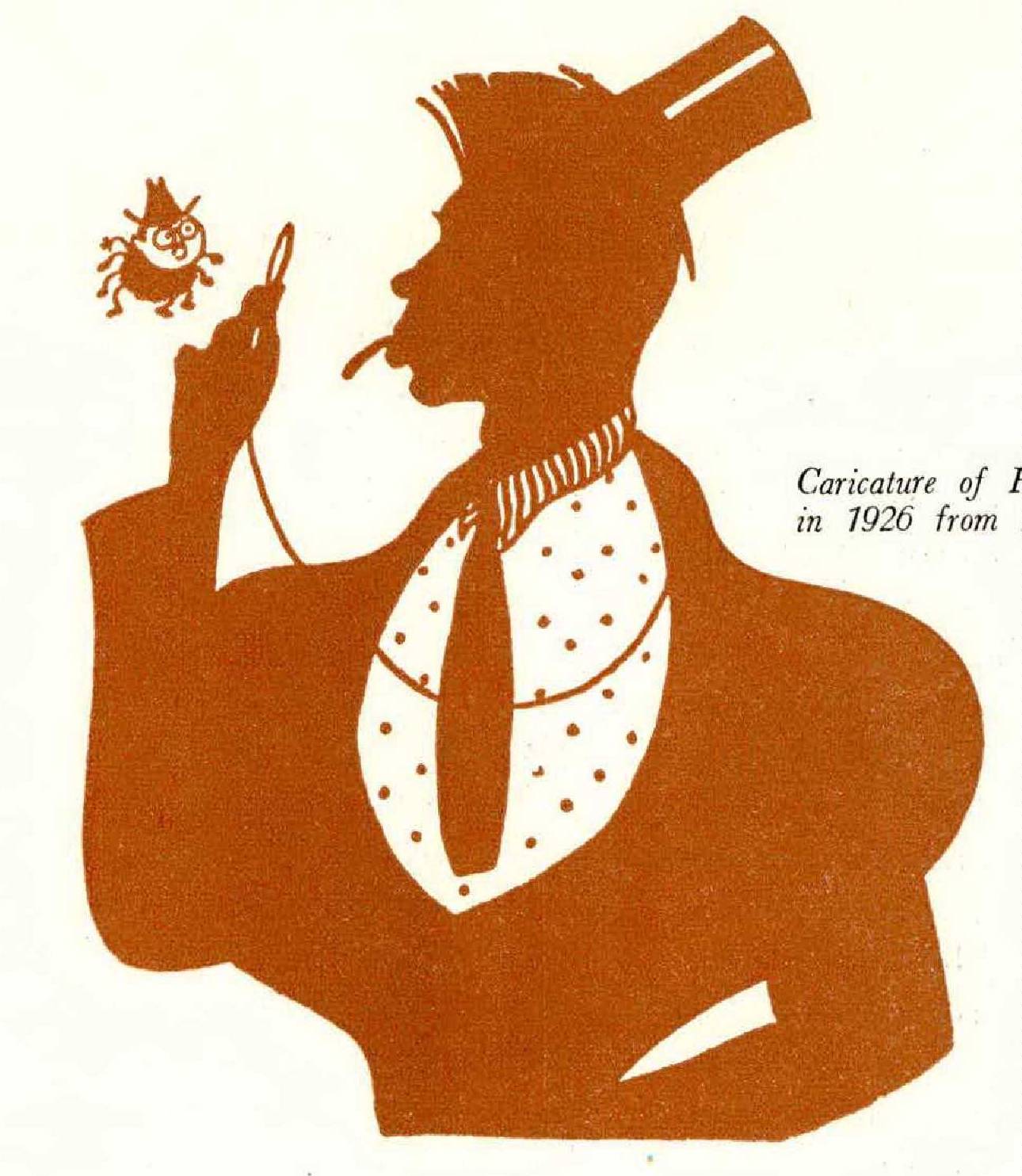
SO MANY people have told me that Harold Ross was a simple mechanism, and so many others have assured me that he was a complex character, it is small wonder that I dreamed the other night that he was both complified and simplicated. There are those who contend that the multiple editor of the New Yorker never stepped off the elevator on his office floor without putting on an invisible military uniform. He was accused of having a secret respect for rigid military discipline, in spite of his waggish and scalawaggish experiences in the AEF. His frequent and profane denunciations of all top brass were supposed to cover a sneaking admiration for GHQ red tape. I can’t go along with this, if only because I’m unable to dispel the image of Ross as the jittery skipper of a schooner out of Coleridge, a ship’s master with more than a dash of mutineer in him. When he is not that figure in my nightmares, he is an “aw shucks” farm boy from Colorado trying to land a 1900 biplane in the middle of Fifth Avenue.
When, as Private H. W. Ross, he was editor of the Stars and Stripes, the situation was more comic opera than American Army. He was once put in the guardhouse for some insubordination by Captain Guy T. Viskniskki, but he had to be released or the newspaper could not have been got out. As editor, he could give orders to Captain Franklin P. Adams and to Sergeant Alexander Woollcott, who once called him, in Paris, “the best editor in the world.” Where and how he finally learned his obsessive reverence for Order and Organization nobody will ever know for sure. Although he was always scornful of American big business and big businessmen, he talked constantly of “running this place like any other business office.” He was vociferous in his contempt for the way most metropolitan newspapers were run, but I always felt that his urge to tear down walls and set up a Central Desk was an unconscious tendency to create a vast city room, with everyone in full sight of everyone else. I go on feeling this in the face of his continual scoffing at all things intramurally journalistic in any writer’s copy. He didn’t want any stories by reporters and ex-reporters about their work on newspapers. “It makes me self-conscious,” he would say, and he once went so far as to insist when I used “city room” in a Talk story that it be changed to “the room where the reporters write their stories.” Whatever the origin of his driving desire for Order and Organization may have been, it satisfied two of his deepest needs: something to keep trying for, and something to keep grousing about.
When I was in Columbus, Ohio, in the summer of 1927, on vacation and on my way out of the job of “running the magazine,” I got a six-word note from Andy White that read: “Thurber. The new passing system. White.” The new passing system, typed on an enclosed piece of paper, went like this: “White passes to Levick who passes to Ross.” I have no copy at hand and it may be that I have left out one of the passes. Perhaps it went like this: “White passes to Barnes who passes to Levick who passes to Ross.” If there was a Barnes, he has long since passed and been forgotten. Sometimes I wake up at night and chant to myself, “White passes to Tinker who passes to Evers who passes to Chance who passes to Ross.” This old system, indicating the official route for “Notes and Comment” from White’s typewriter to Ross’s desk, was one of a hundred similar systems devised by distraught executive editors in a futile effort to set Ross’s organization-conscious mind at rest. These systems formed what Stanley Walker, who later got involved in them, called “the rigmaroles.”
The man who had thought up a way to reroute Comment, so that Ross wouldn’t worry about its getting lost between Andy’s office and his, was named William Levick. He lasted about as long as I had in the untenable job of mastermind and whipping boy to Harold Ross. Levick’s final frantic response to the editor’s demand for a method of keeping track of everything was an enormous sheet of cardboard, six feet by four, divided into at least eight hundred squares, with fine hand lettering in each of them covering all phases of the scheduling of departments and other office rigmaroles. This complicated caricature of System, this concentration^ all known procedural facts, hung on a wall of the Talk meeting room until one day it fell down of its own weight. Ross had stared at it now and then without saying anything. When it crashed, he told his secretary, “Get rid of that thing.” I suppose this was also what he said about a sign I made at the time and hung on a wall near the elevators: “Alterations going on as usual during business.”
BILL LEVICK, one of the few men Ross always called by his first name in the office, had been a friend and colleague of the editor in his San Francisco newspaper days. He had greatly impressed Ross at that time by his calm and efficient direction of a staff of reporters one night when some disaster struck the city. Levick, as I remember it, had been night city editor of the paper. His calmness and efficiency, which had stood up under disaster, did not long stand up under Ross’s continual badgering and heckling. After he gave up the hopeless task of trying to please Ross in the Big Job, he did not leave, like most of the others, but became the art make-up man. He was unhappy in that role, too, because he didn’t like artists, and thought most of their drawings were silly. “You’re the only cartoonist that can spell,” he once told me sourly, “and you may be the only one that can read and write.” I wasn’t ever close to him, but we got along well, although he rarely had much to say beyond his invariable morning greeting, “One day nearer the grave, Thurber.”
A now tottery graybeard says he saw Levick one day in the office with tears in his eyes — tears of fury or frustration were not infrequent in some of the men who worked for Ross. But Levick could be tough, too, and his faint, gentle smile could turn cold when Ross backed him into a corner. One day the editor went up in flames because of the similarity and proximity of two drawings in the front of the book, but instead of bawling Levick out himself, he sent his secretary to the make-up man with a sharp reprimand. Levick took a swing at the fellow and, when Ross sent the young man back with an even sharper message, knocked him down, resigned, went away, and was not seen again.
Bill Levick died a few years later, somewhere in New Jersey, out of work and down on his luck, and I told Ross about it. He was genuinely saddened, and the news depressed him for days. “I didn’t treat him right, goddam it,” he told me. “But he kept calling me ‘Sir,’ and standing there mocking me and grinning at me. He called Woollcott ‘Foolish.’ He would say, ‘Foolish is late with his copy this week for “Shouts and Murmurs.”' He kept saying ‘sked’ for schedule and ‘pix’ for drawings. All he cared about was his goddam pianola rolls. He had millions of them, there wasn’t anything else in his house. You don’t play the pianola every night unless there’s something the matter with you. He even edited the damn rolls, pasting them up with tissue paper, collaborating with guys like Beethoven. He was a good man, though. I was fond of him, but he didn’t belong here.” I thought of asking him, “Who does?” but I just went away and left him with his memories and miseries.
When a system fell down, Ross was usually dejected until he or somebody else thought up a new one, but once in a while the mutineer in him took over. He was gleeful if the falling down or pushing over of a system disturbed, or tangled up, the business department, “those guys upstairs.” Once when a rebuilt typewriter I had been using broke down, I phoned the Underwood Company at noon, ordered its most expensive machine, and charged it to the New Yorker. The typewriter, delivered at the office two hours later, was held up by the alert business office, and a deputy was sent to Ross with the complaint that I had got the machine without authorization or the signing of any requisition slips. The typewriter had been hidden from me in the art stock room, but an office boy told me where it was and I went and got it. The whole illegal procedure delighted Ross. “It’s the only direct action there’s been around here in years,” he yelled at the nervous man from the business department. “I’ll okay it,” and he grabbed pencil and paper and okayed it.
When he found out that I was in the habit of going to the supply stock room, getting in with a passkey and taking whatever I wanted — paper, paper clips, typewriter ribbons, pencils, and wire baskets he sauntered into my office and asked, “How do you get your supplies?” I told him, and he went away grinning. A monthly checkup by the business office had showm a discrepancy in supplies on hand, and again someone had complained to the editor and he had suspected me. I was thwarted for a while when the guys upstairs installed new locks on all the doors, but I smuggled the master key to a locksmith and had a dozen keys made from it. I told Ross about that myself, adding that I had given a few of the extra keys to girls I knew for souvenirs. Ross didn’t believe that, even though it was true. The heartiest laugh of the mutinous skipper came the day I found out, and told him, that the master key to the former system of locks had been retained and hung on a hook beside the new one. I showed it to him. Attached to it was a small wooden plaque on which someone had printed in India ink “master key” and, under that, “doesn’t work.” Ross told the story all over town. It represented to him not merely the bewilderment of some office boy, but the total inefficiency of the business department, which had had nothing whatever to do with it.
AFTER Levick came Arthur Samuels, out of an advertising agency, with previous experience as a newspaper reporter and a magazine promotion man. Art Samuels, who had been a member of the Cottage Club and the Triangle Club in his Princeton days, was a close friend and idol of another Princeton man, Raoul Fleischmann, and any friend and idol of Fleischmann, who was the chief backer of the magazine, was a target for Ross’s slings and arrows, and doomed from the start. Raoul once told me, “Art is one of the funniest men in the world on two Martinis.” When I mentioned this praise to Ross, he said, “I guess I always got to parties when he was on his third, or left before he finished his first.”
Samuels had taken over one of the largest New Yorker offices and furnished it with rugs, large handsome bridge lamps, and other fancy appointments that must have brought Ross’s disapproving tongue out of his mouth when he first beheld this change. He himself liked a plain newspaper-type office — “I don’t want to look like the editor of Vanity Fair.” Samuels lasted until just after he came back from a six-week leave in Europe. I learned later that Ross had intended to fire him while he was abroad, but he put it off until Art’s ship was back in the harbor of New York. Then, just before Samuels disembarked, he got a telegram from Ross telling him he was through. Late that afternoon the editor called me into his office. He was sitting with his head in his hands, and he said, “Samuels was just in here bawling the holy hell out of me. No white man would have fired him the way I did, I guess.” I could tell he had taken quite a verbal lashing, and he was to get others.
Later, hell and high voices broke loose in his office when Geoffrey Heilman gave him a verbal going over, which no doubt Ross had coming to him. Some weeks after that, Ross held up a Hellman piece so long that Katharine White said to him one day at a Talk meeting, “Why haven’t you put the Heilman piece through? We all think it’s very good.” Ross turned this over in his mind for ten seconds and then said, “He called me a liar,” picking one of the least provocative of Geoffrey’s descriptions of him. (He bought the Hellman piece that day.)
It was a basic fact of Ross’s nature that he really respected no man who didn’t, at one time or another, fight back and yell him down. I had many a yelling bout with him in his office, but we always ended up on good, even affectionate terms. One day ten years ago he and William Shawn were trying to explain to me what they thought was the matter with a couple of pieces I had written in a series on soap operas, and Ross snapped, not out of his heart, but out of his ulcers, “If you could see, you would know what we mean.” That sent me rocketing into the higher reaches of lurid damnation of all editors. He said he was sorry, and he was, but he never immediately got over the effects of one of our yelling spells. That noon I was having lunch at the Algonquin with my wife and daughter (then sixteen), when Ross came over to our table. We talked amiably for a while and then he spurted, “Something happens to Jim once a month that makes him carry on like a woman.” This indelicate allusion was remarkable in a man as self-conscious as a choir boy in the presence of women, and embarrassed to death if anyone then made a reference to the functional. My daughter had met him first when she was only nine and he was in one of his most blustery moods. I asked her afterward what she thought of him, and she said, “He’s gruff, but I’m not afraid of him.” She might have been speaking for her sex in general.
Thorne Smith doesn’t properly belong in any New Yorker or, for that matter, any other category, but he underwent a stretch of torture, both give and take, as a member of the staff during the winter of 1929-1930. I had brought him in and introduced him to Ross, saying that he had given up an advertising job to write a book — it must have been The Stray Lamb — and found himself unable to get work. Thorne Smith, straight out of Wonderland, looked like a cousin of the White Rabbit, and completely befuddled Harold Ross. The editor took him on, though — mainly, I am sure, because he had edited a service magazine during World War I, a Navy publication called Broadside. The two men, disparate if there ever was disparity, talked about the Stars and Stripes and a mutual acquaintance who had been on the wartime Army Gas Attack. Everything went wrong between Ross and Thorne, who once didn’t show up for a week. “You ought to know where he is,” Ross told me. “He’s your responsibility.” I said that Smith was God’s responsibility, not mine or any man’s. When he finally did appear, Ross said, “Why didn’t you telephone and say you were sick?” Thorne had a lovely answer to that: “The telephone was in the hall and there was a draft.”
The New Yorker had in a special file at that time a stack of profiles that needed editing before they could be used, and Smith had been given an office and told to try his hand at fixing them up. It didn’t work out. “He can’t use a typewriter, or if he can, he won’t,” Ross told me, and then, with dramatic voice and gestures, “He sits out there writing on foolscap with a quill pen.”
“By candlelight?” I asked.
“You have me there,” said Ross. “Where the hell did you find him, anyway?”
“I didn’t find him,” I said. “God sent him to you.” Smith departed soon after that, to join the other poor little lambs who had gone astray. It was only the other day that I found out he had once written, on foolscap, but with a modern fountain pen, an entire Talk department which was never used. Ross must have put him up to that secretly. I count it among my sorrows, and literature’s losses, that his Talk department is nowhere to be found.
JAMES M. CAIN was a puzzle to Ross, too. All men puzzled him to some degree, but Thorne Smith and Jim Cain were much too much for his understanding. “We called him Dizzy Jim,” an old-timer told me recently. “You were Daffy Jim.” It seems that Cain liked to work on the floor, where there was a lot of room, and used to put the Talk department together down there. He once lifted high the hearts of Andy and Katharine White, at a Thanksgiving Day dinner at his apartment, by putting the turkey, platter and all, on the floor and carving it, blandly going on with the story he was telling, and he told stories exceeding well.
Jim wasn’t at the New Yorker long, only a few months, but the memory of him has not dwindled there. When he got the hell out, he didn’t want to sec Ross or the New Yorker again, and I don’t blame him for leaving any mention of it out of the piece about him in Who’s Who. He had been on the Baltimore American, the Baltimore Sun, and the New York World, and he was at one time a professor of journalism at St. John’s College in Annapolis, where he had been born. Cain must have known Ross in France, when he was editor of the 79th Division’s Lorraine Cross. Jim is a big man, and Ross was always a little wary of big men. Once when he got into a hassle with Joel Sayre over a projected profile on Ross’s detective friend, Raymond Schindler, the wary editor said to me, “Jeezus, your friend Sayre is a big guy.” My researches and reflections have turned up the interesting truth that all of the Miracle Men were of short physical stature except Cain and Ralph Ingersoll, and maybe one or two others out of the more than thirty. I am over six feet myself, but when Ross and I tangled, I weighed only 150. (I have reached 186 now, a weight, alas, I’ll never be able to throw around in Ross’s office during a monthly yelling spell.)
In 1931 my daughter had about seven months to go before she was born when her mother and I bought a house a mile outside Sandy Hook, Connecticut, and Ross pretended to be frightened when he heard about my plans to live in the country. Timid, as usual, about taking up personal matters with a man face to face, he assigned Cain the task of trying to dissuade me from moving out of the city. Jim had approached the subject gingerly in my office, saying only a couple of sentences that I recognized at once as bearing the stamp of a Ross panic, when he suddenly stood up and said, “This is none of my business, or Ross’s, either. I’m sorry I mentioned it. Live where you want to and the way you want to.”
One day Jim had sent on to Ross some manuscript of which the editor could make neither head nor tail. He sent it back to Cain with a memo attached that is still in existence. It read, “What is the signifigance of it all?” Anyway, that is the misspelling of “significance” as I had remembered it for twenty-five years, but, as you will see, I was wrong. Just before Jim left he had the memo framed in leather and presented it to his successor, Bernard A. Bergman, who still has it. I wrote him a few weeks ago to check the spelling of the big word and got this reply: “signigifance (sic).” Harold Ross’s spelling was often grotesque. He was always looking up words he questioned in copy he was reading, but he never seemed to doubt his own accuracy. In all the years I knew him he never got “prodigal” right. He spelled it “progidal” and pronounced it as if it were spelled “prodgidal.”
It was in 1934, to get back to Jim Cain, that he brought out The Postman Always Rings Twice. I once asked Ross if he had read it, and he said, “It wouldn’t be my kind of stuff.” I have no doubt that, if he had started reading it, he would have put it down, thus becoming the only reader in the country able to do that. He didn’t even try to read A Farewell to Arms and dismissed that novel with “I understand the hero keeps getting in bed with women, and the war wasn’t fought that way.”
I HAVE a recent letter from Bernard Bergman about Ross that ends: “He was a great man. I wish I could have been close to him, but I never was.” Bergman lasted almost two years, beginning in 1931. He quit because Francis Bellamy had appeared on the scene, and Bergie was wise enough to realize the newcomer was to become the new Genius; the old ritual of firing and hiring was about to begin once more. After Bellamy disappeared, in his time and turn (“He smoked cigars,” was Ross’s epitaph for this victim), the editor phoned Bergman, who had just left the Philadelphia Rec- ord, and tried to get him to come back. He rambled on, in his loud voice, about the job of “editorial publishing,” whatever that meant, and the rebirth of his conviction that Bergman could handle “certain tough problems in the office.” Bergman said, “That’s just what I was doing,” and he laughed, and Ross laughed, too, and they both hung up, laughing.
Bergman, like me, went to Ohio State, helped edit the Daily Lantern, and was a reporter on the Columbus Dispatch. We had been friends since 1915, and I persuaded Ross to hire him to supervise the “Talk of the Town.” Ross had finally found out, after years of hit and miss, what manner of man and writer I was, but I don’t think he ever knew anything about Bergman. A man’s past dropped away, and his life began anew, when he went to work for the New Yorker. Bergie had been a regimental sergeant major in World War I, a newspaper reporter and editor, and a New York press agent. In high school, in Chillicothe, Ohio, nearly fifty years ago, Bergman organized a fourpiece orchestra to play for Saturday night dances at the Knights of Pythias Club. His clarinetist (Bergman played the violin, and played it well) was a youngster named Theodore Friedman, whom Bergman paid two dollars and a half a night until he let him go because he jazzed up everything, did funny things with a plug hat, and disconcerted the other boys. A decade later Theodore Friedman, alias Ted Lewis, was earning 110,000 a week (the Palace, the Ziegfeld Follies, the Ziegfeld Roof), and Bergman was his press agent. For a long time, starting about 1928, Bergie had contributed to “Talk of the Town” the best items and suggestions of any outsider, and when Ross asked me, after the vanishing of Ingersoll, Raymond Holden, Ogden Nash, and several others, if I knew a good man for Talk, I brought Bergman in and he was hired.
I had asked Ross to promise me that he wouldn’t elevate Bergman to the Genius chair, and he said he wouldn’t, but he did. “I’m going to give Bergman a crack at that job,” he told me. “I think he can run the magazine. Don’t say anything about it, though, because I haven’t told him yet.” I left the room, giving the door a good slam. I hated to lose the man who had brought to Talk facts and anecdotes about a dozen New Yorkers whose careers fascinated Harold Ross, the Gee Whiz Guy. They included Jake Volk, the building wrecker, Louis Marshall, an eccentric millionaire lawyer who rode to work on the El and back home on the subway, George and Ira Gershwin, and George Grosz, the German artist, with whom Bergman and I once had dinner. Grosz, I told Ross, wanted to meet the New Yorker artist “whose work began where the other cartoonists’ left off.”
“Well, did he?” Ross asked.
“He meant me,” I said shyly.
“Hogwash,” said Ross, who didn’t believe a word of it. The day that Ross promoted Bergman, I sat outside his office and eavesdropped. Bergman got the works, the whole rigmarole, from “You got to hold the artists’ hands” through “I’m, by God, going to keep sex out of this office” to “I want to run this place like any other business office.” I got up in disgust, went to the men’s room, and put up the window because it was a hot day. I heard the door open and close behind me, but I didn’t see who it was. Then I went out and met Bergman coming down the hall. “Ross’s secretary just came in and said you were going to kill yourself in the men’s room,” he told me. “Ross turned to me and said, ‘That’s my life! Do something about it.’ ”
Bergman had one great failure and at least one great triumph at the New Yorker. His failure lay in his inability to build a “fake partition” by means of which Ross could get to the men’s room unseen and ungreeted in the halls. Nobody else could have designed such a crazy partition, either, and the dilemma wasn’t solved until someone suggested he have a lavatory built just off his office. “Well, I’ll be damned,” Ross must have said, when this simple way out of embarrassment was presented to his astonished mind. The lavatory was installed, and it not only saved Ross the torture of being spoken to by employees, but it eliminated uncomfortable dialogue with writers and editors in the men’s room. Once, standing trough to trough with John Mosher, he grumbled, “Why aren’t you writing any more casuals?” “Because I have lost the slight fancy that sustained me,” Mosher explained. It was the kind of Mosher retort that left Ross flabbergasted, and he was miserable when he had nothing to say.
Bergman’s great triumph was the hiring of Alva Johnston, and I’ll let him tell that story himself:
“When I first took over the M.E. job, Ross said he had been trying to get Alva Johnston to come full time to the New Yorker for a long while. But Alva always refused. Said he was too old to change his field. He was a reporter and he didn’t want to take a chance on magazines. Ross said to me that if I could get Alva to come to the New Yorker, that’s all I’d ever have to do.
“‘How much did you offer him?’ I asked.
“‘Oh, we never discussed salary,’ Ross said.
“‘Well, let’s offer him $300 a week,’ I said.
‘That’s double what he’s getting on the HeraldTribune. And if we offer him a lot of money, he just won’t be able to turn it down.’
“ ‘Bergman, you’re a genius,’ Ross said. ‘I never thought of offering him money.’
“So I made a date with Alva. I told him we’d guarantee him $300 a week. I can still see Alva turning pale, standing up, and saying, ‘Gee, I’ll have to think that over.’
“I went back to Ross and told him we got Alva. We had, too.”
This incident, certainly important in the history of the New Yorker, “showed Ross’s occasionally nai’ve and charming iinpracticality, although he was the world’s greatest.” The quoted words are Bergman’s.
Harold Ross’s loss of Bergman was William Randolph Hearst’s gain, for the former New Yorker editor was hired to build up the New York American’s daily “March of Events” page, known to the printers as “the highbrow page,” and build it up he did. A few months later Ross ran into him somewhere and said, “You’re causing a lot of excitement at the New Yorker — and worry, too, I guess. But keep it up, I like it.” I don’t see how he could have liked it, because Bergman had signed up, among others, for one or two columns a week, Bob Benchley, Frank Sullivan, Clarence Day, Ogden Nash, and Jim Cain. He also got stuff from Mencken and Oliver Herford which Ross would have liked for the New Yorker. I did some columns for the highbrow page, and quite a lot of drawings. The appearance of my drawings there caused Ross to pass the buck to Someone, who passed it to Someone Else, who passed it to Katharine White, who wrote me a note asking me if I hadn’t broken my New Yorker contract by not first letting the art meeting see my drawings for the American. The New Yorker had seen them all and turned them down. I passed this fact to Katharine, who passed it to Someone Else, who passed it to Someone, who passed it to Ross.
My drawings ceased appearing in the American when Bergman got a note from old Hearst himself, which read: “Stop running those dogs on your page. I wouldn’t have them peeing on my cheapest rug.” In 1934 the Old Man stopped Cain’s columns, too, over Bergman’s protest that Jim was one of the best and most popular American writers. Hearst’s final note on this matter read: “Get rid of Cain. I thought Abel had done it. Sorry he failed.”
(To be continued)