Persian Paradox
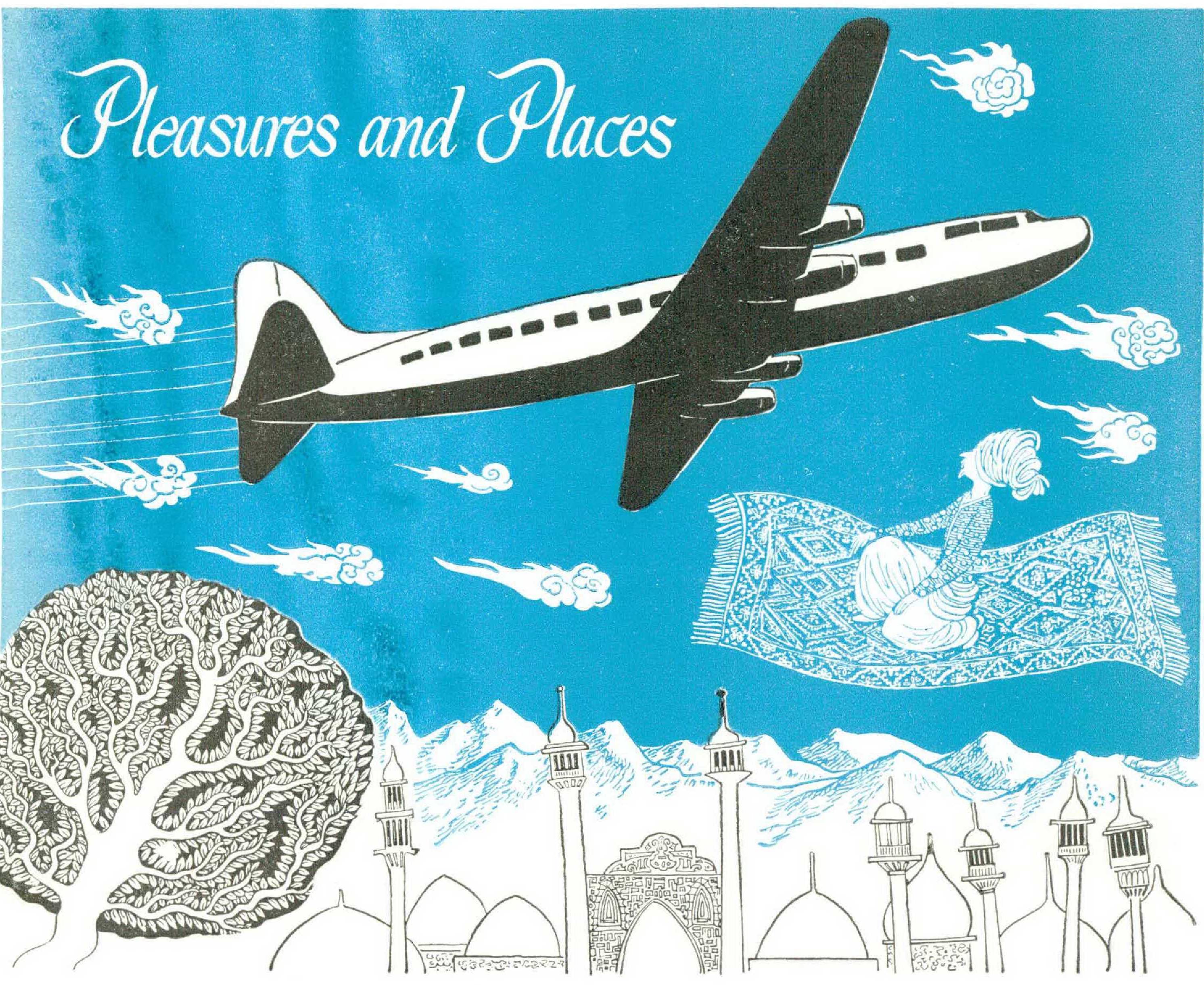
EVERY man in Persia is a poet,” they say in Tabriz. Only they call it Iran today, a name which has in it none of the glint of turquoise and gold, of camels and riches, of mountains and salty inland seas. Persia is but a province of Iran, they insist. But there it lies — the contrast between the old and the new: the Persia of fable and the Iran of modern fact, where oil pipelines rather than caliph’s coffers flow with gold.
But the Persia of fable has not quite yet disappeared. That’s why there are poets still in Persia. And the traveler who collects the very rare and the very beautiful, and who renounces the tiled bathtub of the West for the tiled mosque of the East, with its foot-washing fountains, will find traces of the old grandeur here.
It may be the high altitudes. It may be the air, hazed in summer with dust and heat until it is a sort of beaten gold, and clarified in winter until each blue atom of the air spins separate. And it may simply be the refreshment of new scenes and new faces which seems so to delight travelers from the West. But those who return from Persia — if it is indeed possible to return — feel as if they had climbed a very high mountain. The mountain is neither Demavend above Tehran, nor Mount Ararat across the Turkish border. It is simply the feeling that one has come a long way —upward in space and backward in time.
Tabriz and Tehran
Because they are the old and the new, and because the traveler leaves Shiraz to the very last, with its roses and its ruins and its water one can drink pure from the tap, he thinks first of Tabriz and Tehran. Tabriz is the old capital, Tehran is the new.
In Tabriz, droshky men with motheaten horses and sagging victorias trot you neatly down the narrow side streets, dodging the turbaned mullahs and the scarved women and the young boys with their close-shaved heads. In Tehran you careen about in little English taxis. The boulevards in the modern capital are wide; the acequias — called jubes — at certain hours of the day are young vigorous rivers; and the embassies sit back in high-walled Persian gardens, fountained and rosevined like those of any fairy tale. Instead of wearing the chuddar, the girls go by, slim as young willow shoots, in European clothes whose fabrics the bazaars sell by the yard. For Tehran looks to the future as the Mohammedan looks to Mecca. The very air in Tehran is crisper, newer, though the altitude is nearly the same as that of Tabriz.
The trip in to Tehran
Coming by plane to Tehran from Athens or Ankara, over the long toss and roll of Turkish mountains and valleys, you are hardly prepared for what will come. For hours you have hovered over a strange landscape, where dried-up lake beds lie bleached and white and where the small villages are lost like green-fringed anthills in vast desert spaces.
As you near Tehran, the violent mountains level out into long desert spaces, with green draws as in the Southwest, with long lines of chinar trees and mud-walled fields and the occasional manor house with its fountain. From this height, the valleys of ocher and red and chocolate and bonewhite and infrequent emerald appear to be fractured, as if by Braque, into a cubist’s landscape of flat and oddshaped planes.
You have been nine hours coming in from Athens, by Air France, or six from Ankara, by Pan American. Either way, the earthscapc below is the same. The Air France plane dips down over the island of Cyprus to Tel Aviv, where airport restaurant tables gleam with pitchers of orange juice, then turns north again to Ankara. Pan American, Air France, Middle East, L.A.I., and Scandinavian also take you to Tehran via Beirut (starting from Home or Athens), with the bonus of an overnight stay in Beirut and a morning flight of hardly five hours.
But no matter how you arrive, Tehran always comes as a surprise. After the long stretch of desert and mountains, it seems impossible that there could be a modern city here. Yet here is Tehran, with its statues and parks and cosmopolitan air. Here are first-class hotels with baths, such as the Park, the Ritz, the Ferdosi, as well as German, French, and Italian pensions which lend Tehran a faintly Mediterranean feeling.
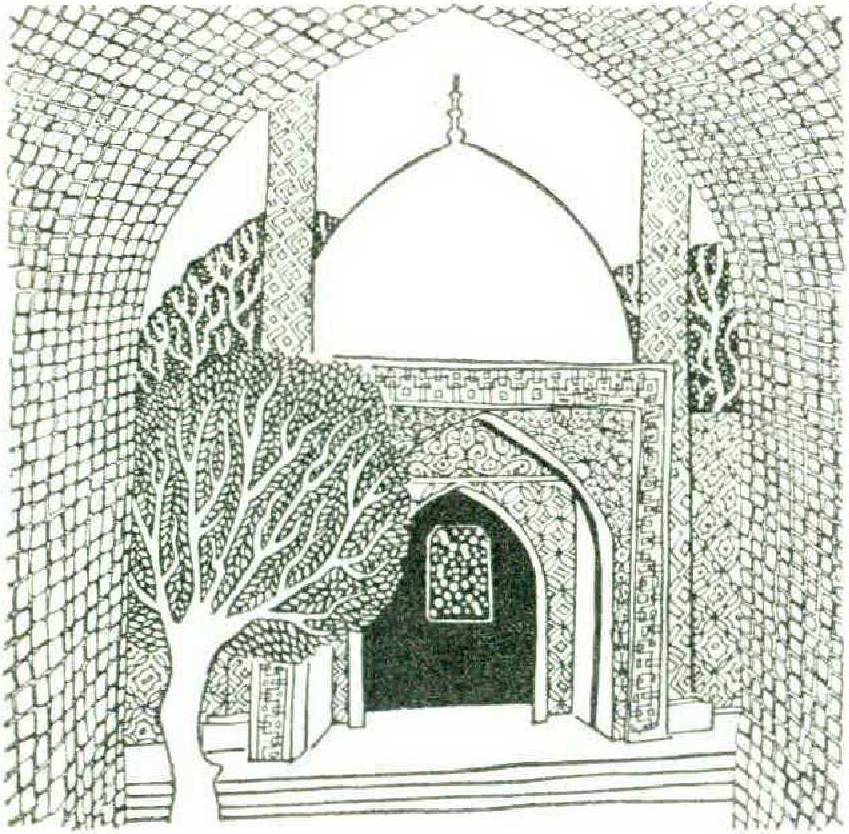
Yet within a block you can enter the Persian world, as you enter, slipperless, the mosque. The world of the West vanishes; you tread on carpets; you go under new ceilings, the wonderfully feminine, arched, domed world of the East, with its intricate décor, its full-breasted silhouettes, its all-pervading blue hues.
The bazaars
The mosques sometimes forbid entrance, but the bazaars are always open. Off the hot dusty streets you go into the alleys of Ali Baba: cool cellars of commerce lit by long shafts of sun which select, as if by spotlight, a burlap bag of rose leaves, a shopkeeper asleep on his bench, a small boy lacing a shoe.
Ten miles of corridors wander here under ceilings that seem a series of tiny mosques, with their inlaid patterns of brick, their domes and arches repeated ad infinitum. The very fact of their being enclosed lends them a sort of mystery. You might get lost in the bazaar — down a long boulevard of shoes with a hundred identical shops, one close-pressed against the other; or down a street of gold jewelry, a corridor of cobblers, a large room opening like a chamber in a cavern and stacked with long Iranian sheep fleeces or brilliantly mosaicked piles of folded Persian rugs.
It is three o’clock. You are in Tehran or Tabriz, and it doesn’t matter, for the bazaars are both the same. The heat beats on the street outside. It is heat the color of dull gold, of adobes, of dust. Several enterprising boys sprinkle jars of water to settle the dust and cool the air. Inside the bazaar, there are few shoppers. It is the time of the Persian siesta, and most of the lights are out. A rug seller snores, stretched out on one of his folded rugs. A money-changer drowses over his piles of many-colored bills.
Siesta-time stroll
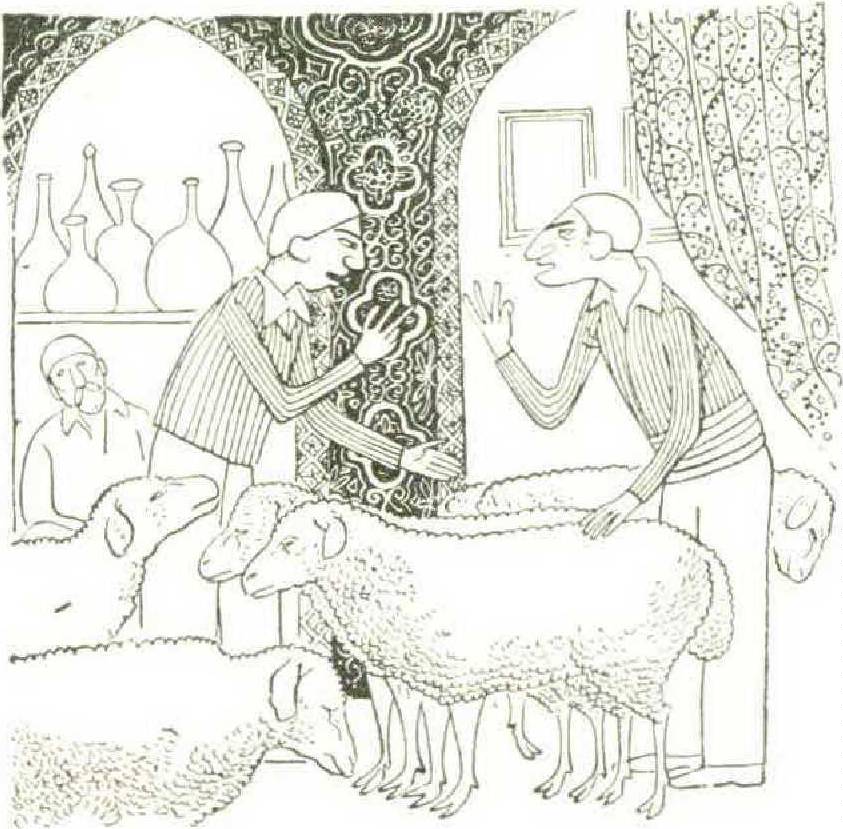
But you are not alone in the time of the siesta. Down the tamped earth floor taps a blind man with his cane. A merchant on a donkey trots, his saddlebags nearly scraping the shops on either side. A little boy hustles by with his brass tray of tea glasses. In the very middle of the bazaar are a flock of sheep and the merchantshepherd; the buyer fingers the live fleeces, and the shepherd shakes the sheep’s fat tail to show its value.
There is one section of new and empty shops, their modern glass doors open, all monotonously alike. But the rest of the shops are as individual as their owners. In one shoulder-wide shop, the woodworker turns doorknobs, using his bare toes as well as his hands. In a shop down the corridor is the brass and copper works, a well of darkness lit by one long shaft of sun and the sparks of golden brass that spurt like fallen stars from the lathe. Here are a whirrr of wheels, the brrr of buffing, the metallic ring as a lathe shapes and smoothes. On the shelves the bright brass samovars sit, each one handmade, with their individual tilt. They cost from 350 to 800 rials, which is about five to ten dollars.
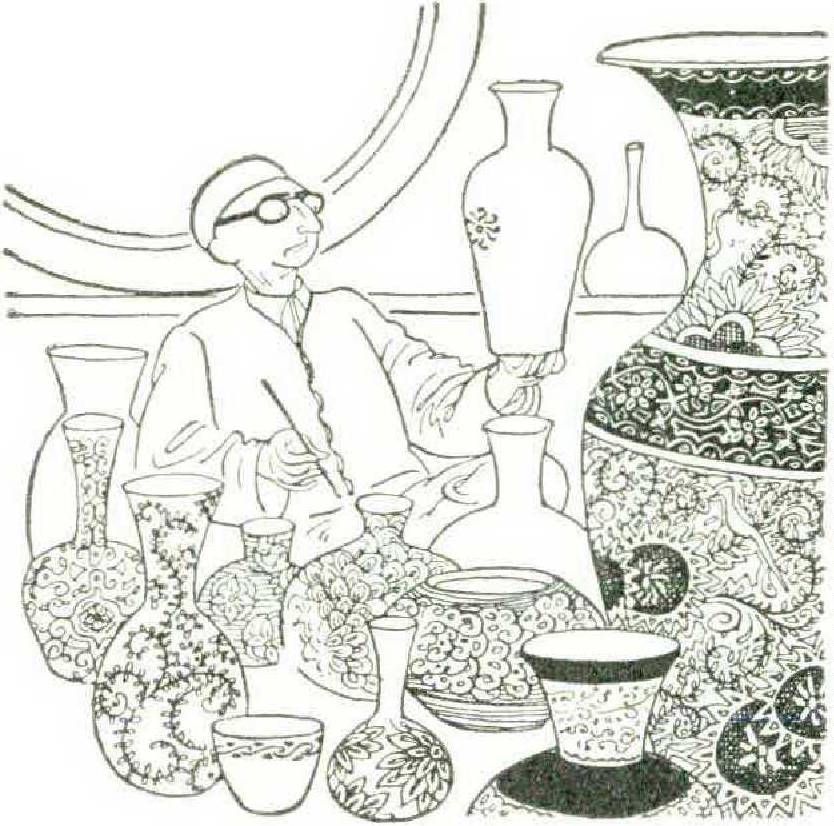
Past the rope market, the cord market, tin-pan alley, and the lane of the long-haired goatskin rugs you go; by the hide market, the soap shops (with a strong, clean, homemade smell), the vendors of the striped pajama pants the little boys wear; by the wooden box makers and the wool market and the pottery bazaars; by the bookstalls and the notion shops and the sellers of crystallized salt and sugar in sparkling nuggets and great glossy wheels; past the butcher and the baker, whose oven door is a bright red arch in the black Dantean depths of his shop; by the candlestick maker, whose wares hang in bundles tied together by their wicks.
This is commerce, and at siesta time it is held in suspension. There is the single tourist and the occasional veiled Moslem woman. But there is a curious absence of girls selling in the shops. For the bazaar is a world of men, large and small. Upstairs in the garrets (for many call the bazaar their living quarters) the women sit. But below, it is a man’s world.
The bazaar in Tehran is old, but the beginnings of the Tabriz bazaar are lost somewhere back in the preIslam days. The structure itself has been here for over a thousand years. Some of the corridors are new, and the mortar between the bricks is white and clean. Others are smoked from centuries of living, from fires that raged through them. And the pigeons are at home in the high brick domes.
The old and the new are under the multiple roofs. There are ancient bellows, big as a man, and cheap modern glassware. There are sari silks from India and wool tweeds from England and American calicoes. And there are the bright embroidered Kurdish skullcaps, all made by hand, and urged upon you, for about fifty cents each, by an eight-year-old merchant with merry eyes. Factory beads and earrings deck one street, but in another corridor the jeweler balances handmade gold earbobs on a scale and counts with an abacus.
Symbol of Persia
Closed on Fridays (save for the Armenian shops), open on other days to Mohammedan, tourist, and Christian, the bazaar lives like a medieval walled city. Enter the small, unassuming archway, like a door to a cave, and you may exit, hours later, in any part of Tabriz. Disappear down one long enticing corridor, and you may, in ten visits, never find that same corridor again. For the mysterious East is kenneled here. It is a tawny Tiffany’s, an arrogant five-andten. Of all the gardens in Persia, with their goldfish ponds, their high mud walls, this is the one you remember. For it is a garden, as anything cool and enclosed, in Persia, becomes a garden.
In a way this inner life, this enclosed richness opposed to the outward bareness, is symbolic of Persia. You find it a land of extremes. And the constant swing from one extreme to another has the odd effect of sharpening the senses. The low grave mounds accent the tall white trunks of the chinars. And the jube, with its tree-bordered banks, is a life-giving tunnel of moist green coolness because it passes through hot, lifeless land. The women, raising and lowering their veils, are conscious of the enhancing quality of contrast.
The trip to Tabriz
To reach Tabriz, one comes eastward by car over the mountain passes from Erzurum in Turkey, passing through canyons reminiscent of the American Southwest and flat beige desert spaces occasionally cooled by green oases and the ever-flowing jubes. Or one can come westward from Tehran, an eighteen-hour drive over desert roads or a brief flight by local airline.
By airline one misses the camel caravans, the occasional musketed sentry on horseback watching for bandits, the towns with the blue-tiled domes of their mosques glittering like eabochon sapphires. One misses, too, the silences of the desert, the feeling of civilization being rolled back, like a Persian rug, to reveal the primitive designs beneath. And one misses the lamb or mutton kabab purchased from the spit and eaten, together with cucumbers and tomatoes, under a chinar tree at the edge of town.
Food and hotels
There is nothing quite like this local kabab, wrapped in its napkin of tortilla-like bread, dripping with its own fat, and curiously fragrant. But there are as many versions of kabab as sheep in an Iranian flock. Some kababs are marinated in yogurt, others in herb wines. The Shamshiri restaurant in Tehran serves one dish : Cholo Kabab, with long-grain Caspian rice cooked slowly over charcoal. Bara Kabab is another Iranian specialty — baby lamb grilled whole, head and all, and stuffed with such delicacies as pistachio nuts and tiny oranges. With the kababs (there are Caspian sturgeon and lake trout kababs, too) one drinks the native duq, a diluted yogurt Iranians claim is a good foil for rich foods. Wines are infrequent, and the native beer good but uneffervescent by American standards.
Dinners at first-class hotels run to $5 or $6, as in Europe. But there are smaller restaurants, hidden away in gardens with columned porticos, fish pools, and potted oleanders, where one can dine quite decently for $1 to $1.50. Luncheons are far less (one dollar, à la carte, at the Park Hotel). In Tabriz eating costs less than in Tehran, and the Hotel Metropole, where all Europeans stay in spite of its non-European plumbing, has a rather fine international cuisine. Order lamb chops for two, for about $2, and you are surprised with a platter of twenly, small and delicate as butterflies.
With the rate of seventy-five rials to the dollar, Persia has somewhat the inexpensive aura of pre-war Europe, where one could find clean pensions for $20 a week — as in Tehran today — and where the dollar went twice as far. Even in Iran’s first-class hotels accommodations are not formidably priced, by American standards. They run (including the elegant Ramsar on the ( aspian) from about $6 to $8 for a single room and from $9 to $12 lor a double. At second-class hotels (such as the Atlantic or Pacific in Tehran) the rates are $4 to $5 and $6 to $8.
The low cost of living makes it unnecessary to change on the gray market. Besides, customs officers at the border are strict. Travelers’ checks must be legally cashed in the Bank Melli in Tehran — which is somewhat inconvenient if you happen to be in Shiraz. And the attempt to take even the smallest tin of caviar out of the country causes a riot at the airport, where loudspeakers are constantly calling out, “Any caviar to declare?”
Since north Persia’s climate is similar to that of the American Southwest, spring and autumn are the seasons to travel. (Tabriz and Tehran, like Denver and Albuquerque, are cold in winter, hot in summer, with day tme temperatures in the nineties; the mountains and the Caspian are cool.) But the length of time spent in Persia depends on you: on your liking for the desert, for ruins more remote and perhaps more poetic than Athens’, for the unhurried Eastern tempo, the scents of cinnamon and roses, and the flavor of strawberries, cherries, and the one hundred and one kinds of Persian melons that linger, luxuriously, in their seasons. The old Persia, or Iran, of contrast still remains. But the delicate balance is not for long. The primitive washboard roads are being smoothed with asphalt. The nomads are being persuaded to the plow. While there is still a little of the old Persia left, it might be wise to enjoy it.
HARVENA RICHTER