Venetian Hotel

CCOLONEL RoHEHT CANTWELL, the Crusty hero of Ernest Hemingway’s novel Across the River and into the Trees, refers to the Gritti-Palace Hotel in Venice as “the best hotel in a city of great hotels.” Mr. Hemingway has personally endorsed his hero’s testimonial by writing in the Gritti’s guestbook: “To our home in Venice.”After his African air crash in 1951, Hemingway announced that he was going to recuperate at the Gritti — “on a cure of scampi and Valpolicella.”
In the course of its relatively brief career — it only opened its doors in 1948, which makes it one of the youngest of the world’s de luxe hotels the Gritti has achieved a clientele of formidable luster. Among its patrons one finds a diversity of royal personages (the King of Belgium, Prince Philip, Princess Margaret); eminent statesmen and military leaders (Churchill, Marshall, Ridgway, Mark Clark): great names in the arts; leaders of haute couture: ambassadors and movie stars galore, and a sizable cross section of the surviving nobility.
The qualities which have projected the Gritti to this enviable eminence are not at first sight obvious. As a newcomer to the coterie of great hotels, it does not have behind it the long and lordly tradition of Claridge’s in London or the romantic associations of that other superlative Venetian hotel, the Royal Danielli (which is under the same ownership). Its public rooms lack the heroic proportions and the ostentatious lavishness of those at the Georges V in Paris or the Madrid Castellana Hilton. It is not as up-to-date, where gadgetry is concerned, as many establishments in Europe and most first-class hotels in the United States; and it is not run with the machinelike efficiency which makes The Four Seasons at Hamburg one of the wonders of the hotel world. The Gritti’s particular distinction is that it gives its clients the sensation of staying in a private house, the kind of private house which the most privileged among them would be delighted to live in.
The choicer suites of the Gritti, with their seventeenth-century Venetian furnishings and Renaissance paintings hanging on the walls; the restaurant terrace on the Grand Canal, facing Longhena’s lovely baroque church, the Madonna della Salute; the chef’s mousse de foie gras au porto and his sole Primo Amore — they leave the visitor sharing, the feeling once expressed by Winston Churchill: “I am not really hard to please. I am easily satisfied with the best of everything.” And the prices one pays at the Gritti are no higher than those of other de luxe hotels in Italy.
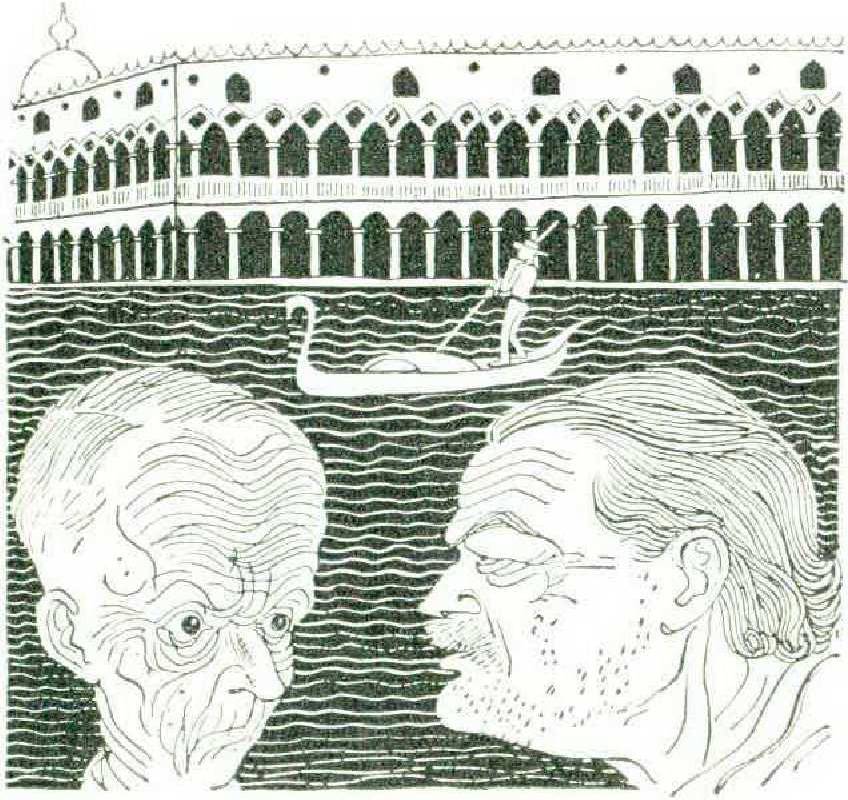
Doge’s palace
When the Gritti opened, the first arrivals were a family of three who took one look around and started to beat a retreat. The assistant manager, Leonetto Filippi, inquired if he could be of service, and the visitors explained that they had made an embarrassing mistake — the hotel was obviously beyond their means. Filippi, a superstitious man, felt it would be a sinister omen if the first prospective clients were to go away, and he induced the family to stay by offering them accommodations for whatever they could afford to pay. This gesture must have charmed the spirits who preside over the hotel business, for the Gritti, in the early stages of its career, had two resounding strokes of luck. The first was the decision of the British Ambassador to Italy to lodge Princess Margaret and her party at the Gritti when she visited Venice in 1948. The second was Ernest Hemingway’s novel, which gave the Gritti a réclame on this side of the Atlantic that no amount of money could buy.
Another famous American novelist, the late Sinclair Lewis, wrote much of his last book at the Gritti; and it was there that Lewis and Hemingway were introduced to each other for the first time.
The Gritti Palace, built at the end of the fifteenth century, came into being as the home of Andrea Gritti, the seventy-seventh Doge of Venice. From the early years of the present century to the late 1940s, the Gritti served as an annex to the Grand Hotel, its next-door neighbor. The inside of the budding was then entirely remodeled; but the exterior, like that of nil palazzi on the Grand Canal, remains in its original slate. Frank Lloyd Wright has called the façade of the Gritti “the best expression of Venetian decoration.”
About half of the Gritti’s rooms are decorated in contemporary style. The remainder, each of them different, have period furnishings, among which are some pieces of considerable value. The “green and gold” suite on the first floor, overlooking the Grand Canal — the favorite of the Aga Khan — is entirely seventeenthcentury Venetian. The treasures distributed through the other suites include an early fifteenth-century Venetian vanity chest of mahogany, ebony, and ivory, and paintings by Guercino, by masters of the schools of Giorgione and Caravaggio, and by Rocco Marconi, one of the best pupils of Bellini. Lamps from late seventeenth-century Venetian galleons illuminate the corridors. In the main salon there are several line pieces of eighteenth-century majolica from the workshops of the royal palace at Capo di Monte near Naples. And on the ground floor there is an ancient clock with chimes rather like those of Big Ben which an American visitor was desperately eager to buy for an extravagant sum.
During the redecoration of the Gritti, when the whitewash was removed from one of the ceilings in the servants’ quarters, a fine fresco by Giovanni Tiepolo was uncovered, depicting a symbolic figure of Venice placing a laurel leaf on the head of the Doge, Pisani. The fresco was transferred — somewhat cavalierly, it would seem — to the ceiling of the first-floor corridor, where hundreds of guests must have walked under it without suspecting that a museum piece lay overhead.
The V.I.P. treatment
Perhaps the most crucial element in the Gritti’s success is that it is, with the exception of the Avis in Lisbon, the smallest of the world’s de luxe hotels. Its seventy-five rooms can accommodate at most 125 visitors; and this enables the management to give each and every guest the V.I.P. treatment. One rainy afternoon when I returned to the hotel soaking wet, the concierge politely scolded me for not telephoning for an umbrella. I pointed out that I was a long way away when the downpour started, and he assured me the Gritti would have thought nothing of sending a page to the furthest end of Venice.
When the Gritti is full, there is one employee to every guest. For two thirds of the year, the staff outnumbers the patrons by as much as two to one. The Gritti’s manager, Grand Ufficiale Raffaele Masprone — his title, higher than Gommendatore, is one awarded for merit — and his assistant, Leonetto Filippi, quite literally discharge the old-fashioned role of mine host. They make a point of knowing each visilor by name, and they inquire daily about his or her welfare and desires. When you leave the Gritti after a first visit, your name is added to a file which records the tastes and idiosyncrasies (generous, slingy, “difficult,” and so on) of all the Gritti’s patrons.
After an embarrassing incident involving one of the Gritti’s precious Persian rugs and the lap dog of a Greek princess, the management regretfully decided that its patrons’ dogs would have to be quartered elsewhere; and a member of the Gritti’s staff thoughtfully opened a canine pensione. The Aga Khan’s parrot, however, is a habitué of the Gritti and he has made the most of his opportunities: he is very possibly ihe only parrot in the world whose repertoire includes the cry of the Venetian gondoliers, “vuole di li? — Are you crossing?”
A great “conductor”
A hotel, it has been said, is like an orchestra — it needs a good conductor. The Gritti’s “conductor,”Raffaele Masprone, is unquestionably one of the world’s most accomplished hotelkeepers. A tall, silver-haired man, always impeccably groomed, Masprone looks much younger than his seventy-odd years. With his monocle and courtly manners, his warmhearted charm and genuine solicitude, he epitomizes the gentleman of the old school at his best.
Masprone, whose father was in the hotel business in Verona, has learned his job from the ground up. He served his apprenticeship at Claridge’s in London, the Meurice in Paris, the Bristol in Berlin, and the Waldorf in New York. After stints at the Fairmont in San Francisco and other holds in Philadelphia and Chicago, he became director of the Bristol in Los Angeles, returning to Paris alter having acquired further experience in Honolulu, Japan, China, and Russia. After the First World War, in which he served as a captain of infantry, Masprone managed various hotels in Italy and was director of the Excelsior in Naples from 1927 until it was burned down in the Second World War.
In the fire that destroyed the Excelsior, Masprone lost his remarkable collection of 500 signed photographs of world-famous figures; in it was a snapshot of Rudyard Kipling, whose wife would not let him be photographed, which was taken by a friend of Masprone’s through the buttonhole of his shirt. Masprone managed, however, to save his equally arresting collection of autographs, which begins in his father’s day with signatures of Ulysses S. Grant and Giuseppe Verdi.
The Hemingway touch
The Gritti’s assistant manager, 44year-old Leonetto Filippi, is a goodlooking six-footer with an amiably owlish expression and ebullient spirits. He has been associated with Masprone since 1932. Filippi, who claims that his uncle was the first man to introduce a jazz band to Italy, started his career as a cigarette hoy in his father’s dance hall in Home, and later worked as a dishwasher, waiter, and cook. He was organizing hotels in Ethiopia when Italy went to war and he spent live years as a prisoner of the British in Kenya. There he became fluent in English, raised tomatoes, and learned a smattering of Swahili, which has greatly endeared him to Ernest Hemingway. When Hemingway arrived at the Gritti after his African air crash, he was greeted in Swahili as “Sir-ofthe-aircraft-that-crashed-too-much.”The “Gran Maestro” of Across the Hirer and into the Trees — he really did light with Hemingway in the First World War — is no longer with tho Gritti; he married one of the patrons, reportedly an American millionairess, and is now living in the United States. But in this instance nature seems to have imitated art, and his successor as maîlre d’hòtel, Lava here Uenuto Corradi, gives the impression of having stepped straight out of a novel by Hemingway (except that he doesn’t ever drink). Corradi — a bald, lantern-jawed man who occasionally sports a monocle and who is well provided with a sharp, sardonic sense of humor has combined a career as maître d’hòtel with active service in three wars, in the hist of which he rose to the rank of colonel. “You can say,”he volunteered with relish, “that I am a war criminal. Si, si è vero. Sona criminate di guerra.” Apparently when Corradi was captured by the Americans in Turin in 1944, he did not shilly-shally about having belonged to the Fascist Party, and was stunned to find himself forthwith classified as a war criminal. His candor, however, made such an impression on the interrogating officer.
— “You’re the first man I’ve met between Sicily and Turin,”he said, “who admits to being a Fascist” — that Corradi, after his record had been found crimeless, was appointed interpreter to the American forces.
Grande cuisne
The restaurant over which Corradi presides is one of the most memorable aspects of the Gritti. There are scores of restaurants in Italy which are admirable but only a few which rise to the exalted level of what the French call la grande cuisine — and the Gritti is one of those few. The Gritti’s chef, Pietro Balestreki — a venerable artist wisely summoned from retirement by Signor Masprone
— has a culinary background which is French and cosmopolitan rather than Italian. He learned his métier in the early years of the century at the Palace and the Ritz in Madrid, and later worked in such exacting establishments as the Hôtel de Paris, Monte Carlo; the Kulm, St. Moritz; the Stephanie, Baden Baden; and the Crillon, Paris. The phase of his career which justty fills him with the greatest pride is his two terms as chef at what in its heyday was perhaps the greatest restaurant in Paris — Paillard’s. The former King of Italy, when he was Crown Prince, once dispatched his chef to study under Balestreki.
In his youth, Balestreki was responsible for an innovation in hightoned Parisian cuisine. When he went to work at the Hôtel Loti in Paris, the use of garlic was absolument défendu in elegant establishments. Balestreki — determined to prove his thesis that “garlic has the same place in cooking as poisons in medicine; in small quantities it is beneficial" — prepared a dish for an important patron with an undetectable soupçon of garlic. The client was rhapsodic; and when the manager relayed his compliments to the chef, Balestreki triumphantly confessed to use of the forbidden herb. Thereafter a touch of garlic was legitimized at the Loti, and in due course other chic establishments followed suit.
Among Balestreki’s masterpieces at the Gritti are mousse of foie gras in port wine; a suppa di pesce or Italian bouillabaisse, in the preparation of which the customary olive oil is largely replaced by butter; filet of sole Stephanie, which has come to be known as sole Primo Amore; and chicken à la Grilti — chicken quartered and boiled in consommé, then placed on a bed of fettucini and baked for seven minutes under a generous covering of sauce Mornay and grated Parmesan.
There are two more key men in Signore Masprone’s impeccably functioning team. One is the concierge, Egidio Lis, who, in a profession in which a certain amount of wizardry is a routine requirement, stands out as an infinitely resourceful, courteous, and conscientious operator. The other is Vittorio Paolucci, the barman, who learned to mix drinks the American way after the war when he was in charge of the bar at the Miramonti Hotel, Cortina d’Ampezzo, then an American officers’ rest center. Like all of the staff of the Gritti, Paolucci is a Hemingway fan, and nothing delights him more than to be asked for “a Montgomery” — the fifteento-one Martini favored by Colonel Cantwell. A connoisseur of Hemingway’s drinking habits, he says diplomatically: “Il signor ‘Emingway beve con coraggio — Hemingway drinks with courage.”
CHARLES J. ROLO