Men and Machines
Now a Junior Fellow in the Society of Fellows at Harvard, DONALD HALL was previously at Christ Church, Oxford. His book of poems, Exiles and Marriages, was published in this country in Woo.
by DONALD HALL
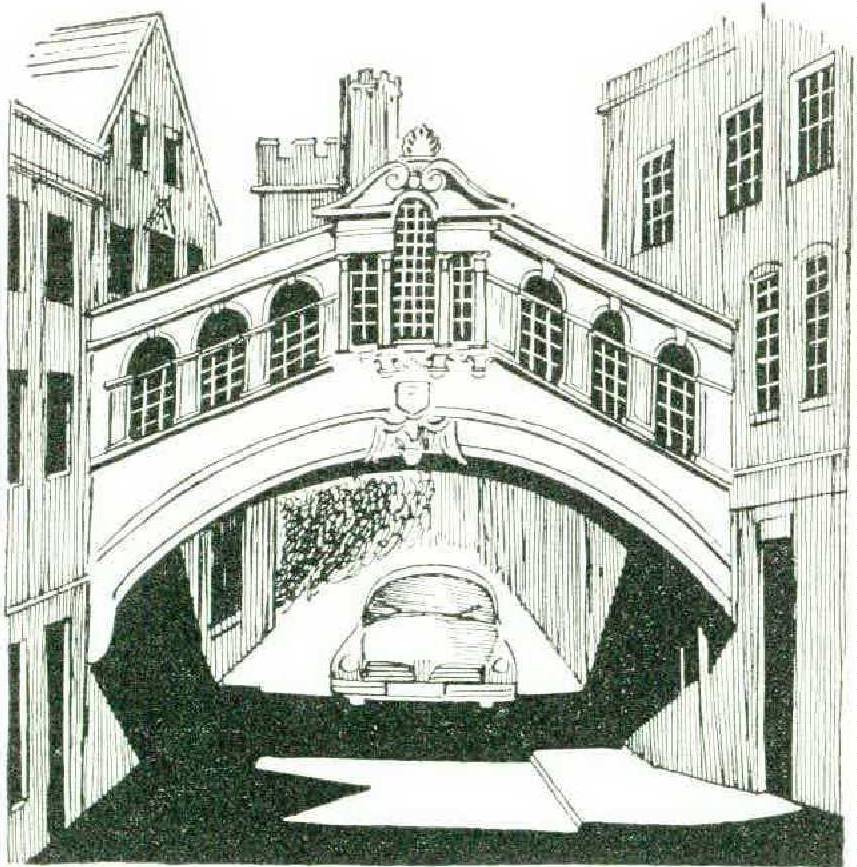
TOWARDS the end of my first, year at Oxford, I was invited to dine at high table in New College by a young professor whom I had recently met. I was pleased to be offered the occasion to eat in the great oaken hall, filled with gowned undergraduates, and especially in a position of eminence. New College is not the oldest of Oxford’s institutions, but there exists a tradition that the dining room is the oldest great hall in Europe which still performs l he function for which it was built. The hall was constructed, for similar gowned undergraduates and scholars, in the fourteenth century.
I met my friend in the Senior Common Room, the first time I had ever invaded one of those sanctums of scholarly society. We drank a glass of Dry Fly in the company of aged and bearded scholars, while I looked briefly over the large, dark room. A brown carpet, dark walls covered with portraits of former dons, brown straight chairs with plush seats, and at the end of the room a large window overlooking the decaying stone of some New College buildings. Conversation was soft, and restricted to small groups. No one came up to us, and no one seemed to notice me as a stranger.
A tightly winding iron staircase led to the great hall directly above. We filed up the narrow stairs, the eldest leading the way, so that my friend and I were the last to emerge into the hall. The other members of the high table were standing behind their chairs while we found our places, and a few feet below us three hundred undergraduates stood at attention. When we were finally in position, the Warden of New College said a brief Latin grace, and three-bund red-odd chairs scraped as we sat down to dinner.
Dinner at high table was large, less badly cooked than the usual Oxford fare, and consisted of fabulous items for the British menu. Oysters — exotic in Oxford as if each contained a pearl — started us off, and to the accompaniment of three wines we proceeded to have a, thick soup, some real venison, and asparagus. There were two desserts — pudding for a “sweet,”and mushrooms on toast for a “savory.”
My friend sat on one side, and on the other I encountered a bearded man who introduced himself as a lecturer in human anatomy, and who discoursed gently on Republicans and Democrats, Jaguars at Le Mans, and the Wardenship of All Souls. He told me also about the oak roof of the hall. Late in the nineties (“the eighteen-nineties” he pointed out) the New College Warden had asked an architect to examine the roof of the hall, still unaltered from its erection in the fourteenth century. The architect reported what the Warden had feared: that the Spanish oak had been eaten to a shell by the deathwatch beetle and needed immediate replacement.
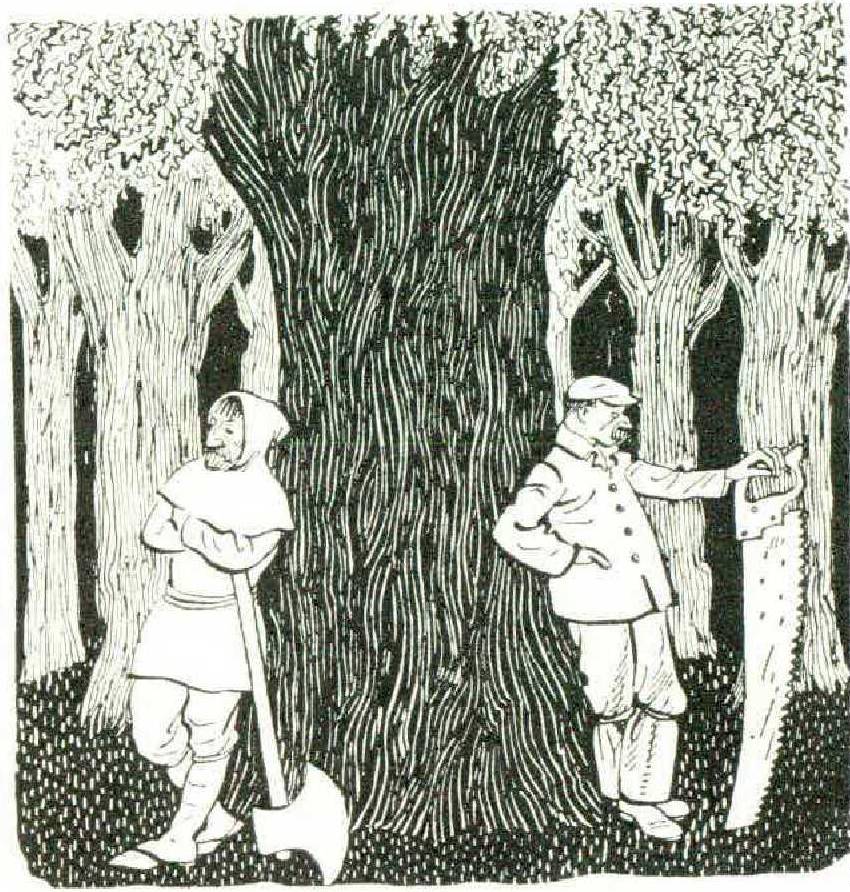
The financial problem seemed immense, until the Warden remembered that there was a stand of ancient oak on some property belonging to the College, a forest with which William of Wykeham, founder of New College, had endowed it. The Warden summoned the woodsman, an elderly man, and asked him if there were enough oak on the land to replace the old roof. The woodsman laughed and said, “Aye, and it’s ‘igh time, too.”
Months later, on an incidental trip outside Oxford, the Warden look a special side journey to ask the woodsman what his words had meant, for he had been puzzling over them. When he returned he told his astonished colleagues what he had learned: hen William of Wykeham endowed New College with the forest, he had told the first woodsman to plant a grove of oak, because by the time the wood had grown to maturity, New College hall would need a new roof. The old roof had endured longer than William had expected, but each retiring woodsman had told the origin of the oak grove to his successor. For five centuries the story was repeated, until the purpose of the planting was finally fulfilled.
When we had eaten the last mushroom, we returned down the winding stairs to the Senior Common Room. The undergraduates, whose fare had been less extended than ours, had long since vacated the hall, and we had been left on the raised ledge alone. The S.C.R. now looked totally different. Fifteen small tables bad appeared, and were set in a horseshoe with the open end in front of the window overlooking the buildings of the quad. At each round table were two chairs, and the tops were furnished each with two glasses and a bowl of fruit. In the back of the room I saw a large square table bearing decanters of Port and Madeira. A servant whom everyone addressed as Arthur stood neatly beside the decanters.
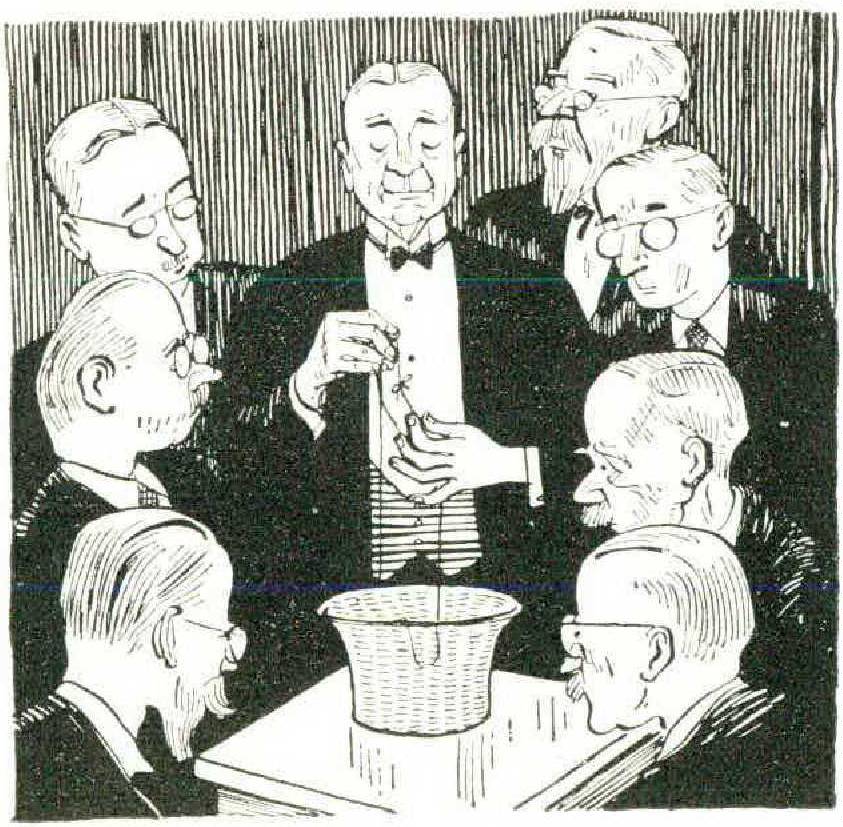
My friend and I found a table and sat down. We had begun to discuss the rather muddy oils that covered the walls, when I noticed an apparatus under the window, running from one end of the horseshoe to the other. It was about six feet long and higher at one end than at t be other. I understood its purpose when a decanter of Port, passing clockwise from table to table, reached one end of the horseshoe. The don who had just filled his glass deposited the decanter in the wicker basket on the elevated end of the machine next to him. By it sown weight, the decanter in the basket slid across the room to the other end of the horseshoe, pulling as it did the other, empty basket from the lower to the higher end of the plane; a grayish string attached the two receptacles. It was a small funicular.
My companion noticed the direction of my st are. “Rather American, isn’t it?” he said. “A ‘labor-saving device,’ I believe you call such things.” I reassured him, and he went on. “A isitors usually are quite taken with it. One of our number observed something similar in a coal mine, I believe in 1820 or thereabouts, and reproduced it in scale. No other college has such a thing. Quite astonishing, I suppose.
I supposed so too, and abandoned myself to the sipping of Madeira with only occasional glances at the academic coal cart. Arthur appeared periodically from the shadows at the back of the room, unobtrusively clearing the remains ol our third dessert and replacing empty decanters with full. He had a heavy, humorous face, adequate to any emergency — as he soon proved; for that was the night the string broke.
Later conversation established that it was almost certainly the original string, a product which had endured from the last year of George the Third’s reign to the last year ol George the Sixth’s. It happened when the don nearest the apparatus gave the decanter and basket an inadvertently sharp push. The empty basket remained in place, while the full sped too swiftly to the bottom of its track, and a decanter ol wine lipped out of its basket and glugglugged indecorously on the carpet.
Conversation, which had been subdued and limited to each table of two, grew suddenly public and alarmed. “Extraordinary,” said the lecturer in human anatomy. We had all arisen, and stood in a perplexed circle around the machine. A professor of chemistry knelt and examined the gray string lying uselessly out of its track. “Broken,” he said, “broken quite through.” “Evidently,”said the occupant of a chair in philology. Someone found a full decanter of Fort and we filled our glasses, but still we circled the defunct machine, vexed and loquacious. With a tiny silver knife the professor of chemistry cut a sample of the string, bent on analysis.
Arthur then appeared rigidly at an opening among us and took a rapid look. “Excuse me, if you please, gentlemen,” he said generally, and squat ted beside the machine. He undid the lace from his right shoe, quickly, and tied the two ends of the broken string to it, testing to keep a proper tension. He tried his repair job with a decanter and it worked smoothly. “’Twill do for now, gentlemen,” he said.
“Extraordinary,” said the lecturer in human anatomy. Arthur disappeared again into the shadows at the back of the room. The rest of us wandered back to our chairs and round tables, to spend the rest of a spring evening sipping Port and Madeira, conversing easily and without further interruption about Republicans, Democrats, Jaguars, irregular verbs, and coal carts.